
Sparse-lobed Grapefern (Botrychium biternatum)
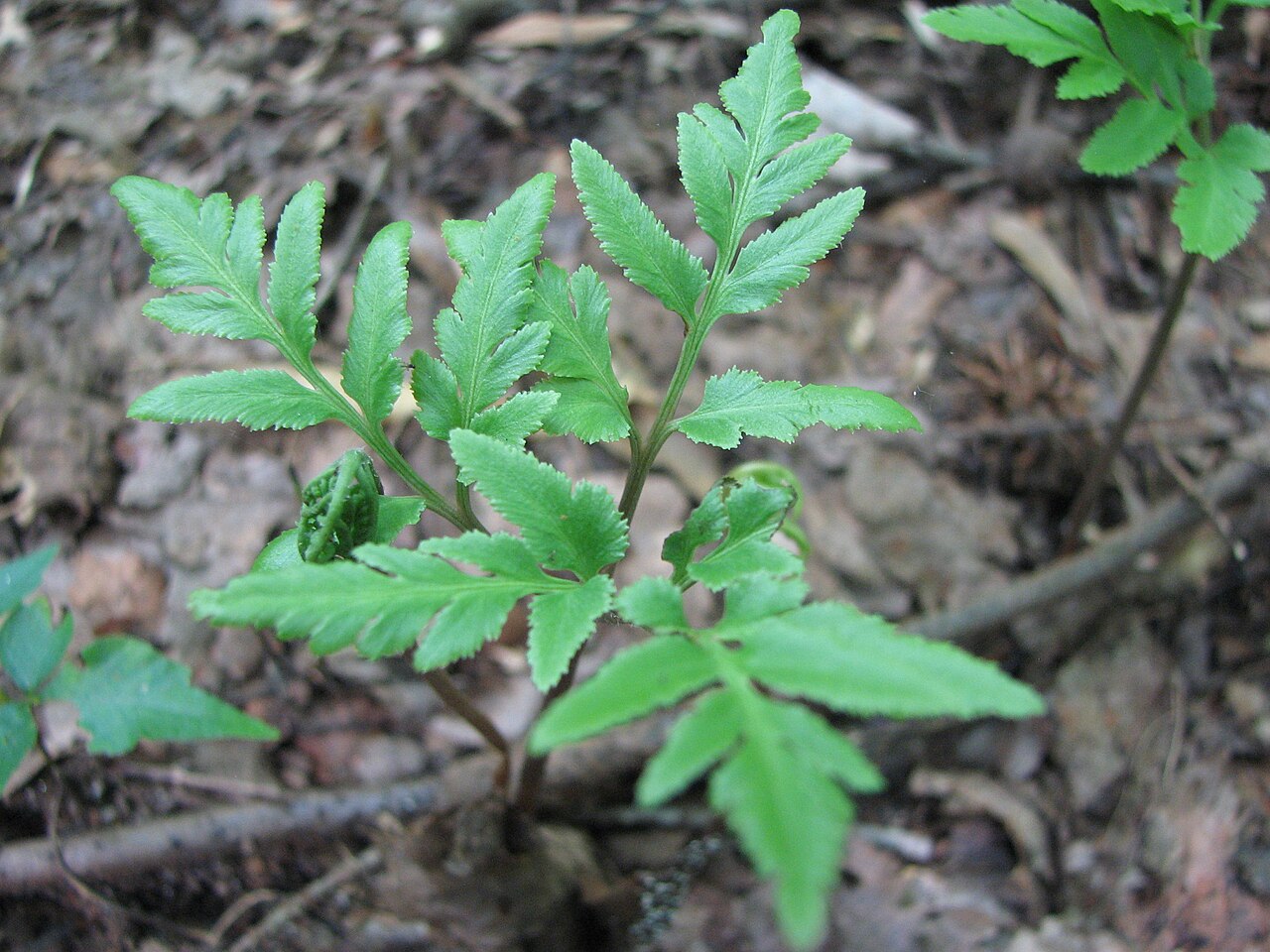
Botrychium biternatum, known as Sparse-lobed Grapefern or southern grapefern, is a small, primitive fern of moist southeastern woods. Each plant produces a single low, leathery, evergreen leaf divided into a few broad, finely toothed segments, and in autumn a separate upright stalk topped with clusters of tiny, bead-like spore cases that resemble bunches of grapes. Plants are usually under a foot tall and easy to overlook among fallen leaves.
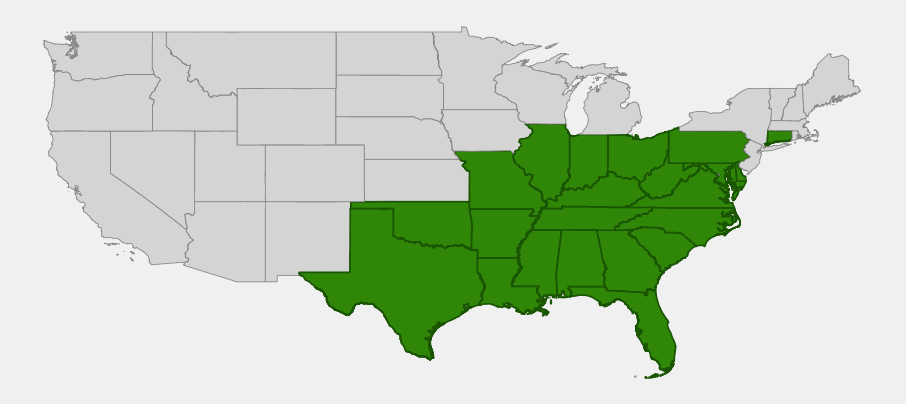
It is native mainly to the Southeastern Coastal Plain and Piedmont, from Florida and eastern Texas north to Virginia, Kentucky, southern Illinois and Missouri, with scattered records farther north in Delaware, Maryland, Ohio, Indiana, Pennsylvania and Connecticut. It grows in floodplain forests, moist hardwood slopes, swamp edges and second-growth woods, and sometimes in shady old fields and lawns.
Grapeferns belong to the adder’s-tongue family (Ophioglossaceae), an ancient lineage only distantly related to most other ferns. Many botanists place this species in the genus Sceptridium, as Sceptridium biternatum. This page explains how to recognize it, where it grows, why it is so hard to cultivate, and where to look for it.
Identification
Sparse-lobed grapefern is one of several evergreen grapeferns in the eastern United States. The key features are the few, relatively large, finely toothed segments of its leaf and the separate fertile stalk that rises in fall.
Sterile Leaf (Trophophore)
Each year the plant sends up one leaf that is held low, often nearly flat to the ground, on a stalk a few inches long. The blade is broadly triangular, 2 to 6 inches wide, and divided two or three times (biternate) into relatively few, broad, oval to lance-shaped segments with finely toothed edges. The texture is somewhat leathery and the color bright to dark green. The leaf appears in late spring or summer and usually stays green through winter, withering the following spring.
Fertile Stalk (Sporophore)
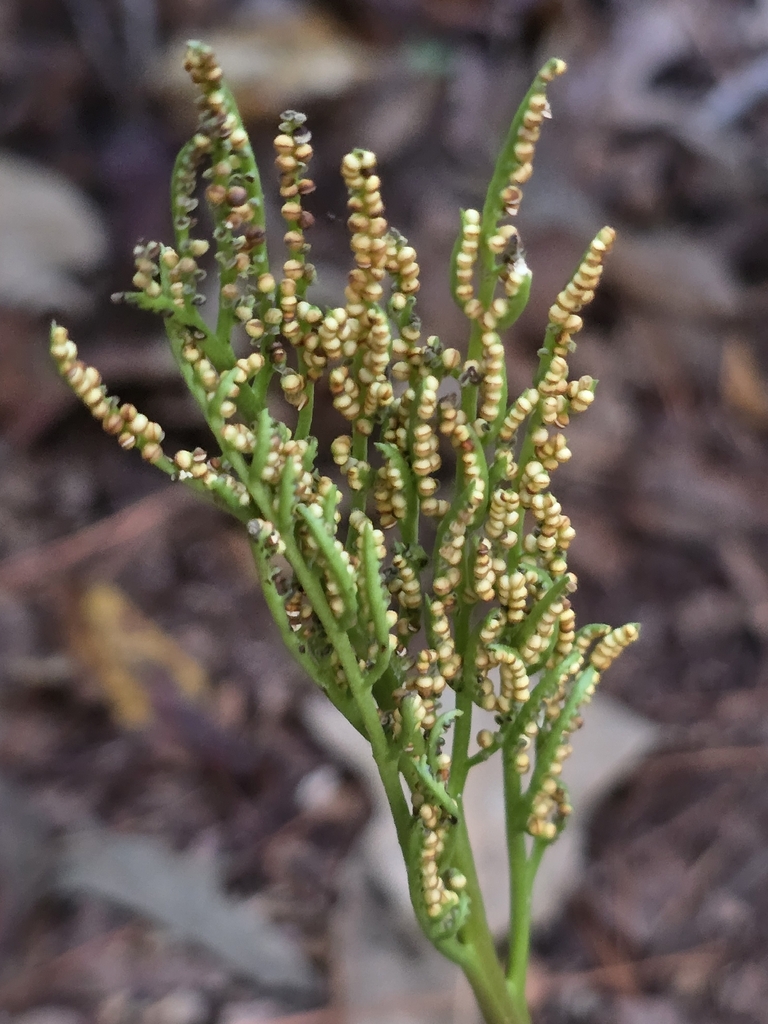
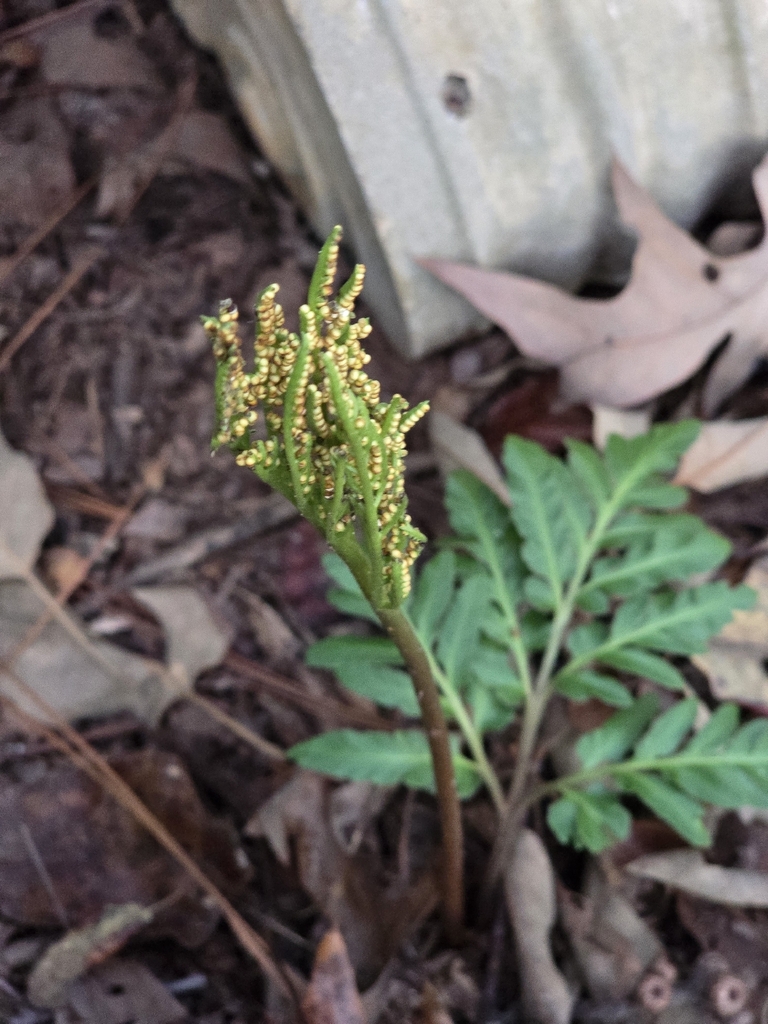
From late summer into fall, a separate upright stalk rises from the base of the leaf stalk, up to about a foot tall. Its top is branched and crowded with round spore cases (sporangia) that turn from green to yellow and then brown as they release powdery spores, usually from October to December.
Roots & Bud
Below ground the plant has a short, upright stem with a few thick, fleshy roots. Next year’s leaf develops slowly inside the base of the current one. The plant has no rhizome and does not spread into patches.
Similar Species
Cutleaf Grapefern has more numerous, smaller and often deeply cut segments, and its leaf usually turns bronze in winter. Common grapefern (B. multifidum) is a northern species with fleshy, rounded segments. Rattlesnake Fern has a thin, lacy, deciduous leaf held upright, with its fertile spike rising from the middle of the leaf in spring and summer. Winter grapefern (B. lunarioides) is tiny and appears only in winter.
Quick Facts
| Scientific Name | Botrychium biternatum (Savigny) Underw. (syn. Sceptridium biternatum) |
| Family | Ophioglossaceae (adder’s-tongue family) |
| Plant Type | Small evergreen fern (grapefern) |
| Mature Height | 3–12 in (including fertile stalk) |
| Mature Spread | 2–6 in; solitary plants |
| Growth Rate | Very slow |
| Sun Exposure | Part shade to full shade |
| Water Needs | Medium to high; moist soils |
| Soil Type | Moist loam, sandy loam or alluvial soils rich in organic matter |
| Soil pH | About 5.0–7.0 |
| Bloom Time | Does not flower; spores shed October–December |
| Flower Color | None; yellow to brown spore clusters |
| Fall Color | Leaf stays green through winter |
| Fruit | None; reproduces by spores |
| Deer Resistant | Moderate |
| USDA Hardiness Zones | 6–9 |
Native Range
USDA PLANTS records sparse-lobed grapefern as native in Alabama, Arkansas, Connecticut, Delaware, Florida, Georgia, Illinois, Indiana, Kentucky, Louisiana, Maryland, Mississippi, Missouri, North Carolina, Ohio, Oklahoma, Pennsylvania, South Carolina, Tennessee, Texas, Virginia and West Virginia. Its center of abundance is the Coastal Plain and Piedmont of the Southeast. It reaches eastern Oklahoma and eastern Texas in the west, and the records from Connecticut, Pennsylvania, Ohio and Indiana are outlying ones at the northern edge of its range.
It grows in moist to wet, shady places: bottomland and floodplain forests, stream terraces, hummocks in swamps, moist hardwood and mixed pine-hardwood slopes, and the edges of bogs and seeps. Like other grapeferns, it also turns up in second-growth woods, shady old fields, cemeteries and even lightly mowed lawns.
It is not found in Canada, and it is essentially a plant of the eastern and southeastern United States. Its populations are secure across most of the South, but it is rare at the northern edge of its range, where several states track it as a plant of conservation concern.
📋 Regional plant lists featuring Sparse-lobed Grapefern: New York, Pennsylvania & Northern New Jersey · Ohio & Indiana · Kentucky & Tennessee · Connecticut, Massachusetts & Rhode Island · New Hampshire, Maine & Vermont · Maryland, Virginia & West Virginia · Delaware, Southern New Jersey & Long Island · Illinois, Iowa & Missouri · Alabama, Georgia & Mississippi · North & South Florida · North & South Carolina · Arkansas, Louisiana, Eastern Oklahoma & Eastern Texas
Can You Grow It?
Sparse-lobed grapefern is essentially impossible to buy and very difficult to grow. Grapeferns depend on partnerships with soil fungi throughout their lives: their spores grow into tiny underground gametophytes that live entirely on fungal partners and can take years to produce a new plant. Dug plants almost always fail. Please never dig it from the wild. If it appears on your property, the best thing you can do is protect the spot.
Light
In the wild it grows in light to full shade under hardwoods, and in partly sunny openings such as old fields and woodland edges.
Soil & Water
It needs moist, organic, undisturbed soil with its fungal partners intact. Avoid soil disturbance, compaction, fertilizer and herbicides around existing plants.
Planting Tips
Rather than planting it, protect it. Grapeferns sometimes appear on their own in shady yards, lawns and woodlots. If you find one, mark it, avoid digging nearby, and mow high or not at all from late summer through fall so the fertile stalk can release its spores.
Pruning & Maintenance
No pruning is needed. Leave fallen leaves in place around plants as natural mulch. Its leaf naturally withers in spring and the plant may skip a year aboveground, so do not assume it is gone.
Propagation
Propagation from spores has rarely succeeded outside the laboratory, because the gametophytes grow underground in the dark and depend on specific fungi. It does not form runners or divisions. For these reasons it is not offered by nurseries.
Where to See It
- Floodplain forests: bottomland hardwood forests of the Gulf and Atlantic Coastal Plain, especially in fall and winter when the leaves stand out against fallen leaves
- State parks and preserves: moist woods in parks such as Big Thicket National Preserve in Texas and Lums Pond State Park in Delaware
- Piedmont woodlands: moist slopes and stream terraces in the Carolinas, Georgia and Virginia
- Shady yards and cemeteries: old, lightly mowed lawns under trees, where grapeferns sometimes appear on their own
- Swamp edges: raised hummocks and the margins of swamps and seeps in the Deep South
Wildlife & Ecological Value
Sparse-lobed grapefern is a small, quiet member of the forest floor community, important mainly as part of the woodland’s biodiversity.
For Pollinators
As a spore-bearing plant, it produces no flowers, nectar or pollen, so it does not feed pollinators.
For Birds
It has no significant food value for birds.
For Mammals
Deer and rabbits occasionally browse grapefern leaves, especially in winter when green foliage is scarce.
Ecosystem Role
Grapeferns are tied into the forest’s underground fungal network. Their roots form close associations with arbuscular mycorrhizal fungi, which supply water and nutrients and, in the plant’s early underground stage, all of its food. Their presence often indicates an older, relatively undisturbed soil.
Cultural & Historical Uses
The genus name Botrychium comes from the Greek botrys, a bunch of grapes, after the clustered spore cases. The species name biternatum describes the leaf, which is divided into three parts that are each divided into three again.
Grapeferns and their relatives, the moonworts and adder’s-tongues, belong to an ancient family of ferns that split from other ferns hundreds of millions of years ago. Unlike most ferns, they do not have coiled fiddleheads, and their spores are produced in large, round sporangia on a separate fertile stalk.
Because grapeferns are small, cryptic and spend part of their life underground, they are often overlooked. Many botanists consider them a sign of a healthy, long-undisturbed woodland soil, and finding one is a small treat for fall and winter hikers.
Frequently Asked Questions
Why is it called a grapefern?
The spore cases on its fertile stalk are round and clustered, like tiny bunches of grapes. The genus name Botrychium comes from the Greek word for a bunch of grapes.
Can I buy or transplant sparse-lobed grapefern?
No. It is not sold by nurseries, and transplanted plants nearly always die because they depend on specific soil fungi. Please do not dig it from the wild. Protect plants where they grow instead.
When is sparse-lobed grapefern easiest to find?
In fall and winter. The fertile stalk rises from late summer into fall, and the evergreen leaf stands out on the forest floor after the leaves of other plants have died back.
How do I tell sparse-lobed grapefern from cutleaf grapefern?
Sparse-lobed grapefern has fewer, larger, finely toothed segments and usually stays green in winter. Cutleaf grapefern has more numerous, smaller segments that are often deeply cut, and its leaf usually turns bronze in winter.
Is Sceptridium biternatum the same plant?
Yes. Sceptridium biternatum is the name used by botanists who place the evergreen grapeferns in their own genus. USDA PLANTS uses Botrychium biternatum.

Looking for a nursery that carries Sparse-lobed Grapefern?
Browse our native plant nursery directory: Alabama & Arkansas · Connecticut, Delaware, Florida & Georgia · Illinois & Indiana · Kentucky, Louisiana, Maryland, Mississippi & Missouri · North Carolina, Ohio & Oklahoma · Pennsylvania, South Carolina, Tennessee, Texas & Virginia · West Virginia

