New England Asters Flopping: Pinching, Support, and Site Checks
Last updated: November 5, 2026

Your New England aster looked great in August. Then the flowers opened, a storm came through, and now the stems are lying across the path.
Flopping is the most common complaint about this plant. It is also one of the most fixable, because it usually comes down to a few site and timing details.
This guide walks you through why the stems go down, what to check in your garden, and how to use pinching and support so next fall’s display stands up.
The Short Answer
New England aster (Symphyotrichum novae-angliae) is a tall, top-heavy perennial that naturally leans on its neighbors. Stems usually flop for one or more of these reasons:
- Not enough sun, which makes stems stretch and weaken.
- Nothing around it to lean on, such as a lone plant in open mulch.
- A tall type or cultivar that was never pinched back.
- Very rich, wet, or heavily fed soil that pushes soft, lanky growth.
- An old, crowded clump with many thin stems.
- Support added too late, after the stems had already bent.
Why New England Asters Flop
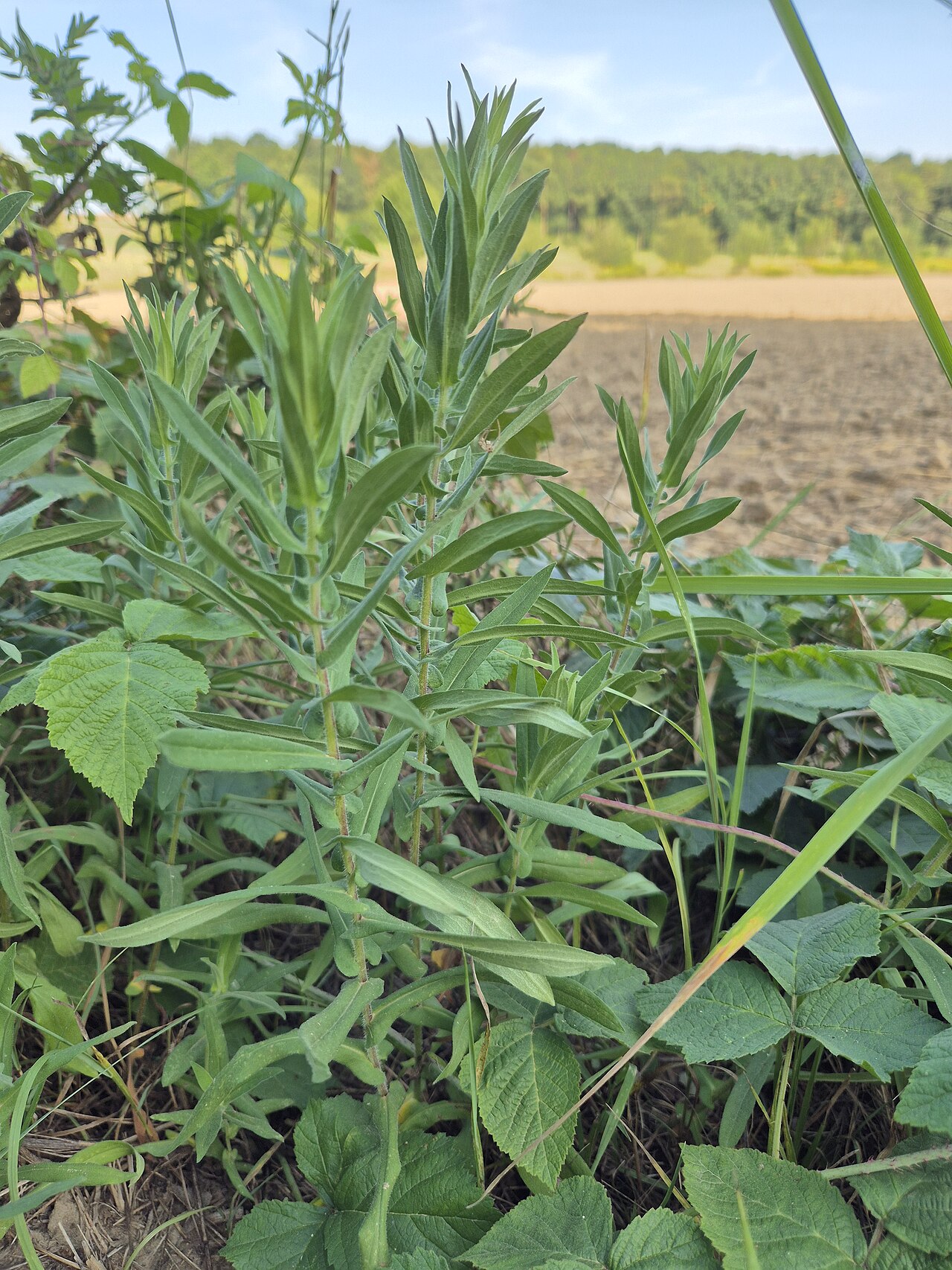
New England aster grows from a crown at ground level. Each spring it sends up several stout, hairy stems that stay mostly unbranched until near the top.
In late summer the tops branch out and fill with flower heads. NC State Extension describes clumps 3 to 6 feet tall and 1 to 3 feet wide. That is a lot of weight carried high on a few long stems.
In the wild, this species grows in moist meadows, prairies, and old fields. There it rises through grasses and goldenrods that hold it upright. The Illinois Wildflowers site notes that the stems often flop over when that supportive vegetation is missing.
The New England Aster Year
| Early spring | New shoots emerge from the crown. This is when to set out stakes or hoops. |
| Late spring – early summer | Stems lengthen quickly. The window for pinching or cutting back. |
| Mid – late summer | Stems reach full height and begin branching at the top. Lower leaves may start to drop. |
| August – October | Flowering. Heavy flower clusters, rain, and wind cause most flops now. |
| Late fall – winter | Seed heads ripen. Stems dry and stand (or lean) through winter. |
That timeline matters. Most fixes for flopping happen in spring and early summer, months before you see the problem.
Check 1: Count the Hours of Sun
Light is the first thing to check. Nebraska Extension recommends full sun to help asters develop strong stems.
In part shade the plant still grows, but it reaches for light. Stems get longer and thinner, and they bend toward the brightest side of the bed. A lean in one direction is the giveaway.
Count the hours of direct sun in midsummer, when nearby trees are fully leafed out:
- 6 hours or more: light is probably not your main problem.
- 4 to 6 hours: expect taller stems. Pinching and support become more important.
- Less than 4 hours: flopping is likely every year. Consider moving the clump.
Shade often creeps in slowly. A young maple or a neighbor’s new fence can change a bed over a few seasons.
Check 2: Look at What Is Growing Around It
A New England aster standing alone in bare mulch has nothing to lean on. That’s the setup most likely to end in a sprawl.
Look at the plant’s neighbors. Are there sturdy grasses or other tall perennials within a foot or two? Or is it an island with open space on every side?
Native bunchgrasses make some of the best living supports. Little bluestem is widely native across the aster’s range, and its upright tufts give lower stems something to brace against. In Midwestern prairie gardens, prairie dropseed does a similar job at the front of a bed.
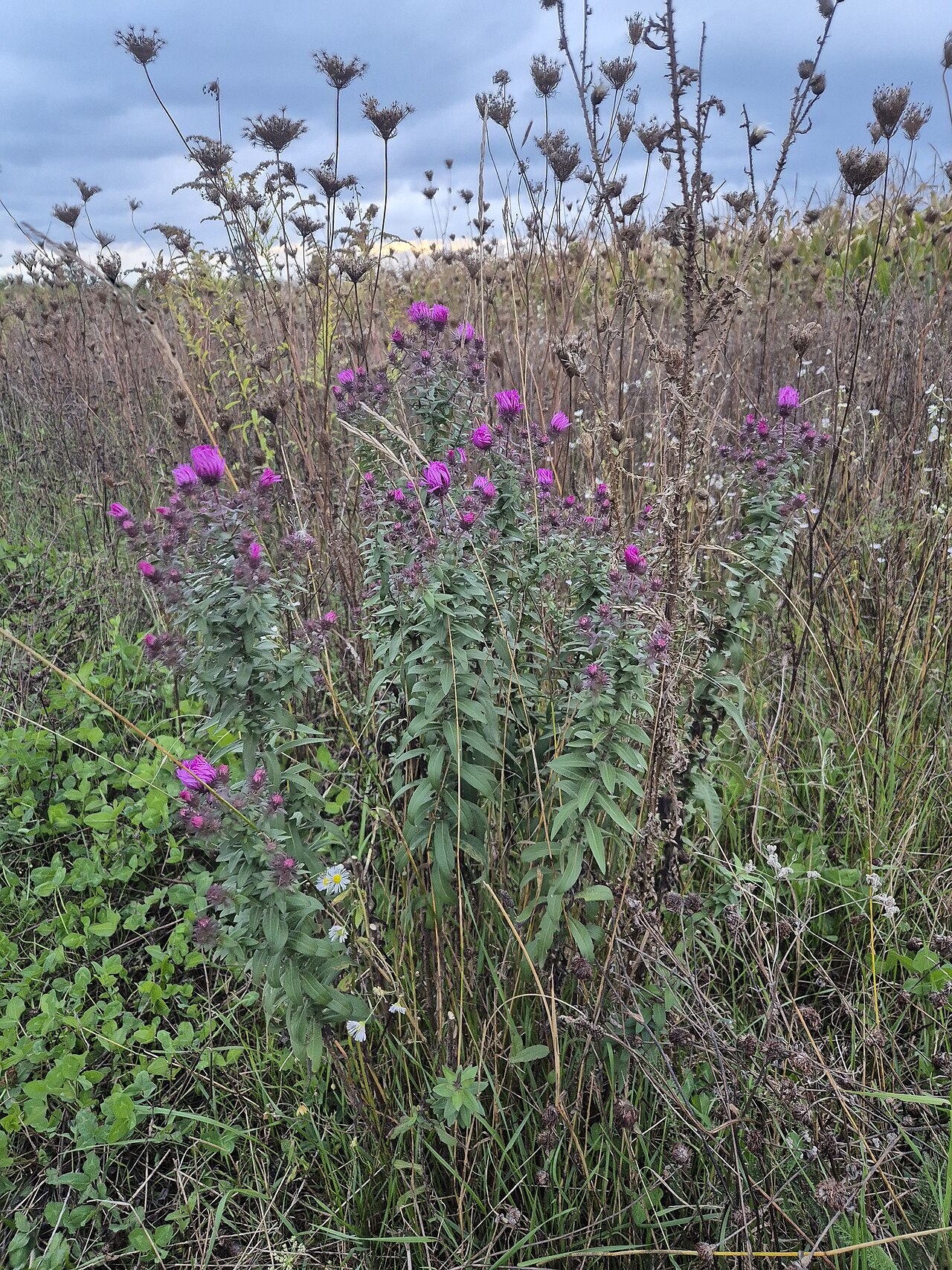
Planting in drifts helps too. Several asters set 2 to 3 feet apart, mixed with grasses, lean on each other instead of on the lawn.
Check 3: Test the Soil Moisture and Feeding
NC State Extension recommends moist, fertile, well-drained soil, and the plant handles clay loams. It doesn’t need pampering beyond that.
Very rich soil, frequent fertilizing, or a bed that stays soggy can produce fast, soft growth. That growth tends to be taller and less able to carry a heavy flower load. This is general practice for tall perennials rather than an aster-specific rule, but it’s worth ruling out.
Ask a few questions:
- Does lawn fertilizer get spread or blown into this bed?
- Was the bed recently amended with a thick layer of manure or compost?
- Does an irrigation zone run here every day?
If the answer to any of these is yes, cut back on the extras. Established clumps rarely need fertilizer at all. A basic soil test tells you whether anything is actually lacking.
Check 4: Know How Tall Your Plant Is Supposed to Be
Not every New England aster is the same size. Wild plants vary a lot, and Wikipedia’s species account gives a typical range of 1 to 4 feet, with some plants reaching 6 to 8 feet.
Cultivars vary too. Most named selections run 3 to 6 feet or more, while ‘Purple Dome’ stays near 1½ feet. Nebraska Extension notes that dwarf types generally don’t need staking, but taller selections over 4 feet do.
If you don’t know what you planted, measure the stems at bloom. Anything over about 4 feet in a garden bed is a candidate for pinching or support. Our guide to how tall New England aster grows covers the size factors in more detail.
Check 5: Check the Age and Density of the Clump
An older clump can become a crowded mass of thin stems. Thin stems bend more easily, and a packed center stays damp and shaded.
Wisconsin Extension’s horticulture staff suggest dividing aster clumps every two or three years in spring. The Lady Bird Johnson Wildflower Center says dividing every several years keeps New England aster growing vigorously.
If your clump has spread wide, has a weak or empty center, or produces a forest of pencil-thin stems, division is part of the fix. Nebraska Extension also suggests thinning some stems by midsummer on very dense plants to reduce disease.
Step 1: Pinch or Cut Back in Late Spring
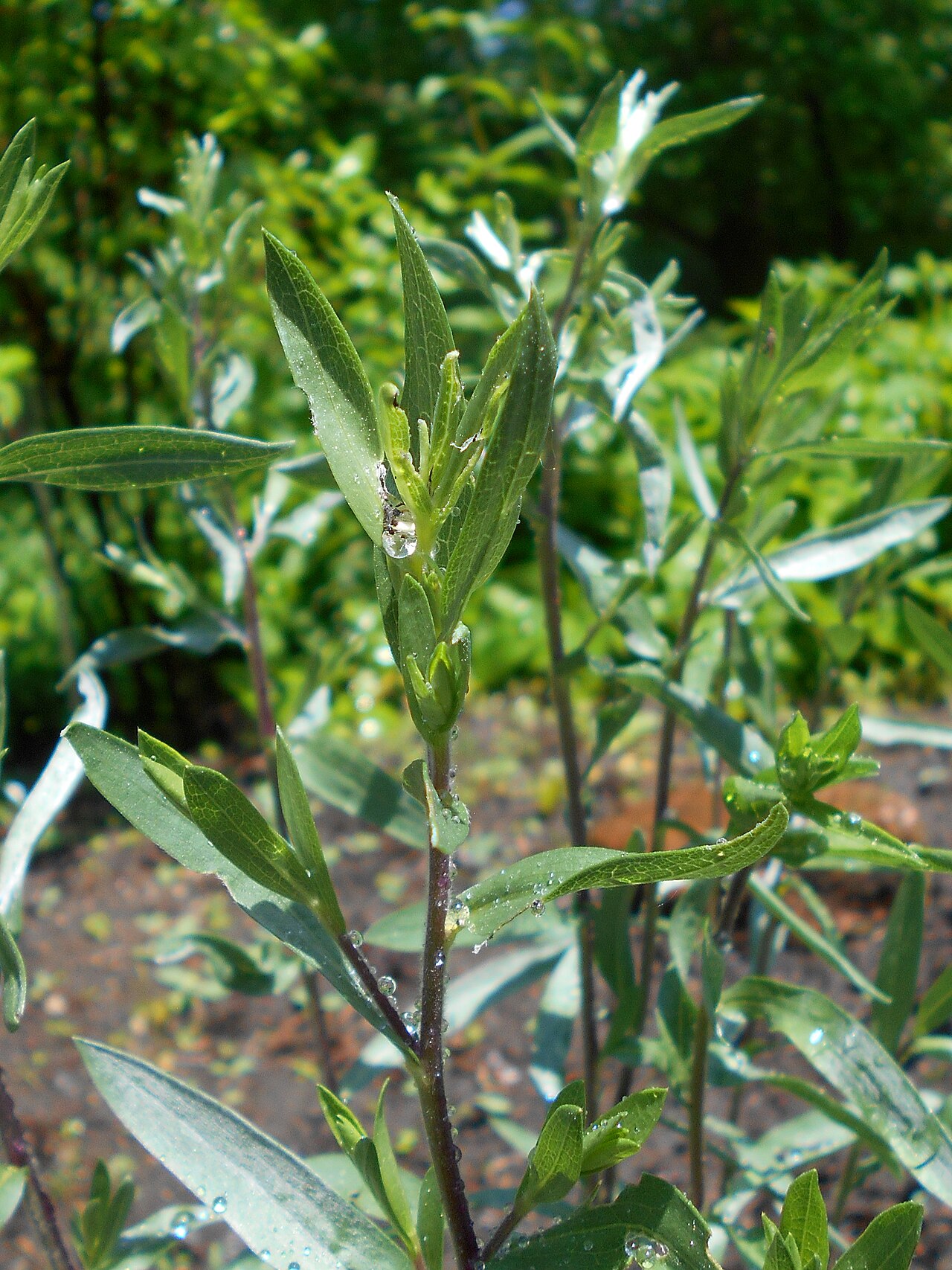
Pinching is the main tool for a shorter, sturdier plant. NC State Extension notes that pinching the stems in spring creates a bushier plant and delays blooming.
Nebraska Extension gives a practical method:
- Cut or pinch each stem back by 4 to 6 inches.
- Do it once or twice between spring and early summer.
- Finish by mid-June. Nebraska Extension uses June 15 as its cutoff.
- Hedge shears make quick work of a large clump.
Each cut tip branches into several shorter stems. The plant ends up lower and fuller, with the flower weight spread across more stems.
Pinching late is risky. Because pinching delays flowering, a cut made well into summer can push bloom later into fall. In the north, that raises the chance that frost catches the buds. If you’re unsure, pinch earlier and lighter rather than later and harder.
You don’t have to pinch the whole clump. Pinching only the front stems produces a stepped plant with shorter stems in front that hide and support the taller ones behind.
Step 2: Put Support in Place Early
If the plant is a tall type, or you don’t want to delay bloom, add support instead of pinching, or in addition to it.
Timing is the trick. Nebraska Extension recommends getting supports in place before plants reach 6 inches tall. The stems then grow up through the support and hide it by midsummer.
A natural-looking method from the same source:
- Push bamboo stakes or strong 1-inch branches, 5 to 6 feet long, firmly into the soil in a circle around the clump.
- Run string between and around the stakes to make a web.
- Make one web at about 18 to 24 inches high and a second at 36 to 48 inches.
Metal hoop supports, grid rings, and twiggy pea-brush work the same way. Whatever you use, set it at the start of the season.
Already flopped? Wisconsin Extension notes that tall asters can be staked in late summer to keep them from flopping. Once stems have bent, gently lift them, loop soft twine around the whole clump, and tie it to two or three stakes. It won’t look perfect, but it saves the bloom.
Step 3: Rethink the Site if Flopping Keeps Happening
If you’ve pinched and staked and the plant still sprawls every year, the site is probably working against you.
Moving a New England aster is straightforward when it’s dormant or just emerging in spring. Choose a spot with full sun and average soil. Plant it among grasses or sturdy perennials it can lean on.
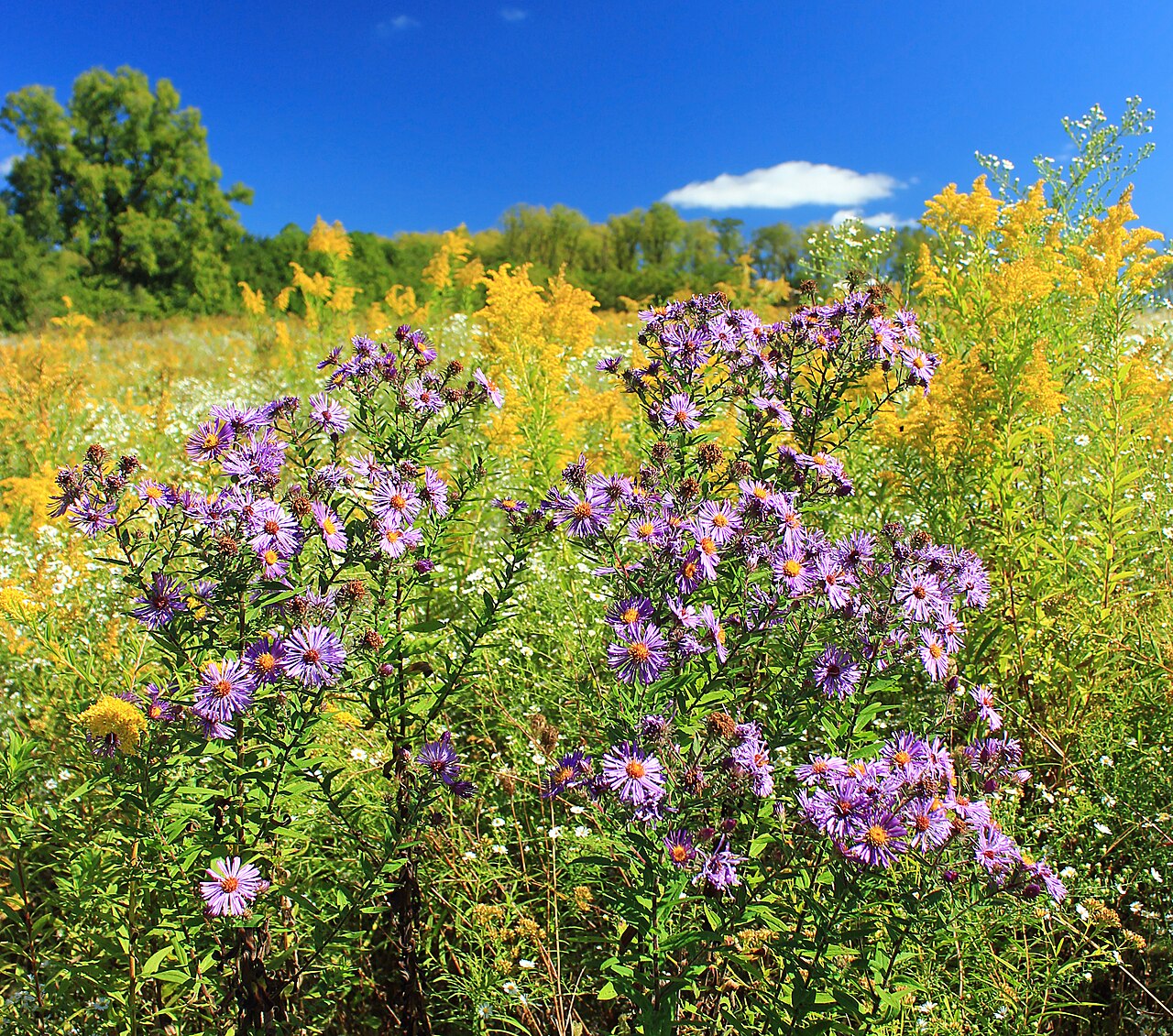
NC State Extension suggests pairing it with a fall-blooming goldenrod, and the purple-and-gold combination is a classic. Build the planting so something stands next to the aster from spring onward. Our pollinator garden design basics guide covers layering plants so they support each other.
For small yards where any lean is a problem, a compact cultivar may simply be the better choice.
Troubleshooting at a Glance
| Stems lean one way, thin and long | Too little sun. Open up the light or move the clump. |
| Plant splays open in all directions | No neighbors to lean on. Add grasses or set a hoop support in spring. |
| Very tall, soft, lush growth | Rich, wet, or fertilized soil. Stop feeding and reduce watering. |
| Stems over 4 feet, never pinched | Pinch 4 to 6 inches off each stem by mid-June next year. |
| Dense clump, weak center | Overcrowded. Divide in spring and replant the vigorous outer pieces. |
| Flopped right after a storm | Lift and corral with twine and stakes now. Set supports early next spring. |
| Bloom very late after a summer cut | Pinched too late. Finish pinching earlier next season. |
What to Do Right Now
What you can do depends on the time of year.
If it’s blooming and flopped: lift the stems gently and corral them with twine and stakes. Don’t cut the flowering stems back. Bees and butterflies are using them, and a cut now ends the bloom.
If bloom is over: leave the stems for now and make notes. How tall did it get? Which way did it lean? What’s growing next to it? Those answers set up next year’s plan.
If it’s early spring: this is your best window. Divide crowded clumps, move plants out of shade, and set supports before shoots reach 6 inches.
If it’s late spring to early summer: pinch. Take 4 to 6 inches off each stem and repeat once more if growth is vigorous, finishing by mid-June.
A Season-by-Season Plan for Next Year
- Early spring: divide old clumps, relocate shaded plants, and put hoops or stake-and-string webs in place.
- Late spring: first pinch, removing 4 to 6 inches from each stem.
- Early summer: optional second pinch, finished by mid-June. Thin a few stems out of very dense clumps.
- Summer: water only in long dry spells, skip the fertilizer, and keep the string web snug as stems grow.
- Fall: enjoy the bloom and record which stems stayed up. Leave seed heads standing for birds.
📋 More on this plant: read the full New England Aster (Aster novae-angliae) profile, or see it in our native plant lists for New Hampshire, Maine & Vermont, Connecticut, Massachusetts & Rhode Island, New York, Pennsylvania & Northern New Jersey, Maryland, Virginia & West Virginia, Ohio & Indiana, Michigan, Wisconsin & Eastern Minnesota, Illinois, Iowa & Missouri, North Dakota, South Dakota & Western Minnesota, and Nebraska, Kansas & Eastern Colorado.
Frequently Asked Questions
Why do my New England asters fall over every fall?
Usually it’s a mix of a tall, top-heavy plant and a site that doesn’t support it. Too little sun, rich or wet soil, and no neighboring plants to lean on all make it worse. Pinching in late spring and setting supports early fix most cases.
When should I pinch back New England asters?
From late spring into early summer. Nebraska Extension suggests cutting each stem back 4 to 6 inches once or twice and finishing by about mid-June. Later cuts delay bloom further into fall.
Does pinching reduce the number of flowers?
Pinching mainly changes the shape and timing. The plant branches into more, shorter stems and blooms somewhat later. NC State Extension notes the result is a bushier plant.
Can I cut back a flopped aster while it’s blooming?
You can, but you’ll lose the flowers on the stems you remove, along with late-season food for pollinators. It’s usually better to lift and tie the stems for now and fix the cause next spring.
Do short New England aster cultivars need staking?
Usually not. Nebraska Extension notes that dwarf cultivars generally don’t need staking, while taller selections over 4 feet do. ‘Purple Dome’ is a well-known compact selection.
Sources
- North Carolina Extension Gardener Plant Toolbox, Symphyotrichum novae-angliae: size, sun and soil preferences, spring pinching, staking, and goldenrod pairing.
- Nebraska Extension in Lancaster County, Plan for Late Summer Color with Asters: full sun for strong stems, staking method and timing, pinching amounts and cutoff date, thinning dense plants.
- Illinois Wildflowers, New England Aster: stems flopping without supportive vegetation, growth habit and habitat.
- Wisconsin Horticulture (UW–Madison Extension), Aster, Symphyotrichum spp.: staking tall asters, spacing for air circulation, and dividing every two or three years.
- Lady Bird Johnson Wildflower Center, Symphyotrichum novae-angliae: dividing every several years to keep plants vigorous.
- Wikipedia, Symphyotrichum novae-angliae: height range, stem structure, and cultivar heights.