
Wood Horsetail (Equisetum sylvaticum)
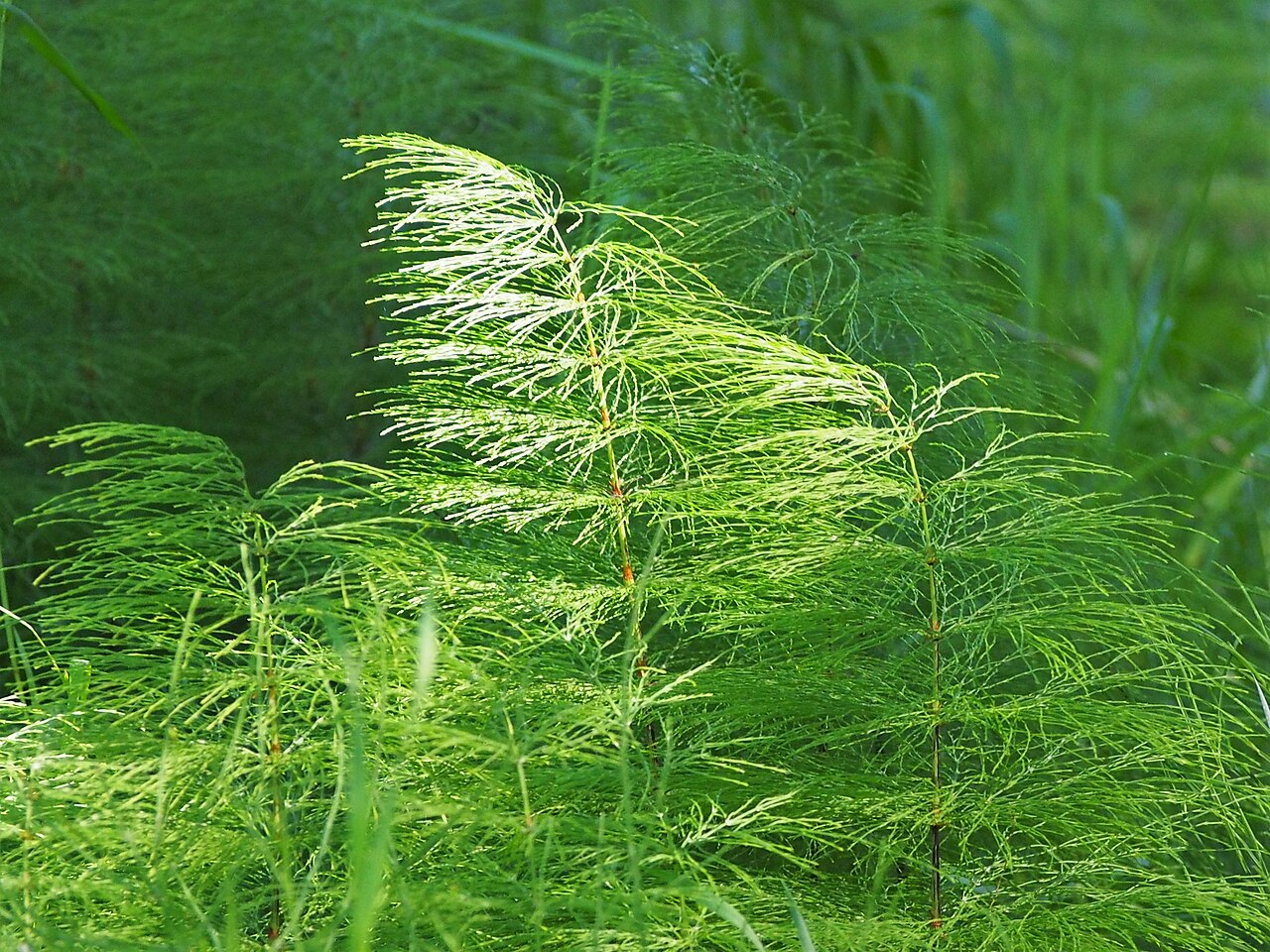
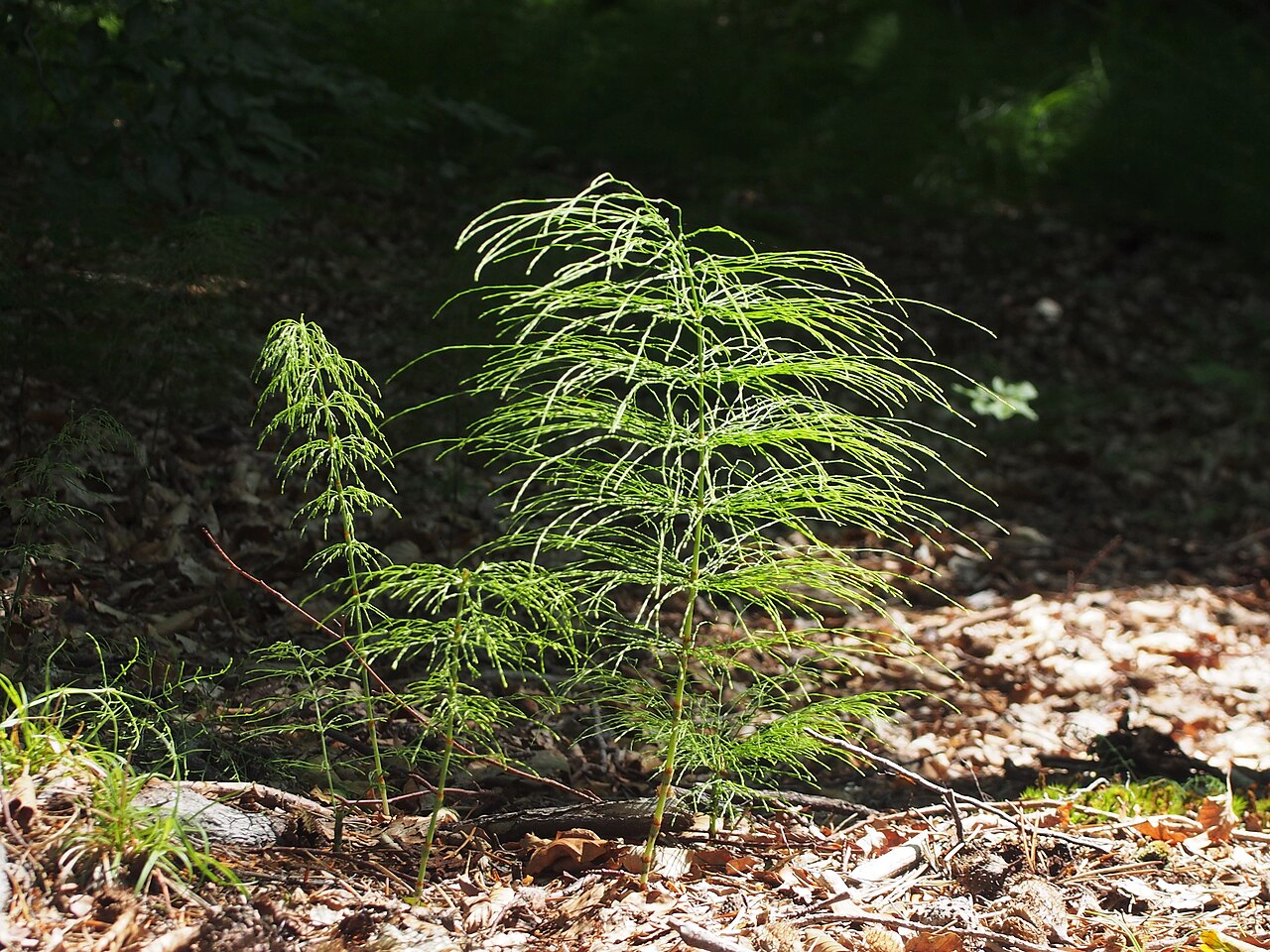
Equisetum sylvaticum, known as Wood Horsetail (USDA: woodland horsetail), is a delicate, spore-bearing perennial of moist northern forests. Horsetails are an ancient group of plants related to ferns, and wood horsetail is often called the most graceful of them. Its jointed green stems, 1 to 2 feet tall, carry whorls of slender branches that are themselves branched again and arch downward, so a patch of wood horsetail looks like a carpet of tiny, feathery green trees.
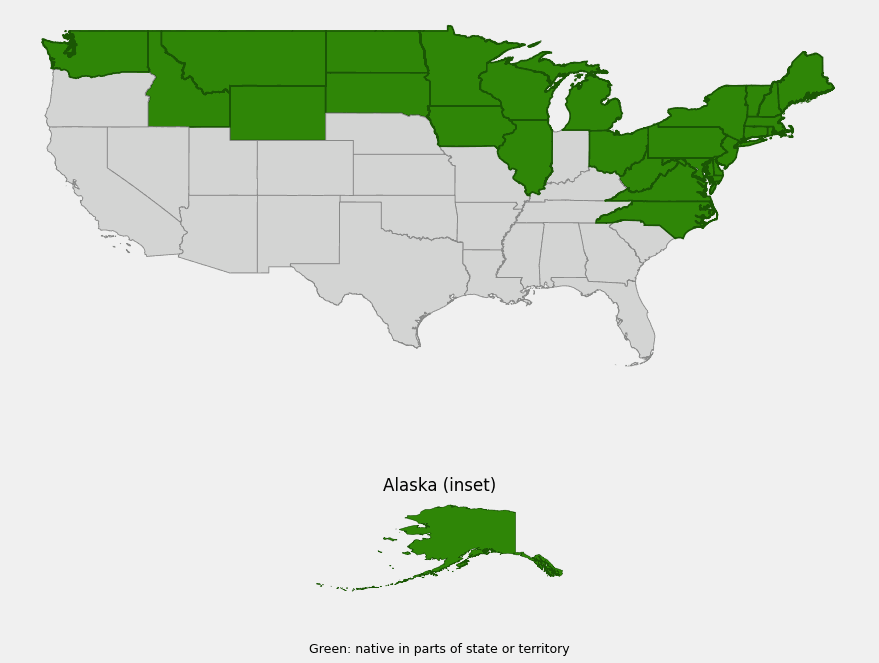
It grows across the cooler parts of the Northern Hemisphere. In North America it is found from Alaska and across all of Canada south through the northern United States, the Great Lakes and New England, and down the Appalachians to Virginia, West Virginia and North Carolina, with western populations in the northern Rockies. Its habitat is moist to wet, shady woods, swamp forests, bog and stream edges, and wet thickets.
Like other horsetails, it spreads by deep underground rhizomes and can form large colonies. It is an attractive groundcover for naturalistic shade and wetland gardens. It is toxic to livestock, especially horses, because it contains thiaminase, an enzyme that destroys vitamin B1, so do not plant it near pastures or where it could end up in hay.
Identification
Wood horsetail is the easiest horsetail to recognize. Look for its soft, lacy appearance: whorls of branches that branch again and droop, on slender stems in shady, moist woods.
Stems
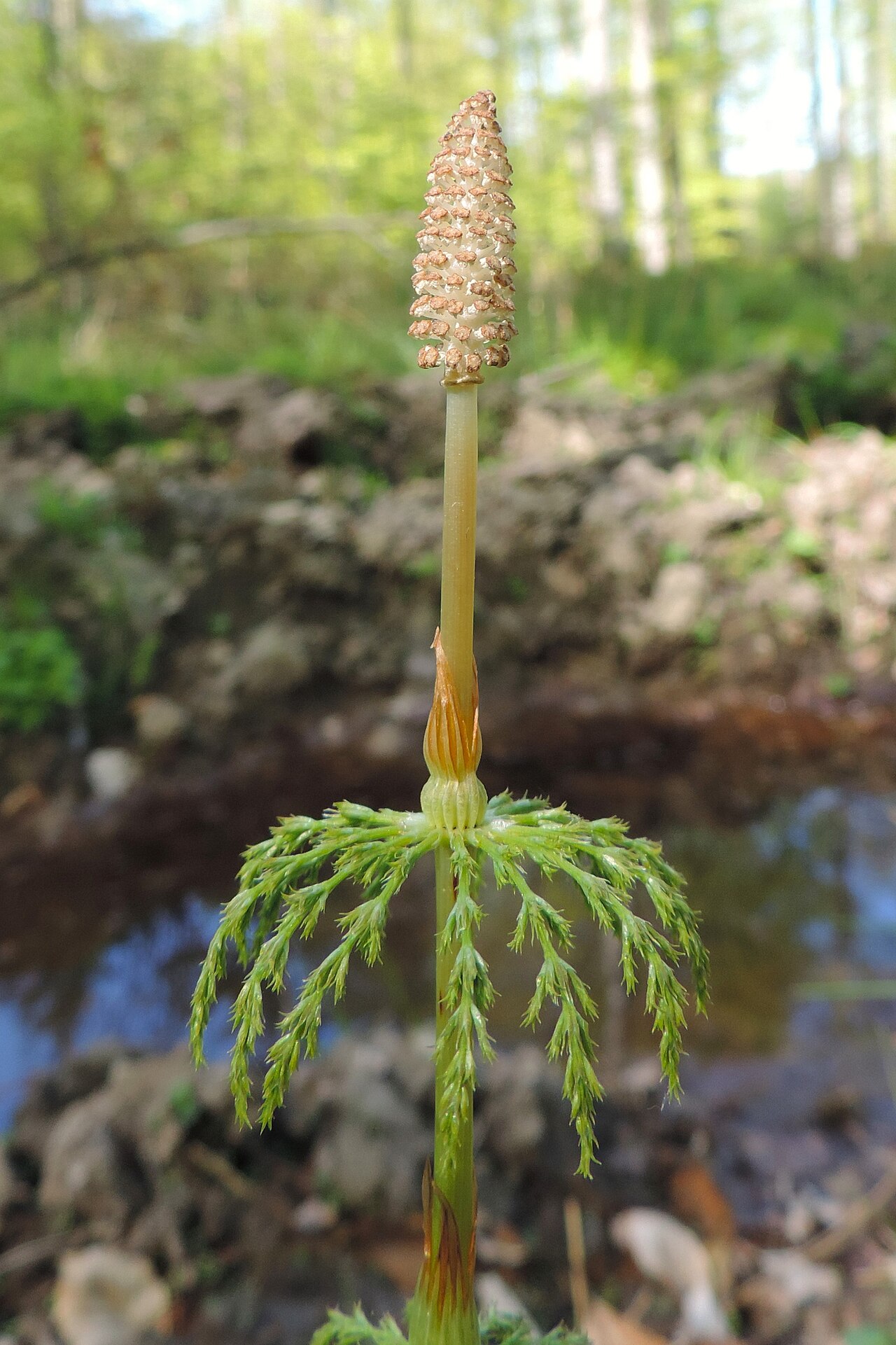
Horsetails have two kinds of stems. The sterile, green stems of wood horsetail are 1 to 2 feet tall (sometimes taller), hollow and jointed, with 10 to 18 fine ridges. At each joint (node) there is a papery sheath. In this species the sheath’s teeth are fused into three or four broad, reddish-brown, papery lobes, a good identification feature. The stems die back each fall.
Branches
Whorls of very slender, green branches grow from each node of the sterile stems. Each branch is itself branched, with smaller branchlets, and the branches arch outward and down. No other North American horsetail has such regularly compound branches, which give the plant its feathery, tree-like or fern-like look.
Fertile Stems & Spores
In spring, from about April to June, fertile stems appear. They start out pale brownish and unbranched, with a spore cone (strobilus) about 1 inch long at the tip. After the spores are shed, the fertile stems turn green, grow whorls of branches like the sterile stems and persist, while the cone withers. Horsetails do not flower or make seeds; they reproduce by wind-borne spores and by spreading rhizomes.
Roots & Rhizomes
The plants spread through dark, branching rhizomes that can run deep in moist soil. A single colony can cover a large area of forest floor or swamp edge.
Look-alikes
Field Horsetail (Equisetum arvense) has simple, unbranched branches that are stiffer and usually point upward or outward, and its brown fertile stems wither soon after shedding spores. Meadow horsetail (E. pratense) has unbranched branches held horizontally. Scouring Rush (E. hyemale) has stiff, evergreen, unbranched stems.
Safety
Toxic to livestock. Horsetails contain thiaminase, which destroys thiamine (vitamin B1). Horses that eat horsetail in hay over a period of weeks can develop thiamine deficiency, with weight loss, weakness, staggering and, in severe cases, death; cattle and sheep can also be affected. Do not plant it near pastures or hayfields. People and pets should not eat it. The stems contain silica and are harmless to touch.
Quick Facts
| Scientific Name | Equisetum sylvaticum |
| Family | Equisetaceae (horsetail family) |
| Plant Type | Rhizomatous, spore-bearing perennial (fern ally) |
| Mature Height | 1–2 ft (occasionally to 2.5 ft) |
| Mature Spread | Spreads by rhizomes to form colonies |
| Growth Rate | Moderate; spreads steadily in moist soil |
| Sun Exposure | Part shade to full shade |
| Water Needs | High; consistently moist to wet soil |
| Soil Type | Moist, humus-rich loam, muck or wet sand |
| Soil pH | Acidic to neutral (about 4.5–7.0) |
| Bloom Time | No flowers; spore cones April–June |
| Flower Color | None (green stems; brown spore cones) |
| Fall Color | Stems fade to yellow and tan |
| Fruit | None; reproduces by spores and rhizomes |
| Deer Resistant | Yes; rarely browsed by deer |
| USDA Hardiness Zones | 2–7 |
Native Range
Wood horsetail is circumboreal, growing across northern North America, Europe and Asia. USDA PLANTS lists it as native in Alaska, Canada, Greenland, Saint Pierre and Miquelon and the lower 48 states. In Canada it grows in every province and territory, from Yukon and British Columbia to Newfoundland and Labrador and north into Nunavut.
In the lower 48 it is most common in the Great Lakes states and New England, including Minnesota, Wisconsin, Michigan, New York and Maine. It extends south through Pennsylvania, New Jersey, Ohio, Illinois and Iowa and down the Appalachians to Maryland, Virginia, West Virginia and North Carolina, where it is uncommon in cool, wet mountain woods. In the West it grows in the northern Rocky Mountains of Idaho, Montana and Wyoming and in northeastern Washington east of the Cascades, and in the Dakotas it occurs in cool, wooded areas such as the Black Hills and the far northeast.
It prefers moist to wet, shady places: swamp forests and wooded seeps, bog and fen edges, stream banks, wet thickets, and moist mixed or coniferous woods, often on acidic, humus-rich soil. It also colonizes moist, shady roadsides and ditches in the north.
📋 Regional plant lists featuring Wood Horsetail: New York, Pennsylvania & Northern New Jersey · Idaho, Eastern Oregon & Eastern Washington · Ohio & Indiana · Montana & Wyoming · Michigan, Wisconsin & Eastern Minnesota · Connecticut, Massachusetts & Rhode Island · New Hampshire, Maine & Vermont · Maryland, Virginia & West Virginia · Delaware, Southern New Jersey & Long Island · Illinois, Iowa & Missouri · Alaska · North & South Carolina · North Dakota, South Dakota & Western Minnesota
Growing & Care Guide
Wood horsetail is easy to grow in the right place: moist to wet, shady ground in a cool climate. It is less aggressive than field horsetail, but it still spreads by rhizomes, so give it room or contain it. It is rarely sold, so look for specialist native plant or fern nurseries.
Light
Plant it in part shade to full shade. It tolerates morning sun in cool, moist sites, but hot afternoon sun scorches the delicate branches.
Soil & Water
It needs soil that stays moist to wet all season: humus-rich loam, peaty muck or wet sand. It is ideal for poorly drained low spots, the edges of ponds and streams, and rain gardens in shade. It does not tolerate drought; plants that dry out go dormant early or die back.
Planting Tips
Plant divisions or potted plants in spring. Set them in groups about 1 to 2 feet apart in a woodland garden, along a shady stream, or with ferns and sedges in a wet shade garden. Its rhizomes can run under paths and into lawns in moist soil, so plant it where spreading is welcome, or in a large, sunken container. Keep it well away from horse pastures and hayfields.
Pruning & Maintenance
Little care is needed. The stems die back in fall; leave them or cut them down in late fall or early spring. Pull up stems that stray beyond the planting area. Do not fertilize.
Propagation
Propagate by dividing clumps or digging sections of rhizome with stems attached in early spring, and replant them immediately in moist soil. Growing horsetails from spores is possible but slow and difficult, since the spores are short-lived and must be sown fresh on moist soil.
Landscape Uses
- Woodland gardens: a soft, feathery groundcover in moist shade
- Wet shade and bog edges: for poorly drained, shady low spots
- Stream and pond banks: rhizomes help hold soil on moist banks
- Shade rain gardens: with ferns, sedges and other moisture lovers
- Fern and texture gardens: fine, lacy contrast to broad-leaved plants
Wildlife & Ecological Value
Wood horsetail is not a food plant for most wildlife, but it contributes to the structure and soil stability of moist northern forests.
For Pollinators
As a spore-bearing plant, it has no flowers and offers no nectar or pollen. It is still useful in a pollinator garden as cover and as part of a diverse, moist woodland community.
For Birds
Ground-nesting and ground-feeding birds of northern forests, such as thrushes and warblers, find cover in dense patches. The plant itself is not an important bird food.
For Mammals
Deer seldom browse horsetails. Some wild herbivores, such as moose and bears in the North, eat horsetails at times in spring and early summer. Livestock, especially horses, can be poisoned if they eat large amounts, mainly in hay.
Ecosystem Role
Its rhizomes bind wet soil along streams and in swamp forests, and its stems accumulate silica. Wood horsetail colonies are part of the herb layer of boreal and northern hardwood forests and often indicate moist, cool, shady sites.
Cultural & Historical Uses
Horsetails are living relatives of plants that dominated swamp forests more than 300 million years ago, when some tree-sized relatives grew up to tens of feet tall. Today only one genus, Equisetum, survives, with about 15 to 20 species worldwide. The name Equisetum comes from Latin for “horse bristle,” and sylvaticum means “of the woods.”
Because horsetail stems are rich in silica, people in many cultures have used them to scour pots and polish wood and metal, and the Lady Bird Johnson Wildflower Center notes their use as pot scrubbers and bottle brushes. Several Native American and First Nations peoples used horsetails for scrubbing, as toys and in traditional medicine.
Wood horsetail is admired by naturalists and photographers for its delicate, symmetrical form, especially when dew or rain beads on its branches. It is a familiar plant of trails through cool, wet woods across the North.
Frequently Asked Questions
Is wood horsetail toxic?
Yes, to livestock. It contains thiaminase, which destroys vitamin B1, and horses that eat horsetail in hay can become seriously ill. Do not plant it near pastures or hayfields, and do not eat it.
How is wood horsetail different from field horsetail?
Wood horsetail’s branches are branched again and droop, giving it a lacy look, and its fertile stems turn green and branched after releasing spores. Field horsetail has simple, unbranched branches, and its brown fertile stems wither.
Is wood horsetail invasive?
It is native across the northern U.S. and Canada and is not invasive there, but it does spread by rhizomes in moist soil. Plant it where it has room or contain it.
Does wood horsetail need wet soil?
It needs consistently moist to wet soil and shade. It is not suited to dry or sunny gardens.
Does wood horsetail have flowers?
No. Horsetails reproduce by spores from cones on the fertile stems, and by spreading rhizomes. They never flower or make seeds.

Looking for a nursery that carries Wood Horsetail?
Browse our native plant nursery directory: Alaska · Connecticut & Delaware · Idaho, Illinois & Iowa · Maine, Maryland, Massachusetts, Michigan, Minnesota & Montana · New Hampshire, New Jersey, New York, North Carolina, North Dakota & Ohio · Pennsylvania, Rhode Island, South Dakota, Vermont & Virginia · Washington · West Virginia, Wisconsin & Wyoming