
Camphor Pluchea (Pluchea camphorata)
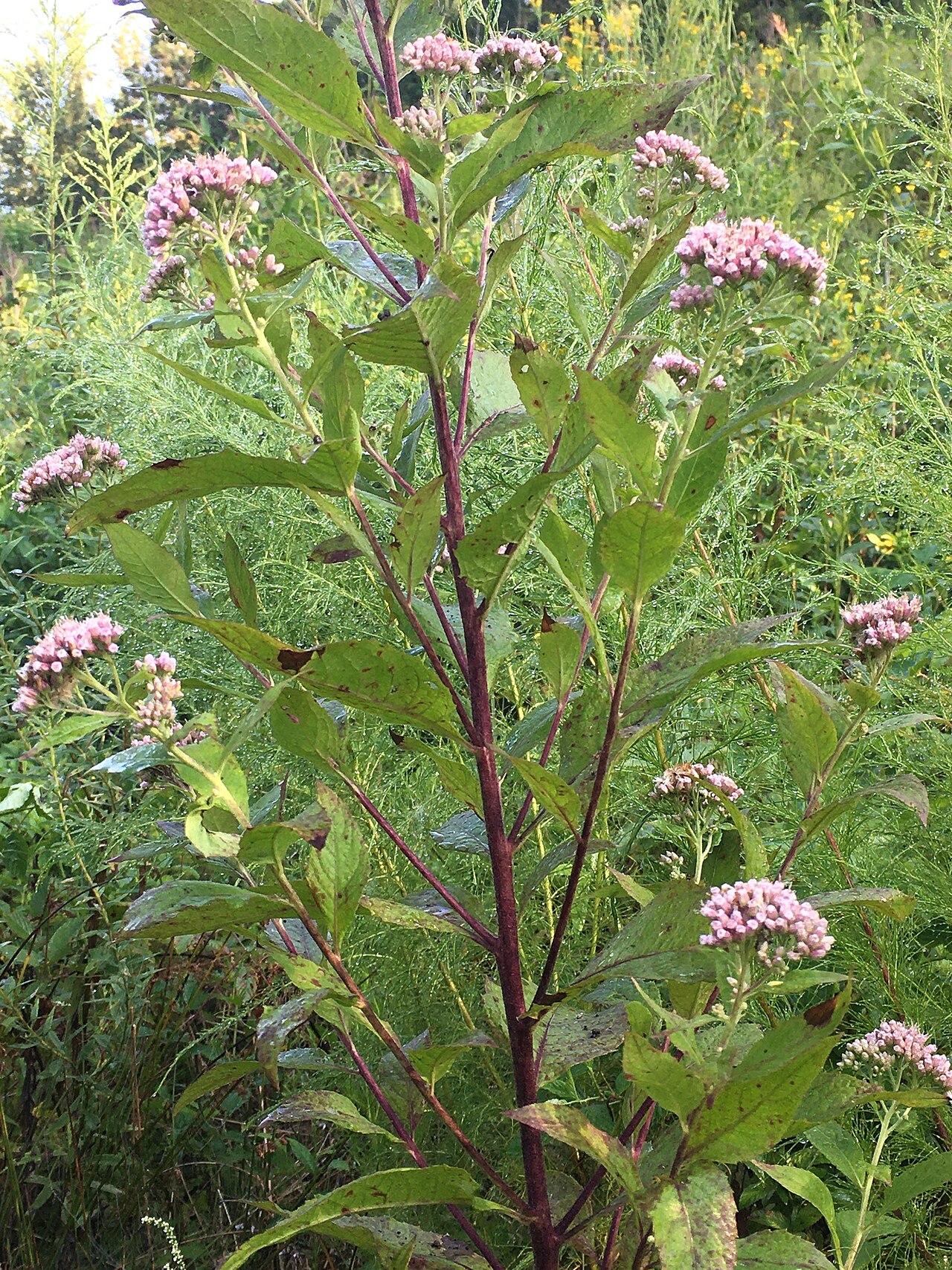
Pluchea camphorata, known as Camphor Pluchea (also called camphorweed), is a tall wetland wildflower of the southeastern and south-central United States. It belongs to the aster family (Asteraceae). Its leaves and stems give off a strong, camphor-like smell when touched, and in late summer and fall it bears flat-topped clusters of small, rayless, pinkish to mauve flower heads that attract many bees, wasps and butterflies.
It is an annual or short-lived perennial, usually 2 to 5 feet tall, with broad, stalked, finely toothed leaves. It grows in freshwater marshes, swamp edges, wet meadows, floodplains, pond margins and wet ditches, from the Gulf Coast and Florida north to the Ohio Valley, Maryland and New Jersey, and west to Texas, Oklahoma and Kansas. It flowers from about August to October, when its fuzzy pink clusters brighten wet ground.
Camphor pluchea is easy to grow from seed in wet, sunny spots such as rain gardens, pond edges and wet meadows, where it reseeds itself. Note that the name “camphorweed” is also used for a different plant, Camphorweed (Heterotheca subaxillaris), a yellow-flowered aster of dry, sandy soil, so this page uses the USDA name camphor pluchea.
Identification
Look for a tall, leafy, strongly camphor-scented plant with broad, stalked, toothed leaves and flat-topped clusters of small pinkish to mauve, rayless flower heads in late summer, in wet, sunny places.
Stems & Habit
Camphor pluchea is an annual or short-lived perennial, usually 2 to 5 feet (60 to 150 cm) tall and occasionally taller. It has a single, upright, leafy stem that is often reddish or purplish, branching in the upper part. The stems are smooth to finely hairy and slightly sticky toward the top.
Leaves
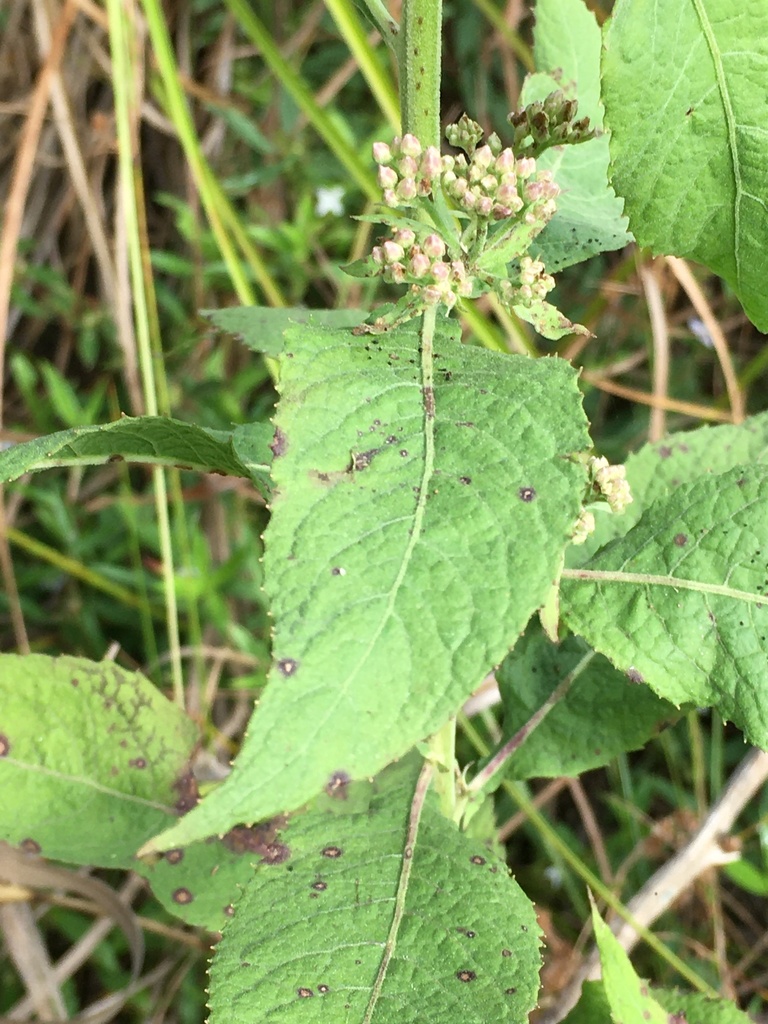
The leaves are alternate, 2 to 6 inches (5 to 15 cm) long, elliptic to lance-shaped or oval, with a short stalk, a pointed tip and finely toothed edges. They are green, thin and nearly smooth to finely glandular, and smell strongly of camphor when crushed.
Flowers
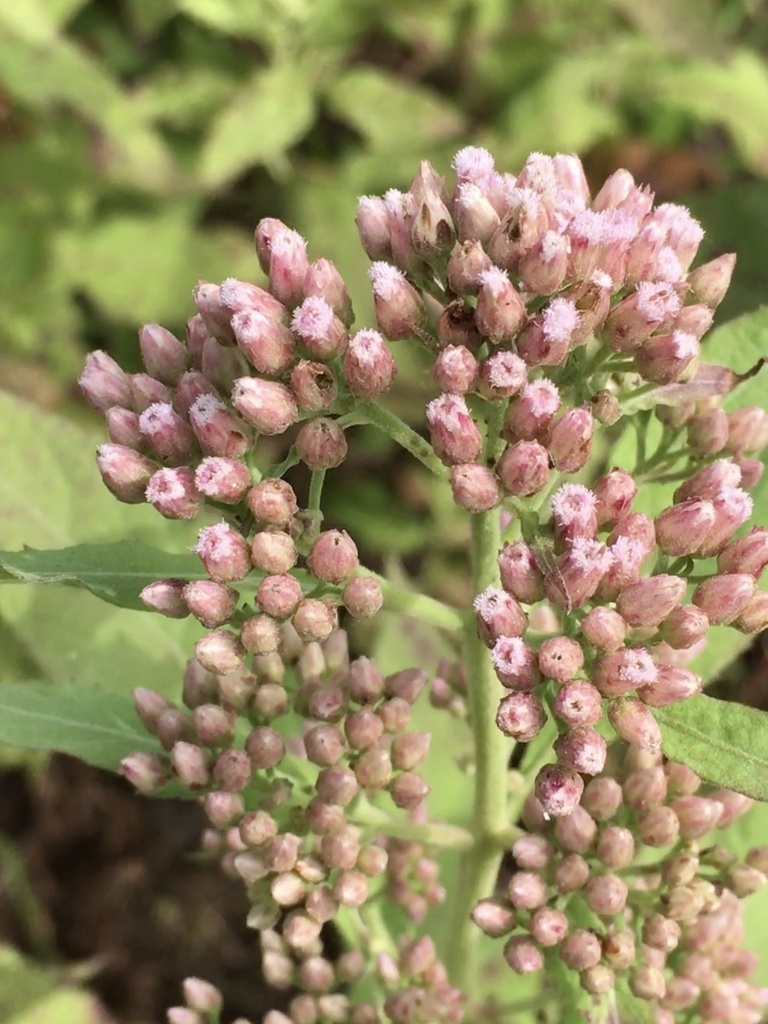
The flower heads are small, about 1/4 inch (5 to 7 mm) across, and have no rays. They are made of many tiny pinkish, rose-purple or mauve disk florets surrounded by overlapping, often purplish bracts. The heads are crowded in rounded to flat-topped clusters at the ends of the branches. Bloom time is about August to October, sometimes into November in the South.
Fruit & Seeds
Each floret produces a tiny, ribbed achene topped with a tuft of white bristles (pappus), which carries the seed on the wind. After seeding, the dry, brown flower clusters often persist into winter.
Look-alikes
Marsh Fleabane (Pluchea odorata) is similar but grows mainly in coastal salt and brackish marshes and has brighter rose-pink heads. Stinking camphorweed (P. foetida) has stalkless leaves that clasp the stem and creamy white heads. Joe-pye weeds (Eutrochium) have whorled leaves and larger, looser pink heads, and Boneset has white heads and leaves joined around the stem. Camphorweed (Heterotheca subaxillaris) shares the camphor smell but has yellow, daisy-like flowers and grows in dry sand.
Safety & Conservation
Camphor pluchea is not considered a food or medicinal plant, so do not eat it. The strong-smelling foliage may irritate sensitive skin. It is common across most of its range, but it is rare at the northern edge: NatureServe ranks it critically imperiled (S1) in Ohio and Kansas and imperiled (S2) in Maryland, and it is considered historical or extirpated in Pennsylvania, Delaware, New Jersey and West Virginia.
Quick Facts
| Scientific Name | Pluchea camphorata |
| Family | Asteraceae (aster family) |
| Plant Type | Annual or short-lived perennial wildflower |
| Mature Height | 2–5 ft |
| Mature Spread | 1–2 ft |
| Growth Rate | Fast |
| Sun Exposure | Full sun to part shade |
| Water Needs | Wet to moist; tolerates shallow flooding |
| Soil Type | Wet clay, loam or muck; freshwater marshes, ditches, floodplains |
| Soil pH | About 5.5–7.5 |
| Bloom Time | August–October |
| Flower Color | Pink, rose-purple or mauve |
| Fall Color | Dried brown seed heads persist into winter |
| Fruit | Tiny achene with white bristles, wind-dispersed |
| Deer Resistant | Yes; strong-smelling foliage is seldom browsed |
| USDA Hardiness Zones | 5–10 (often grown as an annual) |
Native Range
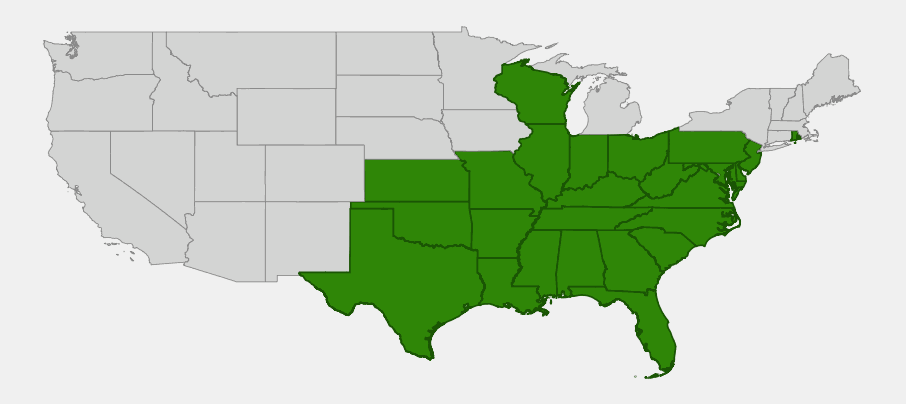
Camphor pluchea is native to the southeastern and south-central United States. USDA PLANTS lists it as native in 25 states, from Florida and Texas north to Oklahoma, Kansas, Missouri, Illinois, Indiana, Ohio, Kentucky, West Virginia, Virginia, Maryland, Delaware, New Jersey and Pennsylvania. It is most common in the Gulf and Atlantic Coastal Plains, the lower Mississippi Valley and East Texas.
At the northern edge of its range it is rare or historical: NatureServe considers it historical or extirpated in Pennsylvania, Delaware, New Jersey and West Virginia and critically imperiled in Ohio and Kansas. USDA also lists outlying records from Rhode Island, based on old collections from coastal ponds, and Wisconsin, based on a single 1919 collection from Sheboygan; these are far outside the main range. In Texas it is most common in the east and along the coast, with scattered records south to the Rio Grande Valley.
It grows in open, sunny to lightly shaded wet places: freshwater and slightly brackish marshes, swamp edges, wet meadows and prairies, floodplains, river and pond margins, wet ditches and roadsides, and disturbed wet ground. It often appears in large numbers in drawn-down ponds and wet fields in late summer.
📋 Regional plant lists featuring Camphor Pluchea: New York, Pennsylvania & Northern New Jersey · Ohio & Indiana · Michigan, Wisconsin & Eastern Minnesota · Kentucky & Tennessee · Nebraska, Kansas & Eastern Colorado · Connecticut, Massachusetts & Rhode Island · New Hampshire, Maine & Vermont · Maryland, Virginia & West Virginia · Delaware, Southern New Jersey & Long Island · Illinois, Iowa & Missouri · Alabama, Georgia & Mississippi · North & South Florida · North & South Carolina · Arkansas, Louisiana, Eastern Oklahoma & Eastern Texas · South & West Texas
Growing & Care Guide
Camphor pluchea is an easy, fast-growing native for wet, sunny ground. Treat it as a self-sowing annual: it may disappear in one spot and come up in another.
Light
Full sun to part shade. It flowers best in full sun.
Soil & Water
It needs consistently moist to wet soil and tolerates shallow, temporary flooding. It grows in clay, loam, sand or muck, and does not need rich soil or fertilizer. In dry soil it stays small and may die early.
Planting Tips
Scatter seed on bare, moist soil in fall or early spring and do not cover it, since the tiny seeds need light. Use it in rain gardens, around ponds, in wet meadows and along ditches, with other late-season wetland plants such as boneset, mistflower and swamp hibiscus. Expect plants to move around from year to year as they reseed.
Pruning & Maintenance
No pruning is needed. Leave the seed heads for winter interest and to let the plants reseed. If it spreads more than you want, pull extra seedlings in early summer or cut the flower heads before the seeds ripen.
Propagation
Grow from seed. Collect the fluffy seed heads in fall when they turn brown, and sow on the surface of moist soil outdoors in fall, or after a few weeks of cold, moist storage indoors in spring. Germination is usually good in warm, wet, sunny conditions.
Landscape Uses
- Rain gardens: tolerates wet soil and short flooding
- Pond and stream edges: late-season color on wet banks
- Wet meadows: a self-sowing annual among grasses and sedges
- Pollinator gardens: late-summer nectar for bees, wasps and butterflies
- Wetland restoration: a quick, native cover for disturbed wet ground
Wildlife & Ecological Value
Camphor pluchea is a late-season nectar plant of wetlands, when many other flowers have finished.
For Pollinators
The flower clusters attract a wide range of insects, including small native bees, honey bees, many kinds of wasps, flies and butterflies such as skippers and hairstreaks. Late-summer blooming wetland asters like this one help pollinators fuel up before fall.
For Birds
Small seed-eating birds such as sparrows and goldfinches may pick at the seed heads in fall and winter. The tall, leafy stems also give cover to wetland birds.
For Mammals
Deer and rabbits generally avoid the strong-smelling foliage, which makes it useful in gardens with heavy deer browsing.
Ecosystem Role
Camphor pluchea quickly colonizes open, wet ground such as drawn-down ponds, floodplains and disturbed wetlands, holding soil and adding late-season flowers. Its wind-borne seeds let it move between wet sites, and its abundant blooms support a large community of insects and the predators that feed on them.
Cultural & Historical Uses
The genus Pluchea honors Noël-Antoine Pluche, an 18th-century French naturalist and writer. The species name camphorata means “camphor-scented,” describing the strong odor of the leaves. Plants of this genus are often called fleabanes, a name given to several strong-smelling plants once thought to repel fleas.
The common name camphorweed is used for several unrelated plants with a camphor smell. On this site, Camphorweed refers to Heterotheca subaxillaris, a yellow-flowered plant of dry, sandy ground. This page uses the USDA name camphor pluchea to avoid confusion.
Related plants on this site include Marsh Fleabane (Pluchea odorata) of coastal marshes and Arrowweed (Pluchea sericea), a silvery shrub of desert washes in the Southwest.
Frequently Asked Questions
Is camphor pluchea the same as camphorweed?
The name camphorweed is used for more than one plant. Camphor pluchea (Pluchea camphorata) is a pink-flowered wetland plant. The plant usually called camphorweed on this site, Heterotheca subaxillaris, is a yellow-flowered aster of dry, sandy soil.
Why does it smell like camphor?
The leaves and stems contain aromatic oils that give off a strong camphor-like scent when touched or crushed, which also discourages deer and rabbits.
Is camphor pluchea an annual or perennial?
It is usually an annual, sometimes a short-lived perennial. It reseeds readily in wet, open ground.
Is camphor pluchea good for pollinators?
Yes. Its late-summer and fall flowers attract many bees, wasps, flies and butterflies.
Where should I plant camphor pluchea?
Plant it in full sun to part shade in wet or consistently moist soil, such as a rain garden, pond edge, wet meadow or ditch.

Looking for a nursery that carries Camphor Pluchea?
Browse our native plant nursery directory: Alabama & Arkansas · Delaware, Florida & Georgia · Illinois, Indiana & Kansas · Kentucky, Louisiana, Maryland, Mississippi & Missouri · New Jersey, North Carolina, Ohio & Oklahoma · Pennsylvania, Rhode Island, South Carolina, Tennessee, Texas & Virginia · West Virginia & Wisconsin