
Golden Corydalis (Corydalis aurea)
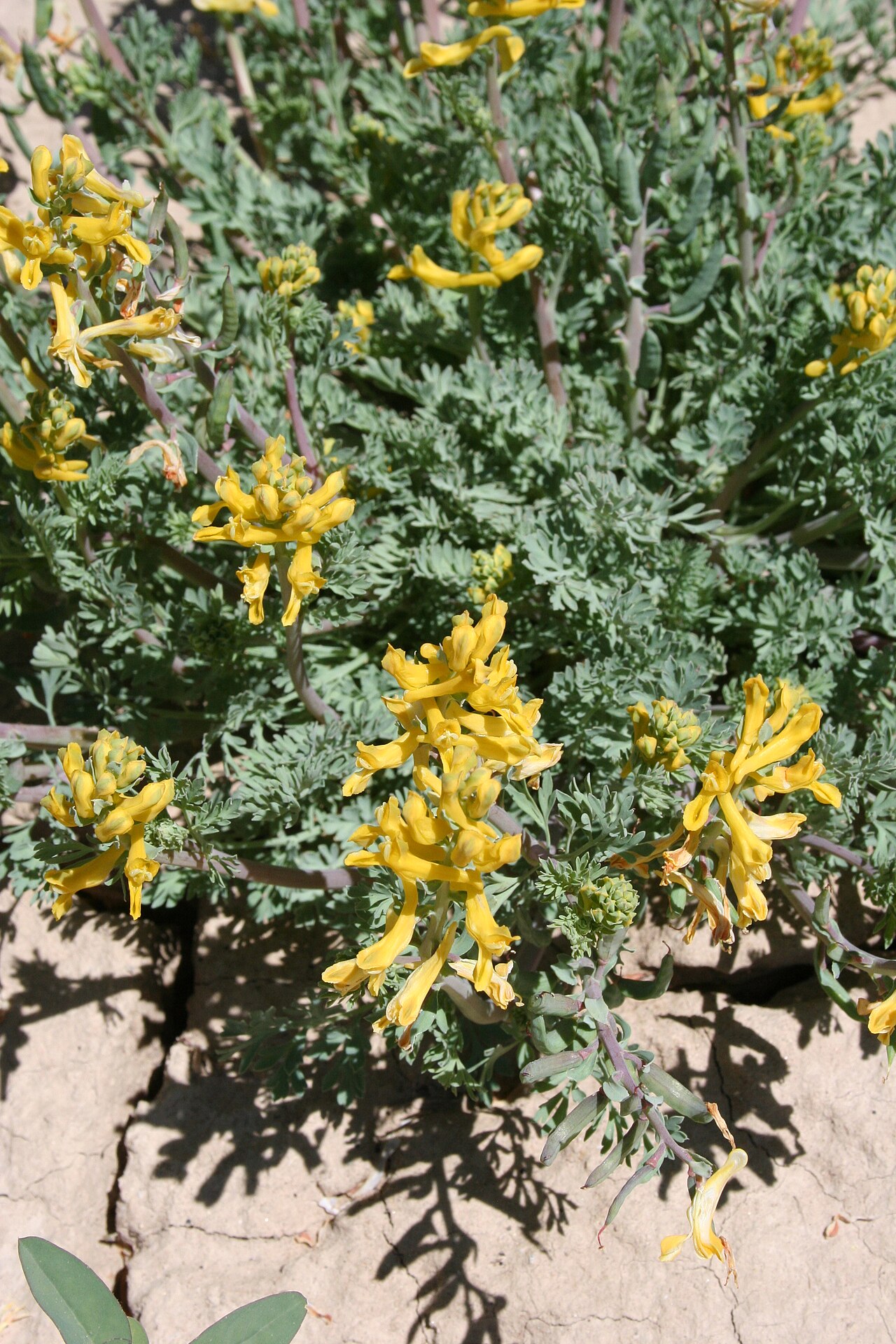
Corydalis aurea, known as Golden Corydalis, is a low, sprawling native wildflower of the poppy family (Papaveraceae, often placed in the fumitory family, Fumariaceae). It is also called scrambled eggs, the name USDA PLANTS uses, and golden smoke. It is an annual or short-lived biennial that grows from a slender taproot into a loose mound of lacy, blue-green leaves, 6 to 16 inches long, topped in spring and early summer with short clusters of bright yellow, spurred flowers.
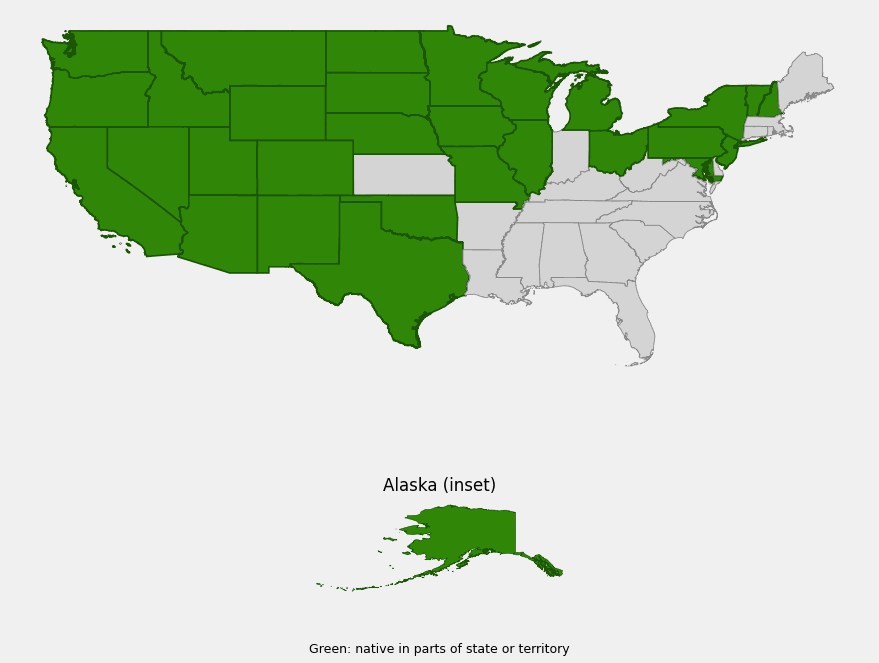
Golden corydalis has one of the widest ranges of any North American corydalis. It grows from Alaska and western Canada south through the Rocky Mountains, Great Basin and Southwest into Mexico, east across the northern Great Plains to the Great Lakes, and in scattered, rare populations as far east as New England and the mid-Atlantic. It is a classic plant of gravelly slopes, rock outcrops, sandy washes, stream banks and recently burned or disturbed ground.
Safety note: all parts of golden corydalis contain isoquinoline alkaloids, and the plant has been reported to poison sheep and cattle that eat it in quantity. Do not eat any part of it or use it as a home remedy, and keep it away from children, pets and grazing livestock.
Identification
Look for a low, sprawling plant with finely cut, blue-green to gray-green leaves and short spikes of yellow, tubular flowers, each with a short spur at the back, followed by slender, curved seed pods.
Growth Habit
Golden corydalis is a winter or spring annual, sometimes biennial, with several weak stems that lie on the ground or lean on rocks and other plants, reaching about 6 to 16 inches long. The whole plant is smooth and has a whitish, waxy bloom that gives it a soft blue-green color. Plants are often scattered, but they can carpet the ground after a fire or soil disturbance.
Leaves
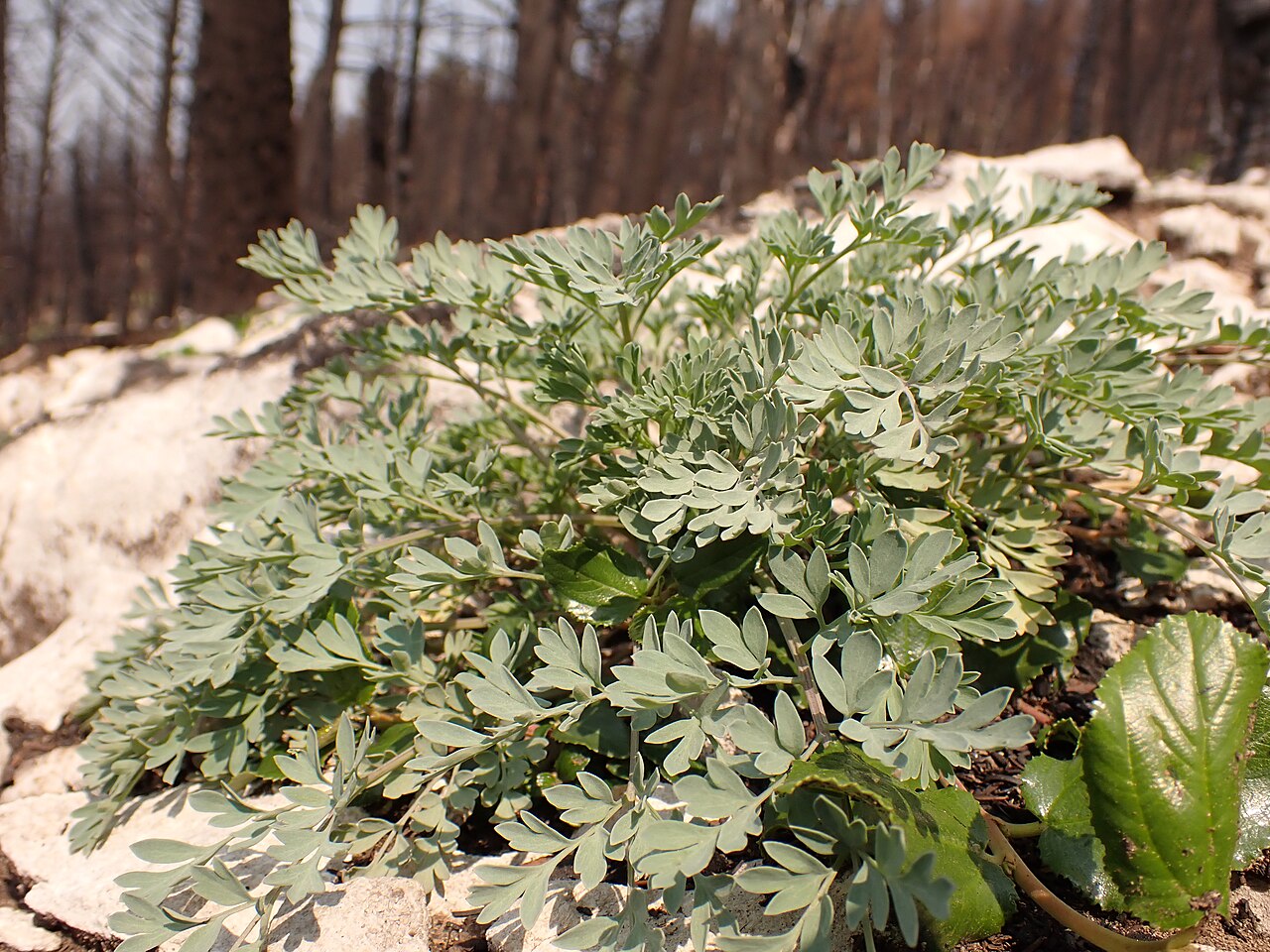
The leaves are alternate and finely divided two or three times into small, oval to wedge-shaped lobes, giving them a lacy, almost fern-like look. They are blue-green to gray-green and smooth. Basal leaves are on long stalks, and the stem leaves become smaller upward.
Flowers
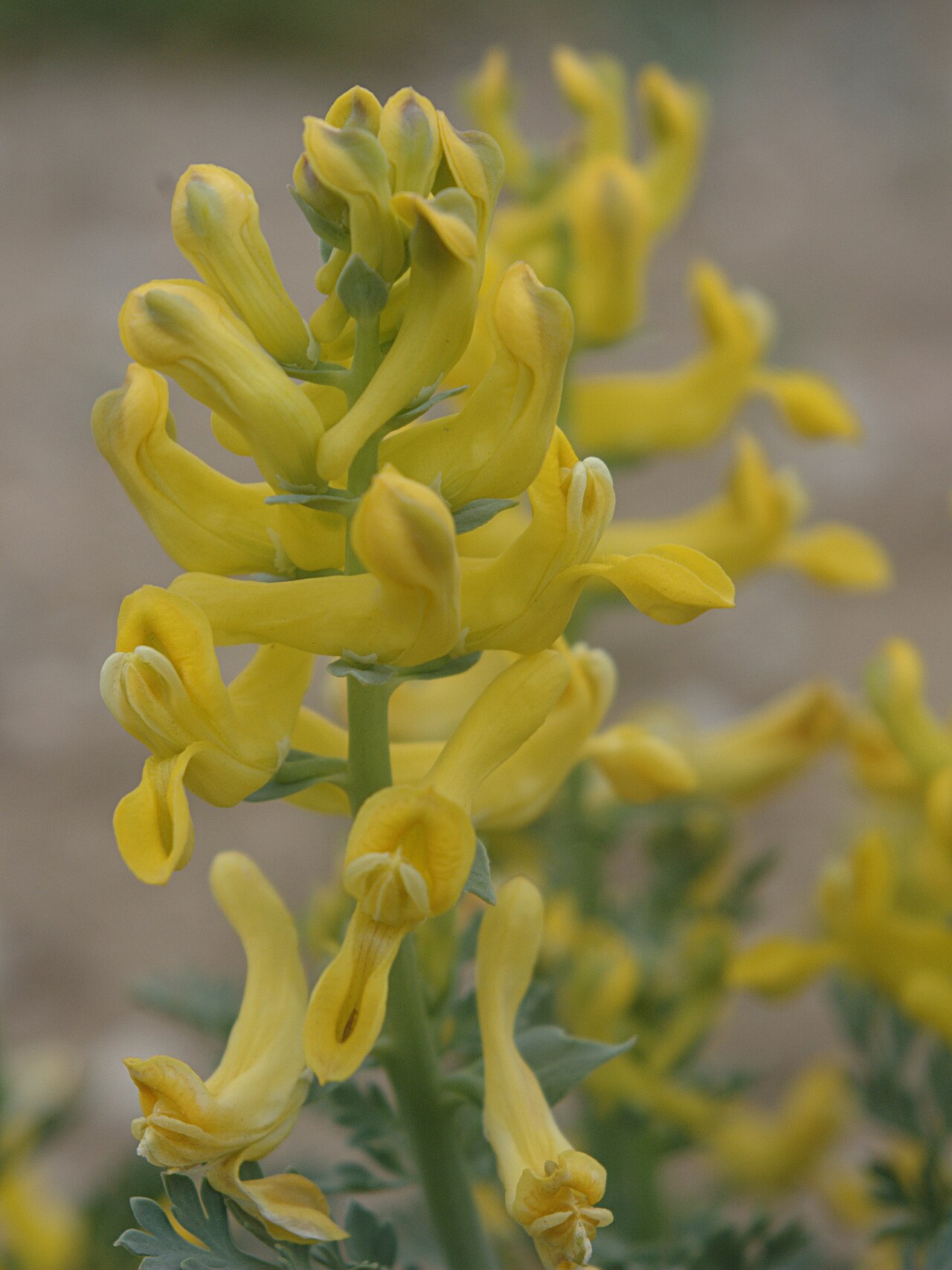
Bright yellow flowers, about 1/2 to 3/4 inch long, grow in short racemes of up to about 30. Each flower is tubular and two-lipped, with four petals; the upper petal ends in a short, rounded spur at the back, and the petal tips at the front are crested and slightly flared. In subspecies aurea the racemes are often shorter than the leaves. Subspecies occidentalis, more common in the Southwest and southern Plains, has larger flowers in racemes that stand above the leaves. Flowering runs from late winter in the desert Southwest to summer in the mountains and the North.
Seed Pods
The fruit is a narrow capsule, roughly 3/4 to 1 1/4 inches long, that often curves upward like a little bean pod. It splits open to release shiny black seeds, each with a small fleshy appendage (elaiosome) that attracts ants.
Look-alikes
Yellow corydalis (Corydalis flavula), of eastern woodlands, has smaller, paler yellow flowers with a toothed crest on the outer petal. Slender fumewort (C. micrantha) of the Plains has smaller flowers and straighter pods. Rock harlequin (C. sempervirens) is taller and more upright, with pink flowers tipped in yellow. Golden corydalis is also related to Dutchman’s breeches and golden eardrops, which share the finely cut, blue-green leaves.
Quick Facts
| Scientific Name | Corydalis aurea |
| Family | Papaveraceae (poppy family; formerly Fumariaceae) |
| Plant Type | Annual or biennial wildflower |
| Mature Height | 6–16 in (sprawling stems) |
| Mature Spread | 6–18 in |
| Growth Rate | Fast |
| Sun Exposure | Full sun to part shade |
| Water Needs | Low to medium; well drained |
| Soil Type | Gravelly, sandy or rocky soil; disturbed ground |
| Soil pH | Slightly acidic to alkaline (about 6.0–8.0) |
| Bloom Time | February–August, depending on elevation and latitude |
| Flower Color | Bright yellow |
| Fall Color | None; plants die after setting seed |
| Fruit | Slender, curved capsules with shiny black seeds |
| Deer Resistant | Yes; toxic alkaloids |
| USDA Hardiness Zones | 3–9 (grows as an annual) |
Native Range
Golden corydalis ranges across much of North America. USDA PLANTS records it as native in 30 states, including Alaska, and in Alberta, British Columbia, Saskatchewan and Ontario in Canada. It also extends south into Mexico. Its core range is the interior West: the Rocky Mountains from Montana and Idaho to Colorado and New Mexico, the Great Basin, the Colorado Plateau, the mountains of Arizona and West Texas, and the drier interior of eastern Oregon and Washington and northeastern California. In Oregon and Washington it grows mainly east of the Cascades.
It continues east across the northern Great Plains, including the Black Hills and badlands of the Dakotas, Nebraska and Oklahoma, to the Upper Midwest and Great Lakes, where it grows on sandy and rocky ground in Minnesota, Wisconsin, Michigan, Iowa, Illinois and Missouri. East of there it is rare and scattered. Records from New York, Pennsylvania, Ohio, Maryland, New Jersey, Vermont and New Hampshire are outlying populations on cliffs, ledges, lakeshore headlands and rocky slopes. NatureServe ranks it as imperiled or critically imperiled in several of these states, and in New Hampshire it is known mainly from historical records.
Typical habitats include gravelly hillsides and talus, rock outcrops and ledges, sandy flats and washes, river and creek bottoms under trees, open ponderosa pine and aspen woods, sagebrush, and especially recently burned, logged or otherwise disturbed soil. It grows from low river valleys on the Plains to high mountain slopes in the Rockies and Great Basin ranges.
📋 Regional plant lists featuring Golden Corydalis: New York, Pennsylvania & Northern New Jersey · Idaho, Eastern Oregon & Eastern Washington · Ohio & Indiana · Montana & Wyoming · Michigan, Wisconsin & Eastern Minnesota · Nebraska, Kansas & Eastern Colorado · Utah & Western Colorado · New Hampshire, Maine & Vermont · Maryland, Virginia & West Virginia · Delaware, Southern New Jersey & Long Island · Arizona & New Mexico · Illinois, Iowa & Missouri · Alaska · South & West Texas · North Dakota, South Dakota & Western Minnesota · California & Nevada
Growing & Care Guide
Golden corydalis is an easy, self-sowing annual for dry, gravelly spots, but it is rarely sold by nurseries. If you grow it, start from seed or from a few seedlings shared by another gardener, and never dig plants from the wild, especially in the eastern states where it is rare. Because the plant is toxic, site it away from play areas and grazing animals.
Light
Full sun to part shade. In hot, low-elevation gardens it appreciates some afternoon shade; in the mountains and the North it does well in full sun.
Soil & Water
Grow it in well-drained, gravelly, sandy or rocky soil. It tolerates poor, disturbed soil and does not need fertilizer. Keep the soil lightly moist while plants are growing and flowering in spring; it needs little water afterward, since plants die back once they have set seed.
Planting Tips
Scatter fresh seed in fall or early winter on bare, gravelly soil in a rock garden, at the edge of a path, in a crevice or along a dry wall. It looks best in drifts among rocks, bunchgrasses and other small wildflowers, where its blue-green foliage contrasts with darker leaves.
Pruning & Maintenance
No pruning is needed. Let plants set seed if you want them to return the next year, then pull the dried stems. Wear gloves when handling large amounts of the plant if you have sensitive skin, and wash your hands afterward.
Propagation
Grow it from seed. The seeds do best sown soon after they ripen, since they can lose viability if stored dry for a long time, and they need a period of cold, moist conditions over winter before they sprout in spring. Once established, plants usually self-sow, helped by ants that carry the seeds away.
Landscape Uses
- Rock gardens: lacy blue-green foliage and yellow flowers among stones
- Dry walls and crevices: grows in gravelly pockets and along wall bases
- Post-fire and disturbed-site plantings: a native pioneer for bare, gravelly ground
- Early spring color: one of the first yellow wildflowers in many western gardens
- Naturalistic gardens: self-sows lightly among bunchgrasses and small perennials
Wildlife & Ecological Value
Golden corydalis is a pioneer that colonizes bare ground quickly and supports early-season insects.
For Pollinators
The flowers are pollinated mainly by bees, especially bumble bees, which are strong enough to push into the tubular flowers to reach the nectar in the spur. Some bees “rob” the nectar by biting through the spur without pollinating the flower.
For Birds
It is not a significant bird food plant, though the insects it supports and the seeds that drop to the ground may be eaten by ground-foraging birds.
For Mammals
Because of its alkaloids, most wild mammals avoid it, and deer seldom browse it. Livestock poisoning has been reported, usually when hungry sheep or cattle eat large amounts where little else is growing.
Ecosystem Role
Ants collect the seeds for their fleshy elaiosomes and carry them back to their nests, spreading and planting them. Seeds can persist in the soil and sprout in large numbers after fire, logging or other disturbance, so golden corydalis is often one of the first plants to cover bare ground and help hold soil on burned slopes.
Cultural & Historical Uses
The genus name Corydalis comes from the Greek korydalis, “crested lark,” because the spurred flower was thought to resemble the crest or spur of a lark. The species name aurea means “golden.” The common name scrambled eggs refers to the jumbled masses of bright yellow flowers.
Several Indigenous peoples of western North America reportedly used golden corydalis in small amounts as a medicine, for example in teas for pain, stomach complaints and sore throats, or by inhaling the smoke. Because the plant contains toxic alkaloids, it should never be used as a home remedy.
Golden corydalis is a good example of a “fire follower.” After a wildfire, seeds stored in the soil can sprout in large numbers, painting burned slopes yellow for a season or two until longer-lived plants return.
Frequently Asked Questions
Is golden corydalis poisonous?
Yes. It contains isoquinoline alkaloids and has been reported to poison sheep and cattle. Do not eat any part of it, and keep it away from children, pets and livestock.
Why is golden corydalis called scrambled eggs?
The name refers to its clusters of bright yellow, tubular flowers, which look like a jumble of scrambled egg. USDA PLANTS uses scrambled eggs as its common name.
Is golden corydalis an annual or a perennial?
It is an annual or short-lived biennial. Plants die after setting seed, but they usually come back from self-sown seed.
Where can I buy golden corydalis?
It is rarely sold. Look for seed from native seed suppliers in the West, or collect a small amount of seed responsibly where it is common and permitted. Never dig wild plants.
Does golden corydalis grow after fires?
Yes. Its seeds can survive in the soil and germinate in large numbers on burned or disturbed ground, making it one of the early wildflowers on recovering burns.

Looking for a nursery that carries Golden Corydalis?
Browse our native plant nursery directory: Alaska & Arizona · California · Colorado · Idaho, Illinois & Iowa · Maryland, Michigan, Minnesota, Missouri & Montana · Nebraska, Nevada, New Hampshire, New Jersey, New Mexico, New York, North Dakota, Ohio & Oklahoma · Oregon · Pennsylvania, South Dakota, Texas, Utah & Vermont · Washington · Wisconsin & Wyoming
