
Field Chickweed (Cerastium arvense)
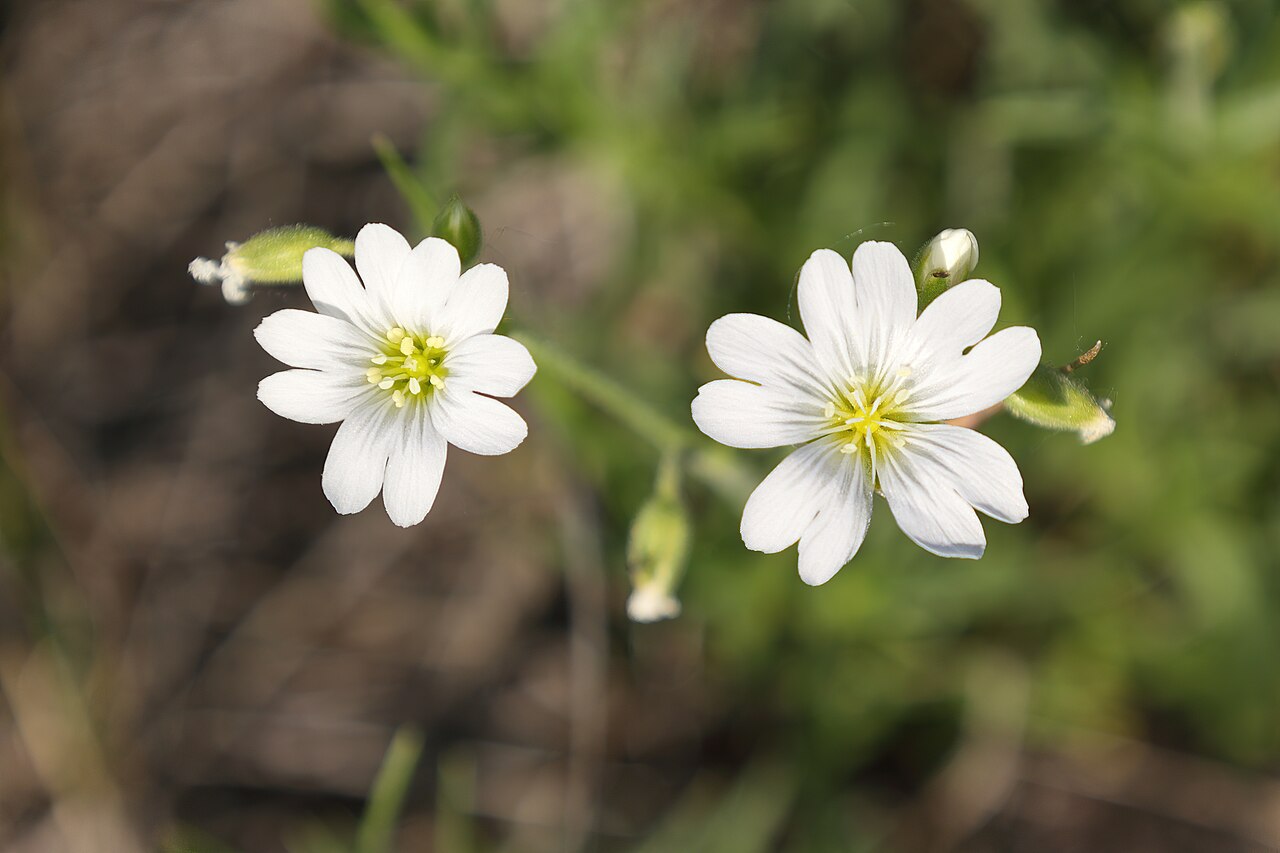
Cerastium arvense, known as Field Chickweed (also field mouse-ear chickweed), is a low, mat-forming perennial in the pink family (Caryophyllaceae). In spring and early summer it covers itself with bright white, five-petaled flowers about 1/2 to 3/4 inch across, each petal deeply notched at the tip. It is much showier than the weedy annual chickweeds of lawns and gardens, and it grows wild across much of North America, Europe and Asia.
The species has a native and a non-native form in North America. The native plant is subspecies strictum (sometimes treated as a separate species, Cerastium strictum, American field chickweed). It grows in prairies, rocky slopes, cliffs, mountain meadows and alpine tundra from Alaska and Canada south through the West and Midwest, and on rocky outcrops and coastal headlands in the East. The European subspecies arvense was introduced to eastern North America and grows mostly in lawns, roadsides, cemeteries and other disturbed places.
For gardeners, native field chickweed is a tough, cheerful groundcover for rock gardens, dry slopes and prairie edges. It needs sun and good drainage, tolerates drought and cold, and blooms early, when pollinators need flowers.
Identification
Look for loose mats of narrow, opposite leaves and upright stems topped by a few white flowers with five deeply notched petals that are about twice as long as the sepals.
Growth Habit
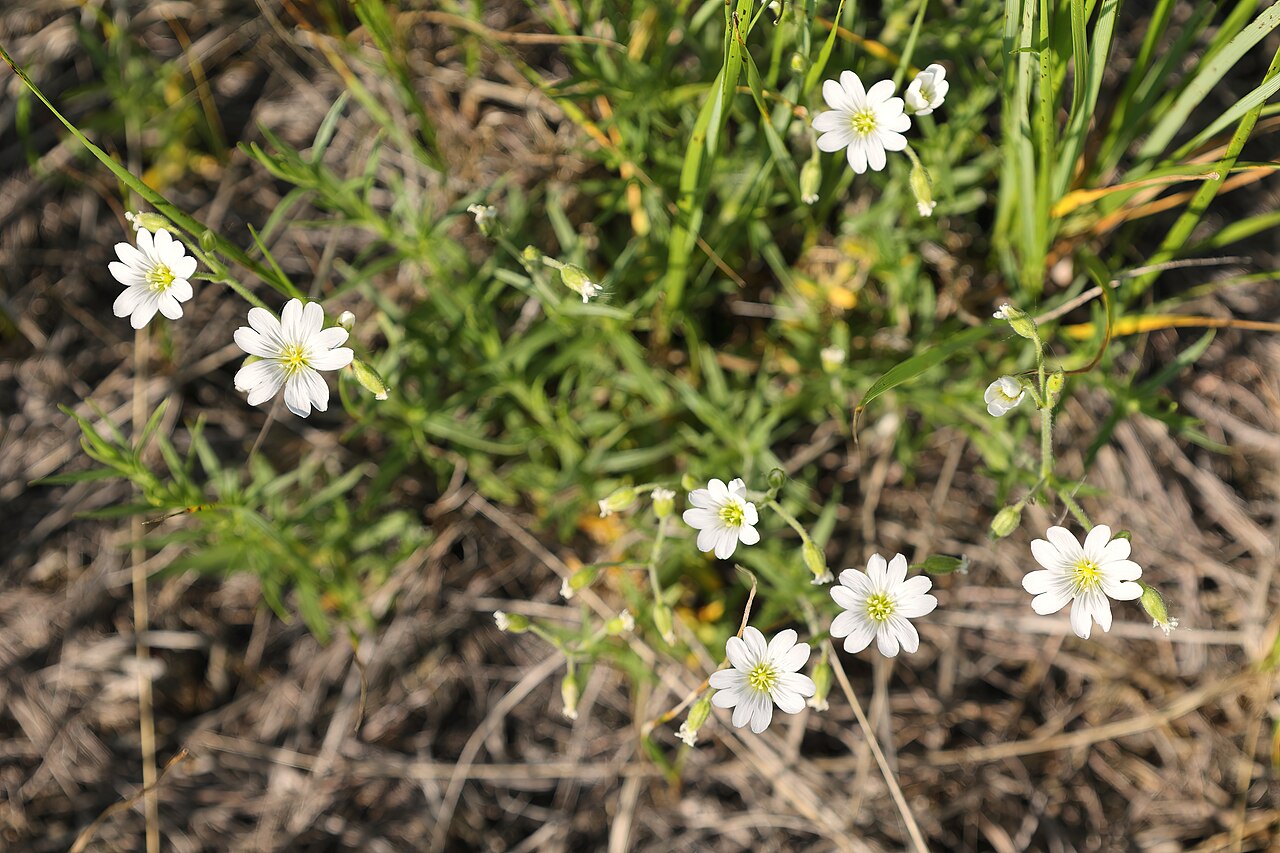
Field chickweed forms low mats or loose tufts from creeping, rooting stems. The flowering stems are upright, 4 to 12 inches tall (rarely more), and usually covered with short, often sticky hairs. Tufts of small leaves often grow in the leaf axils of the lower stems.
Leaves
The leaves are opposite, stalkless and narrow, linear to lance-shaped, about 1/2 to 1 1/2 inches long, with smooth edges. They are green to grayish green and usually finely hairy. Unlike annual weedy chickweeds, plants stay green and leafy near the ground through much of the year.
Flowers
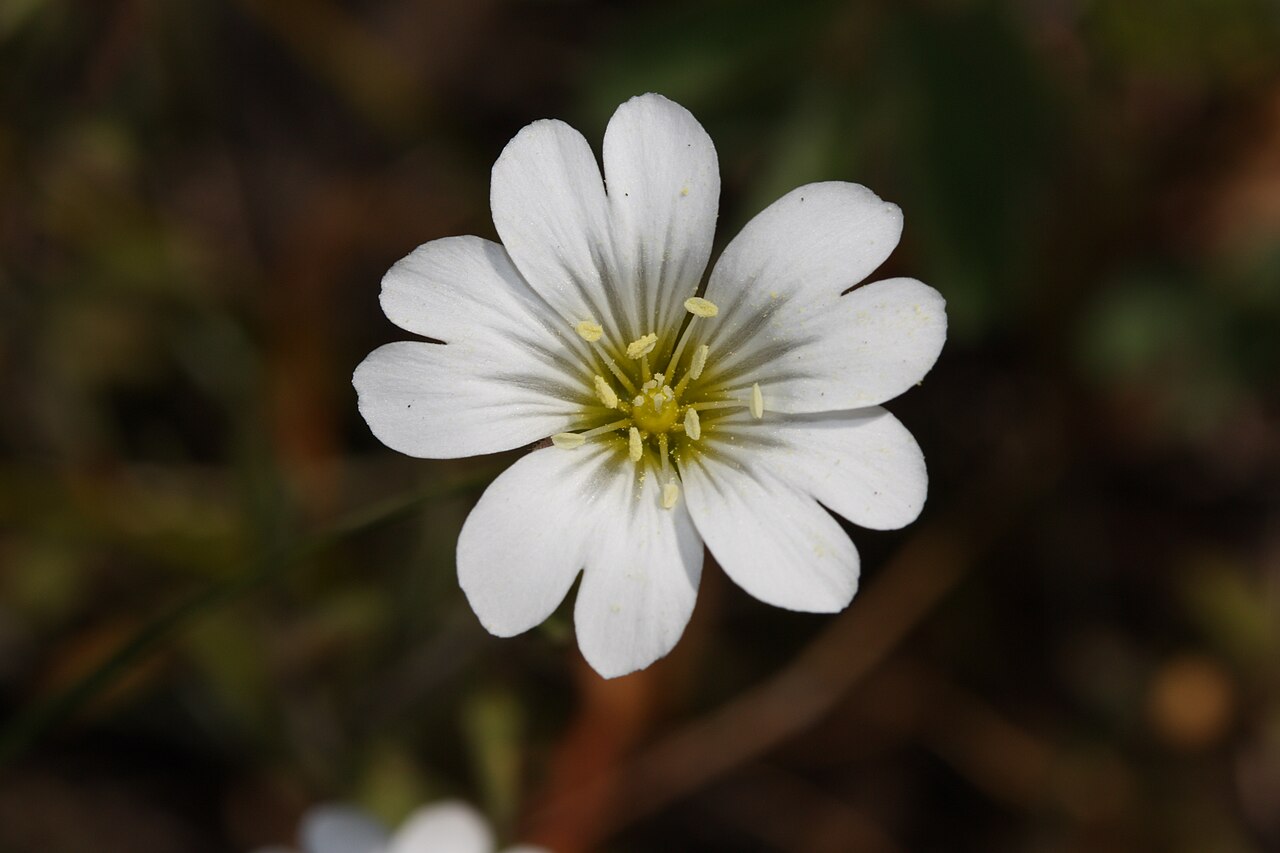
Flowers are borne in loose clusters of one to several at the stem tips. Each is 1/2 to 3/4 inch across, with five white petals that are split about a quarter to a third of their length into two lobes, giving the look of ten petals. The petals are about twice as long as the five green, hairy sepals and have faint, fine veins. There are ten stamens with yellow anthers and five styles. Bloom time is April to July, later at high elevations.
Fruit
The fruit is a small, cylindrical capsule that extends slightly beyond the sepals and opens at the tip by ten small teeth, releasing tiny, brown, bumpy seeds.
Native or Introduced?
The two subspecies look very similar. In general, native subspecies strictum grows in natural, undisturbed habitats such as rocky outcrops, cliffs, high-pH and serpentine barrens, prairies and mountain meadows, while European subspecies arvense has somewhat larger petals and longer flowering stems and grows mostly in human-disturbed places in the Northeast. Go Botany (Native Plant Trust) treats the native plant as Cerastium strictum in New England.
Look-alikes
Common mouse-ear chickweed (Cerastium fontanum) and common chickweed (Stellaria media) are weedy, non-native plants with much smaller flowers whose petals are no longer than the sepals. Snow-in-summer (Cerastium tomentosum) is a European garden plant with silvery-white, woolly leaves that sometimes escapes. Native star chickweed (Stellaria pubera) grows in eastern woodlands and has broader leaves and petals split nearly to the base.
Quick Facts
| Scientific Name | Cerastium arvense |
| Family | Caryophyllaceae (pink family) |
| Plant Type | Low, mat-forming herbaceous perennial |
| Mature Height | 4–12 in |
| Mature Spread | 6–18 in |
| Growth Rate | Moderate |
| Sun Exposure | Full sun to part shade |
| Water Needs | Low to medium; drought tolerant |
| Soil Type | Well-drained sandy, gravelly or rocky soil |
| Soil pH | Acidic to alkaline (about 5.5–8.0) |
| Bloom Time | April–July; later at high elevations |
| Flower Color | White |
| Fall Color | None; foliage often semi-evergreen |
| Fruit | Small cylindrical capsule |
| Deer Resistant | Moderately; rarely browsed heavily |
| USDA Hardiness Zones | 3–8 |
Native Range
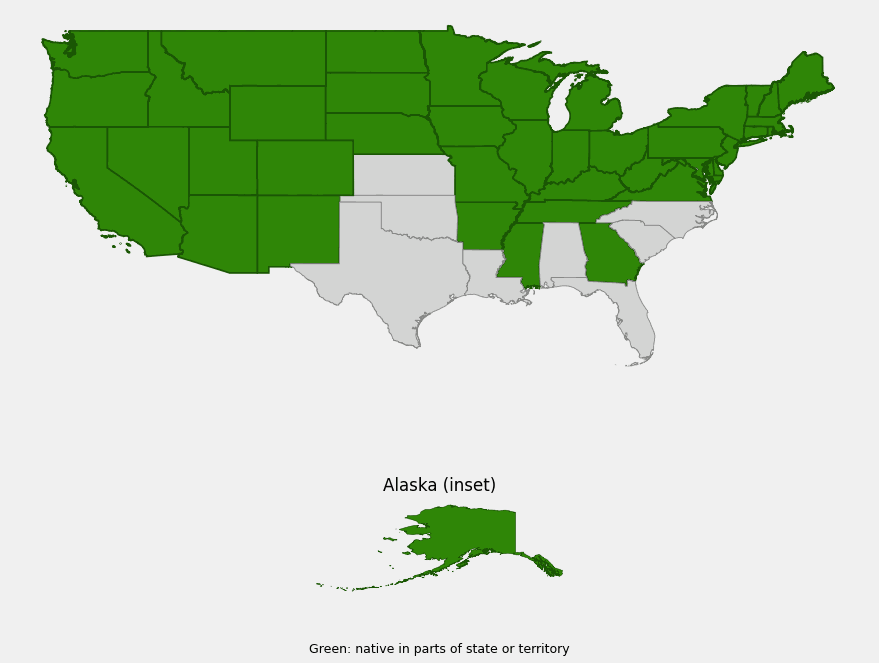
Field chickweed is native across much of the Northern Hemisphere and also grows in South America. USDA PLANTS lists it as native in 40 of the lower 48 states and in Alaska. In Canada it grows from British Columbia and Yukon east across the Prairie Provinces to Ontario, Quebec and the Atlantic provinces, and north into the Arctic.
The native subspecies strictum is most common in the West and on the northern Great Plains: in Alaska, the Rocky Mountains, the Pacific Northwest (including prairies, bluffs and coastal headlands west of the Cascades), the Great Basin mountains, northern California, northern Arizona and New Mexico, and the prairies of the Dakotas, Nebraska and Minnesota. In the Midwest and East it is scattered on rocky outcrops, cliffs, sandy and gravelly prairies, limestone and serpentine barrens and coastal headlands. Records in the Southeast, such as Georgia, Mississippi and Arkansas, are rare and local.
European subspecies arvense also grows in eastern North America, especially the Northeast, in lawns, fields, roadsides and other disturbed ground, so not every eastern plant is native. Native plants are found mostly in natural, open habitats from sea level to alpine tundra.
📋 Regional plant lists featuring Field Chickweed: New York, Pennsylvania & Northern New Jersey · Idaho, Eastern Oregon & Eastern Washington · Ohio & Indiana · Montana & Wyoming · Michigan, Wisconsin & Eastern Minnesota · Kentucky & Tennessee · Nebraska, Kansas & Eastern Colorado · Utah & Western Colorado · Connecticut, Massachusetts & Rhode Island · New Hampshire, Maine & Vermont · Maryland, Virginia & West Virginia · Delaware, Southern New Jersey & Long Island · Arizona & New Mexico · Illinois, Iowa & Missouri · Alabama, Georgia & Mississippi · Alaska · Arkansas, Louisiana, Eastern Oklahoma & Eastern Texas · North Dakota, South Dakota & Western Minnesota · Western Oregon & Western Washington · California & Nevada
Growing & Care Guide
Native field chickweed is an easy, low-maintenance groundcover for sunny, well-drained sites. When buying it, look for native seed or plants of North American origin (often sold as Cerastium arvense subsp. strictum or C. strictum), not the European form or the related snow-in-summer.
Light
Full sun is best for compact growth and heavy bloom. It tolerates light or part shade, especially in hot, dry climates.
Soil & Water
Plant it in sandy, gravelly or rocky soil with good drainage. It tolerates poor, thin soils and a wide range of pH. Water during the first season; after that it needs little or no watering except in long droughts. Avoid wet, heavy soil, where the crowns can rot.
Planting Tips
Plant in spring or early fall, 8 to 12 inches apart, to form a loose mat. It is well suited to rock gardens, the edges of dry paths, gaps in stone walls and the front of prairie plantings. Pair it with low prairie and rock-garden plants that bloom at the same time.
Pruning & Maintenance
Shear the plants lightly after bloom to tidy them and encourage compact growth. It spreads by rooting stems but is not aggressive in most gardens. Divide old, open clumps every few years.
Propagation
Grow it from seed sown in fall or spring on the soil surface, or from stem cuttings taken in late spring. Rooted pieces from the edge of a mat can be dug and replanted in spring or fall.
Landscape Uses
- Rock gardens: a bright white mat for gritty, sunny pockets
- Groundcover: a low, native alternative to snow-in-summer on dry slopes
- Prairie edges: early white flowers among short grasses
- Pollinator gardens: spring nectar and pollen for small bees and flies
- Wall and path plantings: grows in gaps between stones
Wildlife & Ecological Value
Native field chickweed is a small but useful plant in grasslands, rocky habitats and mountain meadows.
For Pollinators
The open, white flowers provide easily reached nectar and pollen for small native bees, syrphid flies and other flies, and small butterflies, from early spring into summer.
For Birds
Small seed-eating birds eat the seeds, and the low mats provide cover for insects that birds feed on.
For Mammals
Rabbits, pikas, ground squirrels and other small mammals nibble the foliage. Elk and deer graze it lightly in mountain meadows.
Ecosystem Role
Its mats help hold soil on rocky slopes and in thin prairie soils. It is one of the first flowers to bloom in many grasslands and alpine areas, supporting early-season insects.
Cultural & Historical Uses
The genus name Cerastium comes from the Greek word for “horn,” describing the shape of the seed capsules of some species. The species name arvense means “of the fields.” The name “mouse-ear chickweed” refers to the small, hairy leaves of many species in the genus.
The native and European forms of field chickweed have been classified in different ways. Many botanists now treat the native North American plant as subspecies strictum or as its own species, Cerastium strictum, while USDA PLANTS keeps it under Cerastium arvense. The exact range of the native form in the East is still being worked out.
Unlike its weedy relatives, field chickweed is rarely a problem in gardens. It is an attractive, long-lived wildflower and has been planted in rock gardens in Europe and North America for a long time.
Frequently Asked Questions
Is field chickweed a weed?
Not the native form. It is a long-lived wildflower of prairies, rocky slopes and mountain meadows. The weedy chickweeds of lawns are different species, and the introduced European subspecies of field chickweed grows mostly in disturbed areas.
How can I tell native field chickweed from the European form?
It is difficult. The European form tends to have larger petals and taller flowering stems and grows in lawns and roadsides. Native plants grow mostly in natural habitats such as rocky outcrops, barrens and prairies.
Is field chickweed related to snow-in-summer?
Yes. Snow-in-summer (Cerastium tomentosum) is a European species in the same genus, with silvery, woolly leaves. Native field chickweed is a good substitute.
Does field chickweed tolerate drought?
Yes. Once established, it handles dry, rocky, sunny conditions well. It dislikes poor drainage more than drought.
When does field chickweed bloom?
From April to July in most areas, with the main flush in spring. At high elevations it blooms in summer.

Looking for a nursery that carries Field Chickweed?
Browse our native plant nursery directory: Alaska, Arizona & Arkansas · California · Colorado, Connecticut, Delaware & Georgia · Idaho, Illinois, Indiana & Iowa · Kentucky, Maine, Maryland, Massachusetts, Michigan, Minnesota, Mississippi, Missouri & Montana · Nebraska, Nevada, New Hampshire, New Jersey, New Mexico, New York, North Dakota & Ohio · Oregon · Pennsylvania, Rhode Island, South Dakota, Tennessee, Utah, Vermont & Virginia · Washington · West Virginia, Wisconsin & Wyoming

