
Tufted Loosestrife (Lysimachia thyrsiflora)
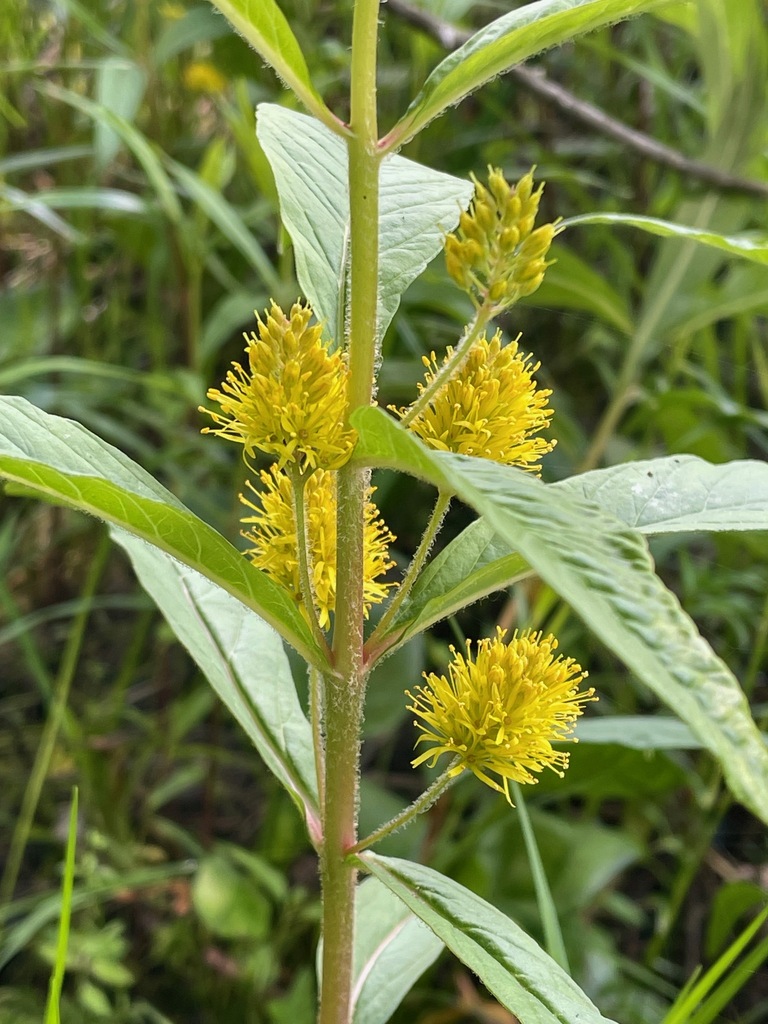
Lysimachia thyrsiflora, known as Tufted Loosestrife, is a native wetland perennial in the primrose family (Primulaceae; sometimes placed in the Myrsinaceae). It grows in marshes, fens, bogs, swamps and shallow water across the northern United States, Alaska and nearly all of Canada, and also in northern Europe and Asia. Its upright stems carry pairs of narrow leaves and, in late spring and early summer, round, fluffy clusters of small yellow flowers on short stalks in the middle leaf axils.
It is sometimes listed under the older name Naumburgia thyrsiflora. It is not related to the invasive purple loosestrife (Lythrum salicaria), a non-native plant with tall spikes of magenta flowers. Tufted loosestrife is a modest native that belongs in North American wetlands, and it is the plant to choose, not to remove.
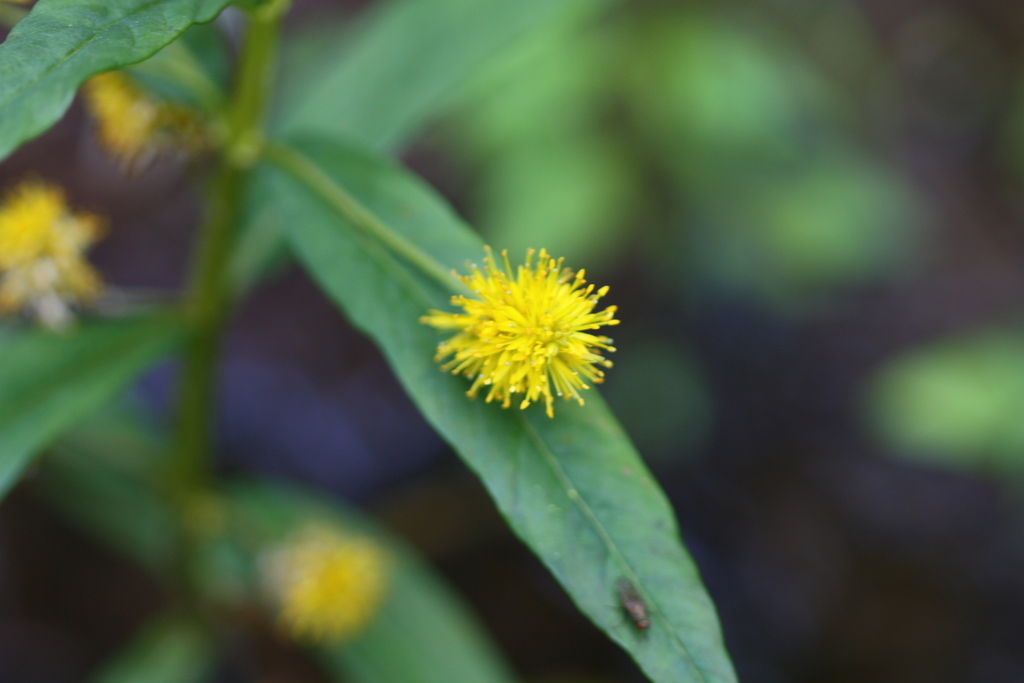
Its unusual flower clusters, which look like small yellow pom-poms tucked among the leaves, make it easy to recognize. It is a good plant for pond margins, rain gardens with standing water and wetland restoration, where it spreads by rhizomes into loose colonies.
Identification
Look for an unbranched wetland stem with pairs of narrow, dotted leaves and round, fluffy clusters of tiny yellow flowers growing from the leaf axils halfway up the stem.
Growth Habit
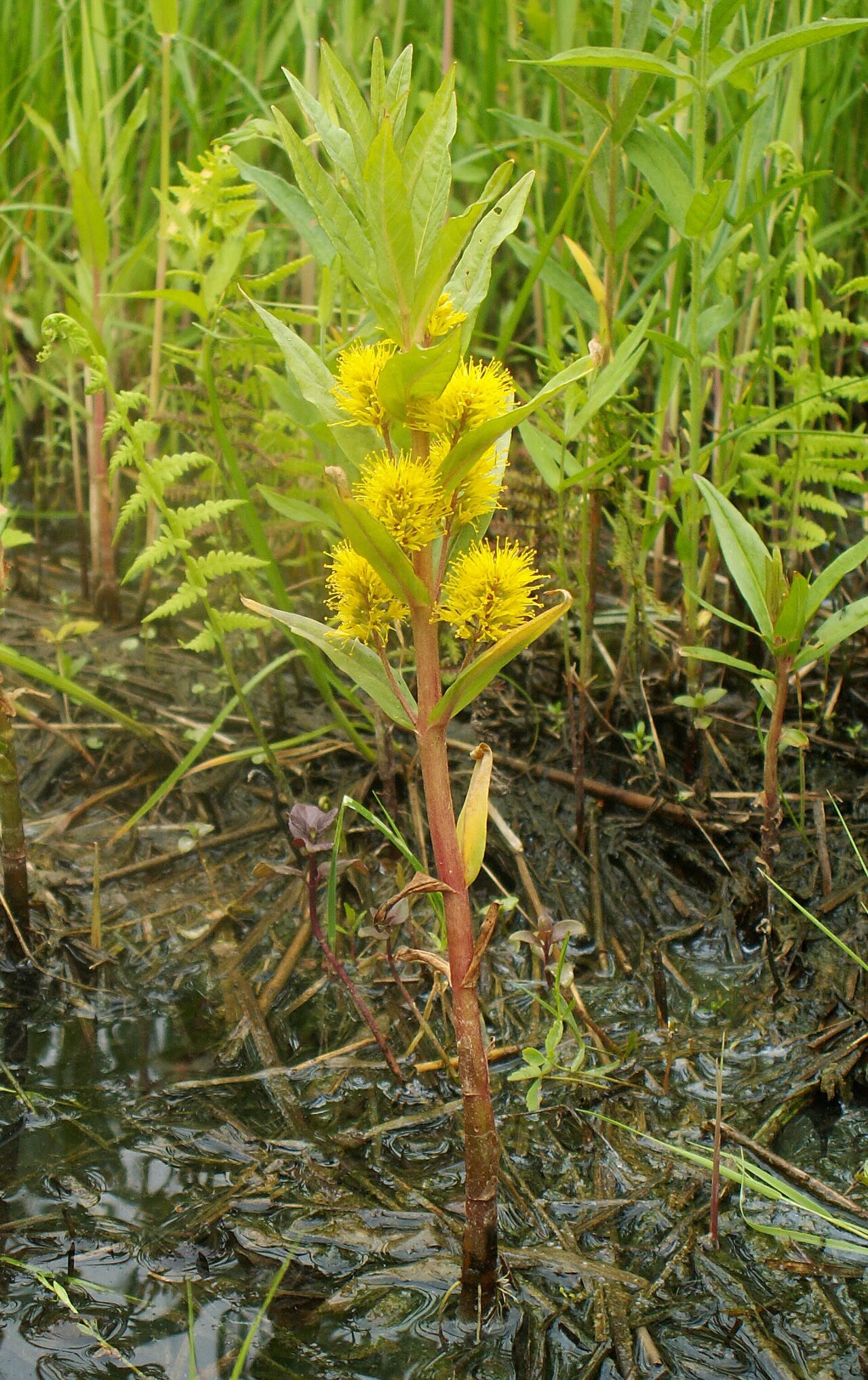
An erect, usually unbranched perennial 1 to 2 1/2 feet tall, spreading by long, creeping rhizomes into loose colonies. The lowest leaves on the stem are reduced to small scales. Plants often stand in shallow water or saturated mud.
Leaves
The leaves are opposite (occasionally in threes), stalkless, narrowly lance-shaped and 2 to 5 inches long, with smooth edges. They are sprinkled with tiny dark glandular dots, visible when held up to the light, and may be finely hairy beneath.
Flowers
The flowers grow in dense, short-stalked, rounded or slightly elongated clusters about 1/2 to 1 inch long, from the axils of the middle leaves, while the top of the stem continues with leaves only. Each small yellow flower has five to seven very narrow petals, often dotted with purple or black, and long stamens that stick out well past the petals, giving the clusters a fuzzy look. Flowering is in late spring and early summer, mostly May to July.
Fruit
The fruit is a small, round capsule with a few seeds. Many colonies spread mostly by rhizomes and set relatively little seed.
Look-alikes
Swamp candles (Lysimachia terrestris) has a single spike of star-shaped yellow flowers with red markings at the top of the stem. The two species sometimes hybridize, producing intermediate plants (Lysimachia × commixta). Fringed loosestrife has larger, nodding, open yellow flowers and fringed leaf stalks. Purple loosestrife (Lythrum salicaria) and native winged loosestrife have pink to purple flowers and belong to a different family.
Quick Facts
| Scientific Name | Lysimachia thyrsiflora (syn. Naumburgia thyrsiflora) |
| Family | Primulaceae (primrose family) |
| Plant Type | Rhizomatous wetland perennial |
| Mature Height | 1–2.5 ft |
| Mature Spread | 1–3 ft; spreads by rhizomes |
| Growth Rate | Moderate |
| Sun Exposure | Full sun to part shade |
| Water Needs | High; wet soil or shallow water |
| Soil Type | Muck, peat, wet loam or sand |
| Soil pH | Acidic to neutral (about 5.0–7.5) |
| Bloom Time | May–July |
| Flower Color | Yellow |
| Fall Color | None notable; leaves yellow |
| Fruit | Small round capsule |
| Deer Resistant | Moderately; seldom heavily browsed |
| USDA Hardiness Zones | 2–7 |
Native Range
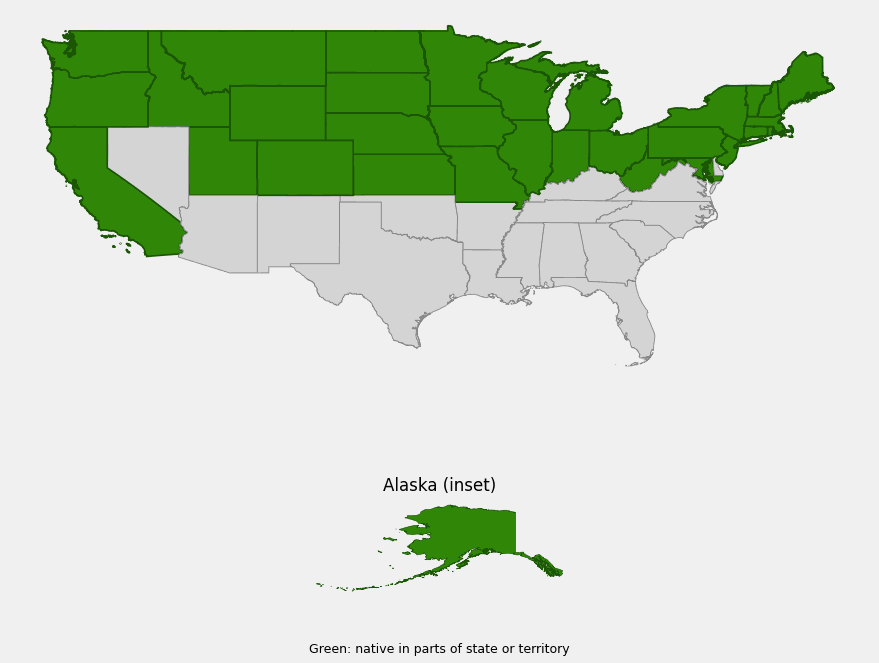
Tufted loosestrife is circumboreal, growing across northern North America, Europe and Asia. USDA PLANTS lists it as native in Alaska, Canada and the lower 48 states, where it ranges across the northern tier of states from New England and New York west through the Great Lakes and northern Great Plains to the Rocky Mountains and the Pacific Northwest. In Canada it is found in every province and in Yukon and the Northwest Territories.
Its range reaches south to northern California, Utah and Colorado in the West, and to Nebraska, Missouri, Illinois, Indiana, Ohio, West Virginia, Maryland and New Jersey in the East. Records near the southern edge, such as those from Kansas, Missouri, West Virginia and Maryland, are scattered and outlying, and the plant is rare in several of these states. It is most common in the glaciated Upper Midwest, the Northeast and Alaska.
It grows in marshes, fens, bogs, wooded swamps, wet meadows and lake, pond and stream margins, often in shallow standing water. In the West it occurs in lowland and mountain wetlands of Washington, including the Puget Sound lowlands, Oregon and northern Idaho, and in wetlands of the northern Great Plains in the Dakotas and western Minnesota.
📋 Regional plant lists featuring Tufted Loosestrife: New York, Pennsylvania & Northern New Jersey · Idaho, Eastern Oregon & Eastern Washington · Ohio & Indiana · Montana & Wyoming · Michigan, Wisconsin & Eastern Minnesota · Nebraska, Kansas & Eastern Colorado · Utah & Western Colorado · Connecticut, Massachusetts & Rhode Island · New Hampshire, Maine & Vermont · Maryland, Virginia & West Virginia · Delaware, Southern New Jersey & Long Island · Illinois, Iowa & Missouri · Alaska · North Dakota, South Dakota & Western Minnesota · Western Oregon & Western Washington · California & Nevada
Growing & Care Guide
Tufted loosestrife is easy to grow wherever the soil stays wet. It is best for pond edges, bog gardens and wetland plantings in cool northern climates.
Light
Full sun to part shade. It flowers best with at least half a day of sun.
Soil & Water
It needs constantly wet soil or shallow water up to about 6 inches deep. Muck, peat and wet sandy or loamy soils all work. It will not tolerate drying out in summer, and it grows poorly in hot, humid southern climates.
Planting Tips
Plant divisions or container plants in spring at the edge of a pond, in a bog garden or in a wet depression. Space plants 1 to 2 feet apart. Because it spreads by rhizomes, it can fill a wet area over a few years; in small water gardens grow it in a submerged pot.
Pruning & Maintenance
Little care is needed. Cut back old stems in late fall or early spring and thin colonies if they spread beyond where you want them.
Propagation
Divide rhizomes in early spring or fall; this is the easiest method. Seed can be sown in fall or given cold, moist treatment for several weeks before spring sowing, and kept constantly moist.
Landscape Uses
- Pond and lake edges: yellow pom-pom flowers at the water line
- Bog and rain gardens: for spots that stay wet or flooded
- Wetland restoration: native marsh and fen plantings in the North
- Shoreline stabilization: rhizomes help bind wet, mucky soil
- Native alternative: a native choice for wet sites instead of non-native loosestrifes
Wildlife & Ecological Value
Tufted loosestrife is a modest but useful plant in northern wetland communities.
For Pollinators
The flowers are visited by small bees, flies and other insects for pollen. Like several other Lysimachia species, its flowers produce little or no nectar, but loosestrife flowers are associated with specialist oil-collecting bees (Macropis) that use floral oils from Lysimachia to provision their nests.
For Birds
Its stems and leaves add cover in marshes used by waterfowl, rails, marsh wrens and other wetland birds.
For Mammals
Muskrats and moose may feed on wetland plants in the same communities. Deer browse it only lightly.
Ecosystem Role
Its rhizomes help hold saturated soils at the edges of lakes, ponds and fens, and it is part of the diverse herbaceous layer of northern marshes and bogs.
Cultural & Historical Uses
The genus name Lysimachia is traditionally linked to Lysimachus, a general of Alexander the Great, who was said to have calmed an ox with a sprig of loosestrife. The English name “loosestrife” is a translation of the Greek, meaning “ending strife.” The species name thyrsiflora means “with flowers in a thyrse,” a compact, branched flower cluster.
The genus Naumburgia, an older name for this species, honored the German botanist Johann Samuel Naumburg. Modern DNA studies have shown that tufted loosestrife belongs within Lysimachia.
Because the word “loosestrife” also appears in the name of the invasive purple loosestrife, native loosestrifes are sometimes pulled by mistake during weed control. Tufted loosestrife has yellow flowers and belongs to a completely different family.
Frequently Asked Questions
Is tufted loosestrife invasive?
No. It is a native North American wetland plant. The invasive species is purple loosestrife (Lythrum salicaria), which has tall magenta flower spikes and is unrelated.
Can tufted loosestrife grow in standing water?
Yes. It grows in saturated soil or shallow water up to about 6 inches deep at the edges of ponds, lakes and marshes.
When does tufted loosestrife bloom?
Mostly from May to July, with round yellow flower clusters in the middle leaf axils.
How is it different from swamp candles?
Swamp candles carries a single spike of star-shaped yellow flowers at the stem tip. Tufted loosestrife has fuzzy, round flower clusters in the leaf axils halfway up the stem.
Does tufted loosestrife spread?
Yes, by creeping rhizomes, forming loose colonies in wet ground. In small ponds grow it in a submerged container.

Looking for a nursery that carries Tufted Loosestrife?
Browse our native plant nursery directory: Alaska · California · Colorado & Connecticut · Idaho, Illinois, Indiana, Iowa & Kansas · Maine, Maryland, Massachusetts, Michigan, Minnesota, Missouri & Montana · Nebraska, New Hampshire, New Jersey, New York, North Dakota & Ohio · Oregon · Pennsylvania, Rhode Island, South Dakota, Utah & Vermont · Washington · West Virginia, Wisconsin & Wyoming

