
Large Twayblade (Liparis liliifolia)
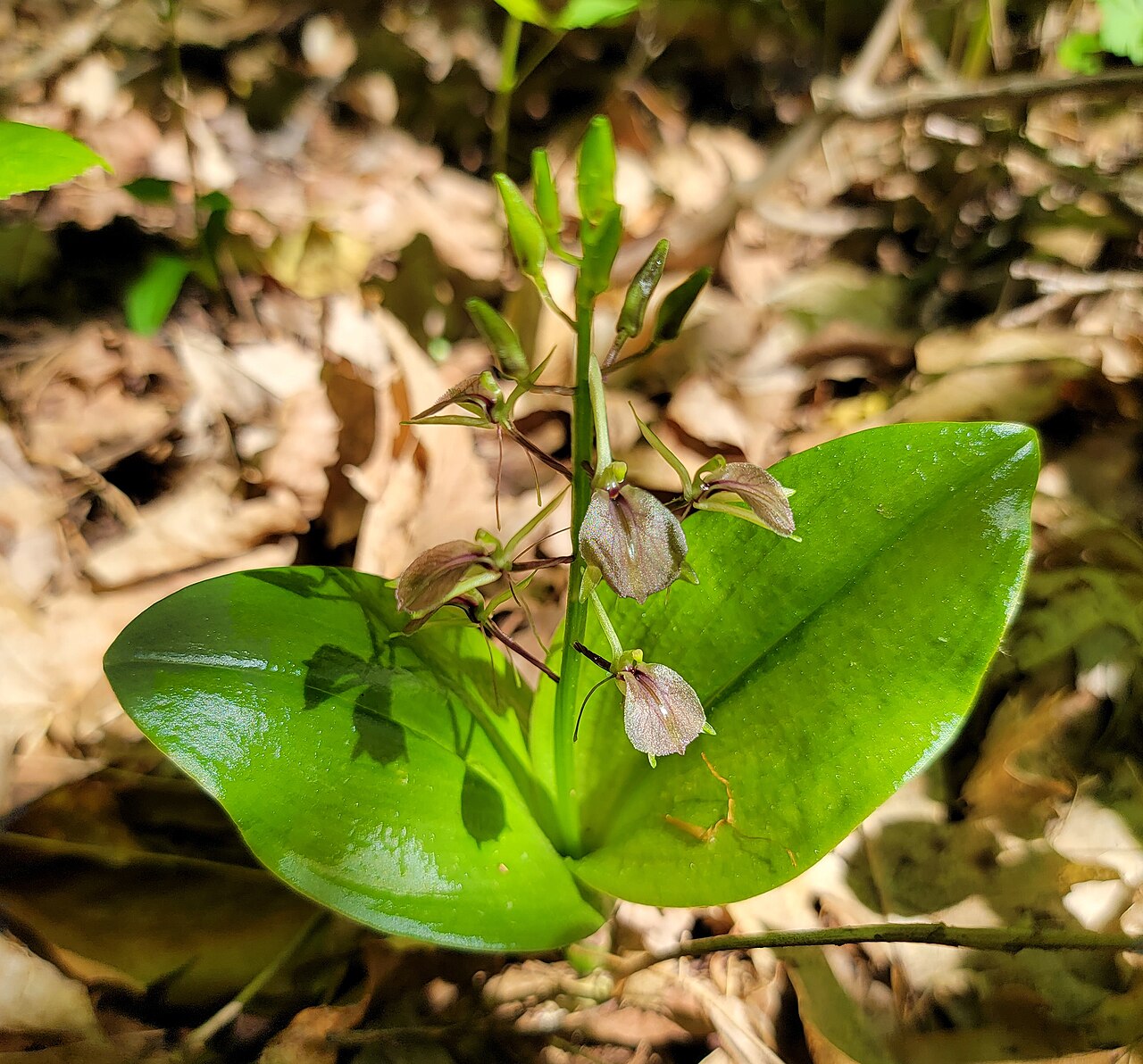
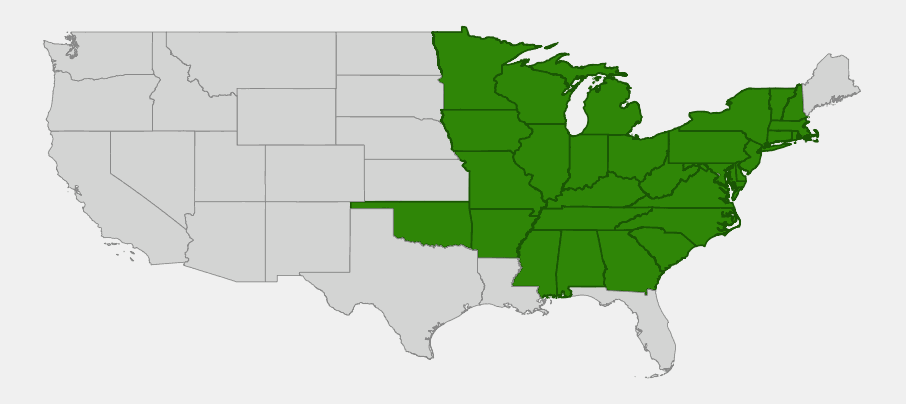
Liparis liliifolia, known as Large Twayblade, is a small woodland orchid of eastern North America. It is also called lily-leaved twayblade and purple twayblade, and USDA PLANTS lists it as brown widelip orchid. It belongs to the orchid family (Orchidaceae) and grows from southern Ontario and New England south to Georgia and west to Minnesota, Missouri and Oklahoma.
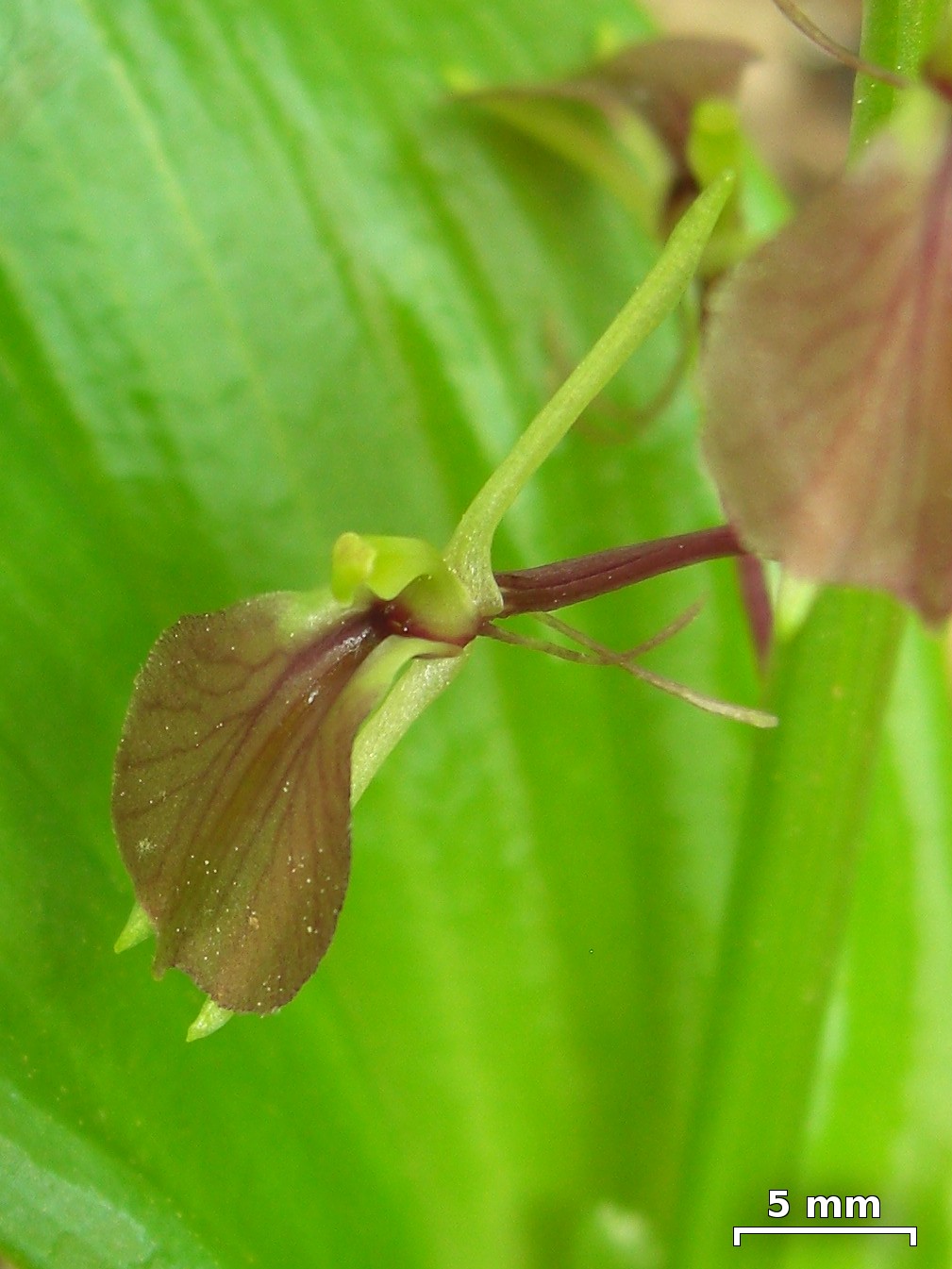
It is easy to overlook. Each plant has just two glossy, broad leaves at the base, like a small lily or lady’s slipper, and in late spring a short spike of curious flowers 4 to 10 inches tall. Up close, each flower is remarkable: a broad, translucent, mauve-purple lip like a little stained-glass window, with two thread-thin purple petals curling out behind it.
Large twayblade is an orchid for appreciation in the wild, not a plant for casual gardening. Like all orchids, its dust-like seeds need specific soil fungi to grow, and wild plants rarely survive being dug up. Never dig it from the wild. If you want to grow it, buy only laboratory- or nursery-propagated plants from a reputable orchid grower, which are rarely available.
Identification
Look for a pair of glossy, broad, light green leaves at ground level in a woodland, and in May to July a spike of small flowers with broad, translucent mauve lips and thread-like petals.
Growth Habit
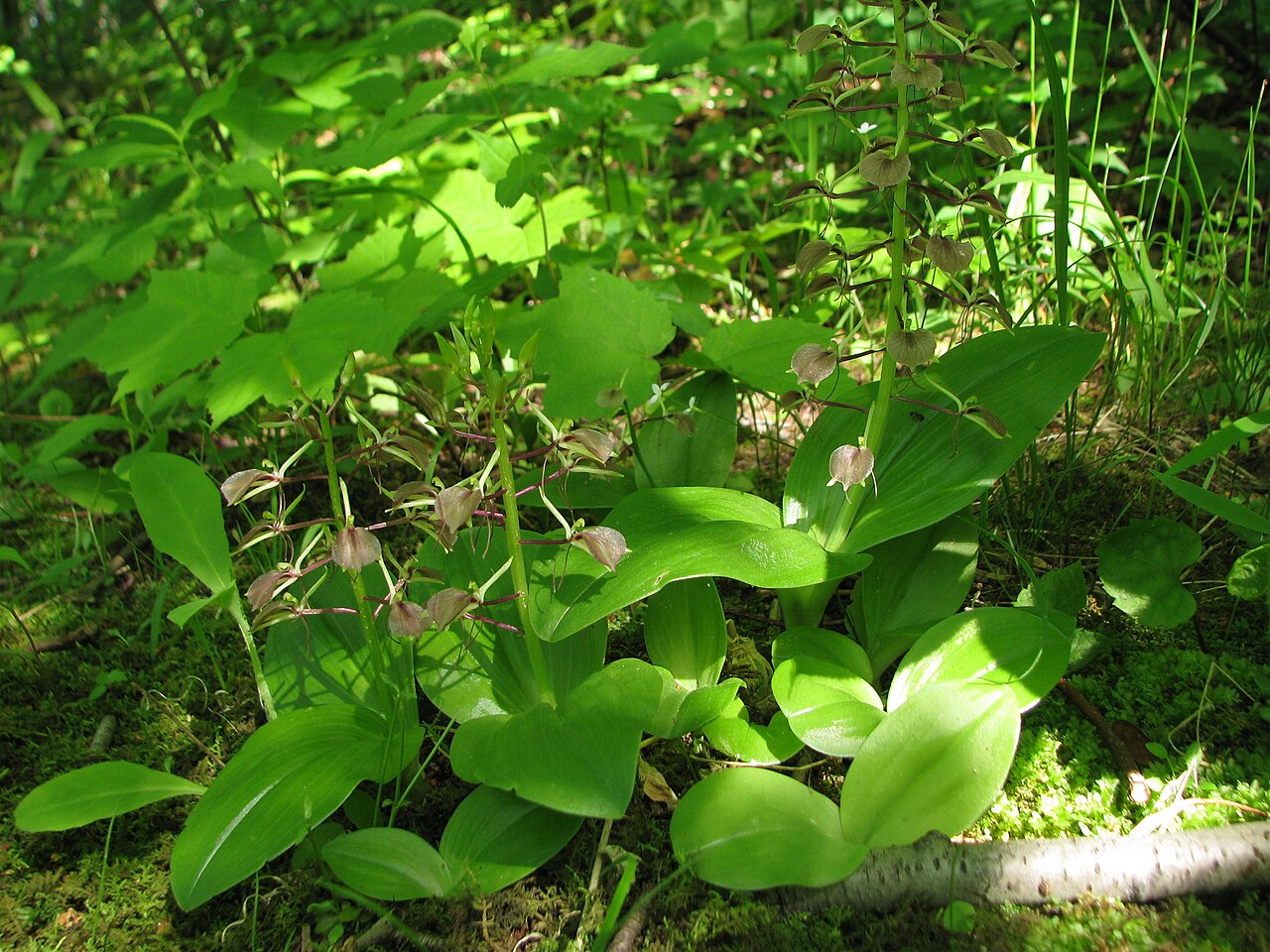
Large twayblade is a small perennial orchid, 4 to 10 inches tall in flower (occasionally to about 12 inches), growing from a small, bulb-like corm (pseudobulb) at or just below the soil surface. Plants may grow singly or in loose groups, and in good years a site may have dozens of flowering stems.
Leaves
Each plant has two leaves (hence “twayblade,” an old word for “two leaves”) that sheathe the base of the stem. They are broadly elliptic to oval, 2 to 7 inches long, smooth, glossy and somewhat succulent, light to medium green with a central fold. The leaves appear in spring and wither in fall.
Flowers
The flowering stem rises between the leaves and carries a loose raceme of about 5 to 30 or more flowers from May to July. Each flower is about 1/2 to 3/4 inch long. The lip is broad, nearly flat, wedge- to egg-shaped, about 3/8 to 1/2 inch long, and translucent mauve, purple or brownish-purple with fine veins. The two lateral petals are thread-like and purple, and the three sepals are narrow and pale green to greenish-white, curling back. Each flower sits on a slender, purplish stalk.
Fruit & Seeds
The fruits are ribbed, elliptic capsules about 1/2 inch long, held upright on the stalk through summer and fall. Each capsule releases thousands of microscopic, dust-like seeds that are carried by the wind.
Look-alikes
Loesel’s twayblade (Liparis loeselii) grows in wetter, sunnier places and has small, yellowish-green flowers with a narrow lip. The true twayblades of the genus Neottia (formerly Listera) have a pair of leaves partway up the stem rather than at the base. Before flowering, large twayblade’s two leaves can be mistaken for young pink lady’s slipper or showy orchis, which have thicker, more strongly pleated or broader leaves.
Quick Facts
| Scientific Name | Liparis liliifolia |
| Family | Orchidaceae (orchid family) |
| Plant Type | Terrestrial perennial orchid |
| Mature Height | 4–10 in |
| Mature Spread | 3–6 in |
| Growth Rate | Slow |
| Sun Exposure | Part shade to shade |
| Water Needs | Medium; moist but well-drained |
| Soil Type | Humus-rich woodland loam; also sandy and disturbed forest soils |
| Soil pH | Slightly acidic to neutral (about 5.5–7.0) |
| Bloom Time | May–July |
| Flower Color | Translucent mauve to purple lip; greenish sepals |
| Fall Color | Leaves yellow and wither |
| Fruit | Ribbed capsule with dust-like seeds |
| Deer Resistant | No; deer and slugs eat the leaves and flowers |
| USDA Hardiness Zones | 4–8 |
Native Range
Large twayblade grows across much of eastern and central North America. USDA PLANTS lists it as native from Ontario and New England south to Georgia and Alabama, west to Minnesota, Iowa, Missouri, Arkansas and Oklahoma. Lady Bird Johnson Wildflower Center describes its range as Ontario east to Vermont, south to Georgia, west to Oklahoma and north through Missouri to Minnesota.
It is most frequent in the Appalachian and Ohio Valley states and the southern Great Lakes region, and becomes rare toward the edges of its range, in northern New England, southern Ontario, the Deep South and the western states. In Minnesota it is found in the southeastern part of the state, around the Twin Cities and the bluff country, and in Oklahoma it is limited to the eastern woodlands.
It grows in moist to fairly dry deciduous and mixed forests, wooded slopes and ravines, stream terraces and thickets. It is notable for showing up in young, second-growth woods, old fields growing back to forest and even pine plantations, as well as in mature forest. Populations can appear, flower for a few years and then decline as the canopy closes.
📋 Regional plant lists featuring Large Twayblade: New York, Pennsylvania & Northern New Jersey · Ohio & Indiana · Michigan, Wisconsin & Eastern Minnesota · Kentucky & Tennessee · Connecticut, Massachusetts & Rhode Island · New Hampshire, Maine & Vermont · Maryland, Virginia & West Virginia · Delaware, Southern New Jersey & Long Island · Illinois, Iowa & Missouri · Alabama, Georgia & Mississippi · North & South Carolina · Arkansas, Louisiana, Eastern Oklahoma & Eastern Texas
Growing & Care Guide
Large twayblade is rarely grown in gardens, and it should never be dug from the wild. Like all orchids, it depends on mycorrhizal fungi in the soil, and transplanted wild plants usually die within a few years. Laboratory-propagated plants are occasionally offered by specialist native orchid growers; buy only those. The notes below are for gardeners who obtain propagated plants or have it appear on their own wooded property.
Light
Part shade to light shade, such as the dappled light under deciduous trees or the edge of a woodland opening. It does not tolerate full, hot sun.
Soil & Water
Give it moist but well-drained, humus-rich woodland soil, slightly acidic to neutral. Avoid heavy, soggy soils, which rot the pseudobulb. Water during dry spells in spring and summer.
Planting Tips
Plant propagated plants in spring with the pseudobulb at or just below the soil surface, in a spot with little root competition. Mark the site, because the plant disappears in fall. Protect it from slugs and deer, which can eat the leaves and flower spikes.
Pruning & Maintenance
Leave the foliage to wither naturally in fall. Keep a thin layer of leaf litter over the area but do not bury the plant under a deep mulch. If it appears naturally on your land, the best care is to leave it alone and keep invasive plants such as Japanese stiltgrass and garlic mustard from crowding it.
Propagation
It is propagated from seed on sterile laboratory media by specialist growers. In the wild it spreads by its dust-like seeds and occasionally by small offset pseudobulbs. Home propagation from seed is not practical.
Landscape Uses
- Wildflower walks: look for it in late spring and early summer in moist woods and young forests
- Woodland gardens: propagated plants can grow in a shaded woodland garden with humus-rich soil
- Native orchid collections: a modest but distinctive species for collectors of propagated native orchids
- Property stewardship: if it appears on your land, protect the site and control invasive plants
- Nature photography: its translucent lip is a favorite subject for macro photographers
Wildlife & Ecological Value
Large twayblade is one of the many native orchids that depend on a web of relationships with fungi, insects and the forest around them.
For Pollinators
The flowers offer no nectar reward that is easy to see. Small insects, including small flies, have been observed visiting them and carrying away the pollen masses, though its pollination has been little studied.
For Birds
It has little direct value for birds, but it grows in the forest understory where many woodland birds nest and forage.
For Mammals
White-tailed deer browse the leaves and flower spikes, and heavy deer browsing can reduce flowering and seed set in some populations.
Ecosystem Role
Its seeds contain almost no stored food and need specific soil fungi to germinate and grow. The orchid depends on these fungi throughout its early life, so it is a sign of healthy forest soil with an intact fungal community.
Cultural & Historical Uses
The genus name Liparis comes from the Greek liparos, meaning “oily” or “shiny,” a reference to the glossy leaves. The species name liliifolia means “lily-leaved.” “Twayblade” is an old English word meaning “two blades” or “two leaves.”
It was one of the orchids illustrated in early 20th-century wildflower books, including Homer D. House’s Wild Flowers of New York and the botanical paintings of Mary Vaux Walcott, which brought it to the attention of many naturalists.
Because it often appears in young forests and plantations and then fades as the woods mature, large twayblade can seem to come and go from a site. It is rare and of conservation concern in parts of its range, especially at its northern and western edges, which is one more reason to leave wild plants undisturbed.
Frequently Asked Questions
Can I dig up large twayblade and move it to my garden?
No. Wild orchids rarely survive transplanting because they depend on soil fungi, and digging them harms wild populations. Buy only propagated plants from a reputable grower.
Why is it called twayblade?
“Twayblade” is an old English word meaning “two leaves.” Each plant has just two leaves at its base.
What does large twayblade look like?
It has two glossy, broad leaves at ground level and a 4- to 10-inch spike of small flowers with broad, translucent mauve-purple lips and thread-thin purple petals.
When does large twayblade bloom?
From May to July, depending on latitude.
Is it the same as brown widelip orchid?
Yes. Brown widelip orchid is the name USDA PLANTS uses for Liparis liliifolia. It is also called lily-leaved twayblade and purple twayblade.

Looking for a nursery that carries Large Twayblade?
Browse our native plant nursery directory: Alabama & Arkansas · Connecticut, Delaware & Georgia · Illinois, Indiana & Iowa · Kentucky, Maryland, Massachusetts, Michigan, Minnesota, Mississippi & Missouri · New Hampshire, New Jersey, New York, North Carolina, Ohio & Oklahoma · Pennsylvania, Rhode Island, South Carolina, Tennessee, Vermont & Virginia · West Virginia & Wisconsin

