
Yellow Pimpernel (Taenidia integerrima)
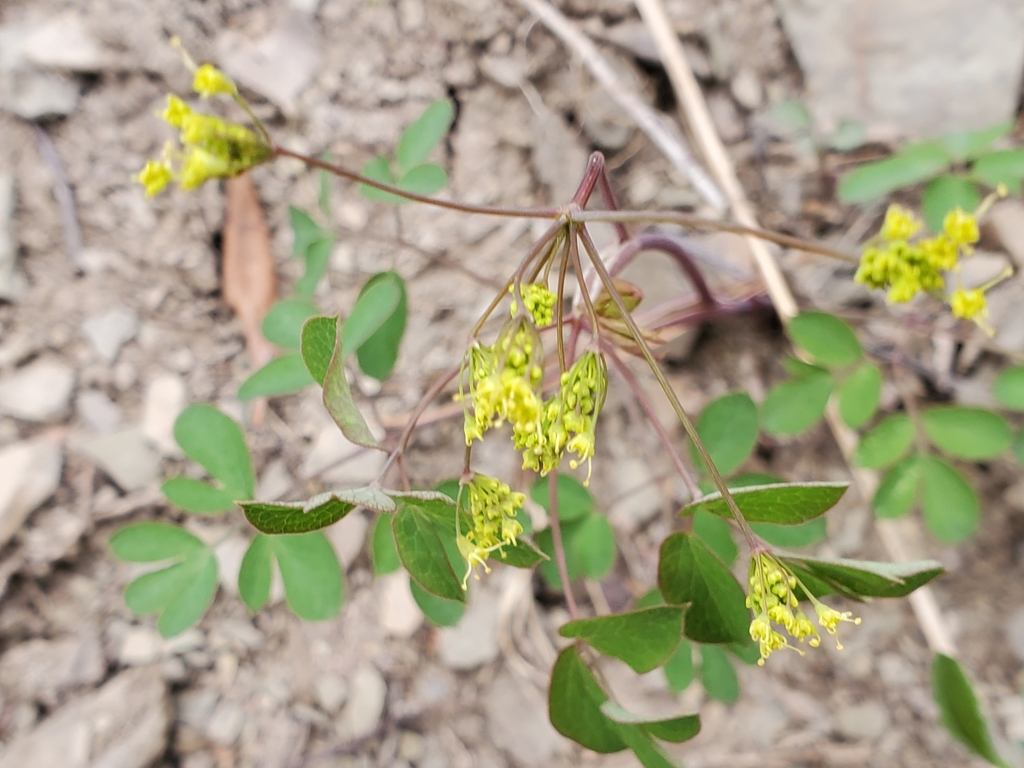
Taenidia integerrima, known as Yellow Pimpernel, is a graceful perennial of dry, open woods, rocky slopes and prairie edges in eastern and central North America. In mid to late spring it carries loose, airy umbels of tiny yellow flowers on slender, bluish-green stems 1 to 3 feet tall, above finely divided leaves with smooth-edged leaflets. The foliage has a mild celery or parsley scent when crushed.
It belongs to the carrot or parsley family (Apiaceae) and is the only widespread member of its small genus; its close relative, mountain pimpernel (Taenidia montana), is a rare plant of shale barrens in the central Appalachians. The species name integerrima means “completely entire”, referring to the untoothed edges of its leaflets, which set it apart from look-alikes such as golden alexanders.
Yellow pimpernel is a tough, drought-tolerant plant for dry shade and woodland edges, and it is a host plant for black swallowtail caterpillars. It is not related to the scarlet pimpernel of European gardens. This guide covers how to identify it, where it grows, how to grow it and its value to wildlife.
Identification
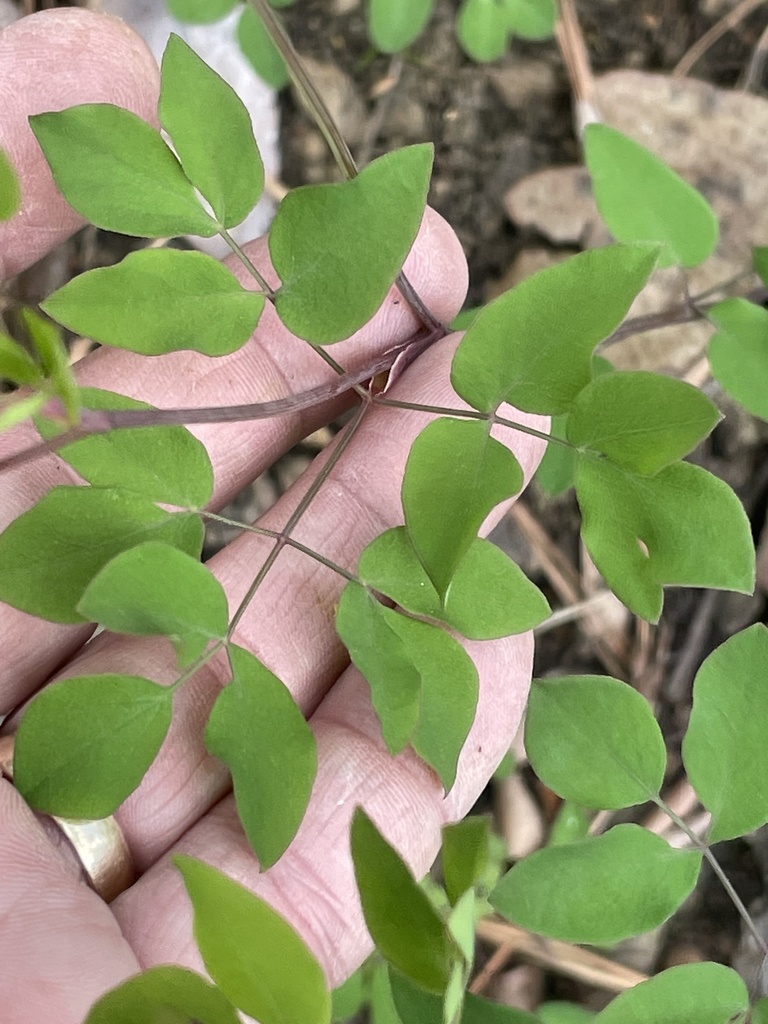
Yellow pimpernel looks a lot like golden alexanders and other yellow-flowered members of the carrot family. The key is the leaves: look for many small leaflets with perfectly smooth edges.
Growth Habit
It is an upright, clump-forming perennial 1 to 3 feet tall, growing from a stout taproot. The stems are smooth, slender and often have a bluish-green, waxy bloom. Plants are often loosely branched near the top, with an airy, open look.
Leaves
The leaves are alternate and two or three times divided into threes or into pinnate groups, with many leaflets. Each leaflet is oval to lance-shaped, about 1/2 to 1 1/2 inches long, smooth and pale green, with smooth, untoothed edges. The lower leaves have long stalks, and the upper leaves are smaller.
Flowers
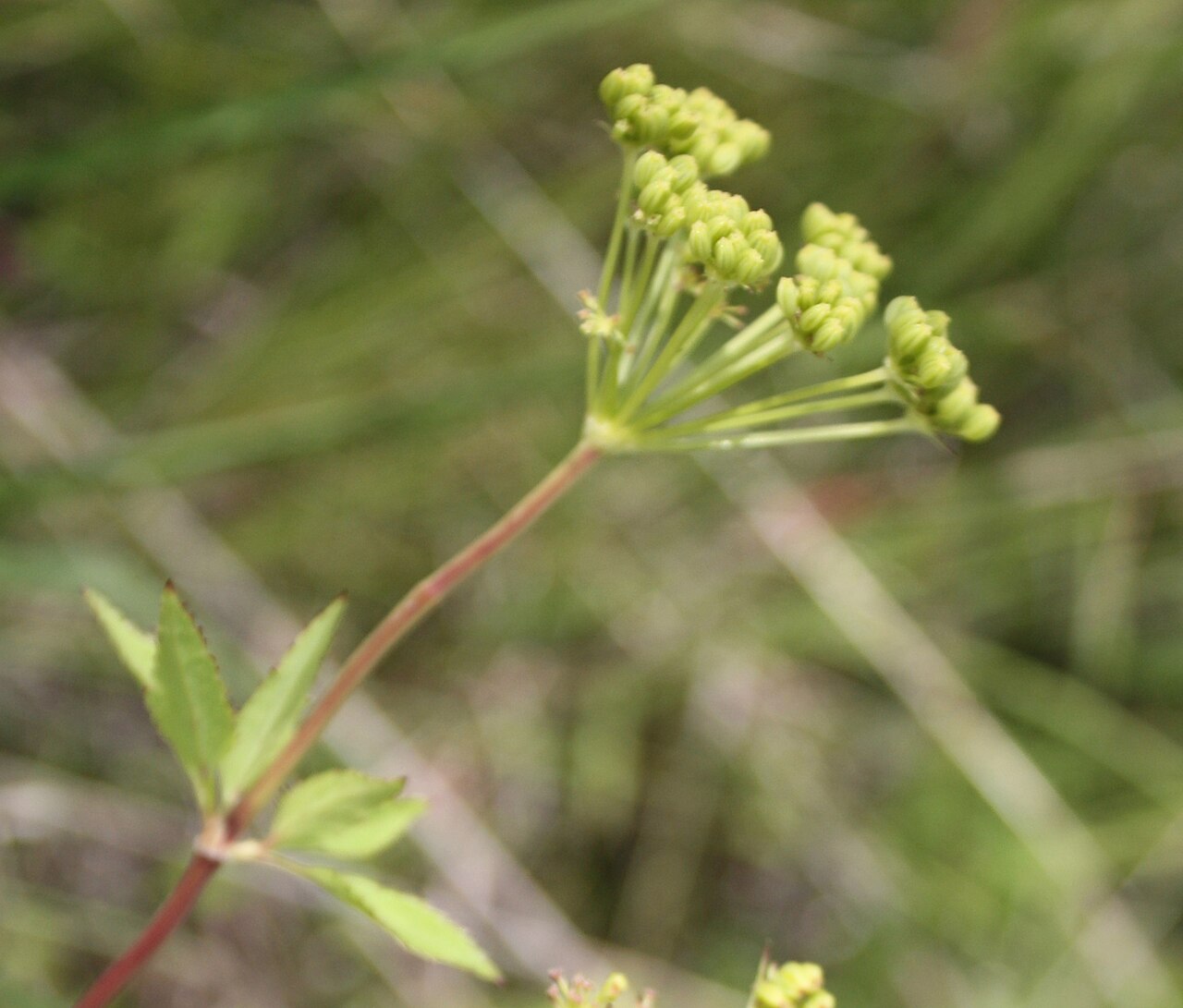
The tiny yellow flowers are clustered in compound umbels 2 to 4 inches across, at the tops of the stems. Each umbel has 8 to 20 slender rays of unequal length, without leafy bracts at the base, giving the cluster a loose, irregular look. Bloom time is mainly April to June.
Fruit & Seeds
The fruit is a small, oval, slightly flattened, smooth seed-like fruit, about 1/8 inch long, with thin ribs. It ripens in summer and splits into two halves.
Look-alikes
Golden alexanders (Zizia aurea) has finely toothed leaflets and more compact flower clusters. Heartleaf golden alexanders (Zizia aptera) has heart-shaped basal leaves. Meadow parsnips (Thaspium) have toothed leaflets and winged fruit. Wild parsnip (Pastinaca sativa), an introduced weed whose sap can cause severe skin burns, is a coarser plant with large, toothed leaflets and flat-topped umbels in summer. Yellow pimpernel is identified by its smooth-edged leaflets, bluish stems and loose, irregular umbels in spring.
Quick Facts
| Scientific Name | Taenidia integerrima (L.) Drude |
| Family | Apiaceae (carrot family) |
| Plant Type | Herbaceous perennial wildflower |
| Mature Height | 1–3 ft |
| Mature Spread | 1–2 ft |
| Growth Rate | Moderate |
| Sun Exposure | Part shade to full sun |
| Water Needs | Low to moderate; drought tolerant |
| Soil Type | Dry to medium, well-drained loam, sand, gravel or rocky soils |
| Soil pH | About 5.5–7.5 |
| Bloom Time | April–June |
| Flower Color | Yellow |
| Fall Color | Foliage yellows before dying back |
| Fruit | Small oval, ribbed seed-like fruit |
| Deer Resistant | Moderately; not a favored browse plant |
| USDA Hardiness Zones | 3–8 |
Native Range
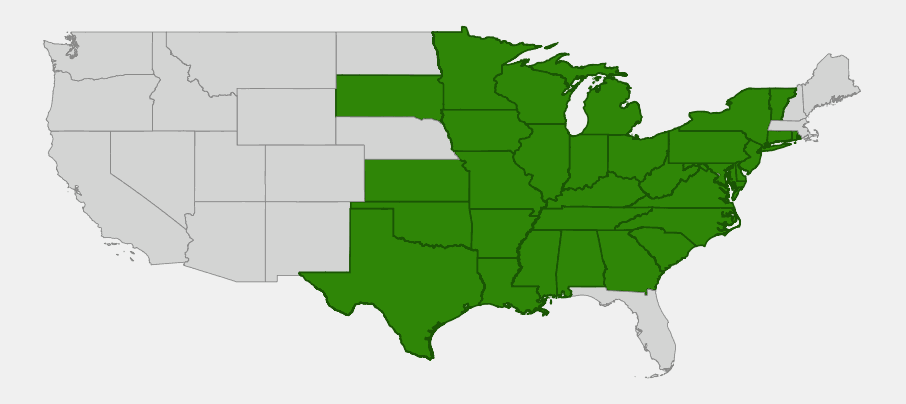
Yellow pimpernel is native to eastern and central North America. USDA PLANTS lists it as native in 31 states, from Vermont, Connecticut and Rhode Island south to Georgia and west to Minnesota, South Dakota, Kansas, Oklahoma and Texas, and in Ontario and Quebec in Canada.
It is most common in the Appalachian region, the Ohio Valley, the Ozarks and the upper Midwest, from New York and Pennsylvania to Missouri, Wisconsin and Minnesota. It is more scattered on the Atlantic and Gulf Coastal Plains, and it reaches its southwestern limits in eastern Oklahoma and East Texas. Records from South Dakota are at the western edge of its range.
It grows in dry to medium habitats: open, rocky woods and woodland edges, oak and hickory forests, bluffs, ledges and talus, glades, savannas and prairie edges, often on limestone or other rocky soils. It is found from low elevations to the lower mountains of the Appalachians.
📋 Regional plant lists featuring Yellow Pimpernel: New York, Pennsylvania & Northern New Jersey · Ohio & Indiana · Michigan, Wisconsin & Eastern Minnesota · Kentucky & Tennessee · Nebraska, Kansas & Eastern Colorado · Connecticut, Massachusetts & Rhode Island · New Hampshire, Maine & Vermont · Maryland, Virginia & West Virginia · Delaware, Southern New Jersey & Long Island · Illinois, Iowa & Missouri · Alabama, Georgia & Mississippi · North & South Carolina · Arkansas, Louisiana, Eastern Oklahoma & Eastern Texas · North Dakota, South Dakota & Western Minnesota
Growing & Care Guide
Yellow pimpernel is an easy, long-lived native perennial for dry shade, woodland edges and rock gardens. It is offered by many native plant nurseries in the East and Midwest, especially those in the upper Midwest. It has a delicate, airy look but is very tough once established, and it combines well with spring woodland wildflowers and grasses.
Light
Grow it in part shade to full sun. It does well in the light shade of open woods or at the edge of trees, and in sunny, rocky spots where the soil stays fairly dry.
Soil & Water
It prefers well-drained, dry to medium soil, including sandy, gravelly, rocky and limestone soils. Once established, it tolerates drought well and needs little or no supplemental watering. Avoid wet, poorly drained soil.
Planting Tips
Plant it in spring or fall, setting plants about 12 to 18 inches apart. Because of its taproot, it is best planted young and left undisturbed. It pairs well with wild columbine, wild geranium, pussytoes and little bluestem in a dry woodland or savanna planting.
Pruning & Maintenance
Little care is needed. Cut the stems back after seeds ripen if you want a tidier look, or leave them for the birds and to allow some reseeding. Leave some foliage for swallowtail caterpillars.
Propagation
It is usually grown from seed. Sow fresh seed outdoors in fall, or give it 60 days or more of cold, moist stratification before sowing in spring. Seedlings grow slowly at first and usually flower in their second or third year.
Landscape Uses
- Dry shade gardens: a tough, airy perennial for difficult spots under trees
- Woodland edges and savannas: spring yellow flowers among grasses and wildflowers
- Butterfly gardens: a host plant for black swallowtail caterpillars
- Rock gardens: well suited to rocky, limestone or gravelly soil
- Habitat restoration: a native of dry woods, glades and prairie edges
Wildlife & Ecological Value
Like many members of the carrot family, yellow pimpernel is valuable to small pollinators and to swallowtail butterflies.
For Pollinators
The tiny, open flowers are easy for short-tongued insects to work and attract small native bees, such as mining bees and sweat bees, as well as flies, small wasps and beetles. It blooms in spring, when these insects need early food sources.
For Birds
Its seeds are eaten by some ground-feeding birds. The plant is too small to be an important food source, but its insect visitors are food for songbirds.
For Mammals
It is not a favored browse plant for deer or rabbits, though they may eat it when other food is scarce.
Ecosystem Role
Yellow pimpernel is a host plant for the caterpillars of the black swallowtail butterfly, which feed on the foliage of many members of the carrot family. As a native of dry woods, glades and prairie edges, it is part of diverse plant communities that are often threatened by fire suppression and invasive shrubs.
Cultural & Historical Uses
The genus name Taenidia comes from the Greek tainidion, a small ribbon or band, probably referring to the fruit. Linnaeus first described the species in the eighteenth century in another genus, and the German botanist Oscar Drude later placed it in Taenidia.
The common name pimpernel is shared with several unrelated plants, including the scarlet pimpernel (Lysimachia arvensis) of European gardens. Yellow pimpernel belongs to the carrot family and is not related to them.
Some Native American peoples reportedly used yellow pimpernel in traditional medicine. Many members of the carrot family, including the deadly poison hemlock and water hemlock, look similar, so yellow pimpernel should never be eaten or used without expert identification.
Frequently Asked Questions
How do I tell yellow pimpernel from golden alexanders?
Look at the leaflets. Yellow pimpernel has smooth, untoothed leaflets and loose, irregular umbels. Golden alexanders has finely toothed leaflets and more compact umbels.
Is yellow pimpernel related to scarlet pimpernel?
No. Yellow pimpernel is in the carrot family (Apiaceae), while scarlet pimpernel is in the primrose family. They only share a common name.
Does yellow pimpernel attract butterflies?
Yes. It is a host plant for black swallowtail caterpillars, and its flowers attract small bees, flies and other pollinators in spring.
Where does yellow pimpernel grow?
It grows in dry, open woods, rocky slopes, glades and prairie edges from Vermont and Quebec west to Minnesota and South Dakota, and south to Georgia, Louisiana and East Texas.
Is yellow pimpernel safe to eat?
It is not known as a food plant, and many look-alikes in the carrot family, such as poison hemlock and water hemlock, are deadly. Never eat a wild carrot-family plant without expert identification.

Looking for a nursery that carries Yellow Pimpernel?
Browse our native plant nursery directory: Alabama & Arkansas · Connecticut, Delaware & Georgia · Illinois, Indiana, Iowa & Kansas · Kentucky, Louisiana, Maryland, Michigan, Minnesota, Mississippi & Missouri · New Jersey, New York, North Carolina, Ohio & Oklahoma · Pennsylvania, Rhode Island, South Carolina, South Dakota, Tennessee, Texas, Vermont & Virginia · West Virginia & Wisconsin

