
Prostrate Tick-Trefoil (Desmodium rotundifolium)
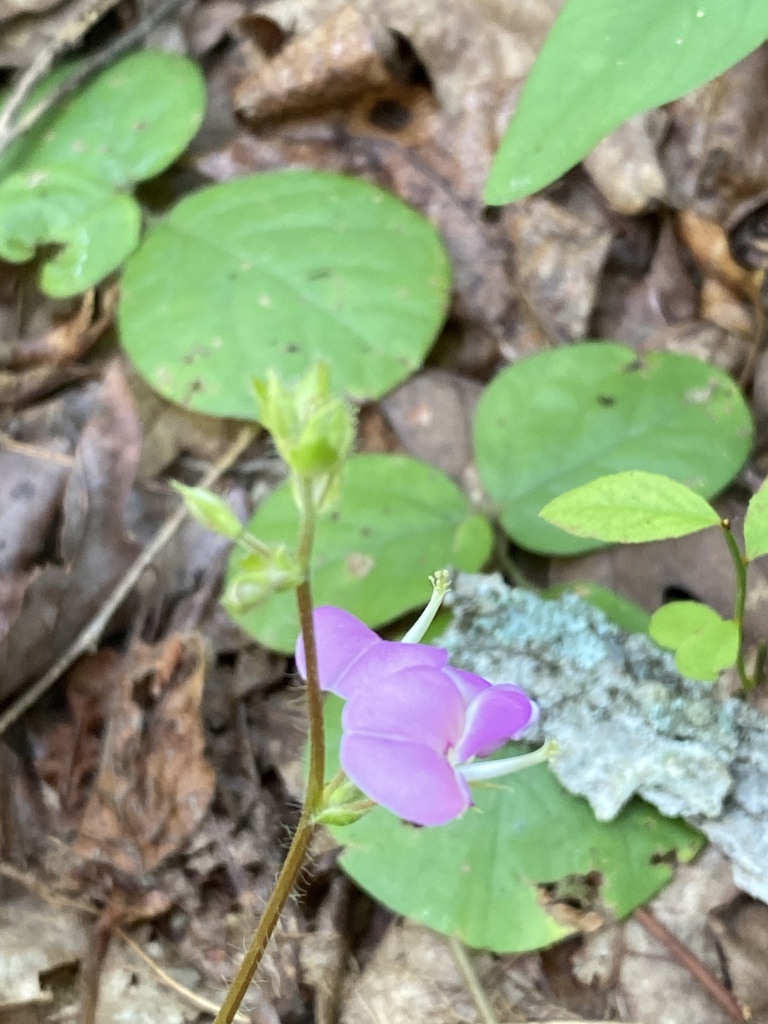
Desmodium rotundifolium, known as Prostrate Tick-Trefoil, round-leaved tick-trefoil, dollarleaf or trailing tick-trefoil, is a trailing perennial of the pea family (Fabaceae) native to the eastern United States and southern Ontario. Unlike most tick-trefoils, which stand upright, its soft, hairy stems creep across the forest floor for 2 to 6 feet. Its leaves have three nearly round leaflets, and in summer short upright stalks carry small pink to purple pea flowers.
It grows in dry, open oak and pine woods, rocky slopes, woodland edges and clearings, usually on acidic, sandy or rocky soils. The flat, jointed seed pods are covered with tiny hooked hairs and stick to clothing and fur, which is how tick-trefoils got their name and how they spread.
Prostrate tick-trefoil is a useful native ground cover for dry shade. Like other legumes, it adds nitrogen to the soil through bacteria in its roots, and it feeds butterflies, bees, quail and deer. It is uncommon to rare at the northern edge of its range, so buy plants or seed from native nurseries rather than digging them.
Identification
Look for a low, hairy, trailing vine on the woodland floor with three-parted leaves of nearly round leaflets, broad leafy stipules at the leaf bases, and small pink-purple pea flowers in mid to late summer.
Growth Habit
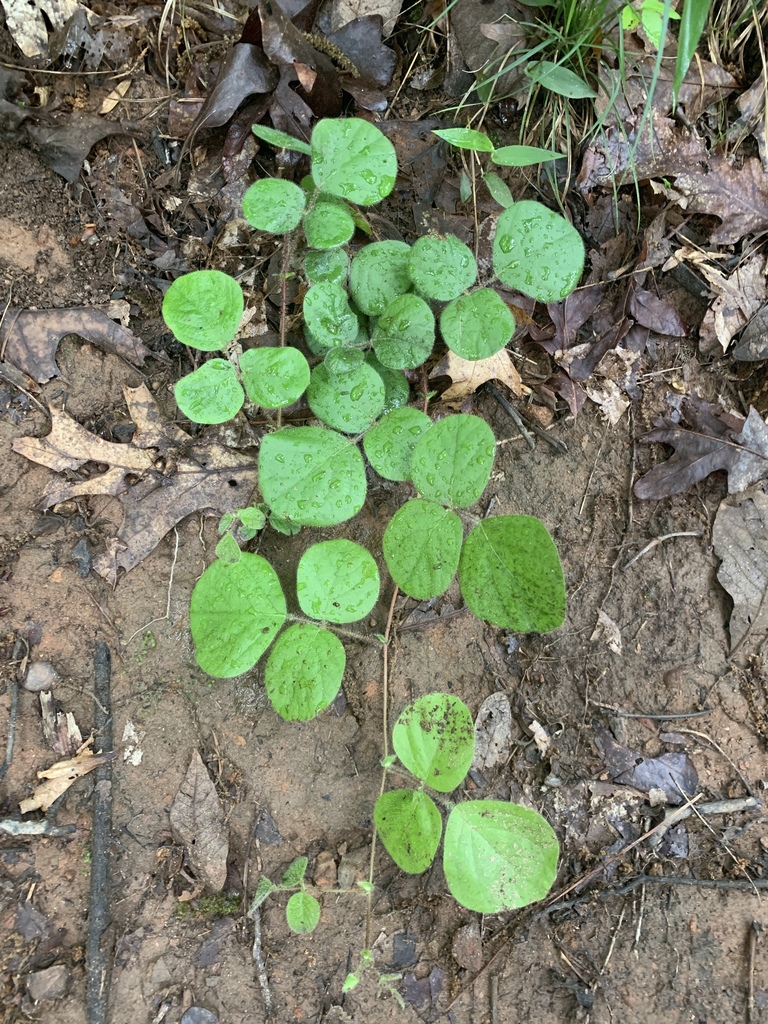
It is a herbaceous perennial with several stems that trail flat along the ground from a woody crown and taproot. The stems are usually 2 to 6 feet long, softly hairy, and do not climb. Only the flower stalks rise up, usually 6 to 18 inches.
Leaves
The leaves are alternate and divided into three leaflets. The leaflets are round to broadly oval, about 1 to 2 1/2 inches long, softly hairy, and the end leaflet has a longer stalk than the two side leaflets. At the base of each leaf stalk are conspicuous, broad, heart-shaped stipules that stay on the plant, a good field mark.
Flowers
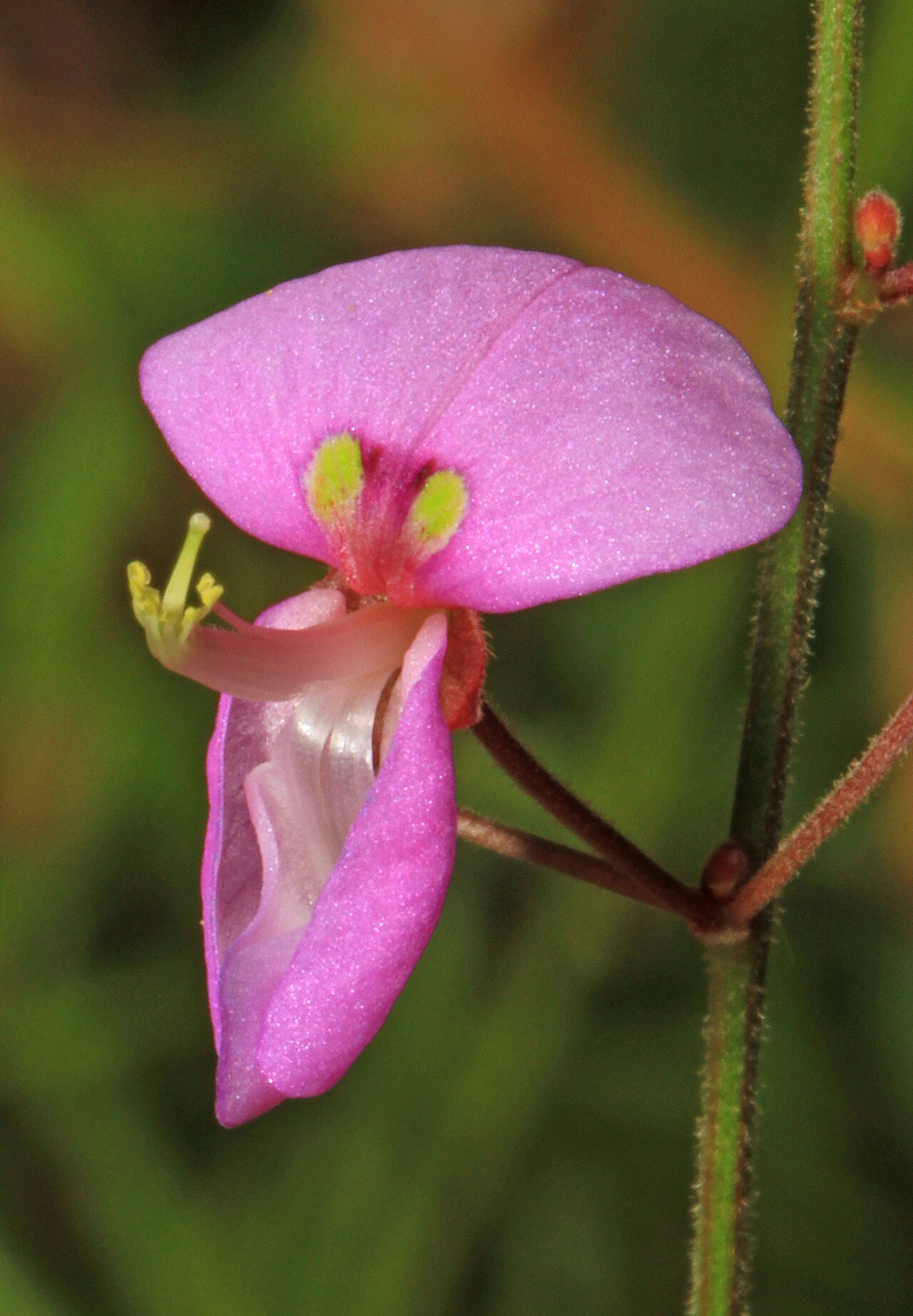
The flowers are typical small pea flowers, about 1/3 inch long, pink to rose-purple, with two yellow-green spots at the base of the upper petal. They are held in loose clusters (racemes) on upright stalks from the leaf axils. Bloom time is June to September.
Fruit
The fruit is a flat, jointed pod (loment) that breaks into 2 to 5 rounded segments, each holding one seed. The segments are covered with tiny hooked hairs and cling to fur and clothing, the familiar “beggar’s lice” of late summer woods.
Look-alikes
Most other tick-trefoils, such as naked-flowered tick-trefoil and pointed-leaved tick-trefoil, grow upright with pointed leaflets. Trailing lespedeza also creeps, but its leaflets are small and oblong and its pods are single-seeded and not jointed. Hog peanut (Amphicarpaea) climbs and has pointed leaflets.
Quick Facts
| Scientific Name | Desmodium rotundifolium |
| Family | Fabaceae (pea family) |
| Plant Type | Trailing herbaceous perennial |
| Mature Height | 6–18 in (flower stalks) |
| Mature Spread | 2–6 ft trailing stems |
| Growth Rate | Moderate |
| Sun Exposure | Part shade to full sun |
| Water Needs | Low; dry to medium soil |
| Soil Type | Sandy, rocky or loamy; well drained |
| Soil pH | Acidic to neutral (about 5.0–7.0) |
| Bloom Time | June–September |
| Flower Color | Pink to rose-purple |
| Fall Color | Leaves turn yellowish before dying back |
| Fruit | Flat jointed pod with sticky hooked hairs |
| Deer Resistant | No; deer browse it |
| USDA Hardiness Zones | 4–9 |
Native Range
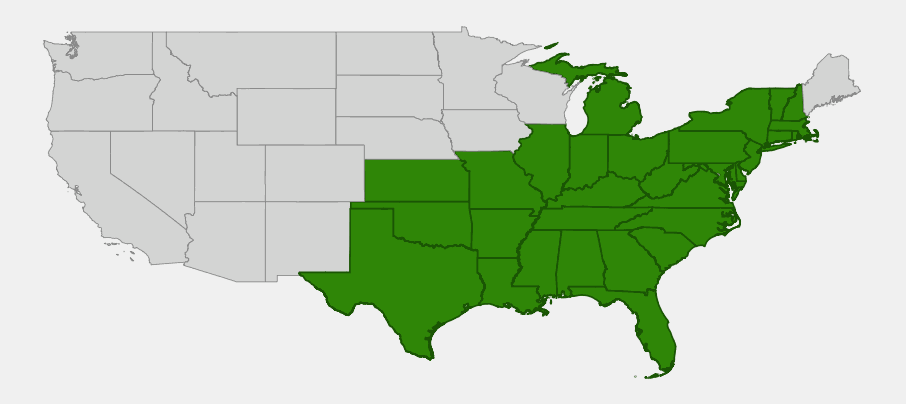
Prostrate tick-trefoil is native to eastern North America. USDA PLANTS lists it as native in Alabama, Arkansas, Connecticut, Delaware, Florida, Georgia, Illinois, Indiana, Kansas, Kentucky, Louisiana, Maryland, Massachusetts, Michigan, Mississippi, Missouri, New Hampshire, New Jersey, New York, North Carolina, Ohio, Oklahoma, Pennsylvania, Rhode Island, South Carolina, Tennessee, Texas, Vermont, Virginia and West Virginia, and in Ontario, Canada.
It is most common in the Appalachian region, the Piedmont, the Ozarks and the Ohio Valley. In the west it reaches southeastern Kansas, eastern Oklahoma and East Texas, and in the south it reaches the Florida Panhandle. It is uncommon to rare at the northern edge of its range in New England, southern Michigan and Ontario.
It grows in dry to mesic oak, oak-hickory and pine woods, rocky and sandy slopes, woodland edges, clearings and roadsides, usually on acidic soils. It does best where the canopy is open enough to let in some sun.
📋 Regional plant lists featuring Prostrate Tick-Trefoil: North & South Florida · Alabama, Georgia & Mississippi · North & South Carolina · Maryland, Virginia & West Virginia · Kentucky & Tennessee · Arkansas, Louisiana, Eastern Oklahoma & Eastern Texas · Illinois, Iowa & Missouri · Ohio & Indiana · Nebraska, Kansas & Eastern Colorado · Michigan, Wisconsin & Eastern Minnesota · New York, Pennsylvania & Northern New Jersey · Delaware, Southern New Jersey & Long Island · Connecticut, Massachusetts & Rhode Island · New Hampshire, Maine & Vermont
Growing & Care Guide
Prostrate tick-trefoil is a tough, low-maintenance plant for dry woodland gardens and naturalized areas. It is not a lawn ground cover, but it fills gaps under trees and on banks where little else grows.
Light
Part shade to full sun. Dappled light under oaks and pines is ideal.
Soil & Water
Well-drained sandy, rocky or loamy soil, preferably acidic. It tolerates poor, dry soil once established and needs no fertilizer, since it fixes its own nitrogen.
Planting Tips
Plant in spring or fall, 2 to 3 feet apart, on dry slopes, woodland edges or under trees. Keep it away from paths if you don’t want sticky seed pods on your clothes and pets in late summer.
Pruning & Maintenance
No pruning is needed. Let the stems die back in fall and leave leaf litter in place. Fence or protect young plants where deer are numerous.
Propagation
Grow from seed. Rub the seeds lightly with sandpaper (scarify) or soak them before sowing in spring, since the seed coat is hard. Plants can also be started from divisions of the crown.
Landscape Uses
- Woodland ground cover: fills dry, partly shaded ground under trees
- Slope and bank cover: trailing stems help hold loose soil
- Wildlife gardens: food for butterflies, bees, quail and turkeys
- Soil improvement: fixes nitrogen in poor, sandy soils
- Woodland restoration: part of the native groundcover of oak and pine woods
Wildlife & Ecological Value
Like other tick-trefoils, prostrate tick-trefoil is an important wildlife plant: its flowers, leaves and seeds feed many animals.
For Pollinators
Bumble bees, leafcutter bees and other native bees visit the flowers. Tick-trefoils are larval host plants for several butterflies, including the hoary edge, the northern and southern cloudywings, the silver-spotted skipper and the eastern tailed-blue.
For Birds
The seeds are eaten by northern bobwhite, wild turkey and other ground-feeding birds. Tick-trefoil seeds are a valued food for quail in managed pine woods.
For Mammals
White-tailed deer browse the leaves, which are rich in protein. The sticky seed pods catch in the fur of deer, foxes, raccoons and other animals, which carry them to new places.
Ecosystem Role
As a legume, it works with root bacteria to add nitrogen to poor woodland soils. Its trailing stems help hold soil on slopes, and it benefits from the openings created by fire and canopy gaps.
Cultural & Historical Uses
The genus name Desmodium comes from the Greek word for a chain or band, describing the jointed seed pods that break into separate segments. The species name rotundifolium means round-leaved.
The name tick-trefoil refers to the three-parted (trefoil) leaves and the flat, tick-like seed segments that cling to socks and fur. Generations of hikers have picked these “beggar’s lice” or “stick-tights” off their clothing after late-summer walks in the woods.
In parts of the Southeast, land managers encourage native tick-trefoils in pine woods because their seeds and leaves are good food for bobwhite quail, turkeys and deer. Prostrate tick-trefoil is one of the few that creeps along the ground instead of standing upright.
Frequently Asked Questions
Why is it called tick-trefoil?
The leaves have three leaflets (trefoil), and the flat seed segments cling to clothing and fur like ticks. They are harmless, just sticky.
Is prostrate tick-trefoil a vine?
It trails along the ground like a vine but does not climb. Its stems can reach 2 to 6 feet long.
Is prostrate tick-trefoil good for wildlife?
Yes. Bees visit the flowers, several butterflies use tick-trefoils as host plants, and quail, turkeys and deer eat the seeds and leaves.
How do I get rid of the sticky seeds?
Brush or pick them off clothing and pet fur. To avoid them, plant prostrate tick-trefoil away from paths and play areas.
Will it grow in dry shade?
Yes. It grows well in dry, partly shaded woodland soil, especially under oaks and pines, and needs no fertilizer.

Looking for a nursery that carries Prostrate Tick-Trefoil?
Browse our native plant nursery directory: Alabama & Arkansas · Connecticut, Delaware, Florida & Georgia · Illinois, Indiana & Kansas · Kentucky, Louisiana, Maryland, Massachusetts, Michigan, Mississippi & Missouri · New Hampshire, New Jersey, New York, North Carolina, Ohio & Oklahoma · Pennsylvania, Rhode Island, South Carolina, Tennessee, Texas, Vermont & Virginia · West Virginia

