
Swan’s Sedge (Carex swanii)
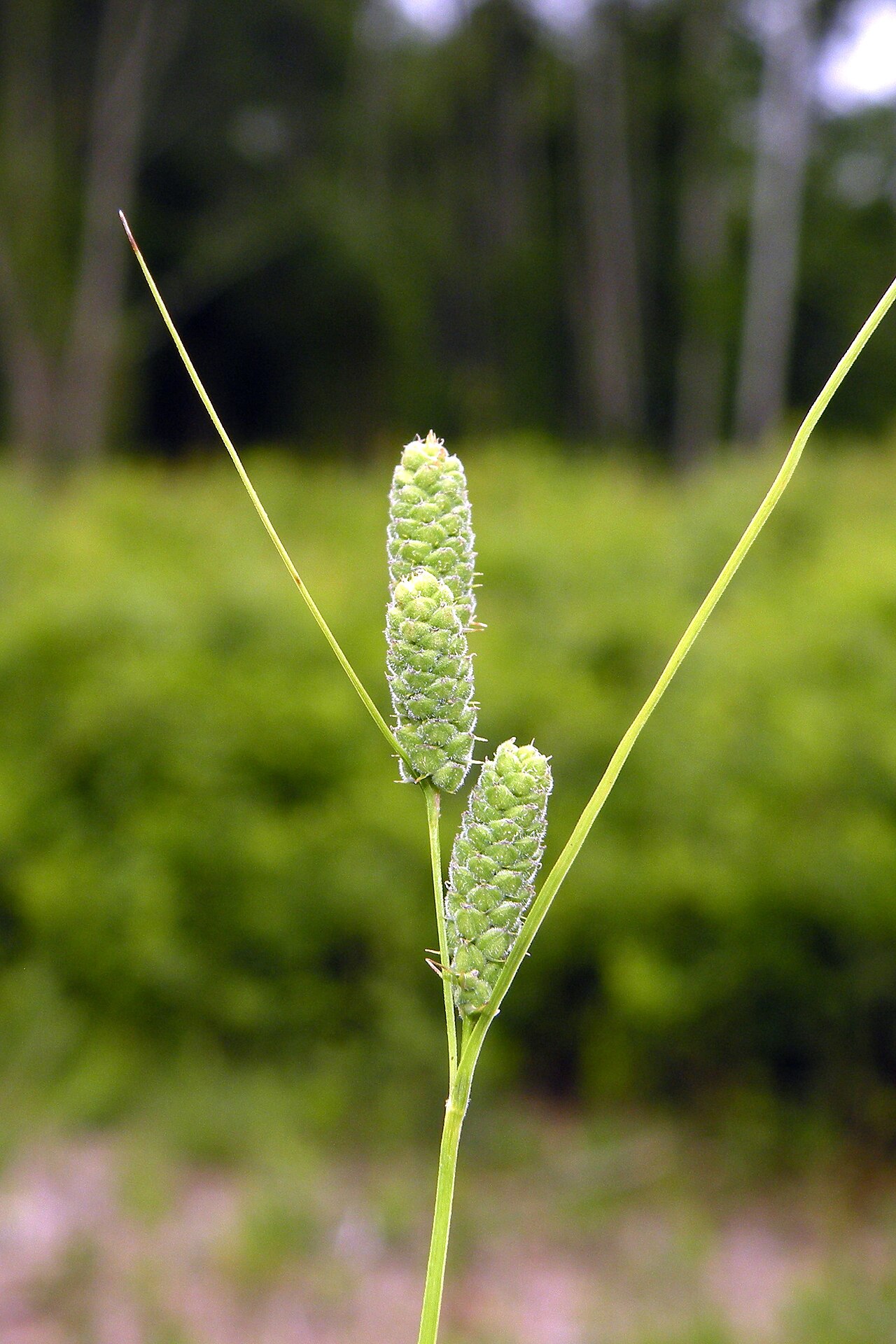
Carex swanii, known as Swan’s Sedge, is a small, clump-forming woodland sedge in the sedge family (Cyperaceae). It forms soft tufts of narrow, hairy leaves, with slender stems 1 to 2 1/2 feet tall that carry a few short, crowded, pale green spikes near the tip in late spring. Its tiny fruits are covered with fine hairs, a trait it shares with its close relative, ribbed sedge (Carex virescens).
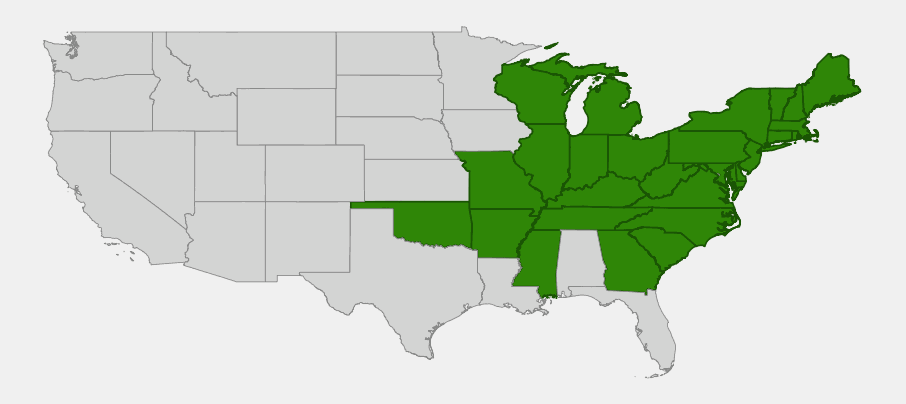
Swan’s sedge is native to eastern North America, from Nova Scotia, New Brunswick, Quebec and Ontario south through New England and the Appalachians to Georgia and Mississippi, and west to Wisconsin, Missouri, Arkansas and eastern Oklahoma. It grows in dry to moist open woods, woodland edges, thickets, clearings and old fields, usually in acidic, sandy or loamy soil.
For gardeners, Swan’s sedge is a modest, fine-textured groundcover for dry to average shade and woodland edges, where it mixes well with other native sedges, grasses and spring wildflowers. Like other sedges, it supports native insects and is deer-resistant. It is seldom sold, but it is sometimes available from native plant nurseries that specialize in eastern sedges.
Identification
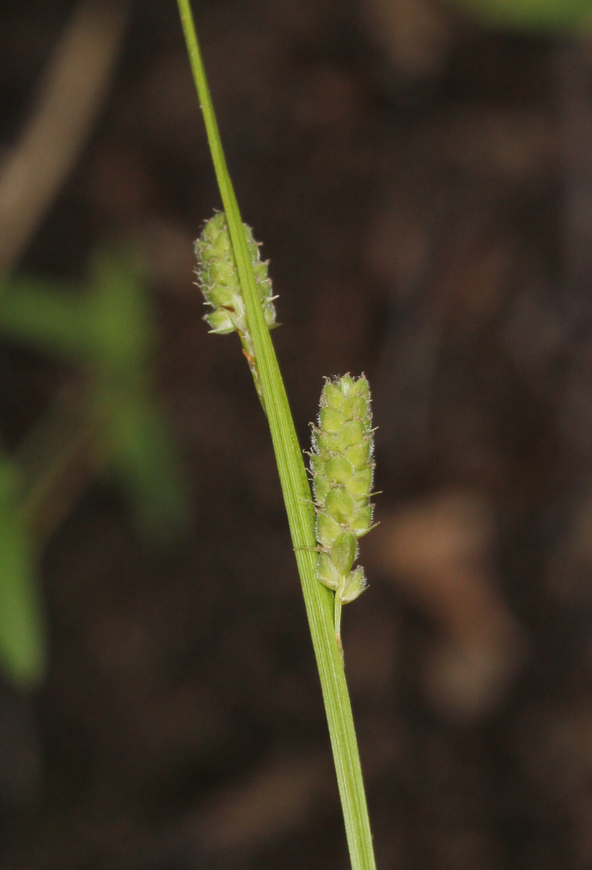
Look for a loose clump of narrow, soft, hairy leaves and slender stems with two to four short, oblong, pale green spikes crowded near the tip; the uppermost spike has a few male flowers at its base.
Growth Habit
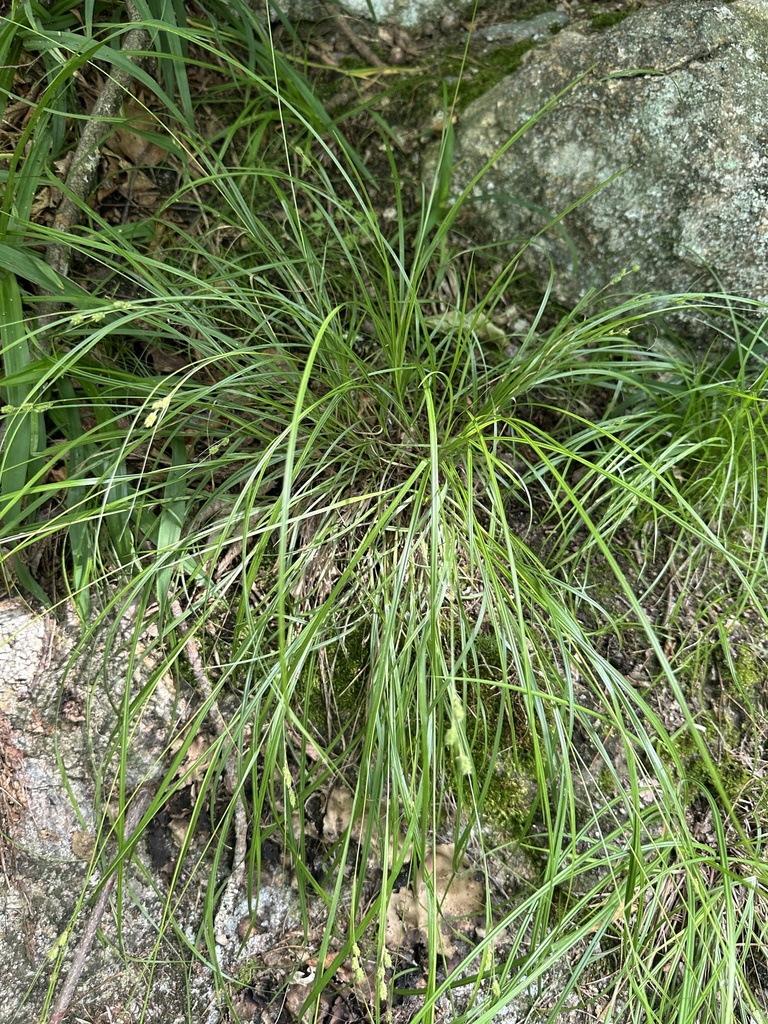
Swan’s sedge is a perennial that grows in loose to dense tufts from short rhizomes. The flowering stems are slender, often arching or leaning, and 1 to 2 1/2 feet tall, usually rising above the leaves. The leaves stay green through much of the growing season.
Leaves
The leaves are narrow, about 1/16 to 1/8 inch wide, soft and grass-like. The blades and especially the leaf sheaths are covered with short, soft hairs, which helps separate it from many other woodland sedges.
Flowers
It flowers in late spring, from about April to June. The stem carries two to four short, oblong to cylindrical spikes, usually less than 3/4 inch long, crowded near the tip. The terminal spike has a few male (staminate) flowers at its base and female flowers above; the lower spikes are female. The flowers are wind-pollinated.
Fruit
The perigynia (the small sacs that enclose each seed) are tiny, about 1/12 inch long, rounded, nearly beakless, and covered with short hairs. They ripen from late spring into early summer, turning from pale green to tan.
Look-alikes
Ribbed sedge (Carex virescens) is very similar but has longer, narrower spikes that are more spread out along the stem, and perigynia with distinct ribs. Hirsute sedge (Carex hirsutella) has hairy leaves too, but its perigynia are smooth and its spikes are rounder. Pennsylvania sedge (Carex pensylvanica) spreads by runners and flowers very early, with a slender male spike above the female spikes. Eastern woodland sedge (Carex blanda) has wider, smooth leaves.
Quick Facts
| Scientific Name | Carex swanii |
| Family | Cyperaceae (sedge family) |
| Plant Type | Clump-forming perennial sedge |
| Mature Height | 1–2.5 ft |
| Mature Spread | 6–12 in |
| Growth Rate | Moderate |
| Sun Exposure | Part shade to light shade; tolerates some sun |
| Water Needs | Low to average; dry to moist, well-drained soil |
| Soil Type | Sandy, loamy or rocky woodland soil |
| Soil pH | Acidic to slightly acidic (about 4.5–6.5) |
| Bloom Time | April–June |
| Flower Color | Pale green spikes |
| Fall Color | Green to tan |
| Fruit | Tiny, hairy perigynia (achenes) |
| Deer Resistant | Yes |
| USDA Hardiness Zones | 4–8 |
Native Range
Swan’s sedge is native to eastern North America. USDA PLANTS lists it from 27 states: Maine, New Hampshire, Vermont, Massachusetts, Rhode Island, Connecticut, New York, New Jersey, Pennsylvania, Delaware, Maryland, Virginia, West Virginia, North Carolina, South Carolina, Georgia, Mississippi, Tennessee, Kentucky, Ohio, Indiana, Illinois, Michigan, Wisconsin, Missouri, Arkansas and Oklahoma. It also occurs in the District of Columbia and in Canada from Ontario and Quebec to New Brunswick and Nova Scotia.
It is most common in the Northeast, the mid-Atlantic and the Appalachian region. Toward the western and southern edges of its range, in Wisconsin, Illinois, Missouri, Arkansas, Oklahoma, Mississippi and Georgia, it is less frequent and more local.
Its habitat is dry to moist open woods, often oak, oak-hickory, or oak-pine forests, as well as woodland edges, thickets, clearings, utility rights-of-way and old fields returning to forest. It prefers acidic, sandy or loamy soils and tolerates some disturbance.
📋 Regional plant lists featuring Swan’s Sedge: Arkansas, Louisiana, Eastern Oklahoma & Eastern Texas · Connecticut, Massachusetts & Rhode Island · New Hampshire, Maine & Vermont · Delaware, Southern New Jersey & Long Island · New York, Pennsylvania & Northern New Jersey · Alabama, Georgia & Mississippi · Illinois, Iowa & Missouri · Ohio & Indiana · Kentucky & Tennessee · Maryland, Virginia & West Virginia · Michigan, Wisconsin & Eastern Minnesota · North & South Carolina
Growing & Care Guide
Swan’s sedge is an easy, low-maintenance sedge for dry to average shade and woodland edges, especially in acidic soil. It is not widely sold, so check specialist native plant nurseries or grow it from seed.
Light
Part shade to light shade is best, such as under oaks or at the edge of a woodland. It tolerates morning sun and some full sun if the soil is not too dry, and it also grows in fairly deep shade, though it flowers less there.
Soil & Water
Grow it in well-drained, acidic, sandy, loamy or rocky soil. It tolerates dry soil once established and needs water only during long droughts. Avoid heavy, wet, alkaline soil.
Planting Tips
Plant plugs in spring or early fall, about 8 to 12 inches apart for a groundcover. It combines well with Pennsylvania sedge, poverty oatgrass, woodland asters, goldenrods and spring wildflowers, and is a good choice under oaks where lawn grasses struggle.
Pruning & Maintenance
Little maintenance is needed. Cut back or rake out old, tattered foliage in early spring before new growth starts if you want a tidier look. It does not need fertilizer.
Propagation
Divide clumps in spring or early fall. Seed ripens in early summer; sow it fresh outdoors or give it about 60 days of cold, moist stratification before sowing in spring. Seedlings grow slowly at first.
Landscape Uses
- Woodland gardens: a fine-textured sedge for dry to average shade
- Lawn alternatives under oaks: a soft, low groundcover for acidic shade
- Woodland edge and meadow transitions: mixes with grasses and wildflowers
- Restoration plantings: for dry oak woods, thickets and old fields
- Deer-resistant plantings: rarely browsed by deer
Wildlife & Ecological Value
Like other woodland sedges, Swan’s sedge plays a quiet but useful role in eastern forest food webs.
For Pollinators
The flowers are wind-pollinated and offer little to bees. However, native sedges are larval food plants for a number of moths and some skippers and satyr butterflies, and their clumps shelter insects through winter.
For Birds
Wild turkeys, sparrows, juncos and other ground-feeding birds eat the seeds of woodland sedges. The clumps provide cover for ground-nesting birds.
For Mammals
Small mammals eat the seeds and use the clumps for cover. Deer seldom eat it.
Ecosystem Role
Its fibrous roots help hold soil on dry woodland slopes and edges. It is part of the native ground layer of oak woods, which helps prevent erosion and resists invasion by weeds.
Cultural & Historical Uses
The species is named for C. W. Swan, a New England botanist and plant collector. It was first described by Merritt Lyndon Fernald as a variety of ribbed sedge, Carex virescens var. swanii, and later raised to a species by Kenneth Mackenzie.
The genus Carex is one of the largest plant genera in the world, with nearly 2,000 species, about 500 of them in North America. Swan’s sedge belongs to a small group of sedges with hairy perigynia, which botanists place in section Porocystis.
Woodland sedges like this one have become more popular with gardeners as low-maintenance, native alternatives to lawn grass in shade. They support native insects and fit naturally into woodland and meadow-edge plantings.
Frequently Asked Questions
Is Swan’s sedge a grass?
No. It is a sedge (genus Carex). Sedges look grass-like, but most have triangular stems and seeds enclosed in small sacs called perigynia.
Where does Swan’s sedge grow best?
In dry to moist, acidic, well-drained soil in part shade, such as open oak woods and woodland edges.
How do I tell Swan’s sedge from ribbed sedge?
Swan’s sedge has short, crowded spikes near the stem tip and smooth-sided, hairy perigynia. Ribbed sedge has longer, narrower spikes spread along the stem and ribbed perigynia.
Can Swan’s sedge replace lawn?
It can be part of a low-traffic lawn alternative in shade, especially combined with Pennsylvania sedge. It does not tolerate heavy foot traffic.
Is Swan’s sedge deer-resistant?
Yes. Deer seldom browse it.

Looking for a nursery that carries Swan’s Sedge?
Browse our native plant nursery directory: Arkansas · Connecticut, Delaware & Georgia · Illinois & Indiana · Kentucky, Maine, Maryland, Massachusetts, Michigan, Mississippi & Missouri · New Hampshire, New Jersey, New York, North Carolina, Ohio & Oklahoma · Pennsylvania, Rhode Island, South Carolina, Tennessee, Vermont & Virginia · West Virginia & Wisconsin

