
Missouri Milkvetch (Astragalus missouriensis)
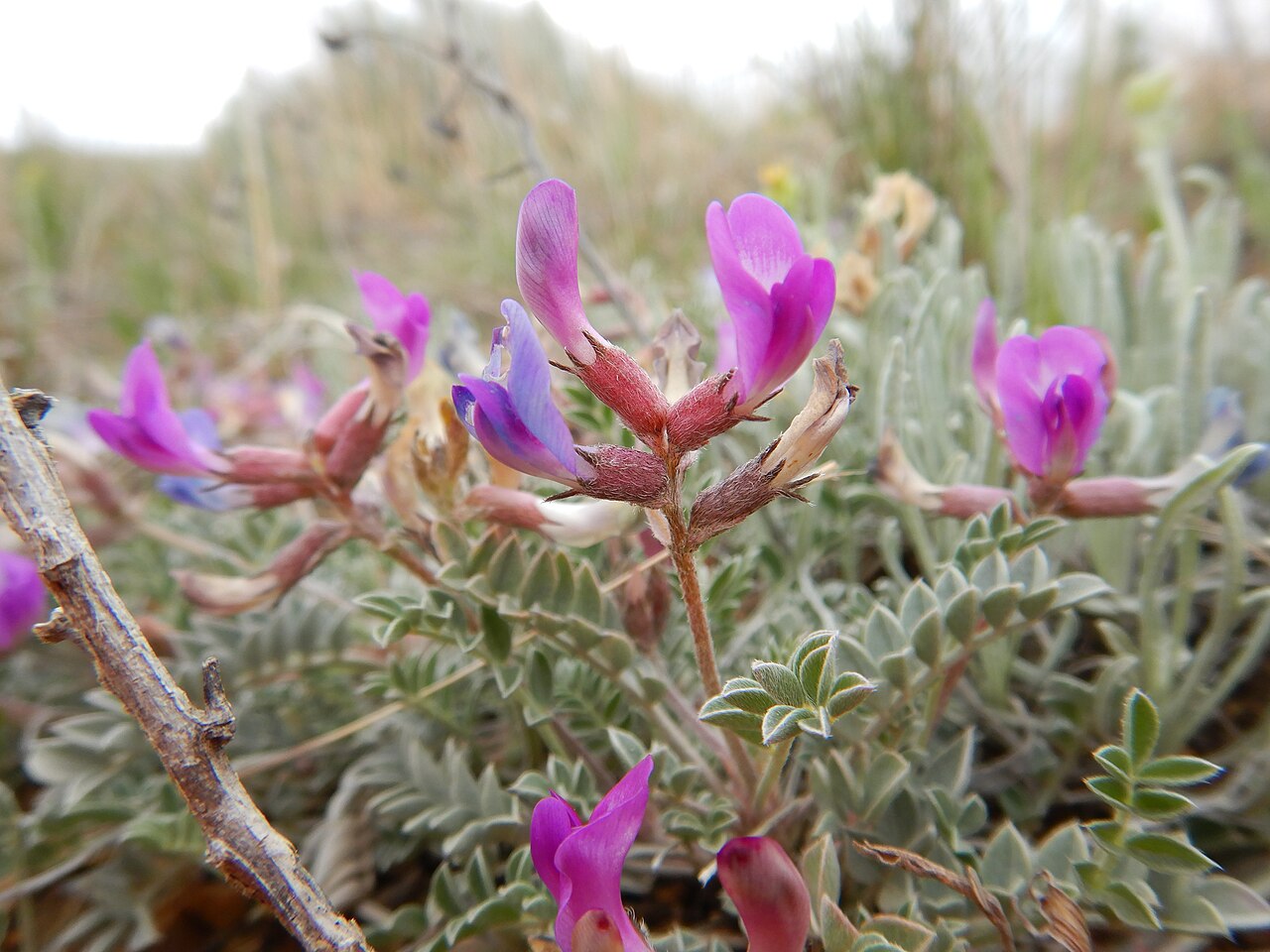
Astragalus missouriensis, known as Missouri Milkvetch, is a low, silvery perennial of the dry prairies, badlands and sagebrush steppe of the Great Plains and Rocky Mountain region. In spring it is one of the first legumes to bloom on the open plains, pressing short clusters of bright pink-purple to magenta pea flowers close to the ground against a rosette of silvery-gray, feathery leaves.
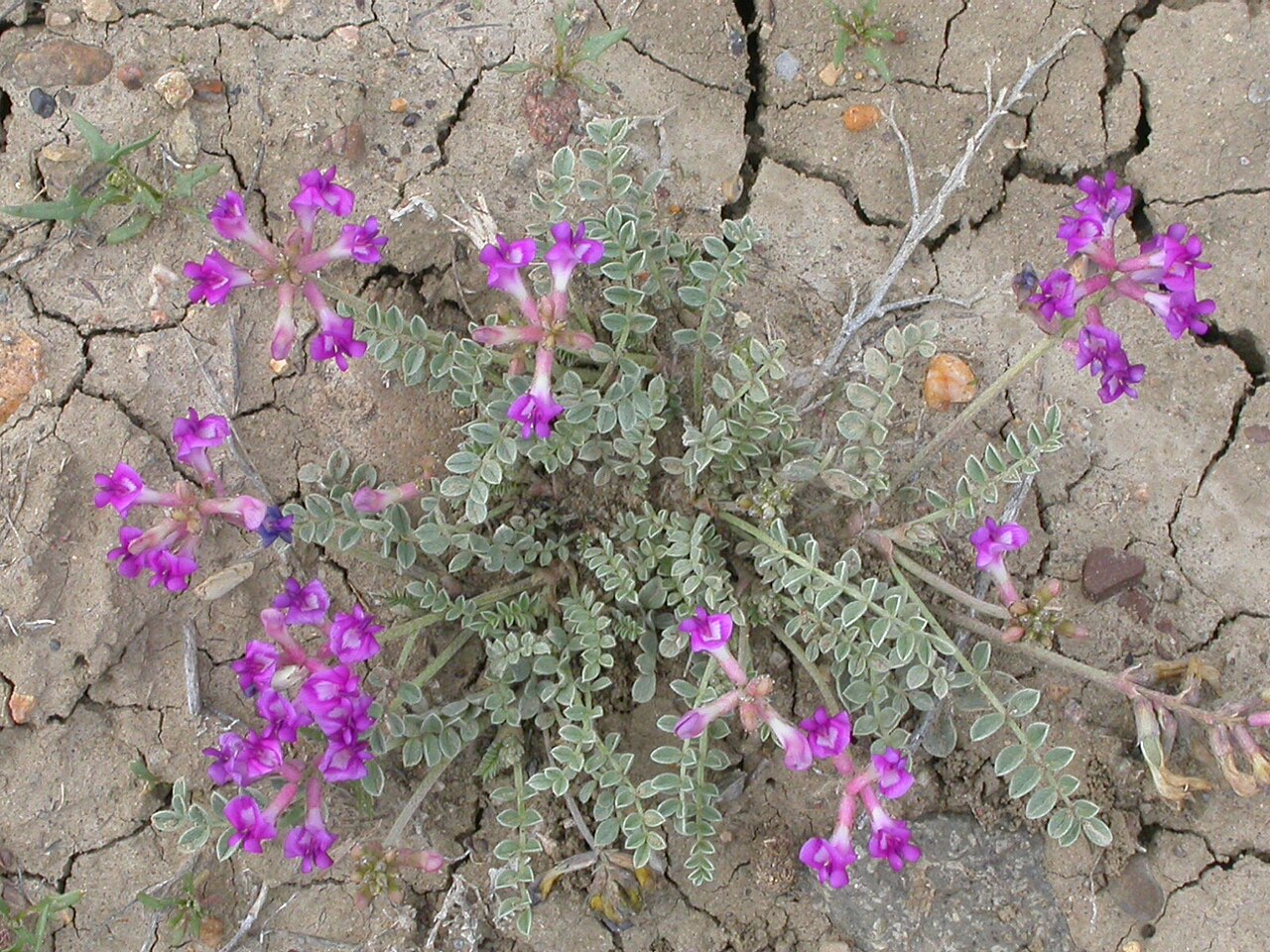
It is a nearly stemless plant, usually only 2 to 6 inches tall, that grows from a deep taproot and a woody crown. Its dense covering of flat, silvery hairs helps it cope with sun, wind and drought on thin, gravelly or clay soils where taller plants struggle. Like other legumes, it partners with nitrogen-fixing bacteria in its roots.
The species was described by Thomas Nuttall from plants collected along the upper Missouri River, which gives it its name. This guide covers how to identify Missouri milkvetch, where it grows, how to grow it in a dry prairie or rock garden, and its value to native bees and other wildlife.
Identification
On the plains in spring, look for a low, flat rosette of silvery, pinnately divided leaves with short clusters of pink-purple pea flowers lying close to the ground. The silvery foliage, nearly stemless habit and early bloom are the main clues among the many western milkvetches.
Growth Habit
It is a low, tufted perennial, usually 2 to 6 inches tall and spreading 4 to 12 inches across. The short stems lie on or near the ground and radiate from a woody crown on top of a deep taproot, so plants form small, flat mats.
Leaves
The leaves are pinnately compound, 1 to 4 inches long, with usually 7 to 17 small, elliptic to oval leaflets. Both leaf surfaces are covered with flat-lying, silvery hairs that are attached at the middle, like a tiny letter T, giving the plant a silvery-gray color.
Flowers
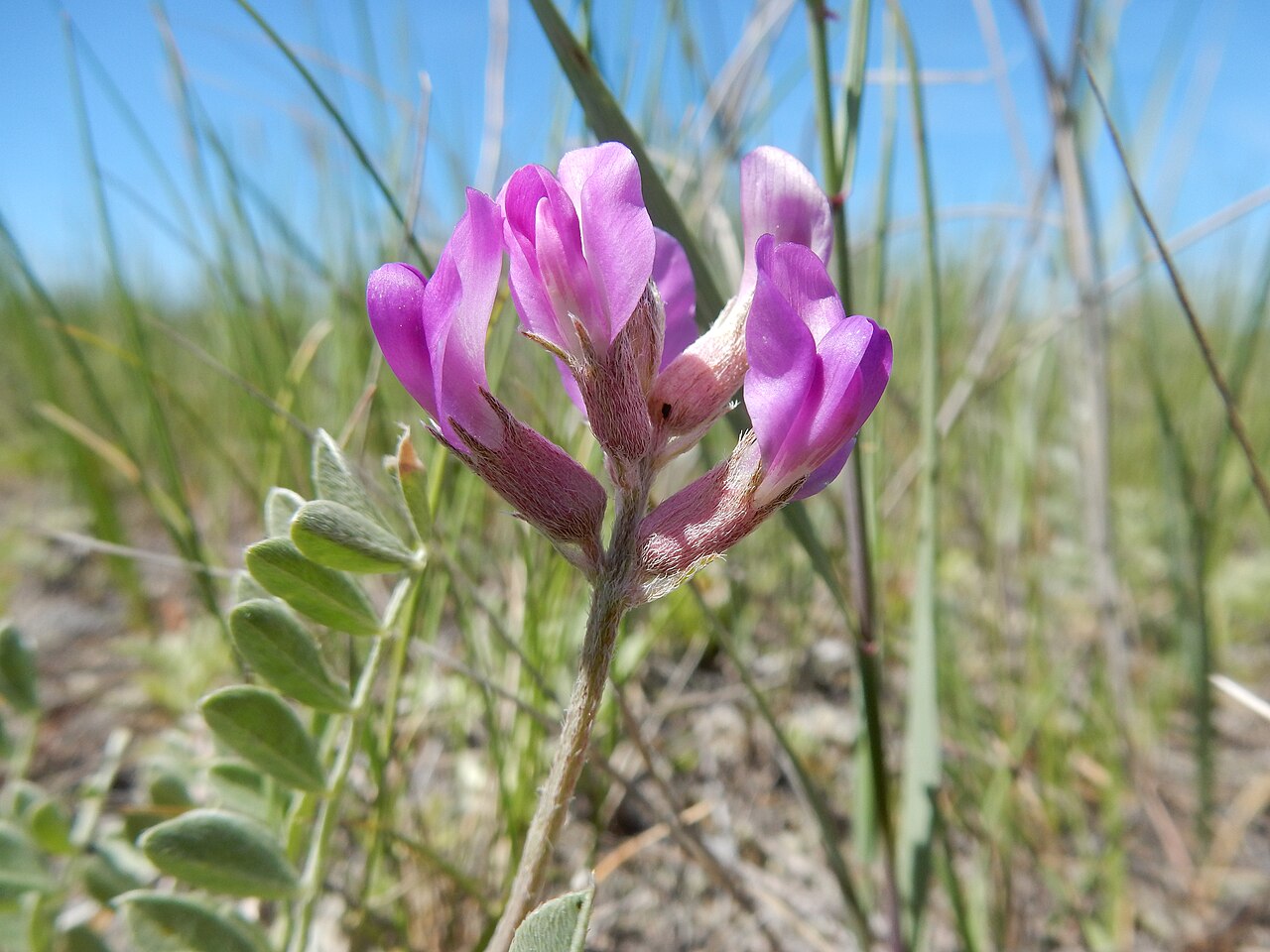
The pea-shaped flowers are pink-purple to magenta, sometimes bluish purple, about 1/2 to 3/4 inch long, with a whitish spot on the upper petal. They are held in short, loose clusters of about 5 to 15 flowers on stalks that barely rise above the leaves. Bloom is mostly April through June, earlier in the south and at low elevations.
Fruit & Seeds
The pods are oblong, slightly curved and pointed, about 3/4 to 1 inch long, leathery and covered with short hairs. They are not mottled, which helps separate this species from several look-alikes. They ripen in early summer and split to release small, dark seeds.
Look-alikes
Ground plum (Astragalus crassicarpus) grows on the same prairies and has similar purple flowers, but its pods are thick, round and plum-like. Woollypod milkvetch (Astragalus purshii) has pods densely covered in long, woolly hairs. Lambert’s locoweed (Oxytropis lambertii) has a pointed beak on the keel petal and flowers on taller, leafless stalks. Missouri milkvetch is best told by its flat silvery rosette, T-shaped hairs and smooth-colored, leathery pods.
Quick Facts
| Scientific Name | Astragalus missouriensis Nutt. |
| Family | Fabaceae (pea or legume family) |
| Plant Type | Low, tufted herbaceous perennial with a woody crown |
| Mature Height | 2–6 in |
| Mature Spread | 4–12 in |
| Growth Rate | Slow |
| Sun Exposure | Full sun |
| Water Needs | Low; very drought tolerant |
| Soil Type | Dry, well-drained gravelly, sandy, rocky or clay soils |
| Soil pH | About 6.5–8.5 |
| Bloom Time | April–June |
| Flower Color | Pink-purple to magenta |
| Fall Color | None; leaves wither in summer drought |
| Fruit | Oblong, leathery, short-hairy pod |
| Deer Resistant | Moderately; low growth and hairy foliage limit browsing |
| USDA Hardiness Zones | 3–7 |
Native Range
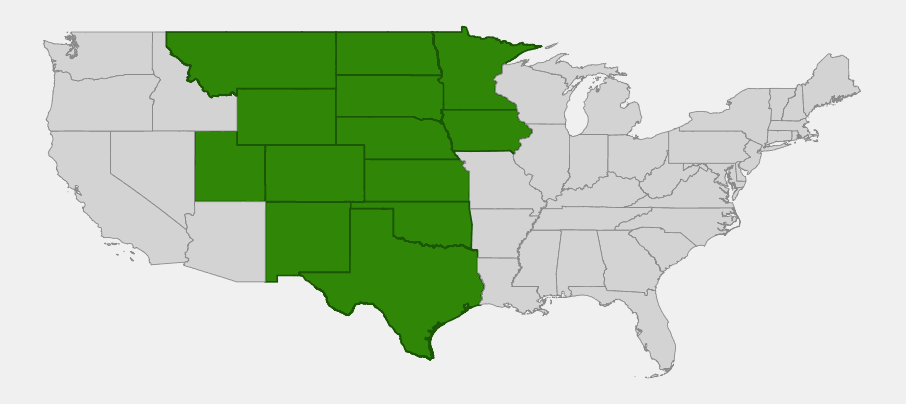
Missouri milkvetch is native to the Great Plains and the adjacent Rocky Mountain region of North America. USDA PLANTS lists it in Colorado, Iowa, Kansas, Minnesota, Montana, Nebraska, New Mexico, North Dakota, Oklahoma, South Dakota, Texas, Utah and Wyoming, and in Alberta, Saskatchewan and Manitoba in Canada.
It is most common on the northern and central plains, from the Canadian prairies through Montana, the Dakotas, Wyoming and Nebraska to eastern Colorado and western Kansas. At the eastern edge of its range it is uncommon in western Minnesota and northwestern Iowa, and in the south it reaches the western Oklahoma panhandle and the Texas Panhandle. Western populations extend into the basins and foothills of Wyoming, Colorado, Utah and New Mexico, where several regional varieties are recognized, including var. amphibolus, var. humistratus and var. mimetes.
It grows on dry, open ground: shortgrass and mixed-grass prairie, eroded hills and bluffs, badlands, shale and clay slopes, gravelly ridges and sagebrush steppe, as well as in pinyon-juniper and ponderosa pine openings in the West. It ranges from about 1,000 feet on the eastern plains to roughly 8,500 feet in the mountains of Colorado and New Mexico.
📋 Regional plant lists featuring Missouri Milkvetch: Montana & Wyoming · North Dakota, South Dakota & Western Minnesota · Nebraska, Kansas & Eastern Colorado · Michigan, Wisconsin & Eastern Minnesota · Illinois, Iowa & Missouri · Utah & Western Colorado · South & West Texas
Growing & Care Guide
Missouri milkvetch is a small, tough plant for dry prairie gardens, rock gardens and xeriscapes on the plains and in the interior West. It is rarely sold as a garden plant, but seed is sometimes available from native seed companies in the Great Plains and Rocky Mountain states, and it is used in some dryland reclamation mixes.
Light
Plant it in full sun. It does not tolerate shade or competition from taller, lush plants.
Soil & Water
Give it lean, very well-drained soil: gravel, sand, rocky loam or even heavy clay on a slope, as long as water does not stand around the crown. It needs no supplemental water once established and is likely to rot with regular irrigation or rich garden soil.
Planting Tips
Sow seed directly where it is to grow, because the deep taproot makes transplanting difficult. Small container-grown seedlings can be planted in spring. Place it at the front of a dry border, in a rock garden or between bunchgrasses such as blue grama and buffalograss, where its low rosette will not be shaded out.
Pruning & Maintenance
No pruning is needed. Keep taller neighbors and weeds from smothering the rosette, and avoid fertilizer, since it fixes its own nitrogen.
Propagation
Grow it from seed. The hard seed coat needs scarification, such as rubbing with sandpaper or a brief hot-water soak, before sowing in fall or early spring. Seedlings grow slowly and may take two or more years to flower. Collect seed only in small amounts and only where permitted.
Landscape Uses
- Rock gardens: a low, silvery cushion with early spring color
- Shortgrass prairie gardens: pairs naturally with blue grama and buffalograss
- Xeriscapes: needs no supplemental water once established
- Pollinator gardens: early spring flowers for native bees
- Dryland restoration: a native legume for eroded hills and disturbed rangeland
Wildlife & Ecological Value
Missouri milkvetch provides some of the earliest flowers on the open plains, and its roots add nitrogen to poor prairie soils.
For Pollinators
Its spring flowers are visited mainly by bumble bees and other native bees, such as mason bees, that are strong enough to open the pea flowers. Milkvetches are also larval host plants for several butterflies, including some blues and sulphurs.
For Birds
Ground-feeding birds of the prairie, such as sparrows and sage-grouse, forage among low forbs like this for insects, leaves and seeds.
For Mammals
Pronghorn, deer and small mammals may browse milkvetches, and rodents eat some of the seeds. Its low growth and hairy foliage keep it from being heavily grazed.
Ecosystem Role
As a nitrogen-fixing legume, it adds nitrogen to the lean, dry soils where it grows. Its deep taproot helps it persist through drought, and it is part of the diverse forb community of healthy shortgrass and mixed-grass prairie.
Cultural & Historical Uses
Thomas Nuttall described Missouri milkvetch in 1818, from plants he collected during his travels up the Missouri River in 1811. Nuttall was one of the first botanists to explore the northern Great Plains, and many plants of the region carry names from that journey.
The genus Astragalus is the largest genus of flowering plants in the world, with well over two thousand species, and western North America is one of its centers of diversity. Many milkvetches are hard to tell apart, and botanists rely on details such as the hairs, pods and leaflets to identify them.
Safety note: some Astragalus species are toxic to livestock, either as “locoweeds” or because they accumulate selenium. Missouri milkvetch is not known as a major livestock poison, but no part of any wild milkvetch should be eaten.
Frequently Asked Questions
Where does Missouri milkvetch grow?
It grows on dry prairies, badlands, eroded hills and sagebrush steppe across the Great Plains and Rocky Mountain region, from Alberta, Saskatchewan and Manitoba south to New Mexico, the Oklahoma panhandle and the Texas Panhandle.
How tall does Missouri milkvetch get?
It is a low plant, usually 2 to 6 inches tall, spreading into a flat rosette 4 to 12 inches across.
When does Missouri milkvetch bloom?
It blooms in spring, mostly from April to June, with pink-purple to magenta pea flowers.
Is Missouri milkvetch poisonous?
It is not known as a major livestock poison, but some related milkvetches and locoweeds are toxic, so no part of it should be eaten.
Can I grow Missouri milkvetch in a garden?
Yes, in full sun and lean, very well-drained soil with no extra water, such as a rock garden or shortgrass prairie planting. It is best started from scarified seed sown in place.

Looking for a nursery that carries Missouri Milkvetch?
Browse our native plant nursery directory: Colorado · Iowa & Kansas · Minnesota & Montana · Nebraska, New Mexico, North Dakota & Oklahoma · South Dakota, Texas & Utah · Wyoming

