
Native Chestnuts and Chinquapins (Castanea)
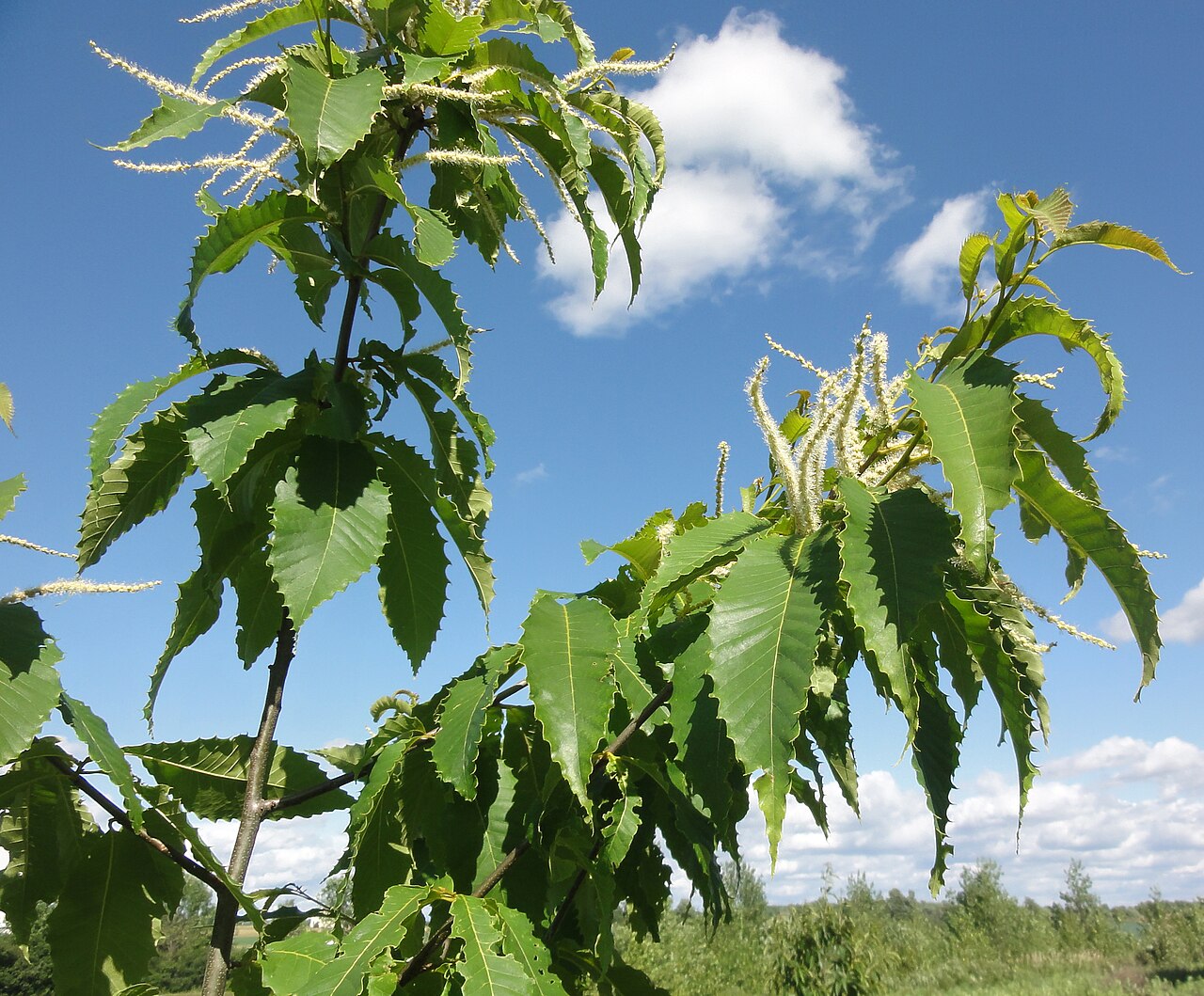
Chestnuts and chinquapins (genus Castanea) are trees and shrubs in the beech family that produce sweet, edible nuts inside spiny husks called burs. Only three are native to the United States: the American chestnut (Castanea dentata), once one of the most important trees of the eastern forest; the shrubby Allegheny chinquapin (Castanea pumila) of the Southeast and Mid-Atlantic; and the Ozark chinquapin (Castanea ozarkensis) of the Ozark and Ouachita Mountains. All three live only in the eastern half of the country.
When gardening lists recommend “chestnut” for New York or other northeastern states, they usually mean the nut trees sold by nurseries today, and most of those are not native. Chinese chestnut, European chestnut, Japanese chestnut and their hybrids make up nearly all chestnut orchards and backyard nut trees in the US, because the native American chestnut was nearly wiped out by chestnut blight in the first half of the twentieth century. The American chestnut still survives in the wild as root sprouts across its old range, and a long restoration effort is underway.
This guide covers the native species, how to tell them from imported chestnuts, and what you can realistically plant if you want a native chestnut or chinquapin today. Note that the European and American “horse chestnuts” (buckeyes, genus Aesculus) are not chestnuts at all: their seeds are poisonous and should never be eaten.
Identification
The genus is easy to recognize. Leaves are simple, alternate and long, with straight, parallel side veins that each end in a sharp tooth. In early summer, long, creamy-white flower catkins cover the tree and give off a strong, musky scent. In fall, the round, very spiny burs split open to release shiny brown nuts.
Bark & Stems
Young chestnut bark is smooth and olive to gray-brown with pale lenticels. On older trees it breaks into broad, flat-topped ridges that often spiral around the trunk. Chestnut blight shows on bark as sunken orange or reddish-brown cankers, often with tiny orange fruiting bodies, which eventually girdle the stem and kill everything above them. Chinquapins are often multi-stemmed and spread by suckers.
Leaves
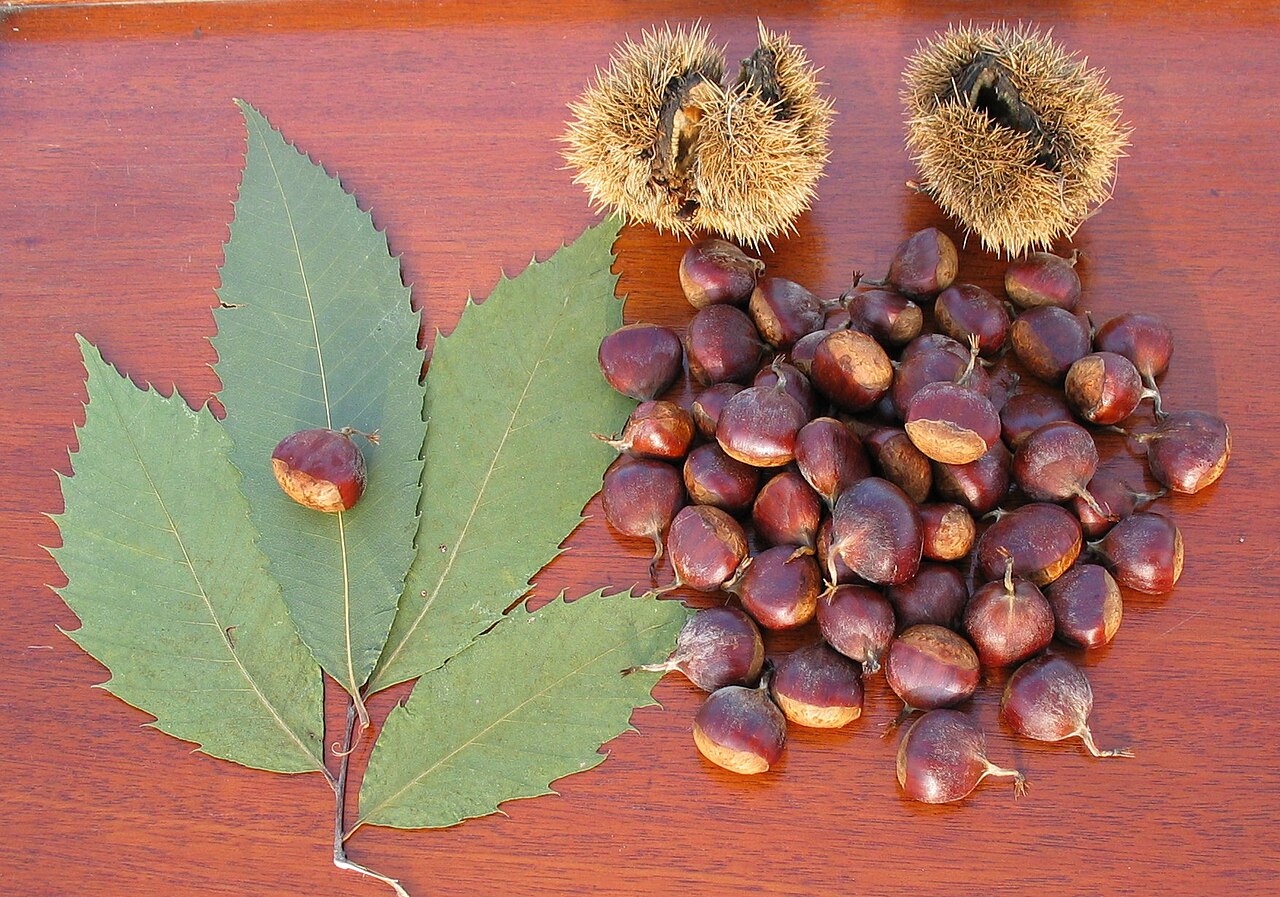
American chestnut leaves are 5 to 11 inches long, narrow and pointed, with large, hooked, bristle-tipped teeth, and they are hairless and green on both sides. Allegheny and Ozark chinquapin leaves are shorter (3 to 8 inches) and usually covered with whitish or pale hairs underneath, which is the quickest way to separate them from American chestnut. Chinese chestnut leaves are wider and glossy with shorter teeth and soft, fuzzy undersides; its twigs are hairy, while American chestnut twigs are smooth.
Flowers
Flowers appear in June and July, after the leaves are full size, which is late for a tree. Long, upright male catkins 4 to 8 inches long cover the crown in creamy white, and small female flowers sit at the base of some catkins. Chestnuts are mostly self-incompatible: a tree needs another tree of the same species nearby, not a clone, to set good nuts.
Fruit & Seeds
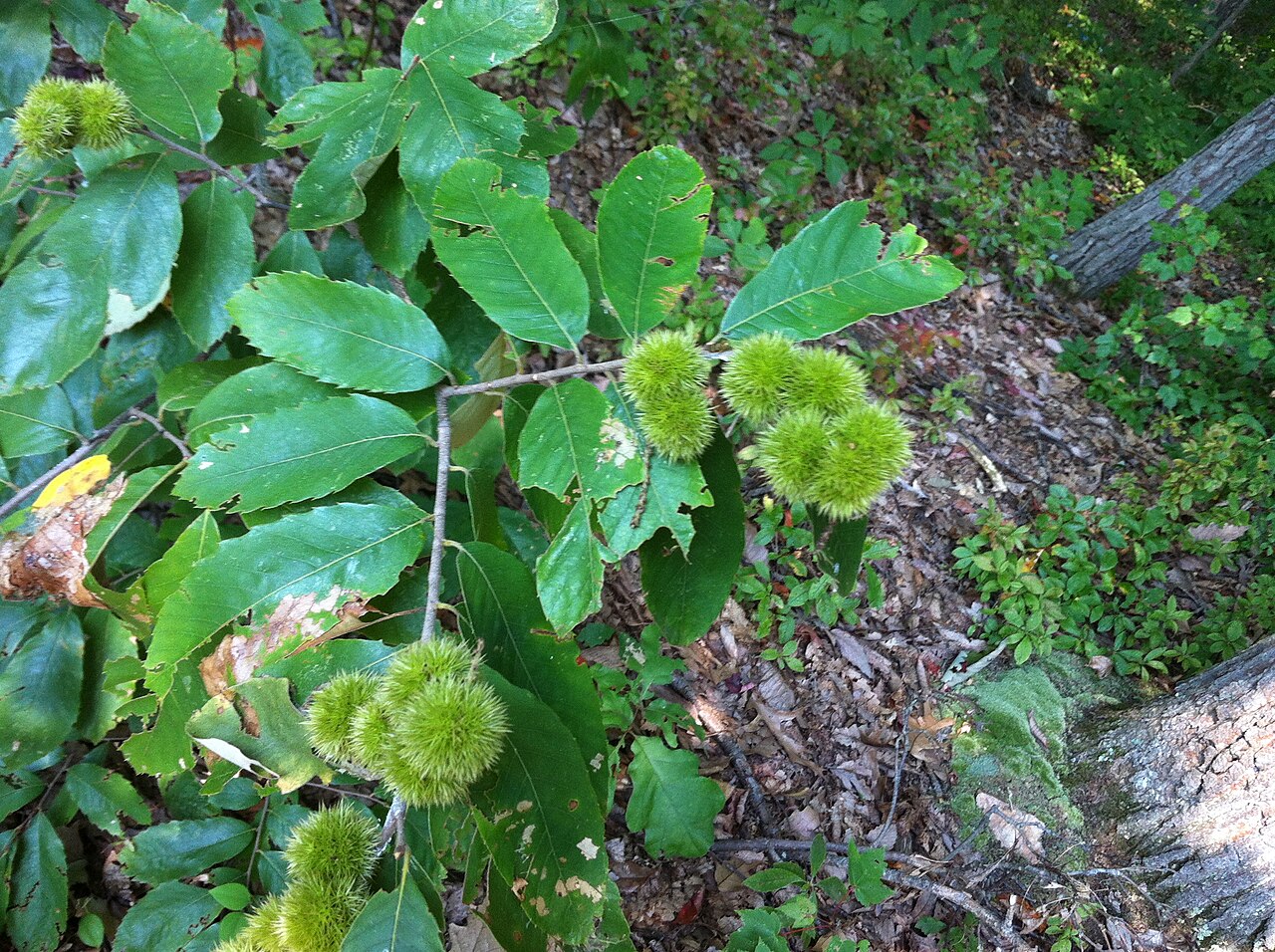
The bur of American chestnut is about 2 to 2½ inches across, densely spiny, and usually holds three nuts, each flattened on one or two sides and pointed at the tip. Chinquapin burs are smaller and hold a single round, glossy nut, usually ½ inch or less. Chinese chestnut nuts are larger than American ones, and European chestnuts larger still. The nuts ripen and fall from mid-September to October.
Quick Facts
| Genus | Castanea |
| Family | Fagaceae (Beech family) |
| U.S. Native Species | 3: American chestnut, Allegheny chinquapin and Ozark chinquapin (about 8–9 species worldwide) |
| Growth Forms | Large trees (American chestnut, historically), small trees and suckering shrubs (chinquapins) |
| Mature Height | Allegheny chinquapin 10–25 ft; Ozark chinquapin up to about 60 ft; American chestnut historically 60–100 ft, now mostly sprouts under 20 ft |
| Growth Rate | Fast |
| Sun Exposure | Full Sun to Part Shade; full sun for nut production |
| Water Needs | Average; drought tolerant once established |
| Soil Type | Well-drained, acidic sandy or rocky loam; intolerant of wet or heavy clay soils |
| Soil pH | About 4.5–6.5 |
| Bloom Time | June – July |
| Flower Color | Creamy white catkins |
| Fall Color | Yellow to golden brown |
| Fruit | Spiny burs holding sweet brown nuts in September – October |
| Wildlife Value | Nuts eaten by deer, turkeys, squirrels, bears and jays; summer pollen for bees |
| Deer Resistant | No; deer browse young trees and eat the nuts |
| USDA Hardiness Zones | About 4–8 (American chestnut); 5–9 (chinquapins) |
Native Range
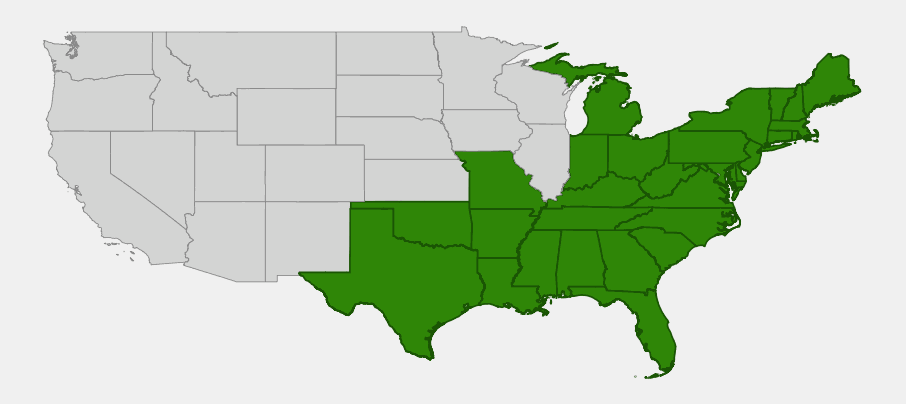
The American chestnut once grew from southern Maine and southern Ontario south along the Appalachians to Georgia, Alabama and Mississippi, and west to southern Michigan, Indiana, Ohio, Kentucky and Tennessee. In the central and southern Appalachians it made up a quarter or more of the trees in many forests, mostly on dry, acidic ridges and upper slopes. It is native to every state in New England, to New York, New Jersey and Pennsylvania, and south through Virginia, West Virginia and the Carolinas. Root sprouts from blight-killed trees still grow throughout this range.
Allegheny chinquapin is a tree of the Southeast and Mid-Atlantic, from New Jersey and southeastern Pennsylvania south through the Piedmont and Coastal Plain to Florida, and west to Kentucky, Tennessee, Arkansas, Louisiana and eastern Texas. It grows in dry, sandy woods, oak-pine forests, sandhills and ridges. The Ozark chinquapin is native to the Ozark Plateau and Ouachita Mountains of Arkansas, southern Missouri and eastern Oklahoma, with scattered records in Louisiana, Mississippi and Alabama.
No chestnut or chinquapin is native west of eastern Texas and Oklahoma, or in the upper Midwest and Plains. American chestnuts planted outside the native range, as in Wisconsin, Michigan’s north, Iowa and the Pacific Northwest, sometimes escape the blight because they are far from infected trees, but they are planted, not wild. The western golden chinquapin belongs to a different genus. The map below shows states where at least one Castanea species is native.
📋 Regional plant lists covering native chestnut country: New York, Pennsylvania & Northern NJ · Delaware, Southern NJ & Long Island · Connecticut, Massachusetts & Rhode Island · New Hampshire, Maine & Vermont · Maryland, Virginia & West Virginia · North & South Carolina · Georgia, Alabama & Mississippi · Kentucky & Tennessee · Ohio & Indiana · Illinois, Iowa & Missouri · Michigan, Wisconsin & Eastern Minnesota · Arkansas, Louisiana, E. Oklahoma & E. Texas
Native Species
The United States has only three native Castanea species, plus a few named varieties of chinquapin. Each name below links to our full plant profile.
American Chestnut (Castanea dentata)
Before the blight, this was a giant of the eastern forest, often 60 to 100 feet tall with trunks 5 feet or more across, and some estimates put its population at around four billion trees. It grew fast, produced nuts every year because it bloomed after late spring frosts, and fed people, livestock and wildlife throughout Appalachia. Today it survives mostly as shrubby sprouts from old root systems that grow until blight kills them back, sometimes flowering before they die. It has long, narrow, hairless leaves with hooked teeth and burs with three nuts. Pure American chestnut seedlings are sold by some native nurseries and restoration groups; plant them knowing they are likely to be infected by blight eventually, except in isolated sites far from other chestnuts.
Allegheny Chinquapin (Castanea pumila)
A multi-stemmed shrub or small tree, usually 10 to 25 feet tall, of dry sandy and rocky woods from New Jersey to Florida and Texas. Leaves are 3 to 6 inches long and white-woolly underneath, and each small bur holds one shiny, sweet nut. It is also susceptible to chestnut blight but survives well because it sprouts freely from the base and fruits young, often within three years from seed. It is the most practical native Castanea for most southeastern gardens. Low, colony-forming plants of the southern Coastal Plain, sometimes called trailing chinquapin, have been named as separate varieties or species in older manuals.
Ozark Chinquapin (Castanea ozarkensis)
A tree once up to about 60 feet tall, native to rocky ridges and slopes of the Ozarks and Ouachitas in Arkansas, Missouri and Oklahoma. Like American chestnut it was devastated by blight after it reached the Ozarks in the mid-twentieth century and now survives mostly as stump sprouts. Its leaves are longer than those of Allegheny chinquapin, with sharp, bristle-tipped teeth, and its burs hold one nut. Some botanists treat it as a variety of Castanea pumila. Volunteer groups are breeding and replanting blight-resistant Ozark chinquapins from surviving trees.
Non-Native Look-Alikes
Almost every chestnut sold for nut production in North America is a non-native species or hybrid. They are planted because they resist chestnut blight far better than the American chestnut, which evolved without it.
- Chinese chestnut (Castanea mollissima), from China and Korea. The most common chestnut in American yards and orchards. It grows into a broad, low-branched, spreading tree 40 to 60 feet tall, rather than the tall, straight forest tree that American chestnut was. Leaves are wider, glossy above and fuzzy underneath; twigs are hairy; nuts are large. It is highly blight resistant. It occasionally seeds into nearby woods in the East but is not considered a major invasive.
- European or sweet chestnut (Castanea sativa), from southern Europe and western Asia. A large tree with big leaves and big nuts, grown mainly in California and the Pacific Northwest where blight pressure is lower. It is susceptible to blight.
- Japanese chestnut (Castanea crenata), from Japan and Korea. A smaller tree with large nuts, now grown mainly as a parent of hybrids such as European × Japanese ‘Colossal’. Chestnut blight is believed to have reached North America on imported Asian chestnut nursery stock around 1900.
- Hybrid chestnuts, such as the Dunstan hybrids and many named orchard cultivars, combine Chinese, Japanese, European and sometimes American chestnut parentage. They are good nut trees but not native plants.
- Horse chestnut (Aesculus hippocastanum) is unrelated. It has hand-shaped compound leaves and poisonous seeds that look like chestnuts. Never eat horse chestnut or buckeye seeds.
- Name look-alikes: chinkapin oak (Quercus muehlenbergii) and chestnut oak (Quercus montana) are native oaks with chestnut-like leaves but acorns, not burs, and the West Coast’s giant chinquapin (Chrysolepis chrysophylla) is a native evergreen relative in a different genus.
To tell a native American chestnut from a Chinese one, check the leaf underside and twigs: American chestnut leaves are hairless and green below with long, hooked teeth, and its twigs are smooth. Chinese chestnut has fuzzy leaf undersides and hairy twigs. Chinquapins have smaller leaves with whitish, hairy undersides and burs with a single nut.
Growing & Care Guide
Light
Chestnuts and chinquapins grow best and produce the most nuts in full sun. They tolerate part shade as young trees, and chinquapins will grow under open oak and pine canopies, but nut crops are light in shade.
Soil & Water
Good drainage is essential. All Castanea species need acidic, well-drained soil such as sandy or rocky loam, and they decline quickly in heavy clay, alkaline soil or anywhere water sits. Wet soils also invite Phytophthora root rot (ink disease), which killed chestnuts in the Southeast even before the blight. Once established, they handle summer drought well; water young trees weekly in dry spells for the first two seasons.
Planting Tips
Plant at least two trees of the same species, from different seed sources, about 30 to 40 feet apart (closer for chinquapins), because chestnuts need cross-pollination to set nuts. Plant nuts or seedlings in spring. Protect seedlings from deer, rabbits and voles with tubes or cages, and plant nuts with a wire screen to keep squirrels from digging them up. If you want to plant American chestnut, contact your state chapter of The American Chestnut Foundation or a local restoration program for sources and guidance.
Pruning & Maintenance
Prune in late winter to remove dead or crossing branches. Watch for blight cankers: sunken, orange or tan patches on bark, often with cracked bark and wilted leaves above. On American chestnut there is no cure, but cutting out infected stems lets the root system resprout. Chestnut gall wasp, an introduced pest, can stunt growth in the Southeast and Mid-Atlantic. Rake up spiny burs in fall where people walk barefoot.
Propagation
Chestnuts and chinquapins grow easily from fresh seed. Collect nuts as they fall, keep them cool and moist (they die if they dry out), and plant them in fall or stratify them in the refrigerator over winter and plant in spring. Chinquapins also spread by root suckers that can be dug and moved in late winter.
Landscape Uses
- Wildlife plantings for deer, turkey and squirrels: Allegheny chinquapin and Ozark chinquapin
- Native shrub borders and hedgerows on dry, sandy sites in the Southeast: Allegheny chinquapin
- Restoration and conservation plantings: American chestnut and Ozark chinquapin, through restoration programs
- Edible landscapes: chinquapins for small sweet nuts; non-native or hybrid chestnuts if large nut crops are the main goal
Wildlife & Ecological Value
For Pollinators
Chestnut catkins provide a heavy flush of pollen in early summer, when spring-blooming trees are finished, and are visited by bees, flies, beetles and other insects. Native chestnuts and chinquapins are also host plants for many moth caterpillars that, in turn, feed songbirds.
For Birds
Wild turkeys, blue jays, woodpeckers, ruffed grouse and bobwhite eat chestnut and chinquapin nuts. Blue jays carry and bury nuts, helping new trees sprout away from the parent. The extinct passenger pigeon fed heavily on chestnuts.
For Mammals
White-tailed deer, black bears, squirrels, chipmunks and mice all eat the nuts. Chestnuts are especially valuable because, unlike oaks, they bloom late enough to escape spring frosts and produce a crop almost every year. Their nuts are also low in tannins compared with acorns.
Ecosystem Role
The loss of the American chestnut was one of the largest ecological changes in eastern North American forests. Oaks, hickories and red maple largely replaced it, and wildlife lost a reliable annual food. Chinquapins remain an important food source in southern oak and pine woods, and blight-resistant American chestnuts and Ozark chinquapins are being returned to their old habitats.
Cultural & Historical Uses
Before the blight, American chestnut was central to Appalachian life. Families gathered the nuts each fall to eat, sell and fatten hogs, and wagonloads of chestnuts were shipped by rail to cities. The wood was straight-grained, light and remarkably rot resistant, and it was used for fence rails, telephone poles, barn beams, shingles, furniture and caskets. Bark and wood were a major source of tannin for leather. Many old barns and houses in the East are still built of chestnut lumber salvaged from dead trees.
Chestnut blight, a fungal disease caused by Cryphonectria parasitica, was first identified in 1904 at the New York Zoological Park (the Bronx Zoo). It spread through the entire native range within about forty years. The fungus kills the trunk and branches but not the roots, which is why sprouts continue to come up from old stumps.
Restoration efforts include The American Chestnut Foundation’s breeding program, which crosses American chestnuts with blight-resistant Chinese chestnuts and then back-crosses to American trees; programs that breed from surviving pure American trees; and research at the State University of New York College of Environmental Science and Forestry on genetically engineered blight tolerance. None has yet returned the chestnut to the forest at scale, but each has produced trees now growing in test plantings.
Frequently Asked Questions
Which chestnuts are native to New York?
Only the American chestnut (Castanea dentata). The Chinese, European and Japanese chestnuts often recommended for planting are imported species. Chinquapins are native from New Jersey south, but not in New York.
Can I still plant an American chestnut?
Yes, but most pure American chestnuts will eventually be infected by blight. They can grow and produce nuts for years, especially in sunny, well-drained sites. For the best chance, use seedlings from restoration programs or blight-resistant breeding lines, and plant several trees for pollination.
What is the difference between a chestnut and a chinquapin?
Both are Castanea. Chestnut burs hold two or three nuts; chinquapin burs hold a single, smaller nut. Chinquapins are usually shrubs or small trees with leaves that are whitish and hairy underneath.
Are chestnuts edible?
True chestnuts and chinquapins have sweet, edible nuts, usually roasted or boiled. Do not confuse them with horse chestnuts or buckeyes (Aesculus), whose seeds are poisonous. True chestnuts have very spiny burs and nuts with a pointed tip and tassel; horse chestnut husks are leathery with a few short spines, and the seeds are rounded with no point.
Why don’t my chestnuts produce nuts?
Usually because there is no second tree to pollinate it. Chestnuts are mostly self-sterile, so plant at least two unrelated trees within about 100 feet of each other. Shade, young age and drought also reduce crops.

Looking for a nursery that carries native chestnuts and chinquapins?
Browse our native plant nursery directory: Alabama & Arkansas · Connecticut, Delaware, Florida & Georgia · Indiana · Kentucky, Louisiana, Maine, Maryland, Massachusetts, Michigan, Mississippi & Missouri · New Hampshire, New Jersey, New York, North Carolina, Ohio & Oklahoma · Pennsylvania, Rhode Island, South Carolina, Tennessee, Texas, Vermont & Virginia · West Virginia

