
Native Blackberries and Raspberries (Rubus)
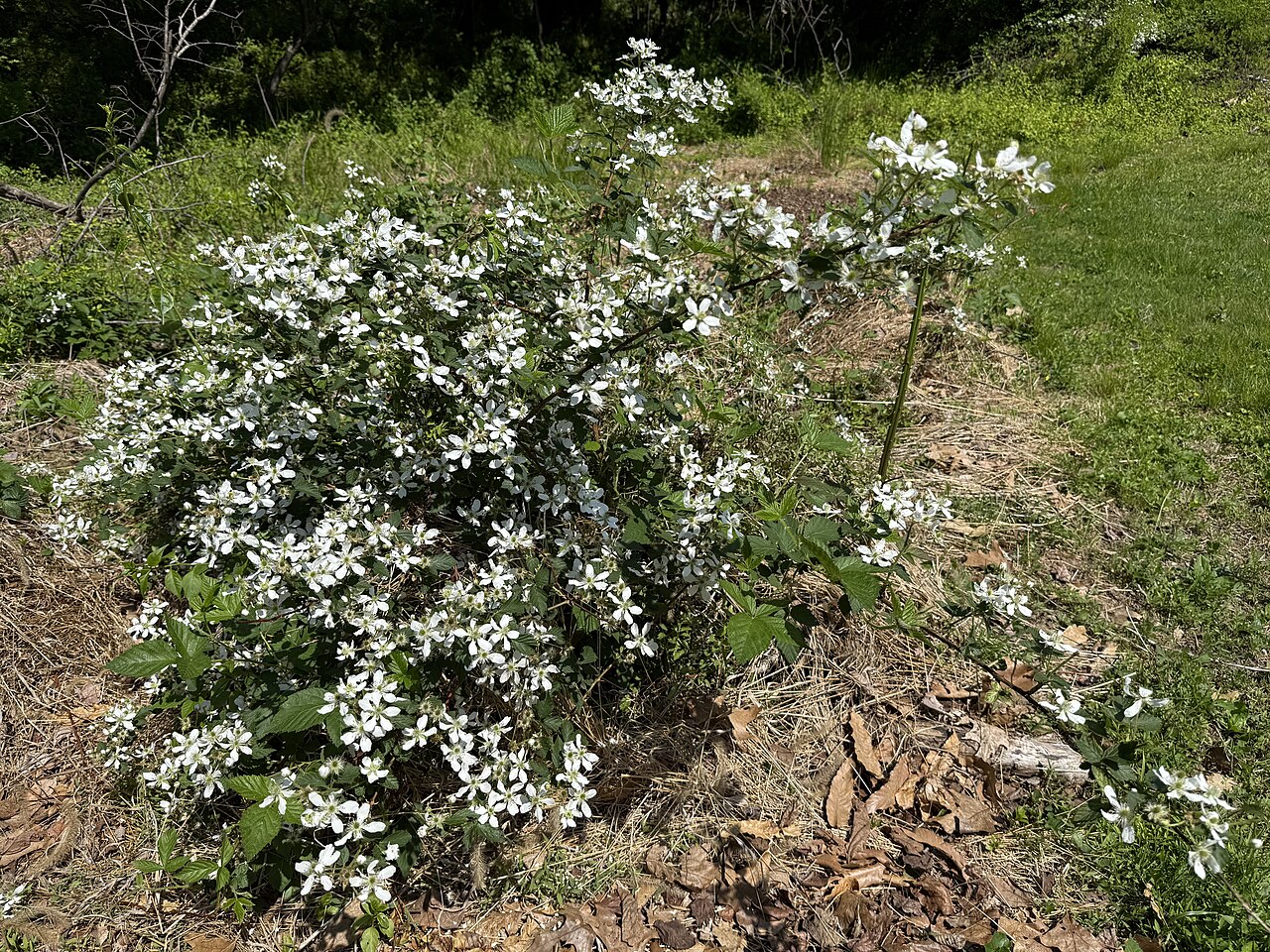
Native blackberries and raspberries (genus Rubus) are the brambles of old fields, woodland edges, clearings and stream banks across the whole United States. Every state, from Florida to Alaska and Hawaii, has at least one wild Rubus. They range from tall, arching, prickly blackberry canes to trailing dewberries, thornless flowering raspberries with flowers like wild roses, and tiny creeping brambles of northern forests and bogs.
When a garden article says “blackberry” without a species name, it usually means one of these wild brambles. In New York, the common native blackberries are Allegheny blackberry (Rubus allegheniensis), the nearly thornless smooth blackberry (R. canadensis) and the trailing northern dewberry (R. flagellaris), with black raspberry, red raspberry and purple-flowering raspberry close relatives. The upright blackberries grow 3 to 8 feet tall, flower white in late spring and early summer, and ripen sweet black fruit in July and August.
This guide covers the most important US-native species, how to tell blackberries from raspberries and dewberries, the invasive non-native brambles that now crowd out natives in many regions, and how to grow native Rubus for fruit and wildlife. Few plant groups feed as many animals: the flowers support native bees, the leaves feed caterpillars, the fruit feeds birds and mammals, and the thorny thickets shelter nesting birds.
Identification
Rubus is in the rose family (Rosaceae). Most species are shrubs with woody but short-lived stems called canes, alternate compound leaves with toothed leaflets, five-petaled flowers and “berries” that are really clusters of small, juicy, one-seeded drupelets. Bramble taxonomy is famously difficult. Blackberries hybridize freely and many reproduce by seed without fertilization, so older manuals named hundreds of blackberry “species.” The Flora of North America takes a broader view and recognizes a few dozen native species. Identifying a wild blackberry to species can be hard even for botanists, but the main groups are easy to tell apart.
Bark & Stems
In most species each cane lives two years. In its first year a cane (the primocane) grows leaves but usually no flowers. In its second year (the floricane) it flowers, fruits and then dies, while new primocanes come up from the crown or roots. Canes may be upright and arching (most blackberries and red raspberry), trailing along the ground and rooting at the tips (dewberries, black raspberry), or low and creeping (dwarf raspberry, cloudberry, five-leaf dwarf bramble). Most are armed with prickles or bristles, but several natives are smooth: thimbleberry, purple-flowering raspberry, Rocky Mountain raspberry and the nearly thornless smooth blackberry. Black raspberry and whitebark raspberry have canes covered with a white, waxy bloom that rubs off.
Leaves
Blackberries and raspberries have compound leaves with three or five leaflets (sometimes seven), arranged like fingers on a hand or along a short axis. Raspberry leaflets are often white or gray-woolly underneath. Thimbleberry, purple-flowering raspberry and cloudberry have simple, maple-like lobed leaves instead, which makes them easy to spot. Many dewberries and southern blackberries keep some leaves through mild winters, often turning red or purple.
Flowers
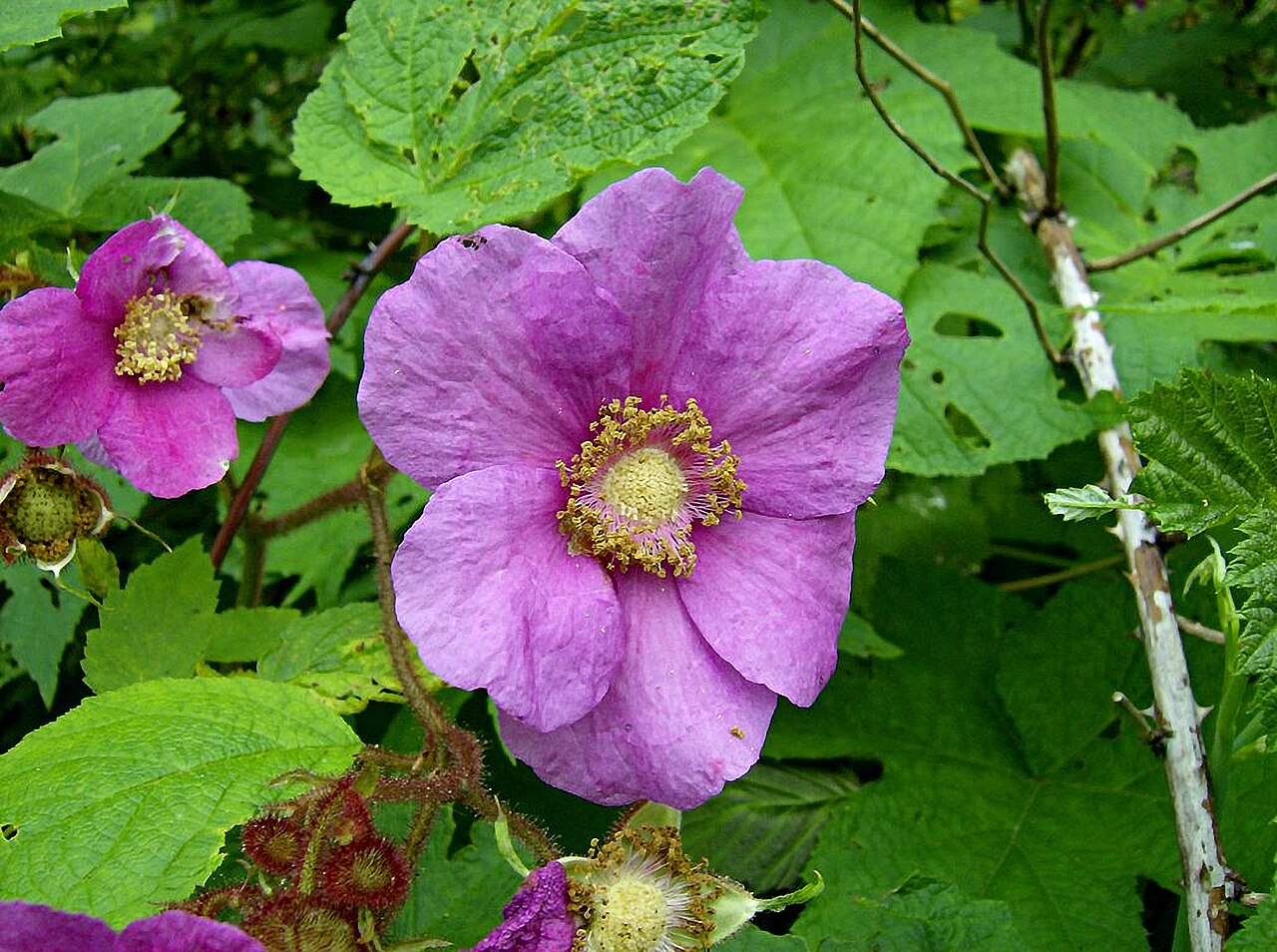
Flowers have five petals and many stamens. Most native blackberries, dewberries and raspberries have white flowers ½ to 1½ inches across, in clusters at the ends of short side shoots. Salmonberry has magenta to pink flowers, purple-flowering raspberry has 1½- to 2-inch rose-purple flowers, and arctic raspberry (R. arcticus) of Alaska has pink flowers. Rocky Mountain raspberry and thimbleberry have showy white flowers up to 2 inches across. Most species bloom from mid-spring to early summer.
Fruit & Seeds
The fruit is the surest way to tell the groups apart:
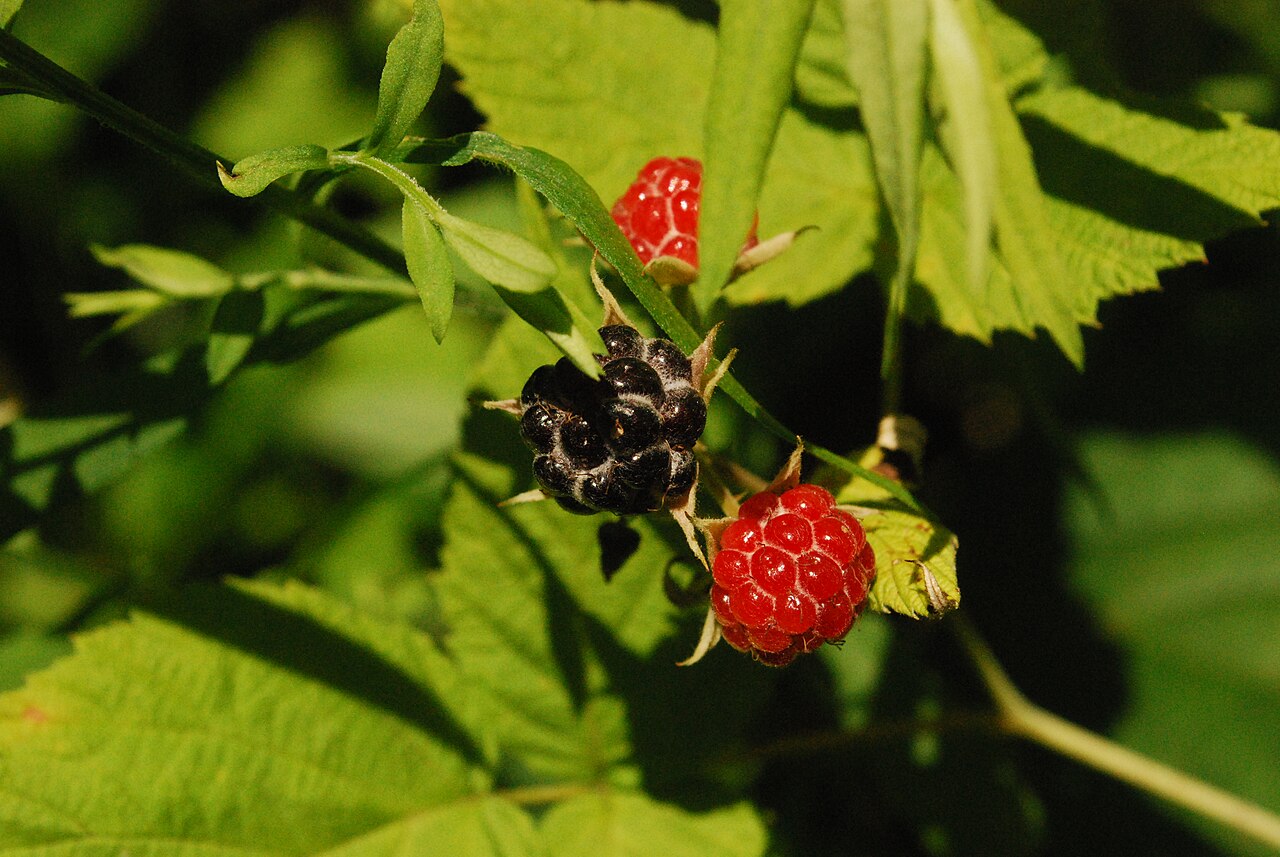
- Raspberries: the ripe fruit pulls away from its core (the receptacle), leaving a hollow, thimble-shaped berry. Fruit may be red (red raspberry), black (black raspberry, whitebark raspberry), salmon to red (salmonberry) or amber (cloudberry).
- Blackberries: the core comes off with the fruit, so a picked blackberry is solid, with a white or green center. Fruit turns from green to red to glossy black.
- Dewberries: blackberries with trailing or low-arching canes that root at the tips. Their fruit is built like a blackberry’s, often larger and fewer per cluster, and ripens earlier.
Birds and mammals eat the fruit and spread the hard seeds, which can stay viable in the soil for years and sprout when a forest is cut or burned.
Quick Facts
| Genus | Rubus (brambles: blackberries, raspberries, dewberries) |
| Family | Rosaceae (Rose family) |
| U.S. Native Species | A few dozen in the Flora of North America treatment (approximate; older manuals named hundreds of blackberry microspecies) |
| Growth Forms | Upright or arching cane shrubs, trailing dewberries and low creeping groundcovers |
| Mature Height | Under 1 ft (dwarf raspberry, cloudberry, five-leaf dwarf bramble) to about 6–10 ft (salmonberry, upright blackberries) |
| Growth Rate | Fast; canes reach full height in one season |
| Sun Exposure | Full Sun to Partial Shade (fruit best in sun) |
| Water Needs | Moderate; a few species grow in bogs and swamps, others on dry slopes |
| Soil Type | Most well-drained soils; many prefer slightly acidic, loamy soil |
| Bloom Time | Mostly April – July, depending on species and region |
| Flower Color | White in most species; pink to magenta in salmonberry, rose-purple in purple-flowering raspberry |
| Fruit | Aggregate berries: black, red, purple, salmon or amber, ripening late spring to late summer |
| Wildlife Value | Very high: nectar and pollen for native bees, caterpillar host, fruit for birds and mammals, thicket cover, nest sites for stem-nesting bees |
| Deer Resistant | No; deer browse leaves and canes, though prickly species hold up |
| USDA Hardiness Zones | About 2–10 depending on species |
Native Range
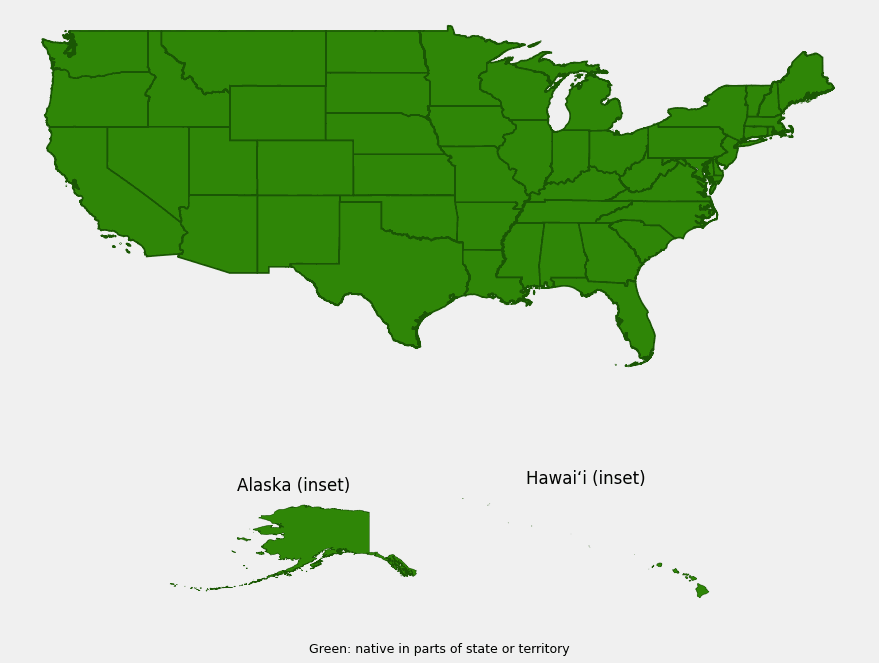
Native Rubus grow in all fifty states. Upright blackberries such as Allegheny, smooth and Pennsylvania blackberry (R. pensilvanicus) dominate old fields and forest edges in the East and Midwest; sawtooth blackberry (R. argutus), sand blackberry (R. cuneifolius) and southern dewberry are common in the Southeast and Texas. Black raspberry, red raspberry and purple-flowering raspberry grow across the North and down the Appalachians.
In the West, thimbleberry ranges from Alaska to New Mexico and east to the Great Lakes, while salmonberry, California blackberry and whitebark raspberry follow the Pacific coast and mountains. Red raspberry also grows high in the Rockies and other western ranges, Rocky Mountain raspberry grows in the foothills of the southern Rockies, and New Mexico raspberry (R. neomexicanus) grows in canyons of Arizona and New Mexico. Cloudberry, arctic raspberry and five-leaf dwarf bramble reach far north into Alaska, and Hawaii has two endemic species, ʻākala (R. hawaiensis) and R. macraei.
Because natives are everywhere, it is easy to forget that some of the most common brambles in the country are not native at all. In the Pacific Northwest and much of California the dominant roadside blackberry is invasive Himalayan blackberry, and in the mid-Atlantic, wineberry has spread through many woods. The map below shows states where at least one Rubus is native.
📋 Regional plant lists covering native bramble country: New York, Pennsylvania & Northern NJ · Delaware, Southern NJ & Long Island · Connecticut, Massachusetts & Rhode Island · New Hampshire, Maine & Vermont · Maryland, Virginia & West Virginia · North & South Carolina · Georgia, Alabama & Mississippi · Kentucky & Tennessee · Ohio & Indiana · Illinois, Iowa & Missouri · Michigan, Wisconsin & Eastern Minnesota · Dakotas & Western Minnesota · Nebraska, Kansas & Eastern Colorado · Arkansas, Louisiana, E. Oklahoma & E. Texas · South & West Texas · Montana & Wyoming · Utah & Western Colorado · Arizona & New Mexico · Idaho, Eastern Oregon & Eastern Washington · Western Oregon & Western Washington · California & Nevada · Alaska · Hawaii
Native Species
These are some of the most important and garden-worthy US-native brambles. Each name links to our full plant profile.
Allegheny Blackberry (Rubus allegheniensis)
The common upright wild blackberry of the Northeast, the Appalachians and the Great Lakes, and the best match for a generic “blackberry” in New York. Its stout, ridged, prickly canes arch 3 to 8 feet tall, and the flower and fruit stalks are covered in sticky glandular hairs. White flowers open in late spring, followed by long, sweet black berries in July and August. It forms thickets in old fields, clearings and woodland edges.
Northern Dewberry (Rubus flagellaris)
A trailing blackberry of dry fields, sandy openings and roadsides across the eastern and central US. Its thin, prickly canes run along the ground and root at the tips, and each flowering shoot carries only a few white flowers. The black fruit ripens in early summer, before the upright blackberries. It makes a tough, low groundcover for dry, sunny banks.
Southern Dewberry (Rubus trivialis)
The common dewberry of the Southeast and Texas, with trailing canes armed with hooked prickles and red bristles, and leaves that are often evergreen. It blooms very early, from late winter into spring, with white to pale pink flowers, and its fruit ripens in April and May in the Deep South.
Swamp Dewberry (Rubus hispidus)
A low, trailing bramble of wet meadows, bogs, swamp edges and damp woods in the eastern US. Its slender canes are covered in soft bristles rather than stout prickles, and its glossy three-parted leaves often stay green through winter. The small fruit turns red to dark purple-black and is usually sour. It is a good native groundcover for damp, acidic soil.
Black Raspberry (Rubus occidentalis)
Also called blackcap. An eastern raspberry with arching canes covered in a white, waxy bloom and hooked prickles; the cane tips root where they touch the ground. The fruit is small, black and hollow, and ripens in late June and July, earlier than blackberries. It is common along woodland edges and fencerows across the East and Midwest.
American Red Raspberry (Rubus idaeus)
The wild red raspberry, native across the northern US, Alaska and the western mountains (the North American form is often called subspecies strigosus). Its upright canes are covered in fine bristles, the leaflets are whitish underneath, and the hollow red fruit ripens in midsummer. It thrives in clearings, burns and rocky slopes, often in great numbers after logging or fire.
Purple-Flowering Raspberry (Rubus odoratus)
A thornless, many-stemmed shrub 3 to 6 feet tall with large, maple-like leaves and fragrant, rose-purple flowers 1½ to 2 inches across from early summer into late summer. Its flat, red fruits are edible but seedy. It is native to the Northeast and the Appalachians, grows in rocky woods and shady roadbanks, and is one of the best brambles for partly shaded gardens.
Thimbleberry (Rubus parviflorus)
The western counterpart of purple-flowering raspberry: a thornless shrub with big, soft, maple-like leaves and white flowers up to 2 inches across. The soft, shallow red fruit is shaped like a thimble. It grows from Alaska through the Rockies and Pacific states and also around the upper Great Lakes, in forest openings, along streams and on roadsides.
Salmonberry (Rubus spectabilis)
A tall, thicket-forming raspberry of moist forests and stream banks along the Pacific coast from Alaska to California. It is among the first shrubs to bloom in spring, with nodding magenta to pink flowers that feed early hummingbirds. The juicy fruit ripens yellow-orange to red. Canes reach 6 to 10 feet and carry weak prickles mostly near the base.
California Blackberry (Rubus ursinus)
Also called Pacific blackberry or trailing blackberry. The only common native blackberry of the West Coast, native in California, Oregon and Washington. Its slender, trailing or mounding canes have small, straight prickles, and male and female flowers are on separate plants, so only female plants fruit. The small, sweet black berries ripen in early summer. It is an ancestor of loganberry, boysenberry and marionberry.
Whitebark Raspberry (Rubus leucodermis)
A western black raspberry with arching canes coated in a white, waxy bloom and hooked prickles. It grows in open forests, burns and canyons from British Columbia to California and east into the northern Rockies. The hollow fruit ripens dark purple to black, occasionally reddish.
Rocky Mountain Raspberry (Rubus deliciosus)
Also called boulder raspberry. A thornless, rounded shrub 3 to 5 feet tall of rocky canyons and foothills in the southern Rockies, especially Colorado. Its large, white, rose-like flowers are its main attraction; the dark red to purple fruit is dry and seedy despite the species name. It is a tough, drought-tolerant flowering shrub for western gardens.
Dwarf Raspberry (Rubus pubescens)
A low, thornless, trailing bramble of moist northern forests, cedar swamps and stream banks across Canada and the northern US. It has three-parted leaves, small white or pale pink flowers, and a few shiny red drupelets per fruit. It works as a woodland groundcover in cool, damp shade.
Cloudberry (Rubus chamaemorus)
A low, thornless plant of peat bogs and tundra, with rounded, lobed leaves and single white flowers. Male and female flowers grow on separate plants. The amber-orange fruit is prized in Scandinavia and Alaska. In the US it grows in Alaska and in a handful of bogs and alpine sites in Maine and New Hampshire, where it is rare.
Roughfruit Berry (Rubus lasiococcus)
A small, thornless, trailing bramble of mountain forests and subalpine meadows in the Cascades and the mountains of northern California. Its creeping stems root at the nodes and carry small, three-lobed or three-parted leaves, single white flowers and small red, finely hairy fruits.
More Rubus profiles: five-leaf dwarf bramble (R. pedatus)
Other widespread natives without their own profiles yet include smooth blackberry (R. canadensis), a nearly thornless upright blackberry of the Northeast and Appalachians; Pennsylvania blackberry (R. pensilvanicus); sawtooth blackberry (R. argutus) of the Southeast; and ʻākala (R. hawaiensis), a large native raspberry of Hawaiian mountain forests.
Non-Native Look-Alikes
Several non-native brambles have escaped from cultivation and are now among the worst invasive shrubs in the country. They look similar to native blackberries and raspberries, so learn the differences before you plant or protect a bramble patch.
- Himalayan blackberry (Rubus armeniacus, also sold as R. discolor or R. procerus), from Armenia and the Caucasus. Massive, thick, strongly angled canes up to 10 feet tall and 30 feet long, with large hooked prickles and usually five leaflets that are white-woolly underneath. It is invasive in Washington, Oregon, California and Idaho and also escapes in the East. It forms impenetrable thickets along streams, roads and pastures and crowds out native California blackberry and salmonberry.
- Cutleaf or evergreen blackberry (Rubus laciniatus), from Europe. Easy to identify by its deeply cut, lacy leaflets. It is invasive in the Pacific Northwest and California and escapes elsewhere.
- Wineberry (Rubus phoenicolasius), from East Asia. A raspberry whose canes, leaf stalks and flower buds are covered in dense reddish, gland-tipped hairs; the leaflets are white underneath and the fruit is bright red and shiny. It is invasive in forests and edges from New England to Georgia and west to Illinois, especially in the mid-Atlantic. No native bramble has red-hairy canes like these.
- European red raspberry and garden blackberries. Cultivated raspberries (European R. idaeus and hybrids) and thornless garden blackberries are mixed-ancestry crops. They are fine in the vegetable garden, but they can escape and are not substitutes for wild native brambles in habitat plantings.
- Invasive brambles in Hawaii. Yellow Himalayan raspberry (R. ellipticus), roseleaf raspberry (R. rosifolius), hill raspberry (R. niveus) and even sawtooth blackberry (R. argutus), native in the eastern US, are serious invasives in Hawaiian forests. In Hawaii, plant only the native ʻākala.
Quick checks: Himalayan blackberry canes are thicker than a thumb and sharply five-angled, with white-backed leaves; cutleaf blackberry has jagged, deeply divided leaflets; wineberry is covered in red hairs. If you have any of these, remove them and replace them with a native species for your region.
Growing & Care Guide
Light
For fruit, grow blackberries, dewberries and red or black raspberries in full sun; they tolerate partial shade but bear less. Purple-flowering raspberry, thimbleberry, salmonberry, dwarf raspberry and swamp dewberry are better suited to partial shade and woodland edges.
Soil & Water
Most native brambles grow in any reasonably well-drained soil and prefer it slightly acidic. Dewberries and Rocky Mountain raspberry handle dry, sandy or rocky soils once established. Salmonberry, swamp dewberry, dwarf raspberry and cloudberry need moist to wet soil. Water new plantings regularly through their first summer; after that, most need watering only in long droughts.
Planting Tips
Choose the right species for the space. Upright blackberries and raspberries sucker and spread into thickets, so give them a back corner, a hedgerow or a wildlife border where they can expand, or contain them with a mowed edge. Trailing dewberries make groundcovers on sunny banks. Thornless purple-flowering raspberry, thimbleberry and Rocky Mountain raspberry work in mixed shrub borders close to paths. Plant in spring or fall, setting crowns at the same depth they grew in the pot.
Pruning & Maintenance
Because most canes die after fruiting, prune by cutting the old, gray, fruited canes to the ground after harvest or in late winter, leaving the vigorous new canes. Thin crowded patches to improve air flow and make picking easier. Tip-pinch black raspberry canes in summer if you want branching rather than spreading. Wild patches meant for wildlife can be left alone or cut back every few years to renew them.
Propagation
Brambles are easiest to propagate by digging rooted suckers or rooted cane tips (black raspberry, dewberries) in early spring. Seed needs a long cold, moist period and often takes more than one year to sprout. Buy plants from native plant nurseries rather than digging from the wild, and avoid moving soil or plants from patches that also contain invasive brambles.
Landscape Uses
- Wildlife hedgerows and thickets: Allegheny blackberry, black raspberry, salmonberry
- Edible native gardens: black and red raspberry, Allegheny blackberry, California blackberry, dewberries
- Groundcover for dry, sunny banks: northern and southern dewberry
- Shade and woodland gardens: purple-flowering raspberry, thimbleberry, dwarf raspberry
- Restoration after clearing or fire: red raspberry, blackberries, thimbleberry
- Flowering shrubs for dry western gardens: Rocky Mountain raspberry
Wildlife & Ecological Value
For Pollinators
Bramble flowers are open and easy to reach, and they feed a wide range of native bees, including bumble bees, mining bees, sweat bees and small carpenter bees, plus flies, beetles and butterflies. Small carpenter bees (Ceratina) and some other stem-nesting bees excavate nests in the soft pith of broken or cut bramble canes, so leaving some old cane stubs 8 to 15 inches tall provides nest sites.
For Birds
Blackberries and raspberries are summer food for dozens of bird species, including gray catbirds, American robins, northern cardinals, brown thrashers, cedar waxwings, wild turkeys and grouse. Dense, prickly thickets protect nesting catbirds, indigo buntings, chestnut-sided warblers and other shrubland birds from predators. Salmonberry flowers are an important early nectar source for returning rufous hummingbirds in the Pacific Northwest.
For Mammals
Black bears, foxes, raccoons, opossums, chipmunks and many small mammals eat the fruit. Deer and rabbits browse the leaves and canes, and rabbits shelter in bramble thickets through winter.
Ecosystem Role
Rubus is one of the most important native host plants for moths and butterflies in the eastern US, supporting the caterpillars of well over a hundred species, which in turn feed nesting birds. Brambles are also pioneers: their long-lived seeds sprout after logging, fire or storm damage, and the thickets hold soil and shade the ground while the forest regrows.
Cultural & Historical Uses
Native peoples across North America gathered wild blackberries, raspberries, thimbleberries, salmonberries and cloudberries as fresh fruit and dried them for winter. Coastal peoples of the Pacific Northwest also historically ate young salmonberry and thimbleberry shoots in spring. In Alaska, cloudberries are still gathered and stored in quantity.
American settlers relied on wild blackberries for pies, jams and cordials, and the hybrid berries of the West Coast came from native stock: loganberry was bred in California from California blackberry and red raspberry, and boysenberry and marionberry also have California blackberry in their ancestry.
The fruit of all native blackberries and raspberries is edible. As with any wild food, identify plants with certainty and avoid patches along busy roads or areas sprayed with herbicide.
Frequently Asked Questions
Are blackberries native to New York?
Yes. Several blackberries are native in New York, most commonly Allegheny blackberry, smooth blackberry and northern dewberry, along with native black, red and purple-flowering raspberries. Upright species grow 3 to 8 feet tall, bloom white in late spring and early summer and ripen sweet black fruit in July and August.
How can I tell a blackberry from a raspberry?
Pick a ripe berry. A raspberry comes off its core and is hollow inside; a blackberry keeps its core and is solid. Raspberry leaves are usually whitish underneath, and black raspberry canes have a white, waxy coating.
Is the blackberry along my road native?
In the East, most roadside blackberries are native, but check for wineberry’s red-hairy canes. In Washington, Oregon and California, large thickets with thick, angled canes are almost always invasive Himalayan blackberry; the native California blackberry is a slender, trailing vine.
Will native blackberries take over my yard?
Upright blackberries and raspberries spread by suckers and rooting cane tips and form thickets if left alone. Give them room or keep them in bounds by mowing around the patch and removing unwanted suckers each spring. Thornless purple-flowering raspberry, thimbleberry and Rocky Mountain raspberry are easier to keep in a border.
Which native brambles have no thorns?
Thimbleberry, purple-flowering raspberry, Rocky Mountain raspberry, dwarf raspberry, cloudberry, roughfruit berry and five-leaf dwarf bramble are thornless, and smooth blackberry is nearly so.

Looking for a nursery that carries native blackberries and raspberries?
Browse our native plant nursery directory: Alabama, Alaska, Arizona & Arkansas · California · Colorado, Connecticut, Delaware, Florida, Georgia & Hawaii · Idaho, Illinois, Indiana, Iowa & Kansas · Kentucky, Louisiana, Maine, Maryland, Massachusetts, Michigan, Minnesota, Mississippi, Missouri & Montana · Nebraska, Nevada, New Hampshire, New Jersey, New Mexico, New York, North Carolina, North Dakota, Ohio & Oklahoma · Oregon · Pennsylvania, Rhode Island, South Carolina, South Dakota, Tennessee, Texas, Utah, Vermont & Virginia · Washington · West Virginia, Wisconsin & Wyoming

