
Virginia Groundcherry (Physalis virginiana)
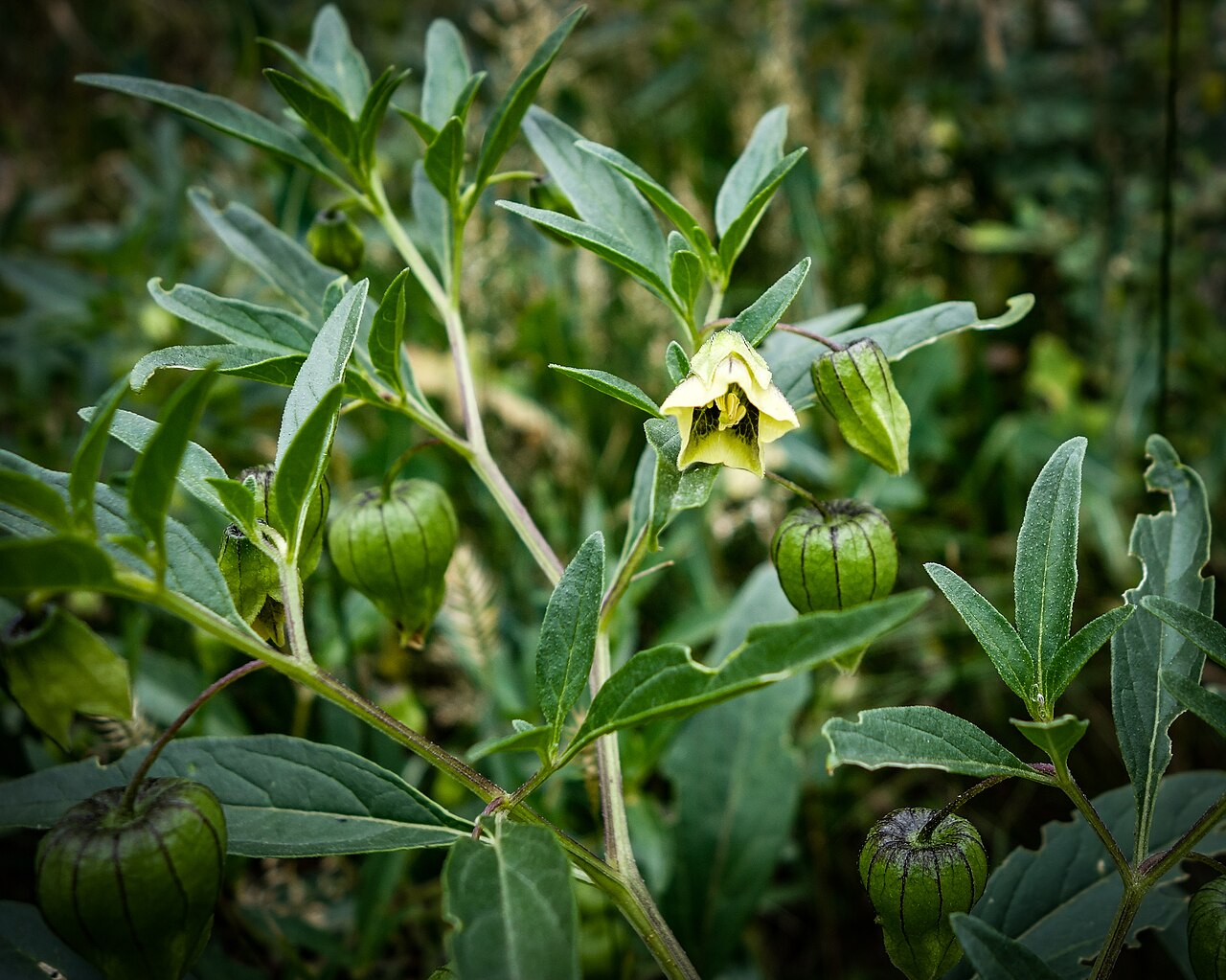
Physalis virginiana, known as Virginia Groundcherry (USDA: Virginia groundcherry; also called lanceleaf groundcherry), is a native perennial wildflower in the nightshade family (Solanaceae). It grows about 1 to 2 feet tall from deep, creeping rhizomes and has narrow, lance-shaped leaves that taper into the leaf stalk. Through summer it bears nodding, bell-shaped yellow flowers with dark purplish-brown blotches in the throat, followed by papery green “lanterns” that each enclose a single round berry.
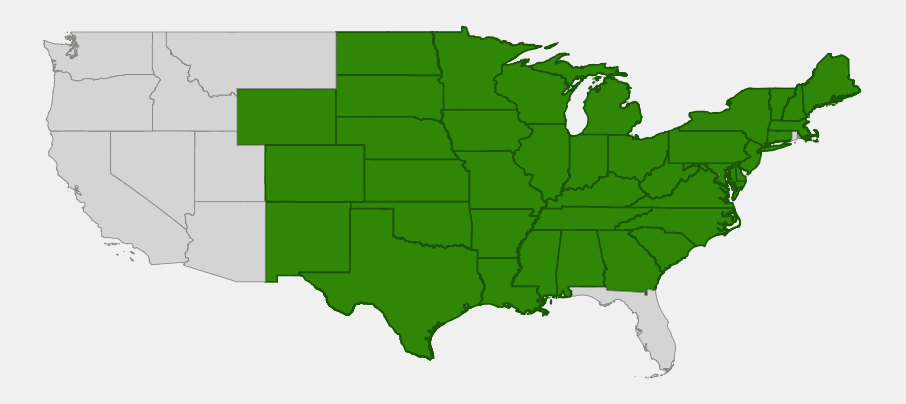
USDA PLANTS records it as native in 38 states, from New England and the Great Lakes south to Georgia and Louisiana and west across the Great Plains to Colorado, Wyoming and New Mexico, and in Manitoba, Ontario and Quebec. It grows in prairies, dry open woods, savannas, old fields, fencerows and roadsides, usually in well-drained loam, sand or gravel.
Safety note: like other groundcherries, the leaves, stems and unripe green berries contain solanine-type glycoalkaloids and are poisonous to people, pets and livestock. Only fully ripe berries, taken out of their dry husks, are reported to be edible. In gardens it is an easy, drought-tolerant prairie plant whose flowers feed specialist native bees.
Identification
Virginia groundcherry is one of several look-alike perennial groundcherries. Narrow leaves that taper gradually to the stalk, short flat-lying hairs (not sticky ones), and a husk that is deeply sunken around the stalk are the best clues.
Growth Habit & Stems
A rhizomatous perennial, usually 8 to 24 inches tall and occasionally taller, with upright to spreading, branched stems. Plants spread slowly by deep, horizontal rhizomes and may form small colonies. The stems are covered with short, stiff hairs that lie flat or curve downward; they lack the long, sticky glandular hairs of clammy groundcherry.
Leaves
The leaves are alternate, lance-shaped to narrowly oval, up to about 3 inches long and usually less than 1 inch wide. They narrow gradually into the leaf stalk (a wedge-shaped base), and the margins are smooth or have a few shallow, wavy teeth. Both surfaces carry short, appressed hairs.
Flowers
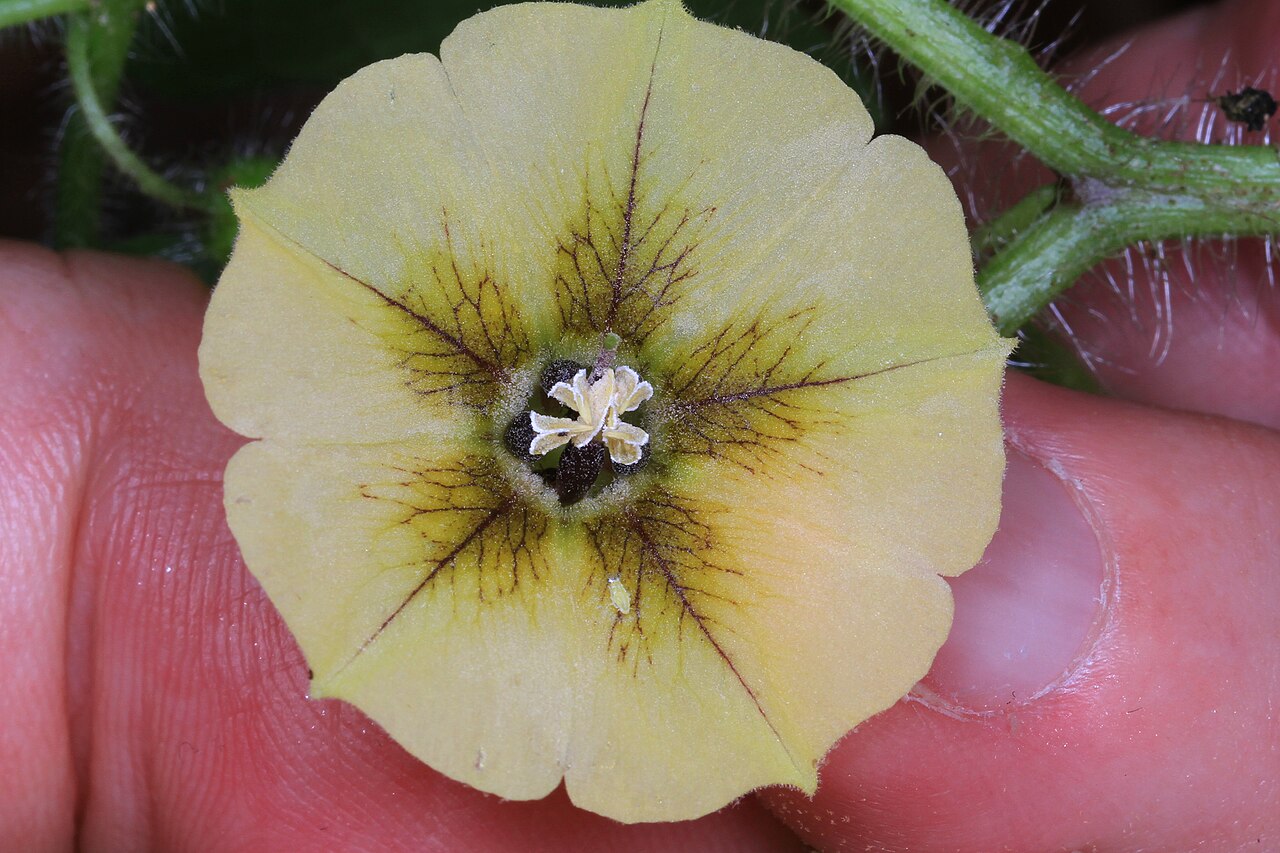
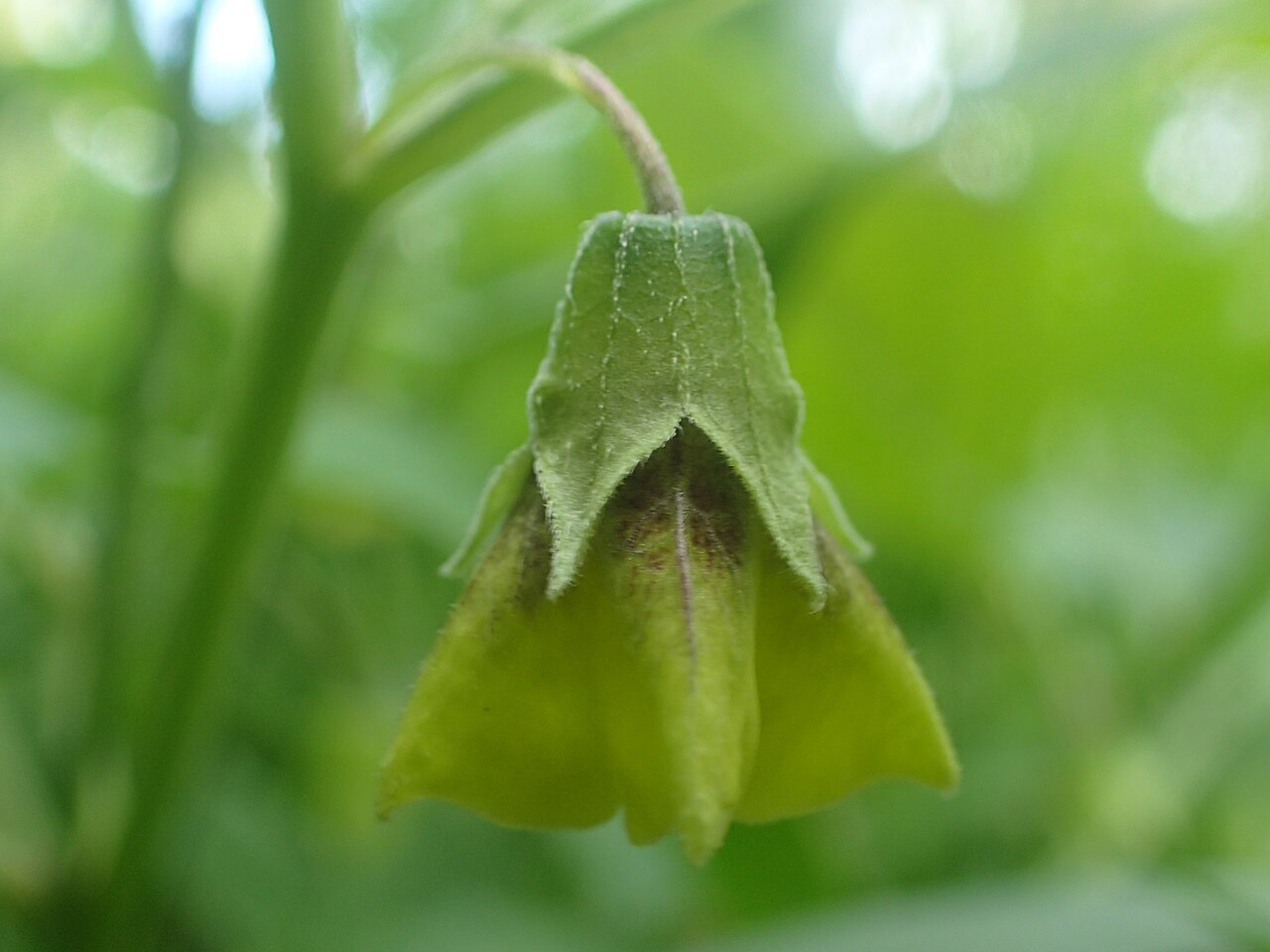
Single flowers hang from the leaf axils on short stalks from about June into August (starting in May in the South). Each is a nodding, bell-shaped corolla about 3/4 inch across, pale to bright yellow with five dark purplish-brown blotches or streaks at the base inside. The anthers are yellow, sometimes tinged blue or purple.
Fruit
After flowering, the calyx enlarges into a hanging, papery, five-angled husk about 1 to 1 1/2 inches long. A good field mark is that the base of the husk is deeply indented (invaginated) around the stalk. Inside is a round berry about 1/2 inch across that ripens red-orange when fully mature, with many small seeds.
Look-alikes
Clammy Groundcherry (Physalis heterophylla) has broad, heart-shaped leaves and sticky glandular hairs. Long-Leaved Groundcherry (P. longifolia) also has narrow leaves, but it is nearly hairless or only sparsely hairy, and is usually a more robust plant with toothier leaves. Annual groundcherries lack the perennial rhizomes and usually have smaller flowers without the large dark blotches.
Safety
The leaves, stems and unripe green berries contain glycoalkaloids related to solanine and are poisonous if eaten, causing stomach upset and, in larger amounts, more serious symptoms. Keep children and pets from eating the plant, and do not let livestock graze heavy stands. Only fully ripe berries removed from the dry husk are considered edible, and even these are best eaten in small amounts. If you are not sure of the identification or ripeness, do not eat them.
Quick Facts
| Scientific Name | Physalis virginiana |
| Family | Solanaceae (nightshade family) |
| Plant Type | Rhizomatous herbaceous perennial wildflower |
| Mature Height | 1–2 ft |
| Mature Spread | 1–2 ft; spreads slowly by rhizomes |
| Growth Rate | Moderate |
| Sun Exposure | Full sun to partial shade |
| Water Needs | Low to medium; drought tolerant once established |
| Soil Type | Sandy, gravelly or loamy, well-drained soil |
| Soil pH | About 5.5–7.5 |
| Bloom Time | June–August |
| Flower Color | Yellow with dark purplish-brown blotches |
| Fall Color | Not significant; husks turn tan |
| Fruit | Round berry, ripening red-orange, inside a papery husk |
| Deer Resistant | Mostly; the toxic foliage is seldom browsed |
| USDA Hardiness Zones | 3–9 |
Native Range
Virginia groundcherry is a plant of eastern and central North America. USDA PLANTS lists it as native in the lower 48 states and Canada, with records from 38 states: across New England, the Mid-Atlantic and the Great Lakes, south to Georgia, Alabama, Mississippi and Louisiana, and west through the Great Plains to Texas, Oklahoma, Colorado, Wyoming and New Mexico. In Canada it is native in Manitoba, Ontario and Quebec.
It is most frequent in the prairie and savanna country of the Midwest and Great Plains, and it becomes scattered toward the Atlantic Coast and the Southeast. Records from Colorado, Wyoming and New Mexico mark the western edge of the range, where it grows on the plains and in the foothills. Groundcherries are a notoriously variable group, and botanists have long debated how to divide the perennial species, so older field guides may lump or split them differently.
Typical habitats are dry to mesic prairies, sand prairies, oak savannas, open woods and woodland edges, glades, old fields, pastures, fencerows, railroad banks and roadsides. It favors open, well-drained ground and tolerates poor, sandy soils.
📋 Regional plant lists featuring Virginia Groundcherry: New York, Pennsylvania & Northern New Jersey · Ohio & Indiana · Montana & Wyoming · Michigan, Wisconsin & Eastern Minnesota · Kentucky & Tennessee · Nebraska, Kansas & Eastern Colorado · Connecticut, Massachusetts & Rhode Island · New Hampshire, Maine & Vermont · Maryland, Virginia & West Virginia · Delaware, Southern New Jersey & Long Island · Illinois, Iowa & Missouri · Alabama, Georgia & Mississippi · North & South Carolina · Arkansas, Louisiana, Eastern Oklahoma & Eastern Texas · North Dakota, South Dakota & Western Minnesota
Growing & Care Guide
Virginia groundcherry is a modest but tough native for sunny, dry spots. It fills gaps between prairie grasses, tolerates poor sandy soil and drought, and supports specialist bees. Because it spreads by rhizomes and its foliage is toxic, give it room in a meadow or wild area rather than a small formal bed.
Light
Full sun gives the best flowering and fruiting. It also grows in light or partial shade along woodland edges and in savannas, though it blooms less there.
Soil & Water
Grow it in sandy, gravelly or loamy, well-drained soil; it does well in low-fertility ground. The deep rhizomes carry it through dry spells, so established plants rarely need watering. Avoid heavy clay that stays wet.
Planting Tips
Set out container plants or sow seed in spring after frost, spacing plants 1 to 2 feet apart. Pair it with prairie grasses and sturdier wildflowers that can hide its sprawling stems. Keep it away from vegetable beds, where its rhizomes can become a nuisance and it may share pests with tomatoes and potatoes.
Pruning & Maintenance
Little care is needed. Cut back or mow dead stems in late winter. Pull unwanted shoots while they are young if it spreads too far. Like other nightshades it can host Colorado potato beetles and flea beetles, which seldom do serious harm in a mixed planting.
Propagation
Collect fully ripe berries, mash them, rinse out the seeds and let them dry. Sow on the surface or barely cover in spring, or sow outdoors in fall for natural cold stratification; seed germinates best in warm soil. Established clumps can be divided by cutting sections of rhizome in early spring.
Landscape Uses
- Prairie and meadow plantings: a low filler among grasses and wildflowers on dry, open ground
- Sandy and gravelly sites: grows on poor, well-drained soils
- Native bee gardens: supports specialist groundcherry bees and other small bees
- Savanna and woodland-edge restoration: tolerates light shade under open oaks
- Wildlife plantings: ripe berries feed birds and small mammals; site it away from children and pets
Wildlife & Ecological Value
Like other groundcherries, Virginia groundcherry looks unassuming, but it supports specialist bees, fruit-eating birds and several insects that feed only on Physalis.
For Pollinators
The nodding flowers are visited mainly by bees. The groundcherry bee (Colletes latitarsis) collects pollen almost entirely from Physalis flowers, and sweat bees and other small native bees also visit for pollen and nectar.
For Birds
Wild turkeys, northern bobwhite and other ground-feeding birds eat the ripe berries and seeds, and the plants give low cover in prairies and old fields.
For Mammals
Mice and other small mammals eat fallen berries and seeds. Deer and livestock usually avoid the toxic foliage.
Ecosystem Role
Groundcherries are host plants for specialist insects such as the three-lined potato beetle, tortoise beetles and groundcherry-feeding moth caterpillars. The rhizomes help hold sandy and disturbed soils, and the plant persists for years in prairie and savanna remnants.
Cultural & Historical Uses
Groundcherries were gathered for food by many Native American peoples, who ate the ripe fruit raw or cooked and dried it for winter. Virginia groundcherry was among the wild species used, and various parts of groundcherry plants were also used in traditional medicine, always with knowledge of which parts and stages are safe.
The species was named by the English botanist Philip Miller, curator of the Chelsea Physic Garden in London, in 1768. Its name “virginiana” reflects the custom of the time, when “Virginia” often stood loosely for much of eastern North America.
The genus name Physalis comes from the Greek word for a bladder or bellows, describing the inflated husk around the fruit. The same feature shows up in its cultivated relatives, the tomatillo and the cape gooseberry, and in the ornamental Chinese lantern.
Frequently Asked Questions
Is Virginia groundcherry poisonous?
Partly. The leaves, stems and unripe green berries contain solanine-type glycoalkaloids and are poisonous to people, pets and livestock. Only fully ripe berries, removed from the dry husk, are reported to be edible.
How do I tell Virginia groundcherry from other groundcherries?
Look for narrow, lance-shaped leaves that taper gradually to the stalk, short flat-lying hairs rather than sticky ones, a husk that is deeply indented around the stalk, and berries that ripen red-orange.
Where does Virginia groundcherry grow?
It is native across the eastern and central United States, from New England and Georgia west to Colorado, Wyoming and New Mexico, and in southern Manitoba, Ontario and Quebec. It favors prairies, savannas, open woods and old fields.
Will it spread in my garden?
It spreads slowly by deep rhizomes and can form small colonies in loose soil, so it is best in meadows, prairie plantings and wild areas.
Does it attract pollinators?
Yes. Bees, including the specialist groundcherry bee (Colletes latitarsis), visit the flowers for pollen and nectar.

Looking for a nursery that carries Virginia Groundcherry?
Browse our native plant nursery directory: Alabama & Arkansas · Colorado, Connecticut, Delaware & Georgia · Illinois, Indiana, Iowa & Kansas · Kentucky, Louisiana, Maine, Maryland, Massachusetts, Michigan, Minnesota, Mississippi & Missouri · Nebraska, New Hampshire, New Jersey, New Mexico, New York, North Carolina, North Dakota, Ohio & Oklahoma · Pennsylvania, South Carolina, South Dakota, Tennessee, Texas, Vermont & Virginia · West Virginia, Wisconsin & Wyoming

