
Purple Giant Hyssop (Agastache scrophulariifolia)
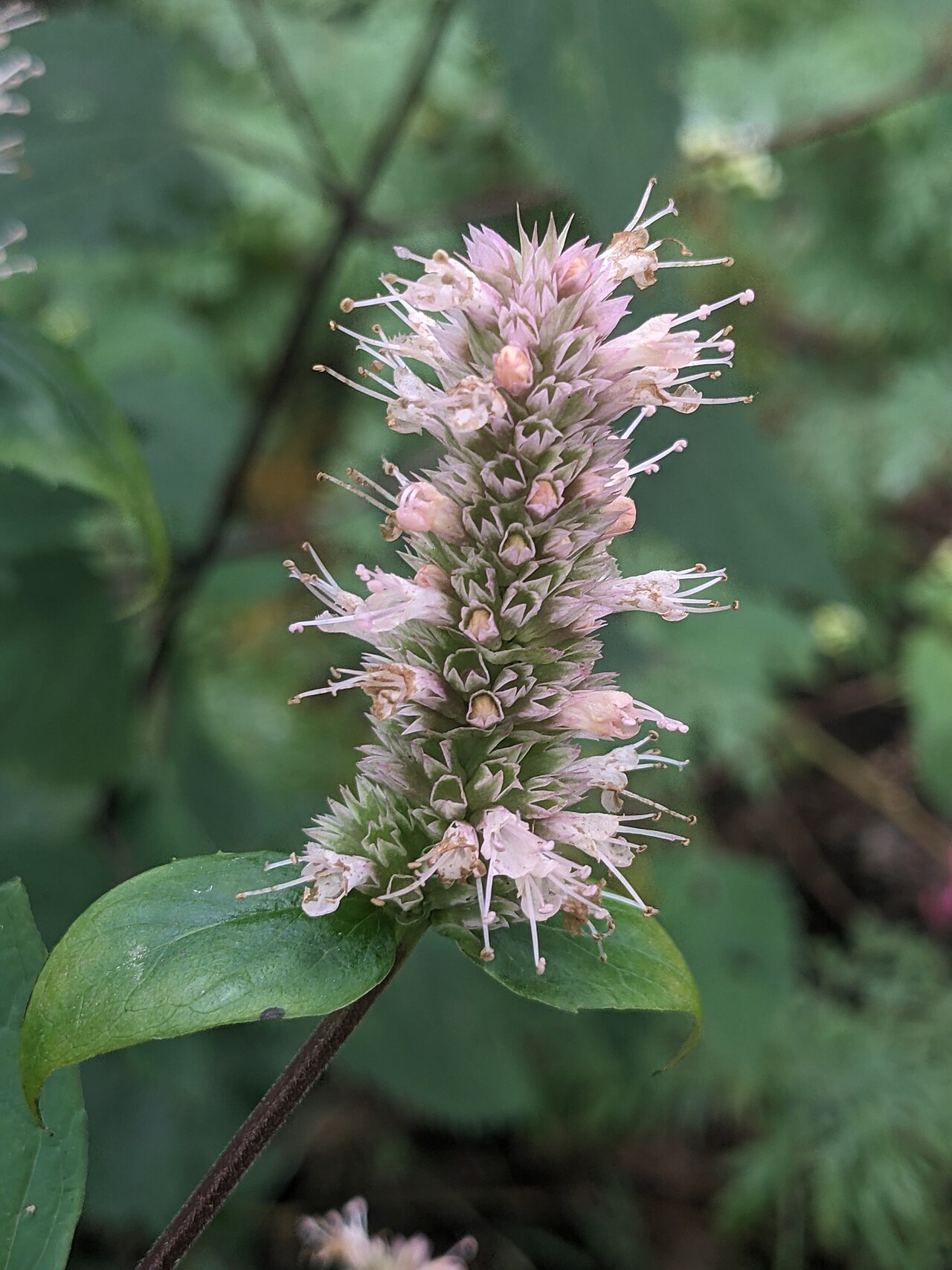
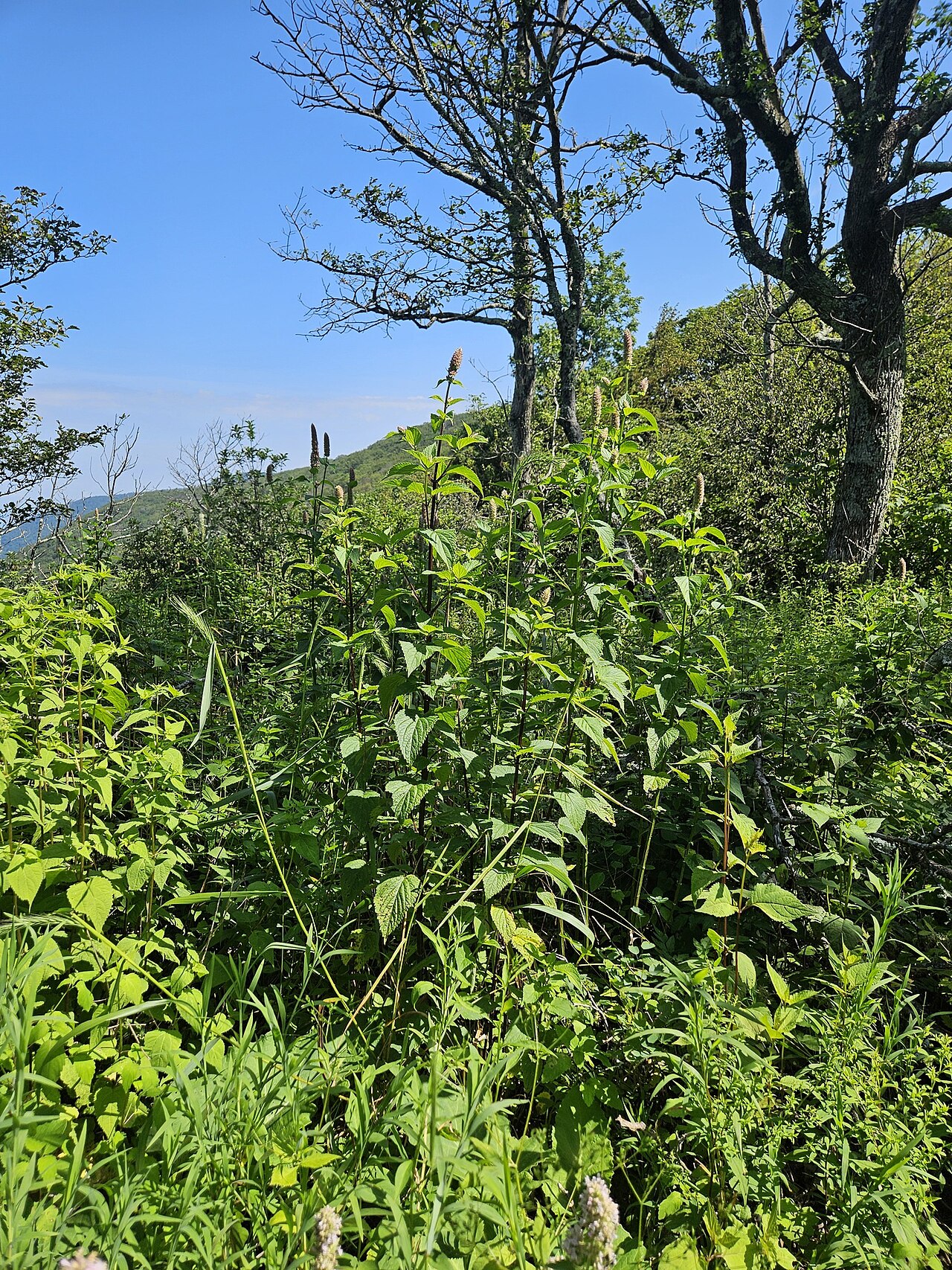
Agastache scrophulariifolia, known as Purple Giant Hyssop, is a tall, upright perennial of the mint family that grows in woodland edges, thickets and open woods across the eastern and central United States. From midsummer into early fall its square, often purplish stems, 3 to 6 feet tall, carry dense, bottlebrush spikes of small pinkish-lavender flowers above coarsely toothed, nettle-like leaves.
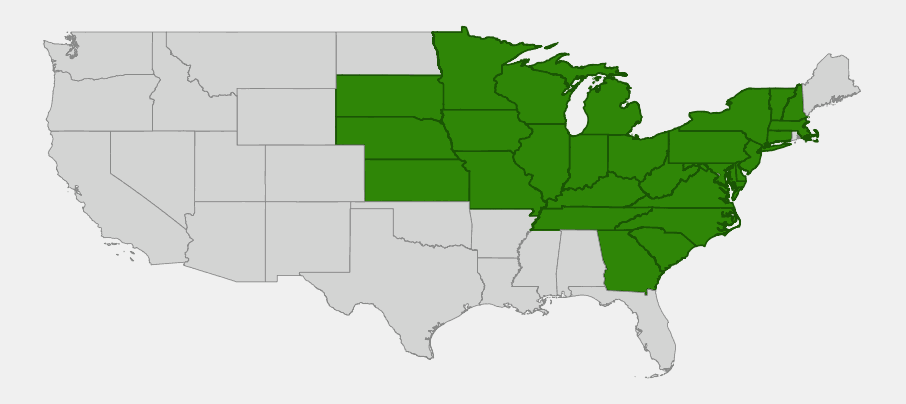
It is native from New England and southern Ontario west to Minnesota, South Dakota and Kansas, and south through the Appalachians to North Carolina, South Carolina and Georgia. Across much of this range it is a scattered and uncommon plant, and several states track it as rare, so it is less familiar than its showier relative, anise hyssop.
In gardens, purple giant hyssop is a tall, easy pollinator plant for the back of a border, a woodland edge or a meadow, attracting bumblebees and other native bees for weeks in late summer. This page covers how to identify it, where it grows, how to grow it from seed, and its value for wildlife.
Identification
Purple giant hyssop is one of three tall, eastern giant hyssops. Its pinkish to purplish flowers, hairy stems and purple-tinged calyces separate it from its close relatives.
Stems
The stems are stout, four-angled (square), and upright, typically 3 to 6 feet tall, branching mainly in the upper part. They are usually purplish and covered with short, spreading hairs, especially on the angles; this hairiness is a key identification feature.
Leaves
The leaves are opposite, ovate to heart-shaped with a pointed tip, about 2 to 6 inches long, and coarsely and evenly toothed, looking much like a nettle leaf but without stinging hairs. The undersides are paler and finely hairy. They have a mild minty scent when crushed, without the strong licorice scent of anise hyssop.
Flowers
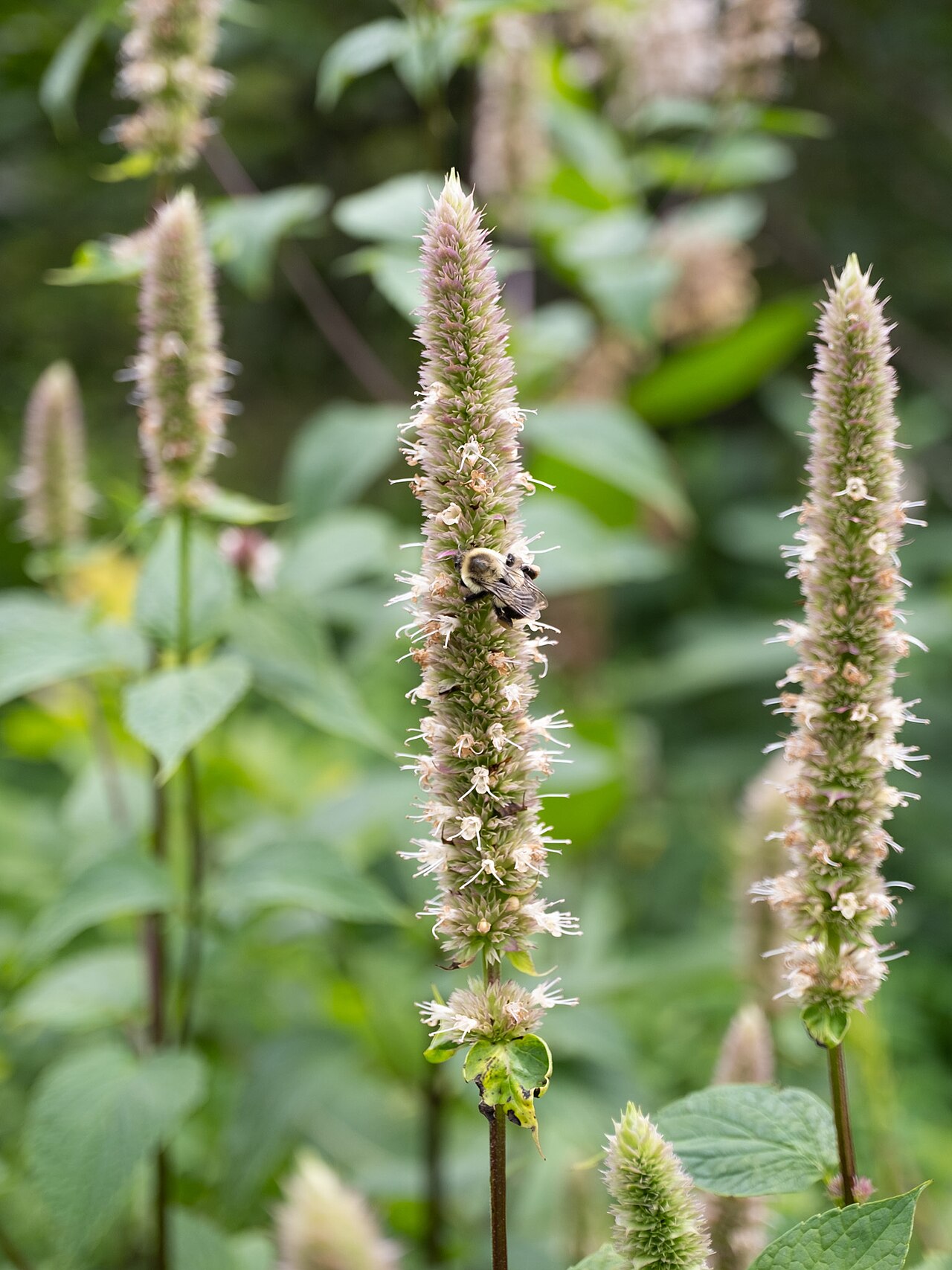
The tiny flowers are packed into dense, cylindrical spikes 2 to 6 inches long at the tops of the stems and branches. Each flower is a small two-lipped tube with protruding stamens, pale pink to lavender or purplish, set in a calyx that is often tinged purple or rose. The overall spike looks soft and slightly fuzzy. Bloom time is July to September.
Fruit
Each flower produces four small brown nutlets, which ripen inside the persistent calyces in fall. The dry, brown seed spikes stand into winter.
Similar Species
Yellow Giant Hyssop (A. nepetoides) has pale greenish-yellow flowers and smooth or nearly smooth stems. Nettle-leaf Giant Hyssop (A. urticifolia) is a western species not found in the East. Anise Hyssop (A. foeniculum) is shorter, with blue-violet flowers and strongly licorice-scented leaves that are whitish beneath. Purple giant hyssop has hairy stems and pinkish to purplish flowers.
Quick Facts
| Scientific Name | Agastache scrophulariifolia (Willd.) Kuntze |
| Family | Lamiaceae (mint family) |
| Plant Type | Herbaceous perennial |
| Mature Height | 3–6 ft |
| Mature Spread | 1.5–3 ft |
| Growth Rate | Fast |
| Sun Exposure | Full sun to part shade |
| Water Needs | Medium; moist, well-drained soil |
| Soil Type | Average to rich loam, clay loam or sandy loam |
| Soil pH | About 6.0–7.5 |
| Bloom Time | July–September |
| Flower Color | Pale pink to lavender-purple |
| Fall Color | None notable; seed heads turn brown |
| Fruit | Four small nutlets in persistent calyces |
| Deer Resistant | Yes, usually |
| USDA Hardiness Zones | 4–8 |
Native Range
USDA PLANTS lists purple giant hyssop as native in Connecticut, Delaware, Georgia, Iowa, Illinois, Indiana, Kansas, Kentucky, Massachusetts, Maryland, Michigan, Minnesota, Missouri, North Carolina, Nebraska, New Hampshire, New Jersey, New York, Ohio, Pennsylvania, South Carolina, South Dakota, Tennessee, Virginia, Vermont, Wisconsin and West Virginia, as well as the District of Columbia and Ontario. In the South it is mostly a mountain plant of the Appalachians, and the Kansas, Nebraska and South Dakota records are at the western edge of its range.
It grows in rich, moist soils of open woods, woodland edges and clearings, thickets, stream banks and floodplain margins, fencerows and roadsides near woods. In the southern Appalachians it occurs in sunny openings and forest edges at higher elevations.
Although widespread, it tends to be scattered and local. It is uncommon in many states and is tracked as rare in several, especially at the edges of its range. Habitat loss, shading by closing forests, and competition from invasive plants affect many populations. Buy nursery-grown plants or seed rather than collecting from the wild.
📋 Regional plant lists featuring Purple Giant Hyssop: Alabama, Georgia & Mississippi · North Dakota, South Dakota & Western Minnesota · Delaware, Southern New Jersey & Long Island · Illinois, Iowa & Missouri · Ohio & Indiana · Kentucky & Tennessee · Maryland, Virginia & West Virginia · Michigan, Wisconsin & Eastern Minnesota · North & South Carolina · Nebraska, Kansas & Eastern Colorado · New Hampshire, Maine & Vermont · Connecticut, Massachusetts & Rhode Island · New York, Pennsylvania & Northern New Jersey
Growing & Care Guide
Purple giant hyssop is a vigorous, easy perennial that is offered by native plant nurseries and seed suppliers in its range. It is fairly short-lived, often lasting a few years, but it reseeds to keep itself going in a garden.
Light
Grow it in full sun to part shade. In full sun it is sturdier and blooms more heavily; in part shade it may lean toward the light and need nearby plants for support.
Soil & Water
It prefers moist, well-drained, fertile soil but adapts to average garden soil, including clay loam. Water young plants during dry spells; established plants tolerate short droughts, though leaves may wilt in hot, dry weather. Avoid soil that stays waterlogged.
Planting Tips
Plant nursery-grown plants in spring or fall, spacing them about 2 feet apart. Its height makes it a good choice for the back of a border, along a fence, or at a woodland edge. Pair it with other tall late-summer bloomers such as Joe-Pye weed and goldenrods.
Pruning & Maintenance
Little maintenance is needed. Leave the seed heads standing over winter for birds and for winter interest, then cut stems down in early spring. To reduce self-seeding, cut off spent flower spikes before the seeds ripen.
Propagation
Grow it from seed sown outdoors in fall, or in spring after one to two months of cold, moist stratification. Seeds are small; press them onto the surface or cover them very lightly. Young clumps can be divided in spring, and stem cuttings root readily in early summer.
Landscape Uses
- Pollinator gardens: long-blooming spikes are visited heavily by bumblebees and other native bees
- Back of the border: a tall, upright accent for late summer
- Woodland edges: thrives in the partial shade of forest margins and clearings
- Meadows and prairie-forest plantings: mixes well with Joe-Pye weed, boneset and goldenrods
- Wildlife gardens: seed heads feed small birds into fall and winter
Wildlife & Ecological Value
Like other giant hyssops, purple giant hyssop is an excellent nectar plant during the late-summer flowering season.
For Pollinators
The flowers are visited by many bees, especially bumblebees, as well as honey bees, smaller native bees, butterflies, skippers and hummingbirds. Because each spike blooms over a long period, a single clump can feed pollinators for several weeks.
For Birds
Small seed-eating birds such as goldfinches pick the seeds from the dry spikes in fall and winter. Hummingbirds sometimes visit the flowers.
For Mammals
The aromatic, hairy foliage is usually avoided by deer and rabbits, which makes it a useful choice where browsing is a problem.
Ecosystem Role
As a tall, late-season bloomer of woodland edges, purple giant hyssop helps bridge the gap between the summer prairie flowers and the fall asters and goldenrods. Its seeds are dispersed mainly by gravity and wind-shaken stems, so it often forms local colonies along edges and openings.
Cultural & Historical Uses
The genus name Agastache comes from Greek words meaning “very many” and “ear of grain,” describing the many crowded flower spikes. The species name scrophulariifolia means “with leaves like Scrophularia,” the figworts, whose coarsely toothed leaves resemble those of this plant.
Several giant hyssops have been used for teas and medicine by Native American peoples, and anise hyssop in particular is a well-known tea herb. Purple giant hyssop has a milder scent and is less often used, though its leaves are not known to be toxic.
In the garden trade, many hybrid hummingbird mints and “agastaches” are derived from western and Mexican species. Purple giant hyssop, with its tall habit and soft pink spikes, is one of the few eastern native giant hyssops grown by native plant gardeners.
Frequently Asked Questions
What is the difference between purple giant hyssop and anise hyssop?
Purple giant hyssop is taller (3 to 6 feet), with pinkish to lavender flowers, hairy stems and leaves with only a mild scent. Anise hyssop is shorter, with blue-violet flowers and strongly licorice-scented leaves that are whitish beneath.
Where is purple giant hyssop native?
It is native to the eastern and central United States, from New England west to Minnesota, South Dakota and Kansas and south in the Appalachians to Georgia, and to Ontario. It grows in open woods, edges and thickets.
Does purple giant hyssop attract pollinators?
Yes. It is very popular with bumblebees and other bees, and butterflies and hummingbirds also visit. It blooms from July to September.
Is purple giant hyssop deer resistant?
Usually. Like most aromatic mint-family plants, it is seldom browsed by deer or rabbits.
Does purple giant hyssop spread?
It does not spread by runners, but it self-seeds readily. Deadhead the spikes before seeds ripen if you want to limit seedlings, or leave them for birds and new plants.

Looking for a nursery that carries Purple Giant Hyssop?
Browse our native plant nursery directory: Connecticut, Delaware & Georgia · Illinois, Indiana, Iowa & Kansas · Kentucky, Maryland, Massachusetts, Michigan, Minnesota & Missouri · Nebraska, New Hampshire, New Jersey, New York, North Carolina & Ohio · Pennsylvania, South Carolina, South Dakota, Tennessee, Vermont & Virginia · West Virginia & Wisconsin

