
Lesser Rattlesnake Plantain (Goodyera repens)
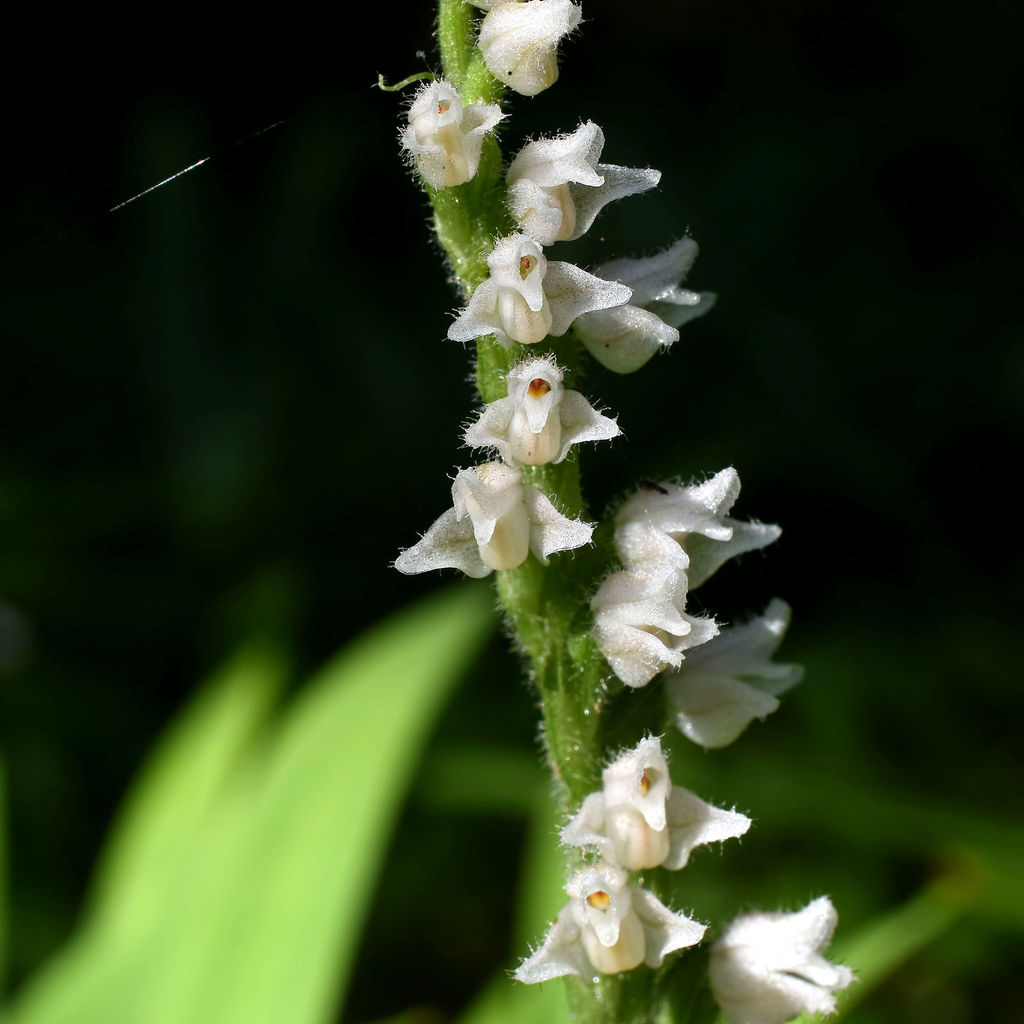
Goodyera repens, known as Lesser Rattlesnake Plantain (USDA: lesser rattlesnake plantain; called creeping lady’s-tresses in Britain), is a small evergreen native orchid of cool northern and mountain forests. It forms low rosettes of oval leaves, often marked with a white net of veins, and in mid to late summer sends up a slender 4- to 10-inch spike of tiny, white, hooded flowers, usually crowded along one side.
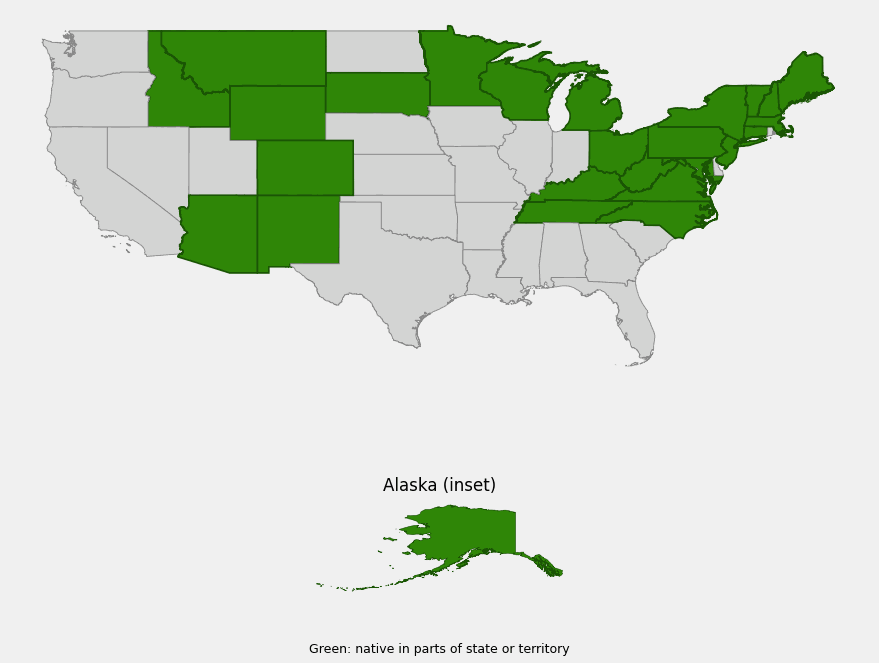
It is the most widespread rattlesnake plantain in the world, found across the boreal forests of North America, Europe and Asia. In the United States, USDA PLANTS lists it as native in Alaska and 25 states in the lower 48: across the northern tier from Maine to Minnesota, south along the Appalachians to North Carolina and Tennessee, and through the Rocky Mountains from Montana to Arizona and New Mexico. It grows in deep moss and needle duff under spruce, fir, pine, cedar and birch.
Like all native orchids, it depends on soil fungi for part of its nutrition and cannot survive being transplanted. Never dig it up from the wild; enjoy it where it grows. This page is a guide to identifying and appreciating it.
Identification
Lesser rattlesnake plantain is the smallest of our four rattlesnake plantains. Its tiny leaves, short one-sided flower spike and preference for mossy conifer woods help separate it from its relatives.
Growth Habit
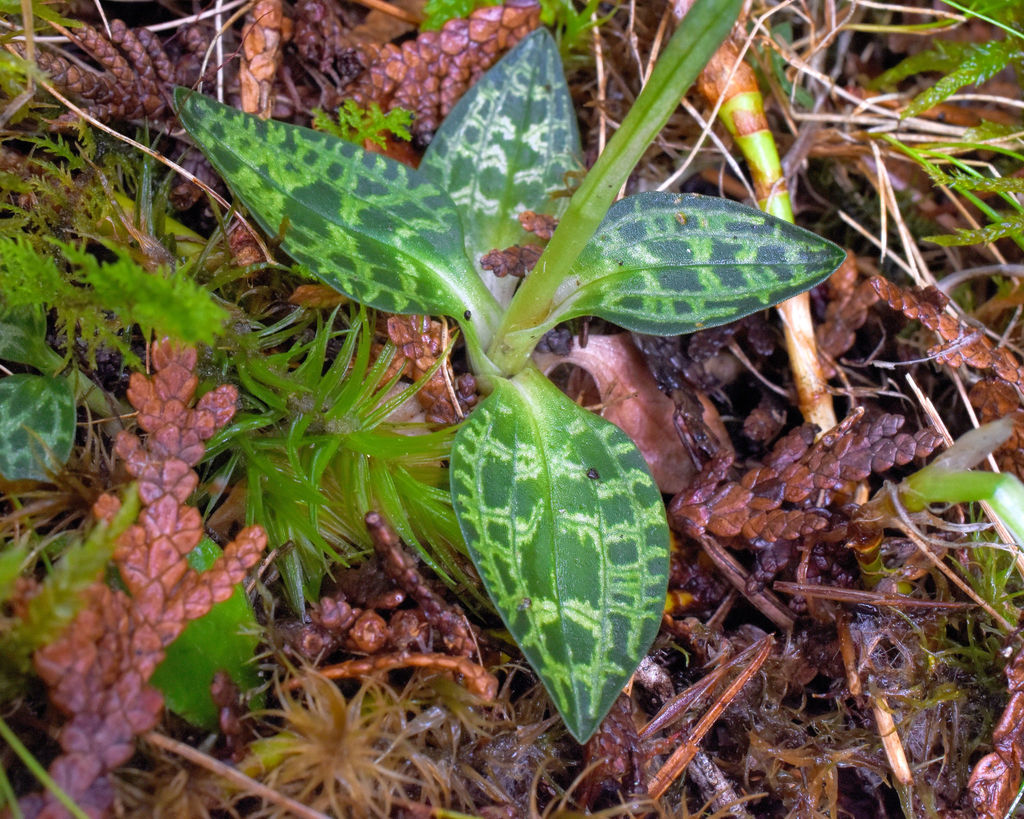
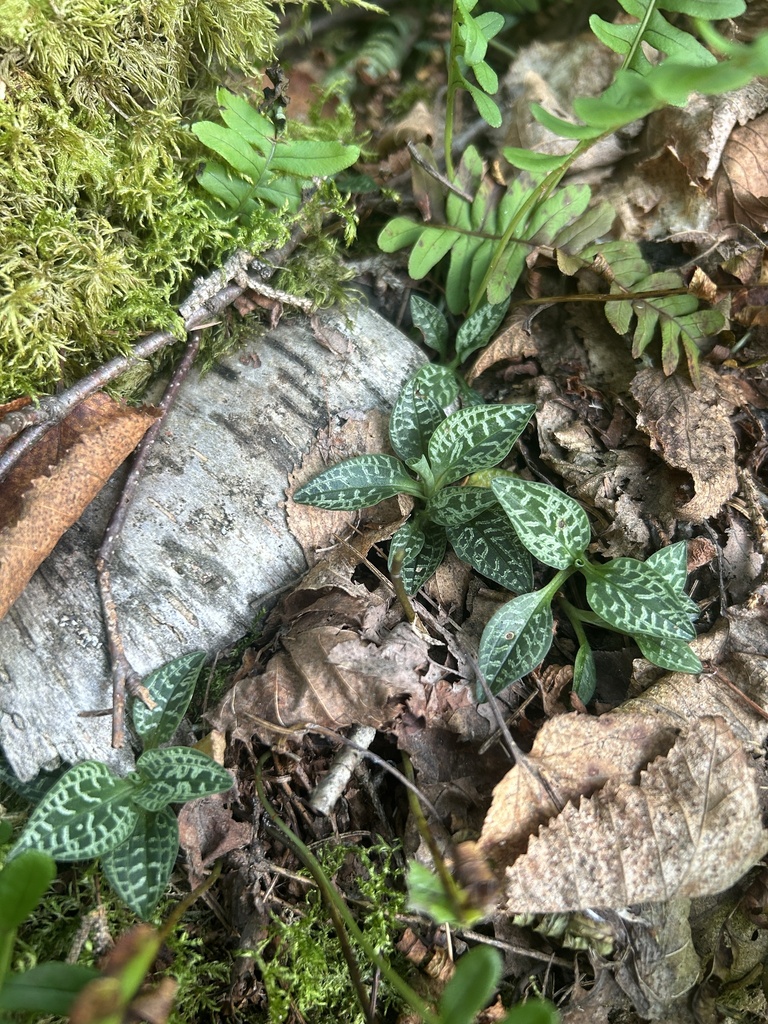
A small, evergreen perennial orchid with a basal rosette of 3 to 7 leaves, connected to neighboring rosettes by creeping, shallow rhizomes that run through moss and duff. Plants often form loose colonies. The flowering stem is 4 to 10 inches tall, finely glandular-hairy, with a few small scale-like bracts.
Leaves
The leaves are oval, about 1/2 to 1 1/4 inches long, dark green and slightly fleshy. In many North American plants (variety ophioides) the veins are outlined in white, creating a fine checkered or netted pattern; others have plain green leaves or only a white midvein. The rosettes stay green through winter under the snow.
Flowers
From about July to September, the spike carries 10 to 35 tiny, white to greenish-white flowers, each only about 1/6 to 1/4 inch long. The flowers are usually arranged in a loose spiral that is twisted to one side of the stem. Each has a hood formed by the upper sepal and petals, and a short, pouched lip with a beaked tip.
Fruit
The fruit is a small, upright, oval capsule that splits in fall to release thousands of dust-like seeds, which are carried by the wind.
Look-alikes
Downy Rattlesnake Plantain (Goodyera pubescens) has larger leaves with a bold white net and a dense, cylindrical flower spike with flowers all around the stem. Checkered Rattlesnake Plantain (G. tesselata) is intermediate in size, with bluish-green, softly checkered leaves and a loosely spiraled spike. Western Rattlesnake Plantain (G. oblongifolia) has longer leaves, usually with a white stripe along the midvein, and taller spikes.
Do Not Dig
Rattlesnake plantains are sometimes dug for terrariums because of their pretty leaves, but wild-collected plants almost always die because they lose the soil fungi they depend on. Collecting also damages slow-growing colonies, and it is illegal on most public land and protected in several states where the species is rare.
Quick Facts
| Scientific Name | Goodyera repens (L.) R. Br. |
| Family | Orchidaceae (orchid family) |
| Plant Type | Small evergreen terrestrial orchid |
| Mature Height | 2–3 in leaves; flower spike 4–10 in |
| Mature Spread | Rosettes 2–4 in; spreads slowly by rhizomes |
| Growth Rate | Slow |
| Sun Exposure | Partial to full shade |
| Water Needs | Medium; cool, evenly moist duff |
| Soil Type | Moss, needle duff and humus over sand or rock |
| Soil pH | Acidic to near neutral (about 4.5–7) |
| Bloom Time | July–September |
| Flower Color | White to greenish-white |
| Fall Color | None; leaves evergreen |
| Fruit | Small capsule with dust-like seeds |
| Deer Resistant | Unknown; small and seldom browsed |
| USDA Hardiness Zones | Native to zones 2–6; not for gardens |
Native Range
Lesser rattlesnake plantain is circumboreal, growing in cool forests across northern North America, Europe and Asia. In North America it ranges from Alaska and across Canada from British Columbia to Newfoundland and Labrador, south into the United States. USDA PLANTS lists it as native in Alaska and in 25 states of the lower 48.
In the East it grows across New England, New York, Pennsylvania, New Jersey, Ohio and the upper Great Lakes states, and south in the Appalachian Mountains through Maryland, Virginia, West Virginia, Kentucky, Tennessee and North Carolina, where it is confined to cool, high-elevation forests and is rare. In the West it follows the Rocky Mountains from Idaho and Montana through Wyoming, the Black Hills of South Dakota, Colorado, New Mexico and Arizona, again in cool conifer forests.
Typical habitats are mossy spruce, fir, pine, hemlock and northern white cedar forests, cedar swamps and bog edges, birch-aspen woods and sandy pine woods near the Great Lakes. It grows in deep moss and needle duff, often on hummocks or rotting logs, from near sea level in the North to over 10,000 feet in the southern Rockies.
📋 Regional plant lists featuring Lesser Rattlesnake Plantain: Alaska · Arizona & New Mexico · Montana & Wyoming · Idaho, Eastern Oregon & Eastern Washington · North Dakota, South Dakota & Western Minnesota · Michigan, Wisconsin & Eastern Minnesota · Ohio & Indiana · Kentucky & Tennessee · North & South Carolina · Maryland, Virginia & West Virginia · New York, Pennsylvania & Northern New Jersey · Delaware, Southern New Jersey & Long Island · Connecticut, Massachusetts & Rhode Island · New Hampshire, Maine & Vermont
Can You Grow It?
Lesser rattlesnake plantain is not a garden plant. It depends on fungi in undisturbed forest soil for part of its food, it is almost never available as nursery-propagated stock, and wild-dug plants nearly always die. The best way to enjoy it is to protect the woods where it grows. Here is what it needs in nature.
Light
It grows in shade to dappled light under conifers and mixed forest canopy, and it does not tolerate full sun or the heat of an open garden bed.
Soil & Water
It needs a deep, cool, evenly moist layer of moss and needle duff, often over sand or rock, and the mycorrhizal fungi (mainly Ceratobasidium) that live in it. Research on this species has shown that the fungus supplies the young plant with carbon and nutrients, and adult plants still exchange nutrients with it. That partnership cannot be recreated with peat or potting mix.
Planting Tips
Do not plant it, and never dig it from the wild. If you want a rattlesnake plantain, native orchid specialists occasionally offer laboratory-propagated Goodyera, most often downy rattlesnake plantain; buy only plants clearly labeled as propagated, not collected. For an evergreen groundcover in shady, acidic woods, plant Partridgeberry or Checkerberry instead.
Pruning & Maintenance
Where it grows on your land, leave the forest floor alone. Do not rake out moss and needles, compact the soil with trails or vehicles, or spray herbicides nearby, and keep invasive plants from overrunning the area.
Propagation
In nature it spreads slowly by creeping rhizomes, forming loose colonies, and by dust-like seed carried on the wind. Seed germinates only with a compatible fungus, and raising plants from seed is a job for orchid laboratories and conservation programs.
Where to See It
- Northern conifer forests: look in mossy spruce-fir and cedar woods in Maine, the Adirondacks, northern Michigan, Wisconsin and Minnesota
- Rocky Mountain forests: shaded subalpine spruce-fir forests in Montana, Wyoming, Colorado and the Southwest mountains
- Alaska: common in mossy boreal forests around Anchorage, the Mat-Su Valley and the Interior
- Best season: flowers from July to September; the evergreen rosettes are easy to spot in spring and fall
- Respectful viewing: stay on trails, photograph without trampling the moss, and never pick or dig plants
Wildlife & Ecological Value
Lesser rattlesnake plantain is a small but telling member of the northern forest floor community, linked to fungi, bees and the conifers above it.
For Pollinators
The tiny flowers are pollinated mainly by bumble bees, which visit the spike from the bottom up and carry away the sticky pollen masses (pollinia) on their mouthparts. The flowers are lightly fragrant.
For Birds
It is not a food plant for birds, but it grows in the mature conifer forests that shelter spruce grouse, boreal chickadees, warblers and other northern birds.
For Mammals
Snowshoe hares, voles and other small mammals may nibble the evergreen leaves in winter, but the plant is too small to be an important food.
Ecosystem Role
It is one of the best-studied examples of an orchid that is both green and partly fungus-fed: experiments with this species showed that carbon can move from the orchid back to its fungal partner, a two-way exchange. Its presence indicates undisturbed, moist forest floor with intact soil fungi.
Cultural & Historical Uses
The genus Goodyera honors John Goodyer, a 17th-century English botanist who helped revise a famous herbal of the time. The species name repens means “creeping,” for its spreading rhizomes.
The name “rattlesnake plantain” comes from the patterned, snake-skin-like leaves of some species and a broad rosette that resembles a plantain. Folk traditions held that the leaves could treat snakebite, an example of the old “doctrine of signatures.” There is no evidence that they work, and the plants should not be used this way.
In Britain and Europe, where it grows in old pine forests, it is known as creeping lady’s-tresses. It is one of the few orchids found on several continents, which makes it a favorite subject for orchid researchers studying how orchids and fungi share nutrients.
Frequently Asked Questions
Is lesser rattlesnake plantain an orchid?
Yes. It is a small evergreen terrestrial orchid in the family Orchidaceae, related to downy, checkered and western rattlesnake plantains.
Where does lesser rattlesnake plantain grow?
In cool, mossy conifer and mixed forests across Alaska, Canada, the northern United States, the Appalachian Mountains and the Rocky Mountains, and also across northern Europe and Asia.
How do I tell it from downy rattlesnake plantain?
Lesser rattlesnake plantain has smaller leaves (usually under 1 1/4 inches) and a short, loose spike with flowers mostly on one side. Downy rattlesnake plantain has bigger leaves with a bold white net and a dense spike with flowers all around.
Can I transplant it into my garden or a terrarium?
No. It depends on soil fungi and almost always dies when moved. Never dig wild orchids; buy only laboratory-propagated plants if you want to grow a Goodyera.
When does it bloom?
From about July to September, depending on latitude and elevation.

Looking for a nursery that carries Lesser Rattlesnake Plantain?
Browse our native plant nursery directory: Alaska & Arizona · Colorado & Connecticut · Idaho · Kentucky, Maine, Maryland, Massachusetts, Michigan, Minnesota & Montana · New Hampshire, New Jersey, New Mexico, New York, North Carolina & Ohio · Pennsylvania, South Dakota, Tennessee, Vermont & Virginia · West Virginia, Wisconsin & Wyoming

