
Marsh Speedwell (Veronica scutellata)
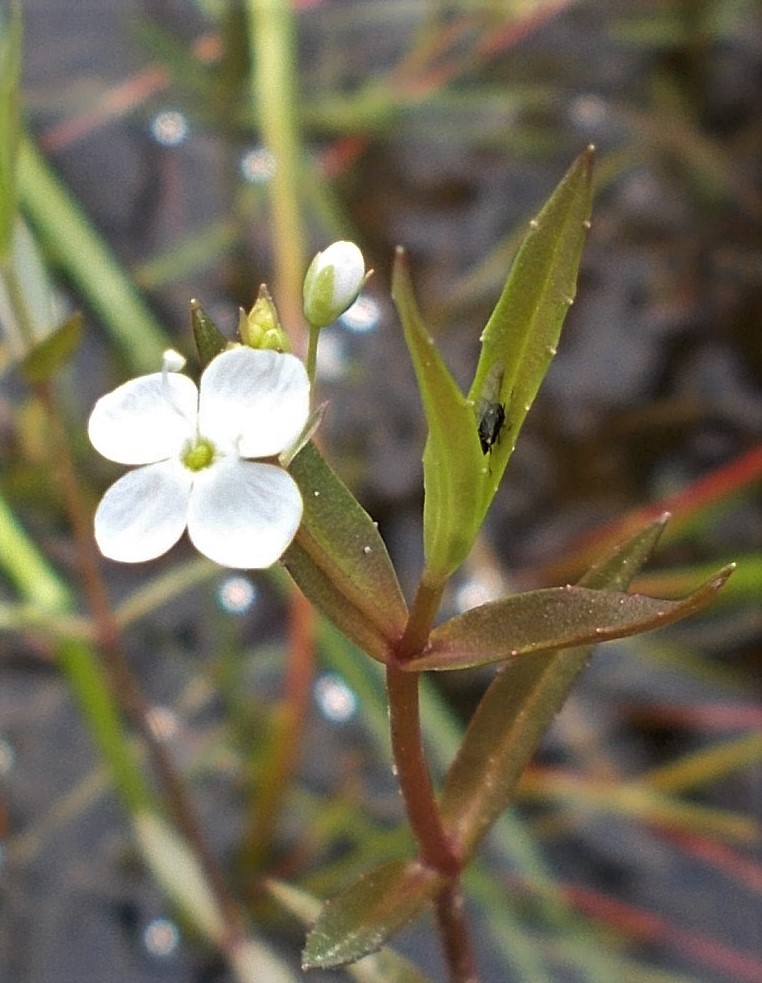
Veronica scutellata, the Marsh Speedwell (also called skullcap speedwell or grassleaf speedwell), is a slender, sprawling wetland wildflower native to the northern United States, Alaska and Canada, as well as Europe and northern Asia. It grows in marshes, wet meadows, bogs, pond and lake shores, ditches and the muddy edges of beaver ponds.
Unlike most speedwells, it has very narrow, grass-like leaves in pairs along weak, trailing stems that lean on surrounding sedges and grasses. From late spring to late summer it bears small, white to pale lilac flowers with fine purple lines, held well away from the stem on long, thread-like stalks.
It is an easy plant to overlook among taller wetland vegetation, but its delicate flowers and distinctive heart-shaped seed capsules make it a pleasure to find. This guide covers how to identify it, where it grows, how to use it in a wet garden or wetland restoration and its role in wetlands.
Identification
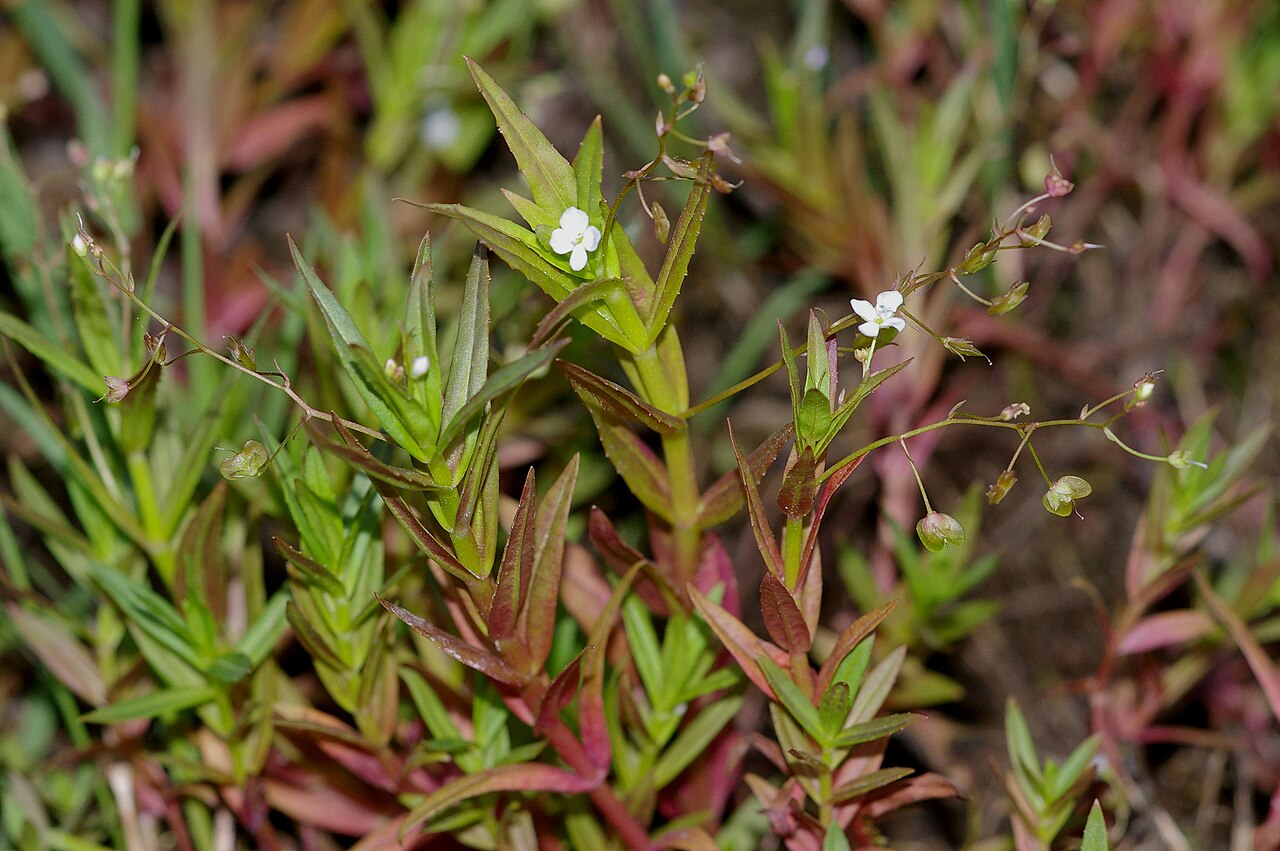
Marsh speedwell is a low, weak-stemmed perennial with narrow, opposite leaves and loose clusters of small, four-lobed flowers on long, thin stalks that arise from only one leaf of each pair.
Stems & Leaves
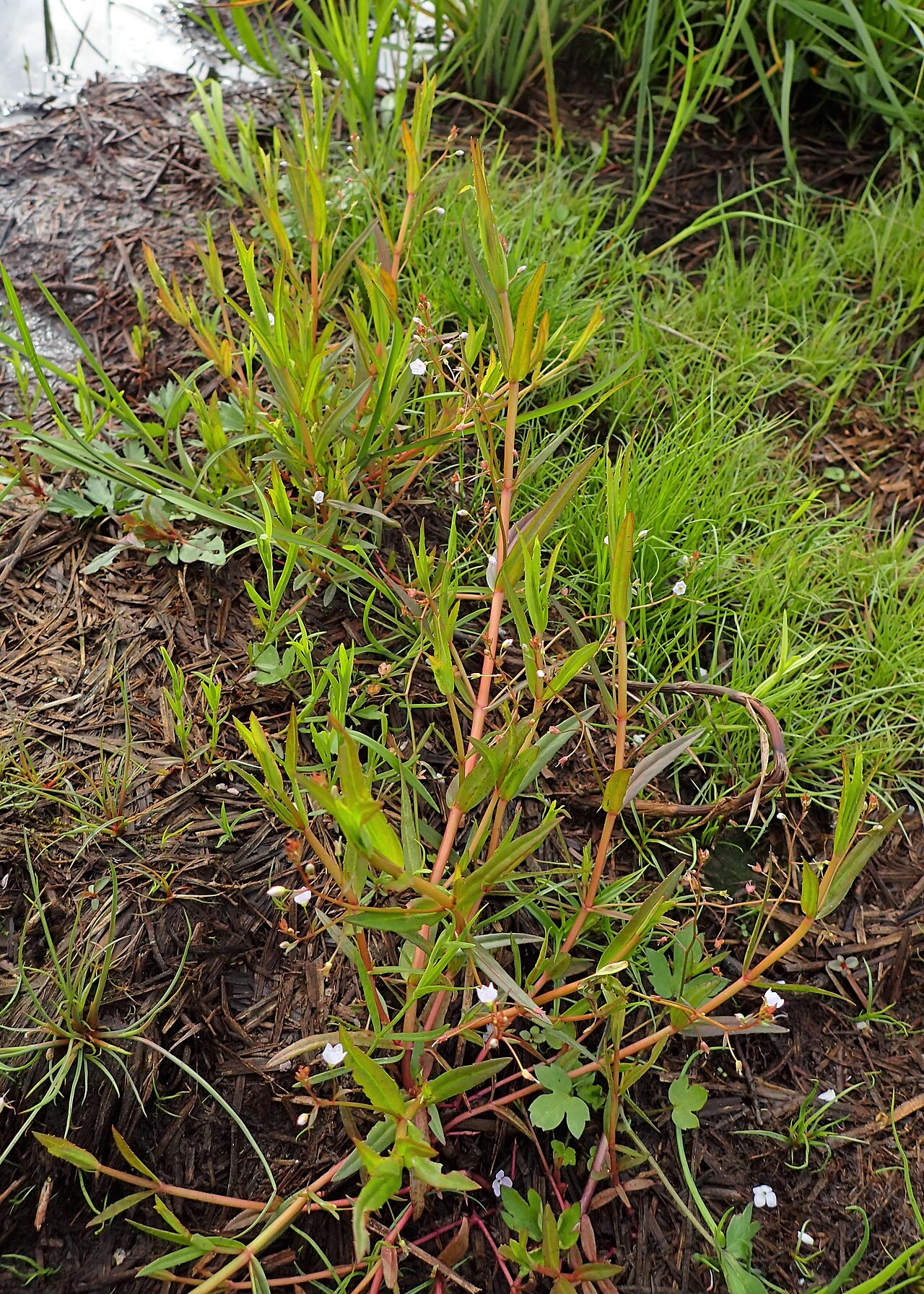
The stems creep and root at the lower nodes, then rise 4 to 20 inches, often leaning on other plants. The leaves are opposite, stalkless, narrowly lance-shaped to linear, about 1 to 3 inches long and less than ¼ inch wide, with a few tiny, widely spaced teeth or none. They are often tinged reddish or yellowish. Most plants are hairless, but a hairy form (var. villosa) grows in some areas.
Flowers
From June to September, loose, zigzag racemes rise from the leaf axils, usually from only one leaf of each pair, so the clusters alternate up the stem. Each flower is about ¼ inch across, with four unequal, white, pale blue or pale lilac lobes marked with fine purple lines, and two stamens. The flowers sit on long, slender, spreading stalks.
Fruit
The seed capsule is flat, broader than long and deeply notched at the top, like two small shields side by side, about ⅛ to ¼ inch wide. The species name scutellata means “like a small shield” and refers to this capsule.
Look-alikes
American Brooklime (V. americana) grows in similar places but has broader, stalked, toothed leaves and flower clusters from both leaves of a pair. Water speedwell (V. anagallis-aquatica) has broad, clasping leaves and denser clusters. Marsh speedwell’s narrow leaves and the long-stalked, alternating flower clusters set it apart.
Quick Facts
| Scientific Name | Veronica scutellata L. |
| Family | Plantaginaceae (plantain family) |
| Plant Type | Perennial wetland wildflower |
| Mature Height | 4–20 in |
| Mature Spread | 6–18 in; spreads by creeping stems |
| Growth Rate | Moderate |
| Sun Exposure | Full sun to partial shade |
| Water Needs | Wet; saturated soil or shallow water |
| Soil Type | Mud, muck, peat, wet sand |
| Soil pH | About 5.0–7.5 |
| Bloom Time | June–September |
| Flower Color | White to pale blue or lilac with purple lines |
| Fall Color | Leaves often turn reddish |
| Fruit | Flat, notched, two-lobed capsule |
| Deer Resistant | Moderate |
| USDA Hardiness Zones | 2–7 |
Native Range
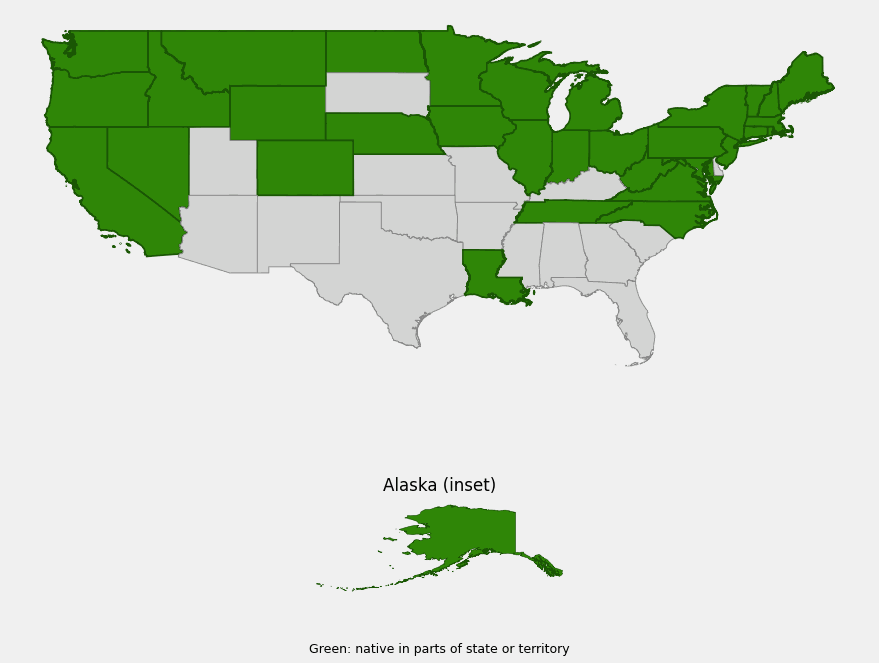
Marsh speedwell is a circumboreal species, native around the Northern Hemisphere. In North America it ranges from Alaska and across all of Canada to Newfoundland, and south through the northern United States. USDA PLANTS lists it in 32 states, from Washington, Oregon, California and Nevada east through the Rocky Mountains, the upper Midwest and the Great Lakes to New England, New York, New Jersey and Pennsylvania, and south in the Appalachians to Virginia, West Virginia, North Carolina and Tennessee. A record from Louisiana is far outside its normal range and is best treated as an outlying record.
It is most common in the northern tier of states, around the Great Lakes, in New England and in the mountains of the West, becoming rare toward the southern edge of its range.
It grows in shallow water and on saturated ground in full sun to light shade: marshes, sedge meadows, bogs and fens, shores of ponds and lakes, beaver meadows, swales and wet ditches, from low elevations to mountain meadows.
📋 Regional plant lists featuring Marsh Speedwell: Alaska · California & Nevada · Montana & Wyoming · Idaho, Eastern Oregon & Eastern Washington · Western Oregon & Western Washington · Illinois, Iowa & Missouri · Ohio & Indiana · Michigan, Wisconsin & Eastern Minnesota · North Dakota, South Dakota & Western Minnesota · Nebraska, Kansas & Eastern Colorado · Connecticut, Massachusetts & Rhode Island · New Hampshire, Maine & Vermont · New York, Pennsylvania & Northern New Jersey · Delaware, Southern New Jersey & Long Island · Maryland, Virginia & West Virginia · Kentucky & Tennessee · North & South Carolina · Arkansas, Louisiana, Eastern Oklahoma & Eastern Texas
Growing & Care Guide
Marsh speedwell is rarely sold by nurseries but is occasionally available from native wetland suppliers. It is a delicate plant for the wet edge of a pond, a rain garden that holds water or a wetland restoration in cool, northern climates, where it weaves among sedges and rushes.
Light
Full sun to partial shade. It flowers best with at least half a day of sun.
Soil & Water
It needs constantly wet soil, mud or shallow water, and tolerates seasonal flooding. It will not survive in soil that dries out. Acidic to neutral, organic or sandy soil is ideal.
Planting Tips
Plant plugs 6 to 12 inches apart in saturated soil at a pond edge or in a wet swale, among sedges, rushes and other low wetland plants that its weak stems can lean on.
Pruning & Maintenance
Little care is needed. It is short-lived in competition with tall, aggressive plants such as reed canary grass or cattails, so keep those in check around it.
Propagation
Divide plants or root stem pieces in spring, since the creeping stems root at the nodes. Seed can be surface-sown on wet soil in fall or after a few weeks of cold, moist stratification.
Landscape Uses
- Pond and lake edges: delicate flowers among sedges and rushes
- Wetland restoration: native cover for marsh and sedge-meadow plantings
- Rain gardens: for the wettest, lowest zone
- Bog and fen gardens: small, fine-textured companion plant
Wildlife & Ecological Value
Marsh speedwell is a small but widespread member of northern wetland plant communities.
For Pollinators
The small flowers are visited by small bees, syrphid flies and other flies, which collect pollen and nectar.
For Birds
Waterfowl and rails forage among the dense wetland vegetation where it grows, and its small seeds are part of the mix eaten by wetland birds.
For Mammals
Muskrats, deer and moose feed in the marshes and wet meadows where it grows, though it is a minor food plant.
Ecosystem Role
Its creeping, rooting stems help bind mud and peat on wet shores and in sedge meadows, and it is often an indicator of good-quality, undisturbed wetland habitat.
Cultural & Historical Uses
Carl Linnaeus named Veronica scutellata in 1753. The species name refers to the shield-shaped seed capsule, and the common name “skullcap speedwell” refers to the same feature.
The genus name Veronica is often said to honor Saint Veronica, and the common name “speedwell” is an old English farewell meaning roughly “go well.” Many speedwells were traditionally used in European herbal medicine.
Unlike many of the speedwells in North American lawns and gardens, which were introduced from Europe and Asia, marsh speedwell is native on both continents and grows wild across Alaska, Canada and the northern United States.
Frequently Asked Questions
Is marsh speedwell native to North America?
Yes. It is a circumboreal species native to Alaska, Canada and the northern United States as well as Europe and Asia.
How do I recognize marsh speedwell?
Look for a weak, sprawling plant in wet places with narrow, grass-like opposite leaves and small white to pale lilac flowers on long, thin stalks in loose clusters that alternate up the stem. The flat, deeply notched capsules are distinctive.
When does marsh speedwell bloom?
From about June to September.
Can I grow marsh speedwell in a garden?
Yes, if you have constantly wet soil or shallow water, such as a pond edge or a wet swale, in a cool climate.
What is the difference between marsh speedwell and American brooklime?
American brooklime has broader, stalked, toothed leaves and flower clusters from both leaves of each pair. Marsh speedwell has very narrow leaves and flower clusters from only one leaf of each pair.

Looking for a nursery that carries Marsh Speedwell?
Browse our native plant nursery directory: Alaska · California · Colorado & Connecticut · Idaho, Illinois, Indiana & Iowa · Louisiana, Maine, Maryland, Massachusetts, Michigan, Minnesota & Montana · Nebraska, Nevada, New Hampshire, New Jersey, New York, North Carolina, North Dakota & Ohio · Oregon · Pennsylvania, Rhode Island, Tennessee, Vermont & Virginia · Washington · West Virginia, Wisconsin & Wyoming

