
Catbird Grape (Vitis palmata)
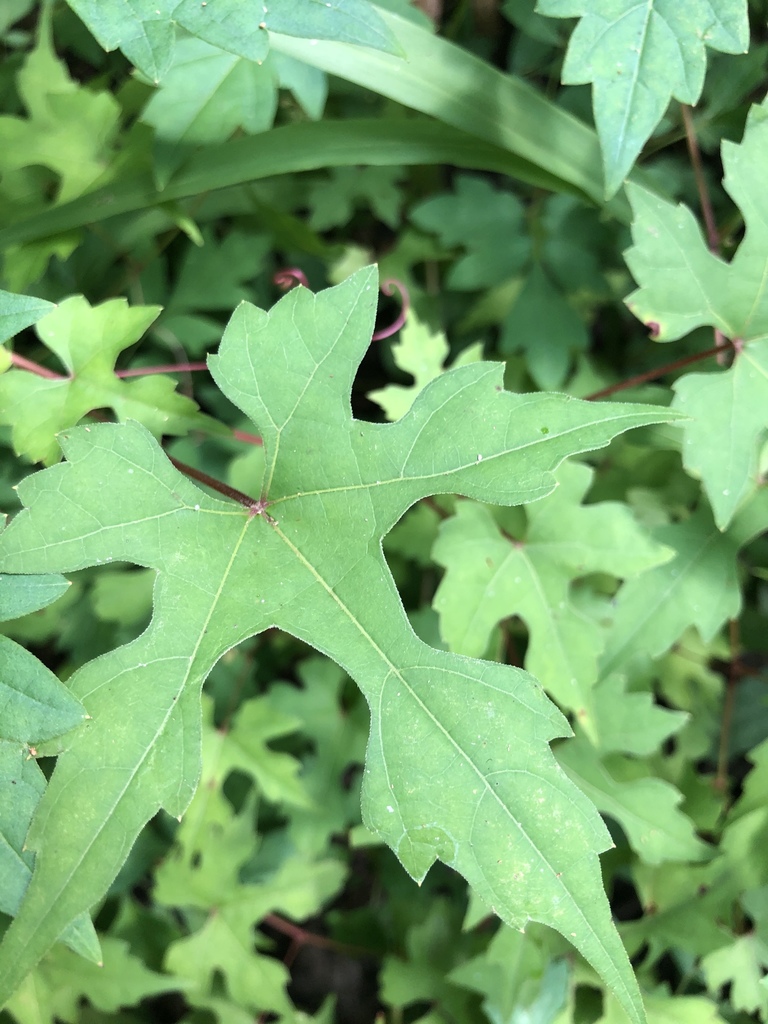
Vitis palmata, known as Catbird Grape, red grape or Missouri grape, is a native wild grape of swamps, river bottoms and wet woods in the southeastern and south-central United States. It is a high-climbing woody vine that clambers over shrubs and into trees with branched tendrils, and it is easy to recognize: its young stems, leaf stalks and tendrils are bright red to maroon, and its leaves are deeply cut into three to five long, pointed lobes.
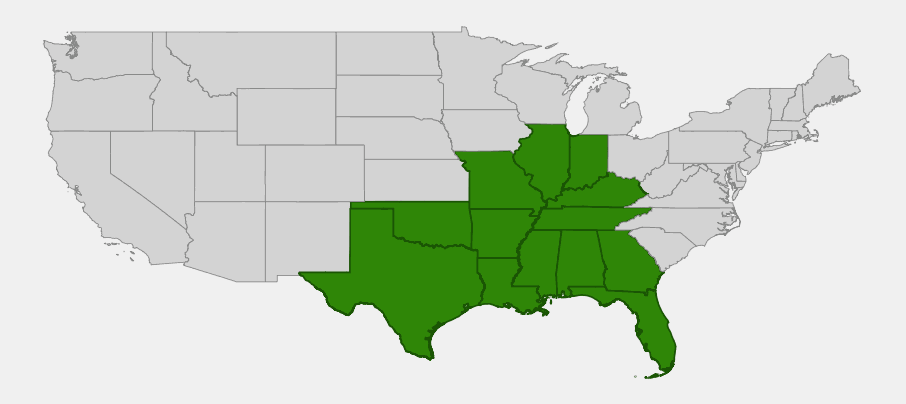
Its native range runs from eastern Texas and Oklahoma east to Georgia and the Florida Panhandle, and north through the Mississippi Valley to Missouri, Illinois and Indiana. USDA PLANTS also lists Connecticut and New Jersey, but those isolated northeastern records are considered introductions, so they are left off this page’s map.
Catbird grape is one of the latest native grapes to bloom and ripen. Its small black grapes are not very juicy, but they are eaten by many birds and mammals, and they can be made into jelly. This guide covers how to identify it, where it grows, how to grow it, and its value to wildlife.
Identification
Wild grapes can be hard to tell apart, but catbird grape is one of the easiest: no other eastern grape combines bright red young stems with such deeply lobed, smooth leaves.
Leaves & Growth Habit
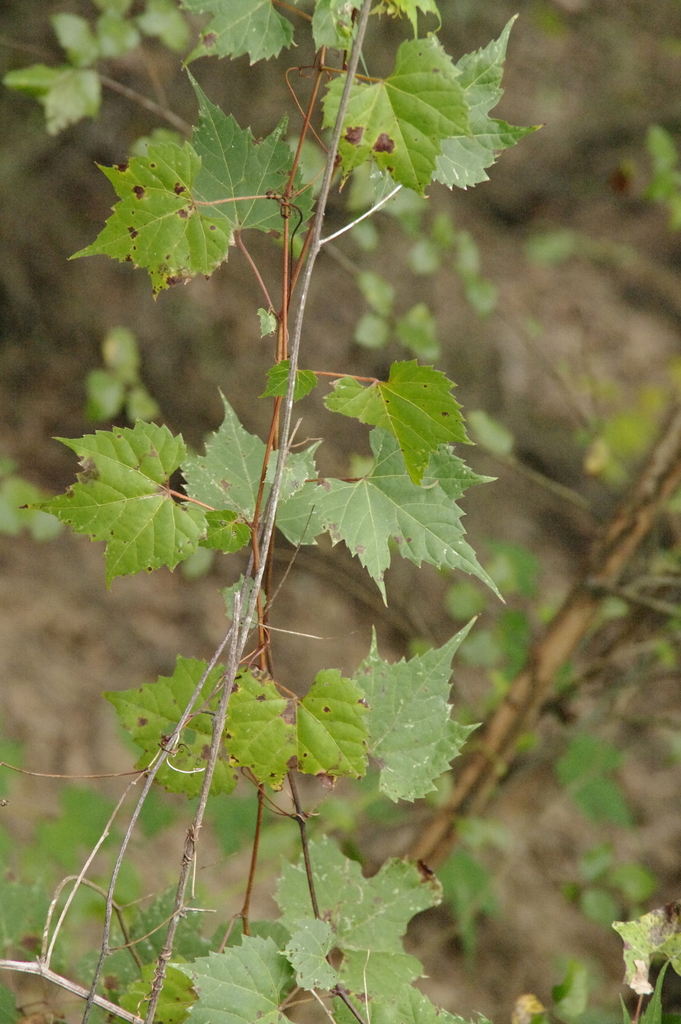
A deciduous woody vine climbing 30 feet or more into trees by forked tendrils, with shreddy bark on old stems. The leaves are 3 to 6 inches long and wide, deeply palmately lobed into three to five lobes with long, tapering tips and rounded sinuses between them. They are smooth above, nearly smooth beneath except for small tufts of hairs in the vein angles, and have coarsely toothed edges.
Stems
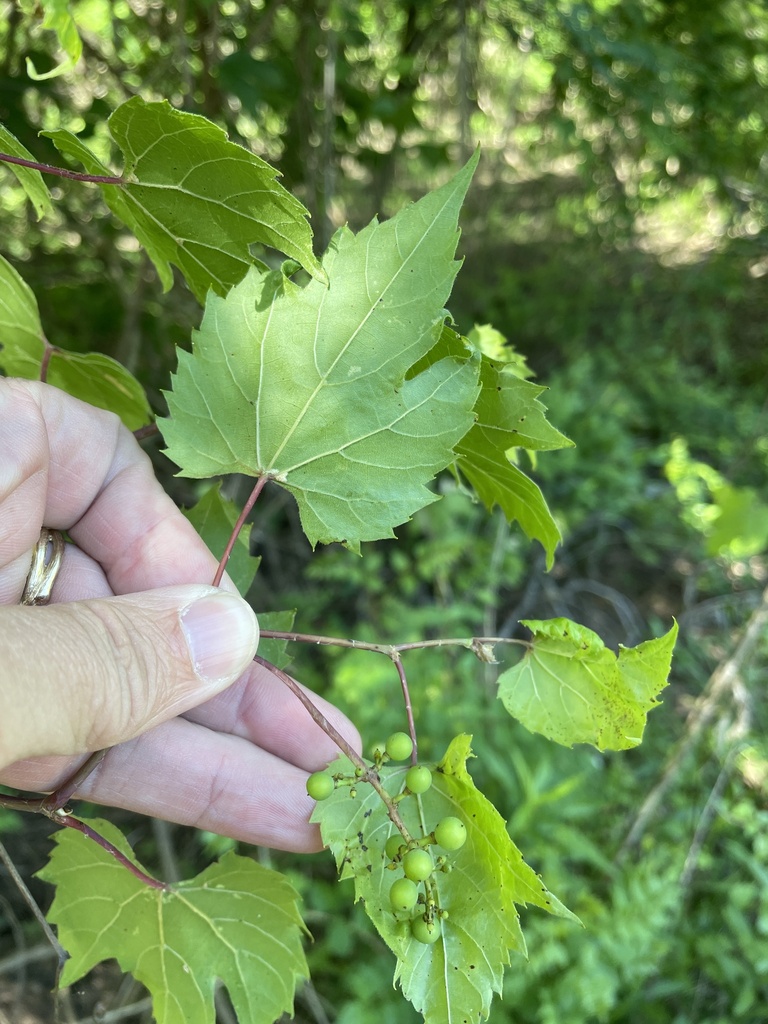
The young branches, leaf stalks and tendrils are bright red to deep maroon and smooth, and the color is visible from a distance in spring and summer. The pith inside the stems is interrupted by woody partitions at the nodes, as in all true grapes.
Flowers & Fruit
The tiny, fragrant, greenish flowers bloom in late spring to early summer, usually later than other wild grapes in the same area, in loose, branched clusters 2 to 6 inches long. Most vines are functionally male or female, so only female vines bear fruit. The grapes are ¼ to ⅓ inch across, black with little or no waxy bloom, and ripen late, from late summer into fall.
Look-alikes
Frost Grape and Riverbank Grape have greenish or brownish stems and less deeply lobed leaves. Summer Grape has leaves that are whitish or rusty-hairy beneath. Caution: the poisonous Moonseed has grape-like black fruit, but it has no tendrils, its leaf stalk attaches inside the leaf edge, and each fruit holds a single crescent-shaped seed. Never eat a wild “grape” unless you are sure of its identity.
Quick Facts
| Scientific Name | Vitis palmata (syn. Vitis rubra) |
| Family | Vitaceae (grape family) |
| Plant Type | Deciduous woody climbing vine |
| Mature Height | Climbs 30–50 ft |
| Mature Spread | Sprawls widely over shrubs and trees |
| Growth Rate | Fast |
| Sun Exposure | Full sun to part shade |
| Water Needs | Medium to wet; tolerates flooding |
| Soil Type | Moist to wet alluvial soils, clay, loam |
| Soil pH | Acidic to neutral |
| Bloom Time | May–June (later than most wild grapes) |
| Flower Color | Greenish, inconspicuous |
| Fall Color | Yellow |
| Fruit | Small black grapes, ripening late summer to fall |
| Deer Resistant | No; foliage is browsed by deer |
| USDA Hardiness Zones | About 6–9 |
Native Range
Catbird grape is native to the south-central and southeastern United States. USDA PLANTS lists it as native in Texas, Oklahoma, Louisiana, Arkansas, Mississippi, Alabama, Georgia, Florida, Tennessee, Kentucky, Missouri, Illinois and Indiana. Its center of abundance is the lower Mississippi Valley and the Gulf Coastal Plain, from East Texas and Louisiana to Mississippi and Alabama.
It follows river valleys north to southern Illinois, southern Indiana and Missouri, and east to Georgia and the Florida Panhandle, where it is uncommon. In Texas and Oklahoma it is limited to the eastern, wetter parts of the states. USDA PLANTS also lists Connecticut and New Jersey, but the Flora of North America and other sources treat those isolated northeastern populations as introductions rather than part of the native range.
It grows in swamps, bottomland hardwood forests, sloughs, wet thickets, river and lake margins and wet fence rows, usually in rich, periodically flooded alluvial soil. It sometimes grows on higher ground at forest edges, but it does best in wet places.
📋 Regional plant lists featuring Catbird Grape: North & South Florida · Alabama, Georgia & Mississippi · Arkansas, Louisiana, Eastern Oklahoma & Eastern Texas · Kentucky & Tennessee · Illinois, Iowa & Missouri · Ohio & Indiana
Growing & Care Guide
Catbird grape is rarely sold, but it can occasionally be found through native plant sales and specialty nurseries in the South. Its red stems and deeply cut leaves make it one of the more ornamental wild grapes, and it is a good choice for wet ground where other grapes struggle.
Light
Full sun to part shade. It climbs toward the light, flowering and fruiting mainly where its upper stems reach sun.
Soil & Water
It prefers moist to wet, fertile soil and tolerates periodic flooding, which makes it well suited to low spots, stream banks and rain-garden edges. Once established it can handle short dry spells.
Planting Tips
Plant in fall or early spring at the base of a sturdy fence, arbor, dead tree or large shrub, since vines grow vigorously once established. Plant both male and female vines, or several seedlings, if you want fruit. Keep it away from small ornamental trees, which it can smother.
Pruning & Maintenance
Prune in late winter while dormant to keep the vine in bounds, removing old canes and long runners. Grapes bleed sap if pruned in spring, which does not usually harm them. No fertilizer is needed in rich soil.
Propagation
Grow it from seed, sown in fall or stratified cold and moist for about three months before spring sowing. Hardwood cuttings taken in late winter and softwood cuttings in early summer also root readily, and layering a low stem is an easy way to start a new plant.
Landscape Uses
- Wildlife gardens: late-ripening grapes for birds and mammals in fall
- Wetland edges and stream banks: a vine that tolerates periodic flooding
- Arbors and fences: ornamental red stems and deeply lobed leaves
- Wild food: tart grapes that can be made into jelly
Wildlife & Ecological Value
Like all native grapes, catbird grape is an important wildlife plant, and its late fruit extends the season when grapes are available.
For Pollinators
Its fragrant, inconspicuous flowers are visited by bees, flies and beetles, and pollen is also carried by wind. Native grapes are host plants for several moths, including sphinx moths such as the Pandorus sphinx and Abbott’s sphinx, and for grape leaf-feeding beetles.
For Birds
As its name suggests, the grapes are eaten by gray catbirds, along with mockingbirds, thrashers, thrushes, cardinals, woodpeckers, wild turkeys and many other birds. The tangled vines offer nesting cover, and several birds use the shreddy bark of grape vines as nesting material.
For Mammals
Raccoons, opossums, foxes, squirrels and black bears eat the fallen grapes, and white-tailed deer browse the leaves and young stems. Pet safety: grapes and raisins can cause kidney failure in dogs, so keep dogs from eating fallen wild grapes.
Ecosystem Role
Vines climbing into bottomland trees add vertical structure and food to southern floodplain forests. Native grapes host a diverse community of specialist insects, which in turn feed birds, and the vines help shade and stabilize stream banks.
Cultural & Historical Uses
The species was described in 1794 by the Danish botanist Martin Vahl. Its name palmata refers to the palmately lobed leaves. André Michaux later called it Vitis rubra, “red grape,” for its stems. The common name catbird grape is generally explained by its popularity with gray catbirds and other birds.
People in the South have long made jelly from wild grapes, including catbird grape, although its small, not very juicy fruit makes it less popular than muscadines or summer grape. Its late ripening means fruit can still be found after other grapes are finished.
Native American grape species were vital to world viticulture. Rootstocks derived from wild American grapes saved European vineyards from the phylloxera root louse in the late 1800s.
Frequently Asked Questions
Are catbird grapes edible?
Yes. The small black grapes are edible and can be made into jelly, though they are less juicy and flavorful than many wild grapes. Be sure of identification first, since the poisonous moonseed has similar-looking fruit.
How can I identify catbird grape?
Look for bright red to maroon young stems, leaf stalks and tendrils, and leaves deeply cut into three to five long, pointed lobes. It grows in wet bottomland woods and swamps across the South.
Why is it called catbird grape?
The name is generally explained by gray catbirds and other birds eating its grapes. It is also called red grape for its red stems, and Missouri grape.
Is catbird grape native to the Northeast?
No. USDA PLANTS lists records from Connecticut and New Jersey, but these are considered introductions. Its native range is the South and the Mississippi Valley, from Texas to Florida and north to Illinois and Indiana.
Can I grow catbird grape?
Yes, in moist to wet, fertile soil in full sun to part shade, on a sturdy fence, arbor or dead tree within its native region. Plant several vines if you want fruit, since most plants are either male or female.

Looking for a nursery that carries Catbird Grape?
Browse our native plant nursery directory: Alabama & Arkansas · Florida & Georgia · Illinois & Indiana · Kentucky, Louisiana, Mississippi & Missouri · Oklahoma · Tennessee & Texas

