
Forget-me-nots (Myosotis)
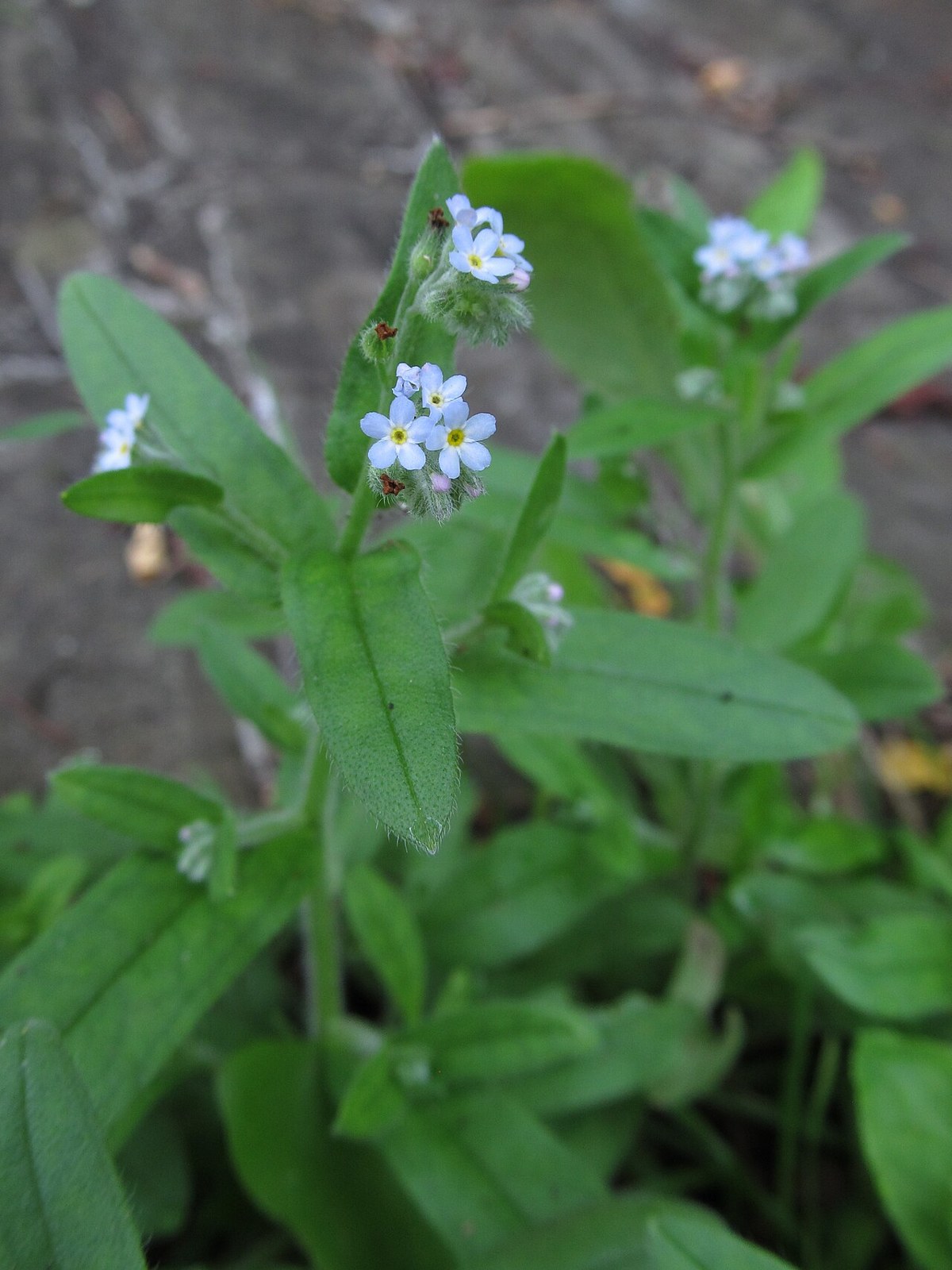
Forget-me-nots are small plants in the genus Myosotis, part of the borage family (Boraginaceae). They are known for their clusters of tiny five-lobed flowers, usually sky blue with a yellow or white eye, held on coiled stems that unroll as the flowers open. The name Myosotis means “mouse ear” in Greek, for the short, soft, hairy leaves of some species.
There are dozens of forget-me-not species worldwide, most of them in Europe and New Zealand. Only a handful are native to the United States, and they are modest plants: bay forget-me-not, a small blue-flowered plant of wet shores and ditches; alpine forget-me-not, the blue alpine wildflower that is the state flower of Alaska; and two small white-flowered annuals of dry woods and fields, spring forget-me-not and large-seeded forget-me-not.
The forget-me-nots most people know are not native. The garden or woodland forget-me-not (Myosotis sylvatica) sold in spring and the water forget-me-not (Myosotis scorpioides) that carpets stream banks are both European plants, and both escape from gardens. If you reached this page from our Maine landscaping guide, the forget-me-not described there is the garden species. This page will help you tell it apart from Maine’s native bay forget-me-not and decide what to plant instead.
Identification
Flowers
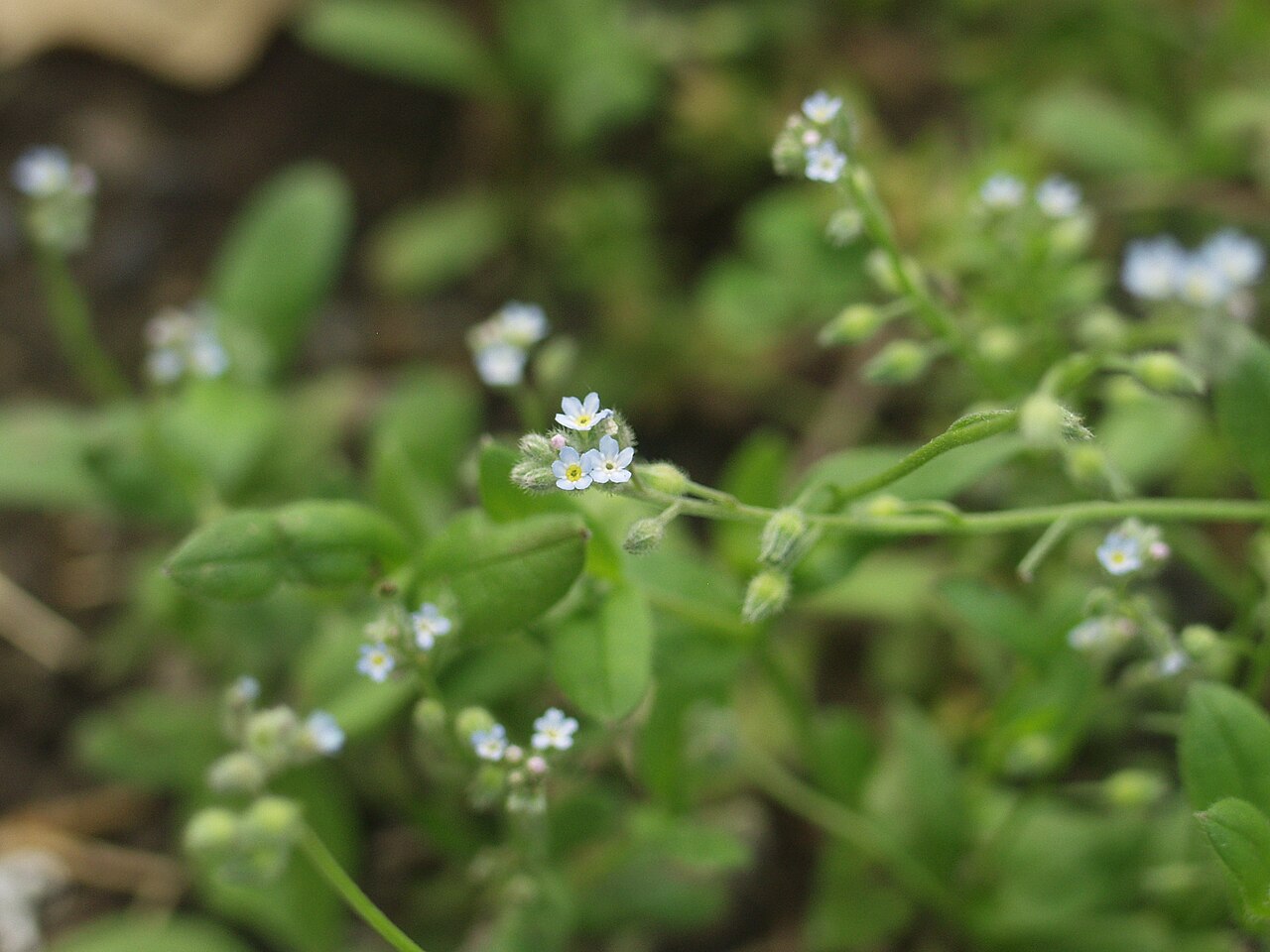
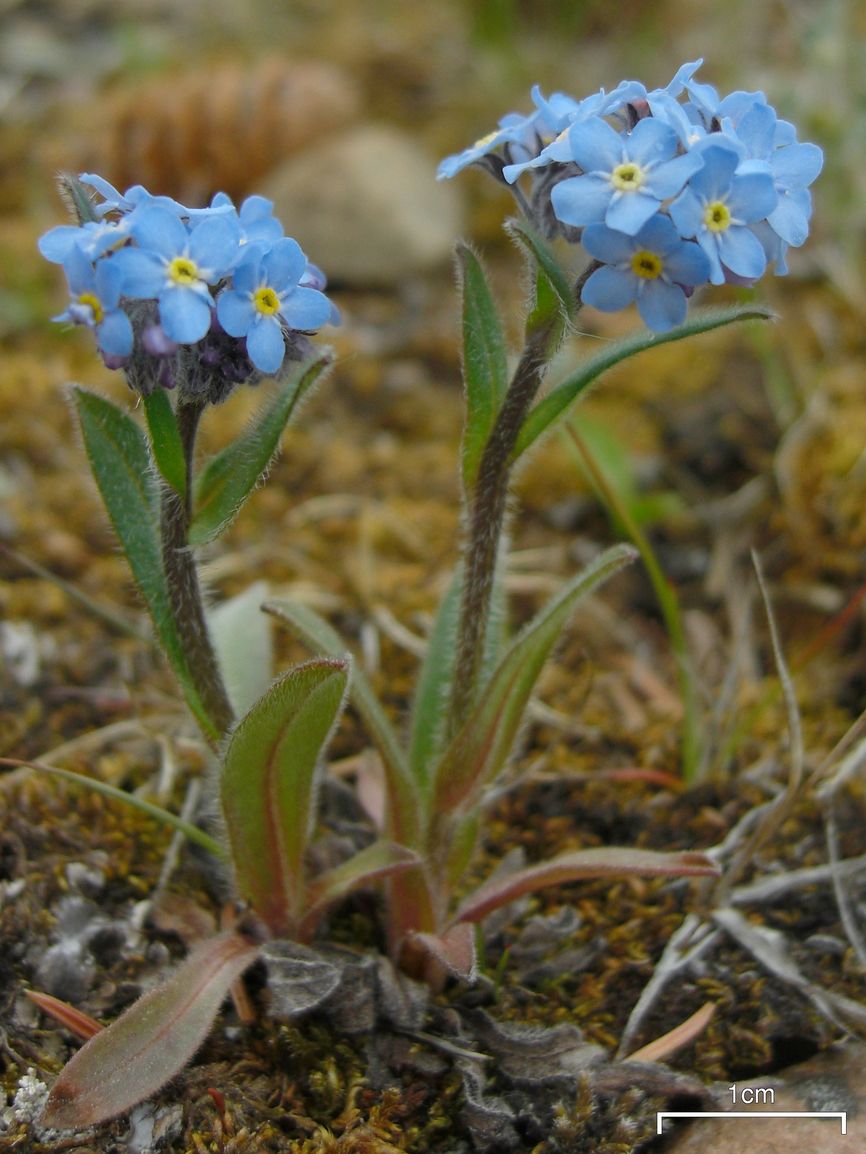
Forget-me-not flowers are tubular at the base and open into five flat, rounded lobes, with five small bumps (scales) in the throat that form a yellow or white ring. They are arranged along one side of a coiled stem, a “scorpioid” cyme, which straightens as the buds open from the bottom up. Flower size is one of the best clues: native bay forget-me-not has blue flowers only about 1/8–1/5 inch (2–5 mm) across; the two eastern annuals have tiny white flowers, 1/16 inch or less; the garden and water forget-me-nots have showier blue flowers about 1/4–3/8 inch (6–10 mm) across. Alpine forget-me-not has bright blue flowers about 1/4 inch across in tight clusters.
Leaves and stems
Leaves are simple, untoothed, oblong to lance-shaped and usually hairy, alternate along the stem, with a rosette of larger leaves at the base in some species. Stems are often soft and weak and may sprawl or root at the nodes in wet places.
Calyx and seeds
Each flower sits in a five-lobed green calyx that stays on as the four small nutlets ripen. Looking at the calyx with a hand lens is the most reliable way to identify species. In bay forget-me-not the calyx has straight, flat-lying hairs and lobes cut more than halfway down. In water forget-me-not the hairs are flat-lying too, but the lobes are short and triangular. Spring forget-me-not, large-seeded forget-me-not and garden forget-me-not have hooked hairs on the calyx that catch on fur and clothing.
Not to be confused with
Several native borage-family plants have similar blue flowers. Virginia bluebells, tall bluebells and mountain bluebells (Mertensia) have hanging, bell-shaped flowers. Virginia stickseed and other stickseeds (Hackelia) have prickly fruits covered in barbed spines. Siberian bugloss (Brunnera macrophylla), a garden perennial, has forget-me-not flowers over large heart-shaped leaves.
Quick Facts
| Scientific Name | Myosotis (genus) |
| Family | Boraginaceae (Borage) |
| U.S. Native Species | About 4: bay, alpine, spring and large-seeded forget-me-not |
| Plant Type | Annual, biennial and short-lived perennial wildflowers |
| Mature Height | Mostly 4–16 in; sprawling stems of bay forget-me-not can trail to about 20 in |
| Bloom Time | Spring to summer; spring forget-me-not April–June, bay forget-me-not May–September, alpine forget-me-not June–August |
| Flower Color | Blue with a yellow eye (bay, alpine); white (spring, large-seeded) |
| Sun Exposure | Full sun to part shade |
| Water Needs | Wet (bay forget-me-not); moist (alpine); dry to moist (spring and large-seeded) |
| Soil Type | Muddy shores and wet meadows; moist alpine meadows; thin soils of open woods and fields |
| Wildlife Value | Small native bees, flies and small butterflies visit the flowers |
| USDA Hardiness Zones | Varies by species; alpine forget-me-not is very cold-hardy |
| Invasive Relatives | Water forget-me-not and garden forget-me-not are European and escape into wetlands and woods |
Native Range
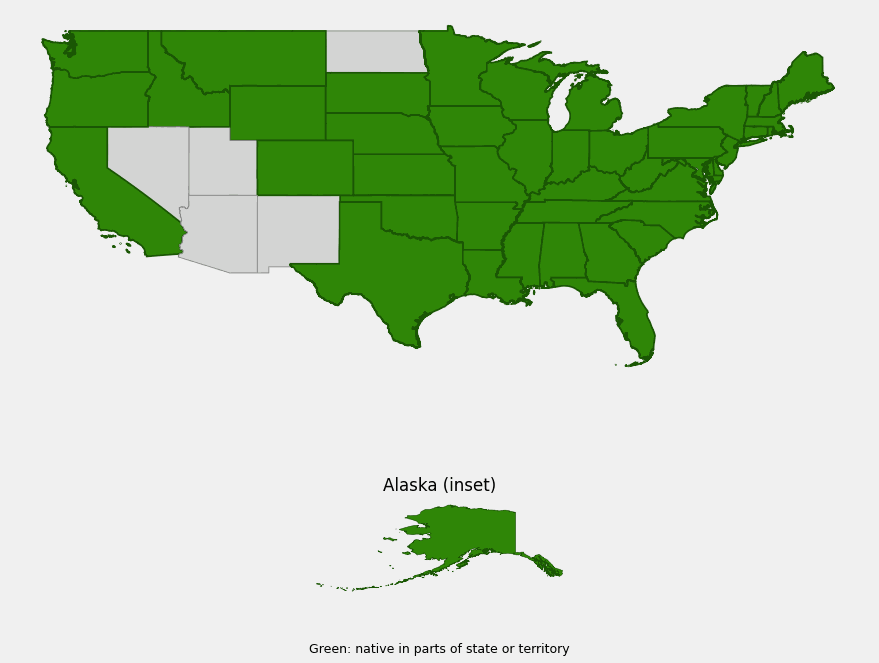
bay forget-me-not is the native blue forget-me-not of the Northeast and the Great Lakes. It grows on muddy shores, in wet meadows, ditches and shallow water from Maine, New Hampshire and Vermont through New England, New York, New Jersey and Pennsylvania to Maryland, Virginia and the mountains of West Virginia and North Carolina, and west through Michigan, Wisconsin and Minnesota. A separate western range runs from Montana and Idaho to Washington, Oregon and California. It also grows across Canada and in Europe.
alpine forget-me-not is a plant of mountain meadows, tundra and rocky slopes in Alaska and the northern Rocky Mountains, reaching south to Washington, Idaho, Montana, Wyoming and Colorado. Many references call it Myosotis alpestris, the name used when it was adopted as Alaska’s state flower.
Spring forget-me-not (Myosotis verna) is the most widespread native species. It grows in dry, open woods, fields, glades and rocky banks across much of the East and Midwest, from Maine and New York to Florida and west to Minnesota, eastern Kansas, Oklahoma and Texas, with a separate range in the Pacific Northwest and northern Rockies. large-seeded forget-me-not is its southeastern relative, growing in moist woods and floodplains from Pennsylvania, Ohio and Illinois south to Florida and Texas.
Taken together, at least one native forget-me-not grows in nearly every state outside the Desert Southwest, Utah, Nevada, North Dakota and Hawaii. The garden and water forget-me-nots, on the other hand, are not native anywhere in North America.
📋 Regional plant lists covering native forget-me-not ranges: Maine, New Hampshire & Vermont · Southern New England · New York, Pennsylvania & Northern New Jersey · Delaware, Southern New Jersey & Long Island · Maryland, Virginia & West Virginia · North Carolina & South Carolina · Georgia, Alabama & Mississippi · Arkansas, Louisiana, Eastern Oklahoma & East Texas · Kentucky & Tennessee · Ohio & Indiana · Illinois, Iowa & Missouri · Michigan, Wisconsin & Eastern Minnesota · Nebraska, Kansas & Eastern Colorado · South & West Texas · Montana & Wyoming · Idaho, Eastern Oregon & Washington · Western Oregon & Washington · California & Nevada · Alaska
Native Species
Three of the U.S.-native forget-me-nots have full growing guides on Plant Native; spring forget-me-not is described here.
Bay Forget-me-not (Myosotis laxa)
Also called smaller forget-me-not or tufted forget-me-not. A short-lived perennial or annual with weak, sprawling stems, soft hairy leaves and small sky-blue flowers with a yellow eye, blooming from late spring to fall. It grows in wet, muddy places and shallow water. In Maine and the rest of New England, this is the native forget-me-not to look for and the one to grow in a wet garden spot or rain garden.
Alpine Forget-me-not (Myosotis asiatica)
A low, tufted perennial of alpine and subalpine meadows with dense clusters of vivid blue, yellow-eyed flowers on stems a few inches to about a foot tall. It is the state flower of Alaska. It grows best in cool climates with gritty, moist but well-drained soil and does poorly where summers are hot.
Large-seeded Forget-me-not (Myosotis macrosperma)
A small annual of moist woods, stream banks and bottomlands in the Southeast and lower Midwest. Its flowers are tiny and white, and its flower stalks lengthen greatly as the seeds ripen. It is easily mistaken for spring forget-me-not but has larger nutlets and longer fruiting stalks.
Spring Forget-me-not (Myosotis verna)
Also called early forget-me-not or Virginia forget-me-not. A hairy annual, usually 4–16 inches tall, with tiny white flowers in spring and calyxes covered in hooked hairs. It grows in thin soils of dry, open woods, glades, fields and rock outcrops. Gardeners rarely plant it, but it often appears on its own in sunny, sparse lawns and woodland edges.
Non-Native Look-Alikes
Most forget-me-nots seen in American gardens, along streams and in shady woods are introduced European species. They are pretty, but several of them spread aggressively outside gardens.
Water Forget-me-not (Myosotis scorpioides)
Also called true forget-me-not. A creeping perennial from Europe and Asia with blue flowers about 1/4–3/8 inch across, spreading by creeping stems that root in mud. It has escaped widely along streams, ponds and wetlands across the Northeast, the Great Lakes, the Appalachians and the Pacific Northwest, where it can form dense mats that crowd out native wetland plants. It is considered invasive in wetlands in a number of states. Avoid planting it near streams, ponds or wetlands. It is easily confused with native bay forget-me-not, which has smaller flowers, deeper-cut calyx lobes and no creeping runners.
Garden or Woodland Forget-me-not (Myosotis sylvatica)
The forget-me-not sold in spring at garden centers, and the one described in many garden guides, including our Maine landscaping guide. A European biennial or short-lived perennial, 6–12 inches tall, with abundant blue (sometimes pink or white) flowers about 1/4–3/8 inch across in spring. It self-seeds heavily and has naturalized in moist woods and along trails in the Northeast, Great Lakes and Pacific Northwest, where it can carpet the forest floor and compete with native spring wildflowers. If you grow it, deadhead after flowering to limit spread, and keep it away from natural woodland.
Field Forget-me-not (Myosotis arvensis) and others
Field forget-me-not is a small, weedy European annual with tiny blue flowers that grows in fields, lawns and disturbed ground. Changing forget-me-not (Myosotis discolor) and strict forget-me-not (Myosotis stricta) are other small European annuals found in scattered places. None is native.
How to tell native from non-native
Flower size is the quickest clue: blue flowers 1/4 inch or more across, in a garden bed or a dense streamside carpet, are almost always garden or water forget-me-not. Native bay forget-me-not has blue flowers 1/8–1/5 inch across on loose, sprawling plants. White-flowered forget-me-nots in dry woods are usually native spring forget-me-not.
Growing & Care Guide
Finding plants
Native forget-me-nots are rarely sold. Bay forget-me-not is occasionally available as seed or plugs from wetland and native plant nurseries in the Northeast and Pacific Northwest, and alpine forget-me-not from specialist rock-garden nurseries. Never dig plants from the wild.
Light, soil and water
Grow bay forget-me-not in full sun to part shade in constantly moist to wet soil: the edge of a pond, a rain garden, a wet ditch or a soggy low spot. Alpine forget-me-not needs a cool, sunny rock garden or trough with gritty, moist but well-drained soil and does best in northern or mountain gardens. Spring forget-me-not prefers sun or light shade on thin, dry soil.
Planting and care
Native forget-me-nots are short-lived and keep themselves going by self-seeding. Sow seed on bare, moist soil in fall or early spring and do not cover it deeply. Leave some plants to set seed each year, and avoid heavy mulch where you want them to reseed.
Native alternatives for blue spring flowers
For a showier blue display in shade, consider Virginia bluebells where it is native (from New York and Pennsylvania west and south) or tall bluebells in northern and western gardens. In sunny, moist spots, blue-eyed grass has small blue flowers in late spring. In Maine wet spots, bay forget-me-not itself is the native match for the garden forget-me-not.
Wildlife & Ecological Value
For Pollinators
The small flowers of native forget-me-nots are visited by small native bees, syrphid flies and other small flies, and small butterflies. The yellow ring in the throat guides insects to the nectar.
Ecosystem Role
Bay forget-me-not is part of the low plant community of muddy shores and wet meadows, helping cover bare mud. The hooked calyx hairs of spring and large-seeded forget-me-not catch on animal fur, carrying the seeds to new places.
Cultural & Historical Uses
Forget-me-nots have been symbols of remembrance and faithful love in Europe since the Middle Ages, and the name translates the German Vergissmeinnicht. Alaska adopted the alpine forget-me-not as its territorial flower in 1917, and it remained the state flower at statehood. Forget-me-nots are grown as ornamentals, not as food; we do not recommend eating any part of them.
Frequently Asked Questions
Are forget-me-nots native to the United States?
A few are. bay forget-me-not, alpine forget-me-not, spring forget-me-not and large-seeded forget-me-not are native. The common blue garden forget-me-not and the water forget-me-not that grows along streams are European plants.
Is forget-me-not native to Maine?
Yes, but not the garden kind. bay forget-me-not and spring forget-me-not are native to Maine. The showy forget-me-not sold for Maine gardens is the European garden forget-me-not, and the one along many Maine streams is the European water forget-me-not.
Are forget-me-nots invasive?
Water forget-me-not and garden forget-me-not escape from gardens and can form dense patches in wetlands and moist woods, crowding out native plants. They are considered invasive in a number of states. Native forget-me-nots are not invasive.
What is the Alaska state flower?
The alpine forget-me-not, often listed as Myosotis alpestris. Botanists now usually call the Alaska plant Myosotis asiatica. It is a native wildflower of Alaska’s mountain meadows and tundra.
How can I tell native bay forget-me-not from water forget-me-not?
Bay forget-me-not has smaller flowers, about 1/8–1/5 inch across, calyx lobes cut more than halfway down, and no creeping runners. Water forget-me-not has larger flowers, short triangular calyx lobes and creeping stems that root in mud.

Looking for a nursery that carries Forget-me-nots?
Browse our native plant nursery directory: Alaska, Arkansas & Alabama · California · Colorado, Georgia, Florida, Delaware & Connecticut · Idaho, Kansas, Iowa, Illinois & Indiana · Montana, Minnesota, Missouri, Louisiana, Michigan, Kentucky, Mississippi, Maryland, Massachusetts & Maine · Nebraska, Oklahoma, Ohio, North Carolina, New Jersey, New York & New Hampshire · Oregon · South Dakota, Texas, Tennessee, South Carolina, Virginia, Pennsylvania, Rhode Island & Vermont · Washington · Wyoming, Wisconsin & West Virginia

