
Four-leaved Milkweed (Asclepias quadrifolia)
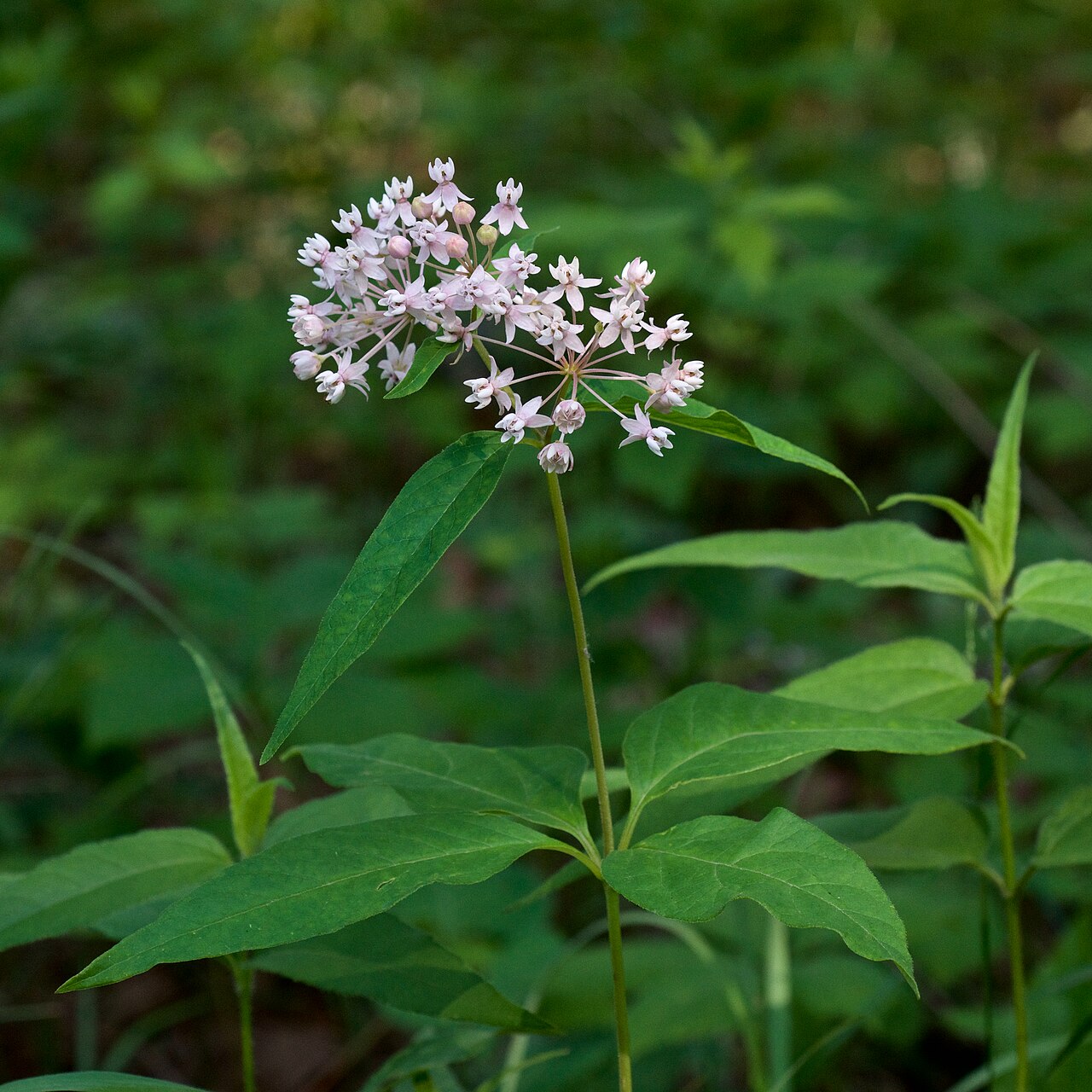
Asclepias quadrifolia, known as Four-leaved Milkweed (USDA: fourleaf milkweed), is a slender, woodland milkweed of the eastern and central United States and southern Ontario. It belongs to the dogbane family (Apocynaceae), which now includes the milkweeds. Unlike most milkweeds, which grow in sunny fields, it is a plant of dry, open woods, rocky wooded slopes and forest edges, from New England and New York south to Georgia and Alabama and west to Iowa, Kansas and Oklahoma.
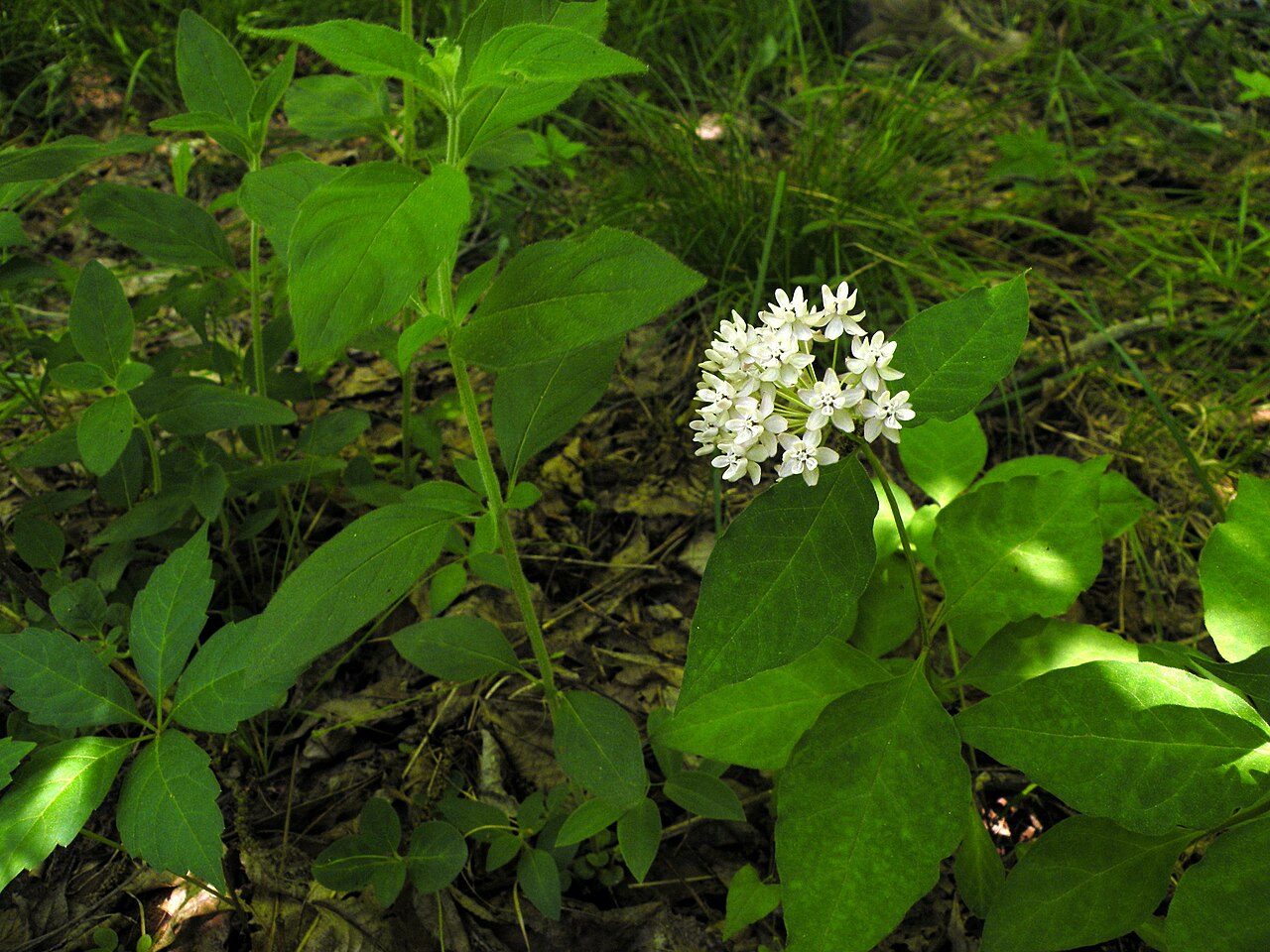
It is one of the first milkweeds to bloom each year, flowering in late spring, from about May to early July. Each plant is a single, delicate stem 1 to 2 feet tall, with one or two whorls of four leaves partway up the stem (the source of its names) and pairs of leaves above and below. At the top are one to several rounded clusters of small, fragrant, pale pink to white flowers.
Four-leaved milkweed is a lovely choice for shady and partly shady native gardens, where it feeds bumble bees and other pollinators and can host monarch caterpillars. It is listed as threatened in New Hampshire and Rhode Island. Like all milkweeds, it is poisonous: its milky sap and leaves contain cardiac glycosides that are toxic to people, pets and livestock if eaten.
Identification
Look for a single, slender milkweed stem in dry woods in late spring, with a whorl of four thin, stalked leaves near the middle of the stem and loose, rounded clusters of pale pink to white flowers at the top.
Stems & Roots
Each plant usually has one unbranched, slender, smooth or finely hairy stem, 1 to 2 feet tall, growing from a thick, fleshy root. Broken stems and leaves leak a white, milky sap. Plants do not spread aggressively by rhizomes as common milkweed does.
Leaves
The leaves are thin, smooth, lance-shaped to oval, 2 to 6 inches long, with pointed tips and short stalks. Typically there is one pair of small leaves near the base, one or two whorls of four leaves (actually two pairs set very close together) at the middle of the stem, and another pair of smaller leaves above. The four-leaf whorl is the best field mark.
Flowers
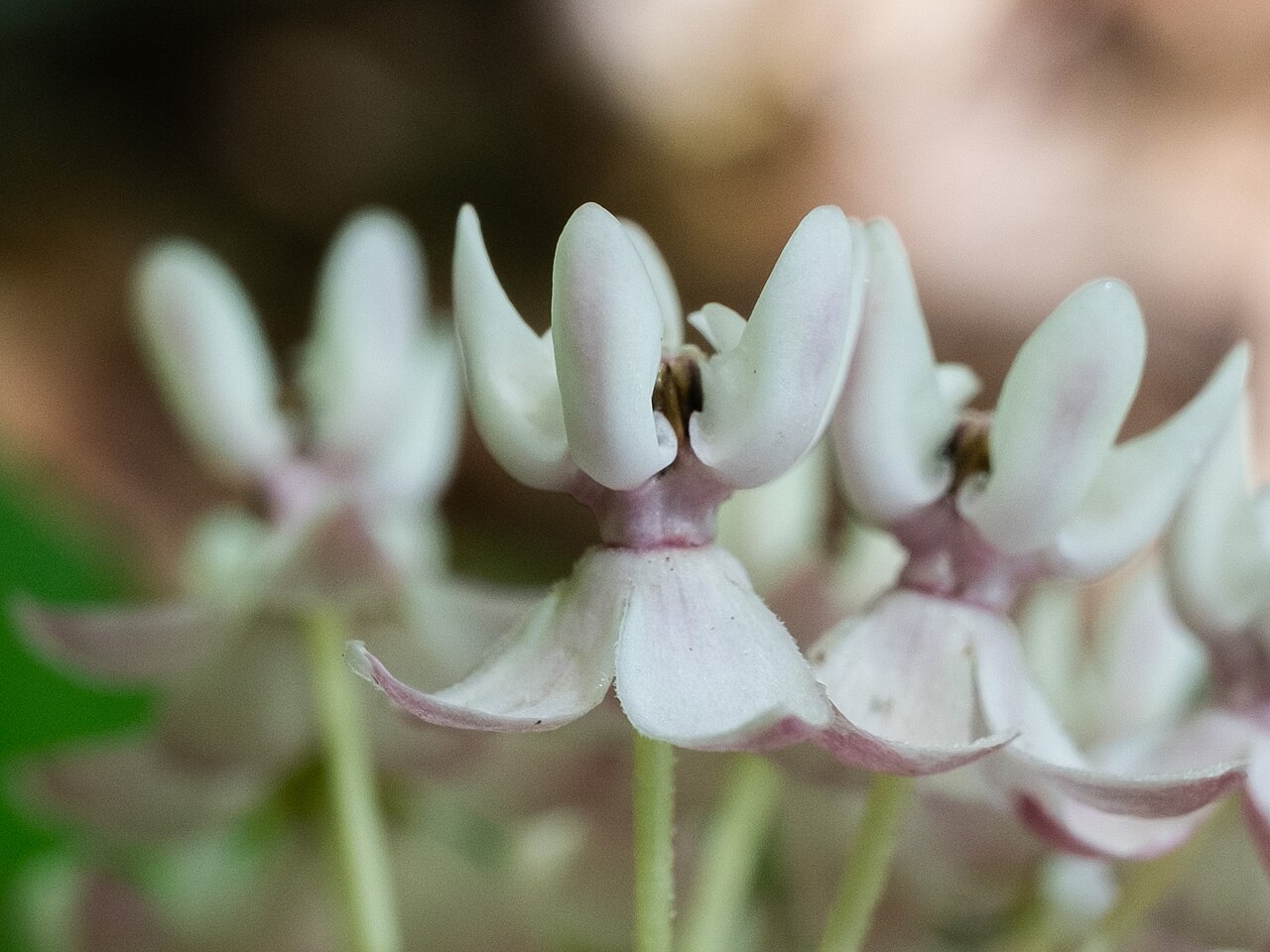
From May to July, one to four loose, rounded clusters (umbels) of flowers appear at the top of the stem and in the upper leaf axils. Each flower is about 1/3 inch long, with five pale pink to lavender petals bent sharply backward and a crown of five white to pinkish hoods, each with a small inward-curving horn. The flowers have a sweet fragrance. Flower buds are often deep pink.
Fruit & Seeds
Slender, smooth, upright seed pods 3 to 5 inches long develop in summer. They split in late summer or fall to release flat brown seeds with tufts of silky white floss that carry them on the wind. Many plants set few pods.
Look-alikes
Poke Milkweed is a taller woodland milkweed with large, opposite leaves and drooping clusters of greenish-white flowers. Redring Milkweed has thicker, opposite leaves and dense, white flowers with a red-purple ring at the center. Whorled Milkweed has very narrow, needle-like leaves in whorls and grows in sunny, dry places. Before flowering, four-leaved milkweed can be mistaken for young dogbane or other woodland plants, but its milky sap and four-leaf whorl identify it.
Safety
Safety note: all parts of four-leaved milkweed, especially the milky sap, contain cardiac glycosides (cardenolides). They are poisonous to people, dogs, cats, horses, sheep, cattle and other animals if eaten, and can cause vomiting, weakness and heart rhythm problems. Wear gloves when handling it, keep the sap out of your eyes, wash your hands afterward and do not plant it where pets or small children may chew plants.
Quick Facts
| Scientific Name | Asclepias quadrifolia |
| Family | Apocynaceae (dogbane family; milkweed subfamily) |
| Plant Type | Herbaceous perennial woodland wildflower |
| Mature Height | 1–2 ft |
| Mature Spread | 6–12 in |
| Growth Rate | Slow |
| Sun Exposure | Part shade to light shade |
| Water Needs | Low to medium; dry to moist, well-drained soil |
| Soil Type | Rocky, sandy or loamy woodland soil; well drained |
| Soil pH | About 5.5–7.5 |
| Bloom Time | May–July |
| Flower Color | Pale pink to lavender and white |
| Fall Color | Leaves yellow before dying back |
| Fruit | Slender, smooth, upright seed pod 3–5 in long |
| Deer Resistant | Yes; toxic and rarely browsed |
| USDA Hardiness Zones | 4–8 |
Native Range
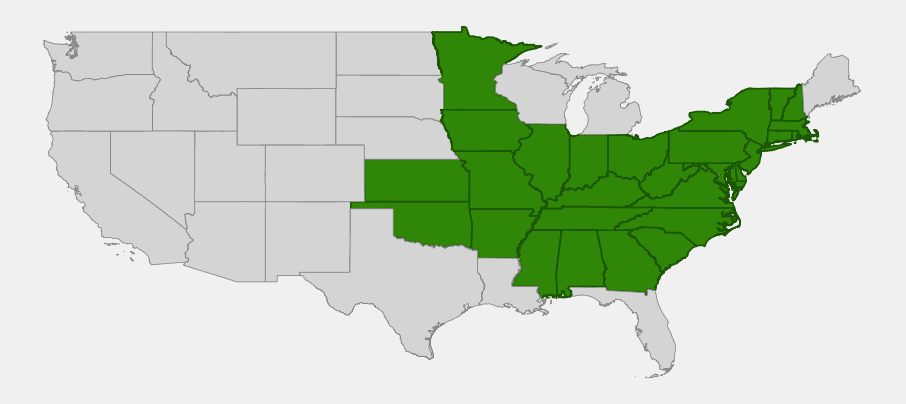
USDA PLANTS lists four-leaved milkweed as native in Canada and the lower 48 states. In Canada it grows only in southern Ontario. In the United States it is recorded from Alabama, Arkansas, Connecticut, Delaware, Georgia, Illinois, Indiana, Iowa, Kansas, Kentucky, Maryland, Massachusetts, Minnesota, Mississippi, Missouri, New Hampshire, New Jersey, New York, North Carolina, Ohio, Oklahoma, Pennsylvania, Rhode Island, South Carolina, Tennessee, Vermont, Virginia and West Virginia.
It is most common in the Appalachian region, from Pennsylvania and New York south through the mountains of Virginia, West Virginia, Kentucky, Tennessee and North Carolina, and in the Ozark and Ouachita Mountains of Missouri, Arkansas and eastern Oklahoma, reaching eastern Kansas. It is scattered across the Midwest and southern New England and becomes rare at the edges of its range; it is listed as threatened in New Hampshire and Rhode Island. The Minnesota record is an old, outlying herbarium collection from the early 1900s.
Typical habitats are dry to moist, open deciduous woods, especially oak-hickory forests, rocky wooded slopes and ridges, wooded bluffs, forest edges and openings. It often grows in thin, rocky soil in light shade.
📋 Regional plant lists featuring Four-leaved Milkweed: New York, Pennsylvania & Northern New Jersey · Ohio & Indiana · Michigan, Wisconsin & Eastern Minnesota · Kentucky & Tennessee · Nebraska, Kansas & Eastern Colorado · Connecticut, Massachusetts & Rhode Island · New Hampshire, Maine & Vermont · Maryland, Virginia & West Virginia · Delaware, Southern New Jersey & Long Island · Illinois, Iowa & Missouri · Alabama, Georgia & Mississippi · North & South Carolina · Arkansas, Louisiana, Eastern Oklahoma & Eastern Texas
Growing & Care Guide
Four-leaved milkweed is one of the few milkweeds suited to shade gardens. It is sold by some native plant nurseries in the East and Midwest, often in small quantities. Buy nursery-propagated plants or seed; never dig plants from the wild, especially where it is rare or protected.
Light
Part shade to light shade, as under high deciduous trees or along a woodland edge. It tolerates morning sun but suffers in hot, full afternoon sun.
Soil & Water
Plant it in well-drained woodland soil, including rocky, sandy or loamy soils with some leaf litter. It tolerates dry shade once established. Avoid heavy, waterlogged clay, which rots the fleshy roots. Water during the first season, then only in long droughts.
Planting Tips
Plant small container plants in spring or fall where they can stay permanently, since the deep, fleshy roots resent being moved. Plant in groups of three or more so the slender stems make a visible show. Combine it with other spring woodland plants such as woodland phlox, wild geranium and Solomon’s seal. Mark the location, since the plants emerge fairly late in spring.
Pruning & Maintenance
Little care is needed. Leave the stems standing until pods split, and leave fallen leaves in place as natural mulch. Expect some leaf feeding by milkweed insects. Wear gloves when handling plants because of the toxic sap.
Propagation
Grow from seed collected from ripe pods just before they split. Sow outdoors in fall, or give seeds 30 to 60 days of cold, moist stratification before spring sowing. Seedlings grow slowly and may take two to three years to flower.
Landscape Uses
- Shade and woodland gardens: one of the few milkweeds that thrives in partial shade
- Pollinator gardens: fragrant late-spring flowers for bumble bees and butterflies
- Monarch habitat: an early-season milkweed for the first spring monarchs
- Woodland restoration: oak-hickory and rocky slope plantings within its range
- Naturalistic plantings: delicate accent among ferns and spring wildflowers
Wildlife & Ecological Value
Four-leaved milkweed is an early-blooming, shade-tolerant milkweed that supports pollinators and milkweed specialists in eastern woodlands.
For Pollinators
The fragrant flowers are visited by bumble bees, other native bees, honey bees, butterflies and moths. The Xerces Society notes special value to native bees and bumble bees. Monarchs use it as a host plant where it grows, and its early bloom helps the first monarchs returning north in spring. Like all milkweeds, its pollen is carried in paired sacs (pollinia) that stick to visiting insects’ legs.
For Birds
Birds rarely eat milkweed leaves or seeds, but some use the silky floss as nest lining, and insect-eating birds hunt the insects drawn to the plants.
For Mammals
Deer and other mammals usually avoid it because of its toxicity.
Ecosystem Role
Four-leaved milkweed supports milkweed specialists such as monarchs, milkweed tussock moths, milkweed beetles and milkweed bugs in shaded habitats where few other milkweeds grow. It is part of the diverse herb layer of oak-hickory forests and serves as an indicator of open, healthy woodland.
Cultural & Historical Uses
The species was named Asclepias quadrifolia by the Austrian botanist Nikolaus Joseph von Jacquin in the 1700s; quadrifolia means “four-leaved.” The genus honors Asklepios, the Greek god of medicine, a nod to the long medicinal use of milkweeds.
Native peoples and early settlers used several milkweeds for fibers and medicine. Because of their toxicity, milkweeds should never be used as home remedies or eaten without expert knowledge.
In recent years, interest in planting milkweeds for monarch butterflies has grown rapidly. Four-leaved milkweed is valued by native plant gardeners because it brings milkweed into shady yards, where sun-loving species such as common milkweed and butterfly weed struggle.
Frequently Asked Questions
Is four-leaved milkweed poisonous?
Yes. Like all milkweeds, it contains cardiac glycosides in its sap and leaves that are toxic to people, pets and livestock if eaten. Wear gloves when handling it and keep it away from pets and children who might chew plants.
Does four-leaved milkweed grow in shade?
Yes. It is one of the most shade-tolerant milkweeds and grows naturally in open woods and on wooded slopes. Part shade or light shade is ideal.
Do monarchs use four-leaved milkweed?
Yes, monarchs can lay eggs on it, and it blooms early, helping the first spring monarchs. It is also an excellent nectar plant for bumble bees and other pollinators.
Why is it called four-leaved milkweed?
Because of the whorl of four leaves near the middle of the stem, formed by two pairs of leaves set very close together.
Will four-leaved milkweed spread in my garden?
No. It does not spread aggressively by rhizomes like common milkweed. It forms single stems or small clumps and spreads only slowly by seed.

Looking for a nursery that carries Four-leaved Milkweed?
Browse our native plant nursery directory: Alabama & Arkansas · Connecticut, Delaware & Georgia · Illinois, Indiana, Iowa & Kansas · Kentucky, Maryland, Massachusetts, Minnesota, Mississippi & Missouri · New Hampshire, New Jersey, New York, North Carolina, Ohio & Oklahoma · Pennsylvania, Rhode Island, South Carolina, Tennessee, Vermont & Virginia · West Virginia