
Sawtooth Blackberry (Rubus argutus)
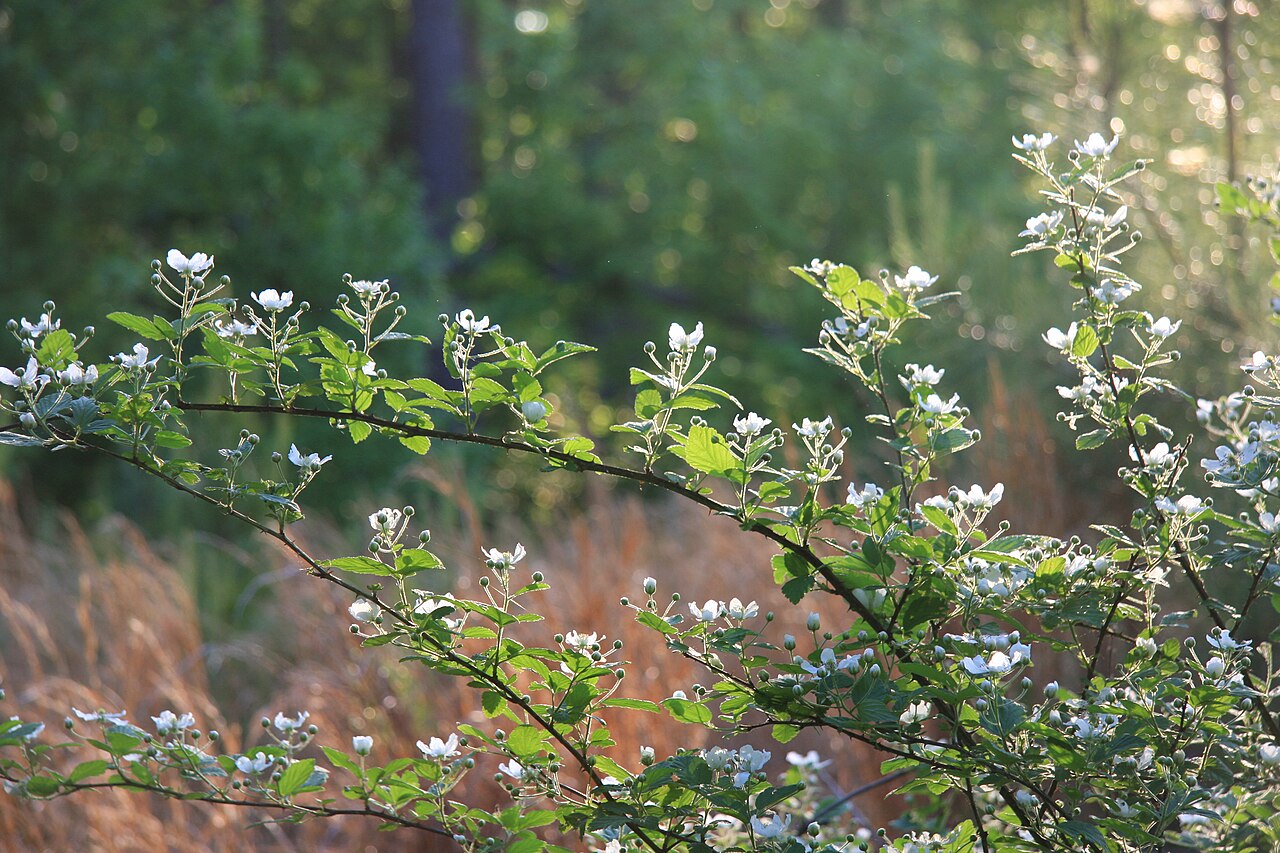
Rubus argutus, the Sawtooth Blackberry (also called southern blackberry or highbush blackberry), is a native thorny shrub in the rose family (Rosaceae). It forms thickets of arching, prickly canes 3 to 8 feet tall, with compound leaves of three to five sharply toothed leaflets, which give it its name. In spring it is covered with white flowers, and in early summer it bears sweet, glossy black berries.
It is one of the most common wild blackberries of the southeastern United States, found from Florida and Texas north through the Ohio Valley to the Mid-Atlantic and southern New England. It grows in old fields, clearings, forest edges, fencerows, roadsides and open woods, and quickly fills in land after logging, fire or abandonment.
In its native range, sawtooth blackberry is an excellent wildlife plant, feeding birds and mammals and sheltering them in its thorny thickets, and its berries are a favorite wild fruit for people. In Hawaii, where it was introduced, it has become a serious invasive weed in native forests and is not part of the native flora.
Identification
Look for an upright to arching blackberry with stout, hooked prickles, leaves of three to five sharply toothed leaflets that are green and mostly smooth beneath, and flower clusters without sticky glandular hairs, growing in sunny old fields and forest edges across the Southeast.
Growth Habit
Sawtooth blackberry is a deciduous to semi-evergreen shrub that grows from a perennial root crown. Its canes are biennial: in the first year a cane (primocane) grows long and leafy, and in the second year (floricane) it produces short side branches that flower and fruit, and then dies. The canes are erect to arching, 3 to 8 feet tall, and root at the tips when they touch the ground, so plants spread into dense thickets. The canes are angled and armed with stout, broad-based, hooked prickles.
Leaves
The leaves are alternate and palmately compound. First-year canes carry leaves with five leaflets; flowering branches usually have three. The leaflets are oval to lance-shaped, 2 to 4 inches long, with long pointed tips and sharp, coarse, often double teeth along the edges. They are dark green above and paler green beneath, smooth to lightly hairy, without the velvety white undersides of some blackberries.
Flowers
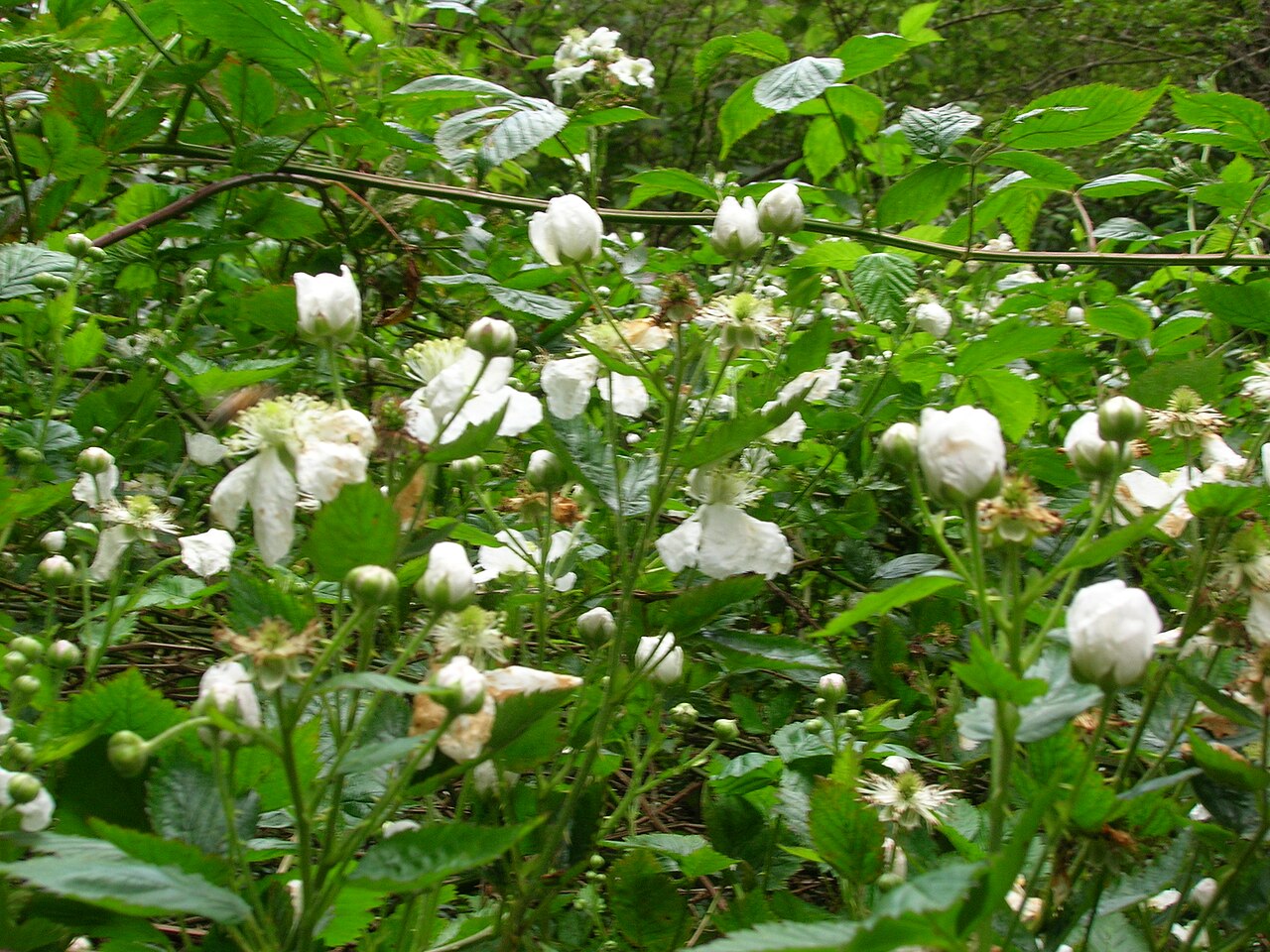
White, five-petaled flowers about 1 inch across grow in loose clusters at the tips of the flowering branches in spring, usually April to June depending on latitude. The flower stalks are hairy but lack the stalked glands found on Allegheny blackberry.
Fruit & Seeds
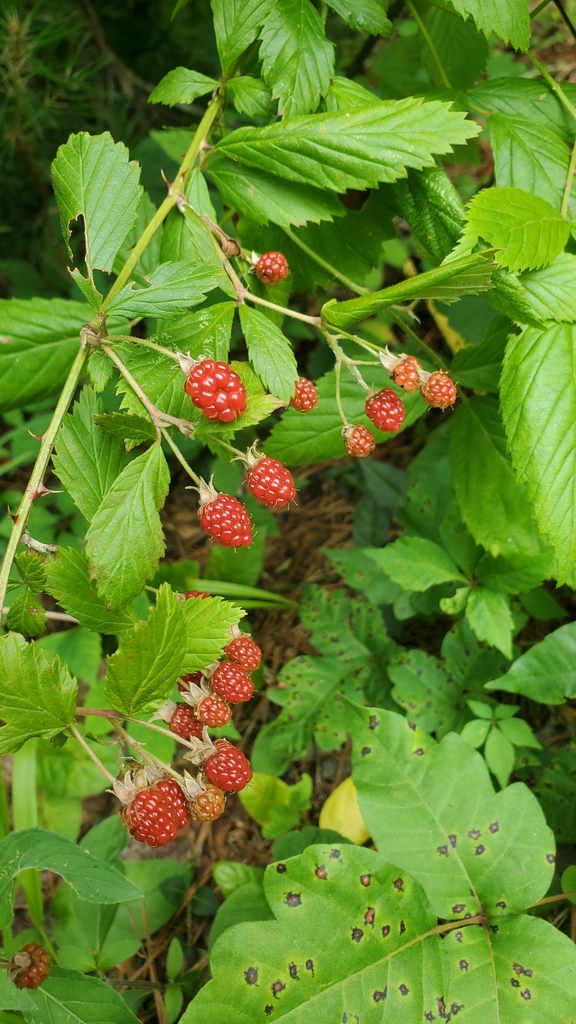
The fruit is an aggregate of many small, juicy drupelets, about 1/2 to 1 inch long, that turns from green to red to glossy black when ripe, usually in June and July. Unlike raspberries, the fruit comes off the plant with its core (receptacle) inside. Each drupelet holds one hard seed.
Look-alikes
Allegheny blackberry is very similar but has sticky, stalked glands on its flower and fruit stalks and is more common northward and in the mountains. Southern dewberry and swamp dewberry trail along the ground instead of arching upright. Sand blackberry (Rubus cuneifolius) is a shorter shrub with small, wedge-shaped leaflets that are woolly beneath. Blackberry identification is notoriously difficult because the plants hybridize, and botanists still disagree on how to divide the eastern species.
Quick Facts
| Scientific Name | Rubus argutus |
| Family | Rosaceae (rose family) |
| Plant Type | Thicket-forming shrub with biennial canes |
| Mature Height | 3–8 ft |
| Mature Spread | 3–10 ft or more (spreads into thickets) |
| Growth Rate | Fast |
| Sun Exposure | Full sun to part shade |
| Water Needs | Moderate; tolerates dry and moist soil |
| Soil Type | Sandy, loamy or clay; adaptable |
| Soil pH | Acidic to neutral (about 4.5–7.0) |
| Bloom Time | April–June |
| Flower Color | White |
| Fall Color | Reddish to purple in some years |
| Fruit | Black aggregate berries, June–July |
| Deer Resistant | No; deer browse leaves and canes |
| USDA Hardiness Zones | 5–9 |
Native Range
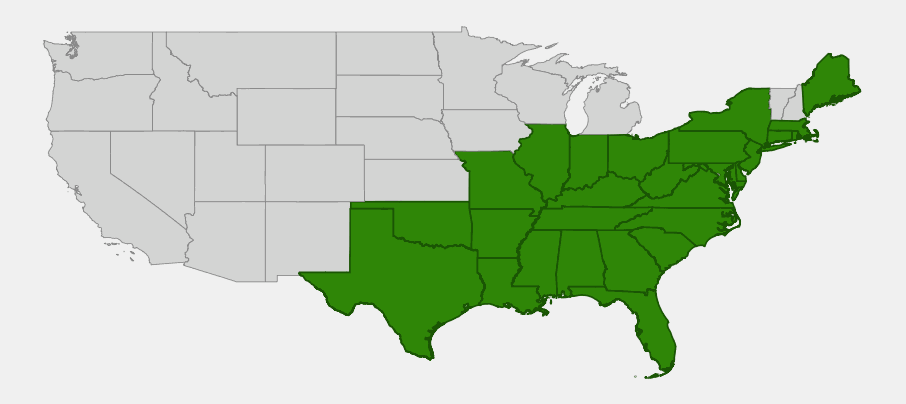
USDA PLANTS lists sawtooth blackberry as native to Alabama, Arkansas, Connecticut, Delaware, Florida, Georgia, Illinois, Indiana, Kentucky, Louisiana, Maine, Maryland, Massachusetts, Mississippi, Missouri, New Jersey, New York, North Carolina, Ohio, Oklahoma, Pennsylvania, Rhode Island, South Carolina, Tennessee, Texas, Virginia and West Virginia. It is most common across the Southeast, from Florida to East Texas and north to Virginia and Kentucky; records from New England and New York are near the northern edge of its range.
USDA also lists it from Hawaii, but there it is introduced. It was brought to the islands, probably for its fruit, and spread into native forests and pastures on several islands, where it forms impenetrable thickets and crowds out native plants. It is listed as a noxious weed in Hawaii, and conservation agencies there work to control it. Hawaii is therefore not shown on the native range map.
Within its native range it grows in old fields, pastures, clearings, cutover and burned forests, forest edges, fencerows, roadsides, rights-of-way, open pine and hardwood woods and the edges of wetlands, usually in sun or light shade.
📋 Regional plant lists featuring Sawtooth Blackberry: North & South Florida · Alabama, Georgia & Mississippi · North & South Carolina · Maryland, Virginia & West Virginia · Kentucky & Tennessee · Arkansas, Louisiana, Eastern Oklahoma & Eastern Texas · Illinois, Iowa & Missouri · Ohio & Indiana · New York, Pennsylvania & Northern New Jersey · Delaware, Southern New Jersey & Long Island · Connecticut, Massachusetts & Rhode Island · New Hampshire, Maine & Vermont
Growing & Care Guide
Sawtooth blackberry is easy to grow and often arrives on its own in sunny, neglected corners. It is best suited to wildlife gardens, hedgerows and naturalized areas where its thorny thickets can spread. Do not plant it in Hawaii, where it is invasive.
Light
Full sun gives the most flowers and fruit. It tolerates part shade at woodland edges but fruits less there.
Soil & Water
It adapts to almost any well-drained soil, from sandy to clay, and to moderately acidic conditions. Established plants tolerate drought, though berries are larger and juicier with summer moisture.
Planting Tips
Plant it along a fence, at the back of a wildlife area or as a living barrier, at least 3 to 4 feet apart. Give it space or a mowed edge, because tip-rooting canes and root sprouts spread it into a thicket.
Pruning & Maintenance
Cut the second-year canes to the ground after they fruit, since they die anyway. In late winter, thin the first-year canes and shorten long ones to make harvesting easier. Mow or pull sprouts where you do not want it to spread. Wear heavy gloves and long sleeves; the prickles are sharp and hooked.
Propagation
Propagate by tip layering (pinning a cane tip to the soil until it roots), by digging rooted suckers from garden plants, or from root cuttings. Seeds germinate slowly and need cold stratification; birds spread them readily. Do not dig plants from parks or natural areas.
Landscape Uses
- Wildlife hedgerows: thorny cover and summer fruit for birds and mammals
- Edible landscaping: sweet wild blackberries in early summer
- Pollinator gardens: spring flowers rich in nectar and pollen
- Barrier plantings: dense, prickly thickets along property lines
- Old-field restoration: a natural early-successional shrub
Wildlife & Ecological Value
Few native plants feed and shelter as much wildlife as wild blackberries, and sawtooth blackberry is one of the most important in the Southeast.
For Pollinators
The spring flowers are visited by many bees, including bumble bees, mining bees and sweat bees, as well as flies, butterflies and beetles. The Xerces Society notes the plant’s special value to native bees and bumble bees. Small carpenter bees and some wasps nest in the pithy dead canes. Blackberry leaves are also eaten by the caterpillars of several native moths.
For Birds
Dozens of bird species eat the berries, including catbirds, mockingbirds, thrashers, robins, cardinals, towhees, bluebirds and wild turkeys and quail. The thorny thickets give nesting sites and protection from predators for songbirds such as indigo buntings, yellow-breasted chats and field sparrows.
For Mammals
Black bears, foxes, raccoons, opossums, coyotes, squirrels and chipmunks eat the berries. White-tailed deer browse the leaves and young canes, and rabbits shelter and feed in the thickets.
Ecosystem Role
Sawtooth blackberry is a pioneer shrub of old fields and disturbed forest. It holds soil, shades out some weeds and shelters tree seedlings until the young forest grows above it. In Hawaii, however, the same vigor makes it a damaging invader of native forests, where native birds and plants did not evolve with it.
Cultural & Historical Uses
Wild blackberries have been gathered for food for thousands of years. Native peoples of the Southeast ate the fresh berries, dried them for winter, and used the roots and leaves in traditional medicine. Blackberry picking in July is still a summer tradition in the rural South, and the fruit is used in cobblers, jams and pies.
Modern cultivated blackberries descend from wild North American and European species. Southern wild blackberries such as sawtooth blackberry carry the heat tolerance that breeders have sought for varieties suited to hot Southern summers, and some gardeners still prefer the intense flavor of the wild berries.
The species name argutus is Latin for “sharp” or “sharply toothed,” referring to the leaflet edges. Blackberry taxonomy is famously tangled: hundreds of names have been published for North American Rubus, and sawtooth blackberry has been combined with or separated from related species by different botanists.
Frequently Asked Questions
Are sawtooth blackberries edible?
Yes. The ripe, glossy black berries are sweet and edible, like other wild blackberries. Pick them when fully black and soft, and avoid plants near roads or sprayed areas.
Is sawtooth blackberry native?
Yes, it is native to the eastern and southeastern United States. It is not native to Hawaii, where it was introduced and has become an invasive weed.
How do I tell sawtooth blackberry from other blackberries?
Look for upright, arching canes with hooked prickles, sharply double-toothed leaflets that are green underneath, and flower stalks without sticky stalked glands. Allegheny blackberry has glandular hairs; dewberries trail along the ground.
Will sawtooth blackberry take over my yard?
It spreads by tip-rooting canes, suckers and bird-dropped seeds, so it can form thickets. Plant it where it has room, or keep a mowed edge around it.
When do sawtooth blackberries ripen?
Usually in June and July, a few weeks after the white spring flowers, with the earliest crops in Florida and along the Gulf Coast.

Looking for a nursery that carries Sawtooth Blackberry?
Browse our native plant nursery directory: Alabama & Arkansas · Connecticut, Delaware, Florida & Georgia · Illinois & Indiana · Kentucky, Louisiana, Maine, Maryland, Massachusetts, Mississippi & Missouri · New Jersey, New York, North Carolina, Ohio & Oklahoma · Pennsylvania, Rhode Island, South Carolina, Tennessee, Texas & Virginia · West Virginia

