
Sticky False Asphodel (Triantha glutinosa)
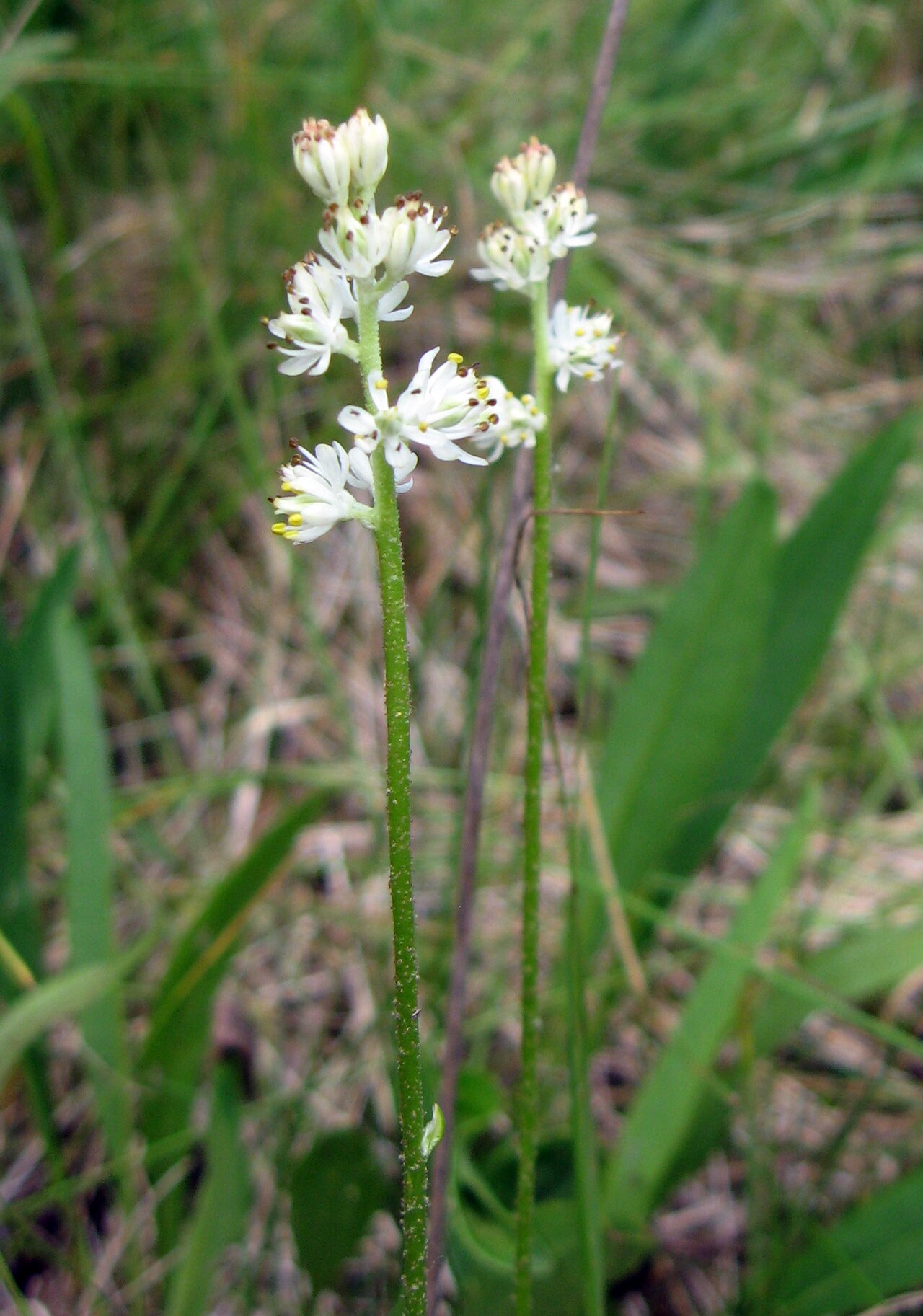
Triantha glutinosa, known as Sticky False Asphodel, sticky tofieldia or northern bog asphodel, is a slender perennial wildflower of fens, wet calcareous shores and mountain seeps in northern North America, long known by the older name Tofieldia glutinosa. From a fan of narrow, iris-like leaves it sends up a single stem, 4 to 20 inches tall, topped in summer by a small, dense head of white flowers. Its upper stem is covered with tiny sticky glands, which give it both its common and scientific names.
It grows across boreal Canada and Alaska and south into the Great Lakes region and New England, with scattered, isolated populations in the Appalachian Mountains as far south as North Carolina, Tennessee and Georgia. It is a specialist of open, wet, mineral-rich (often limy) habitats, and it is rare and state-listed in many states at the edges of its range.
Its western relative, Western False Asphodel (Triantha occidentalis), was shown in 2021 to be carnivorous, catching tiny insects on its sticky stem. Sticky false asphodel has similar glandular hairs and also catches small insects, but whether it digests and absorbs nutrients from them has not been demonstrated. This guide covers how to identify it, where it grows, how it might be grown, and its place in fen ecosystems.
Identification
Sticky false asphodel is a small, easily overlooked lily-like plant. Its fan of flat leaves, a nearly leafless sticky stem, and a compact head of white flowers in groups of three are distinctive.
Leaves & Growth Habit
A tufted perennial from a short rhizome. The leaves are mostly basal, 2 to 8 inches long and narrow, flat and folded at the base around the next leaf, arranged in a flat fan like a small iris. The flowering stem usually has one or two small leaves near the base and is otherwise leafless.
Stem
The stem is 4 to 20 inches tall and slender. Its upper part is densely covered with short, dark, sticky glandular hairs, which often hold small trapped insects. The species name glutinosa means “sticky” or “glue-like.”
Flowers
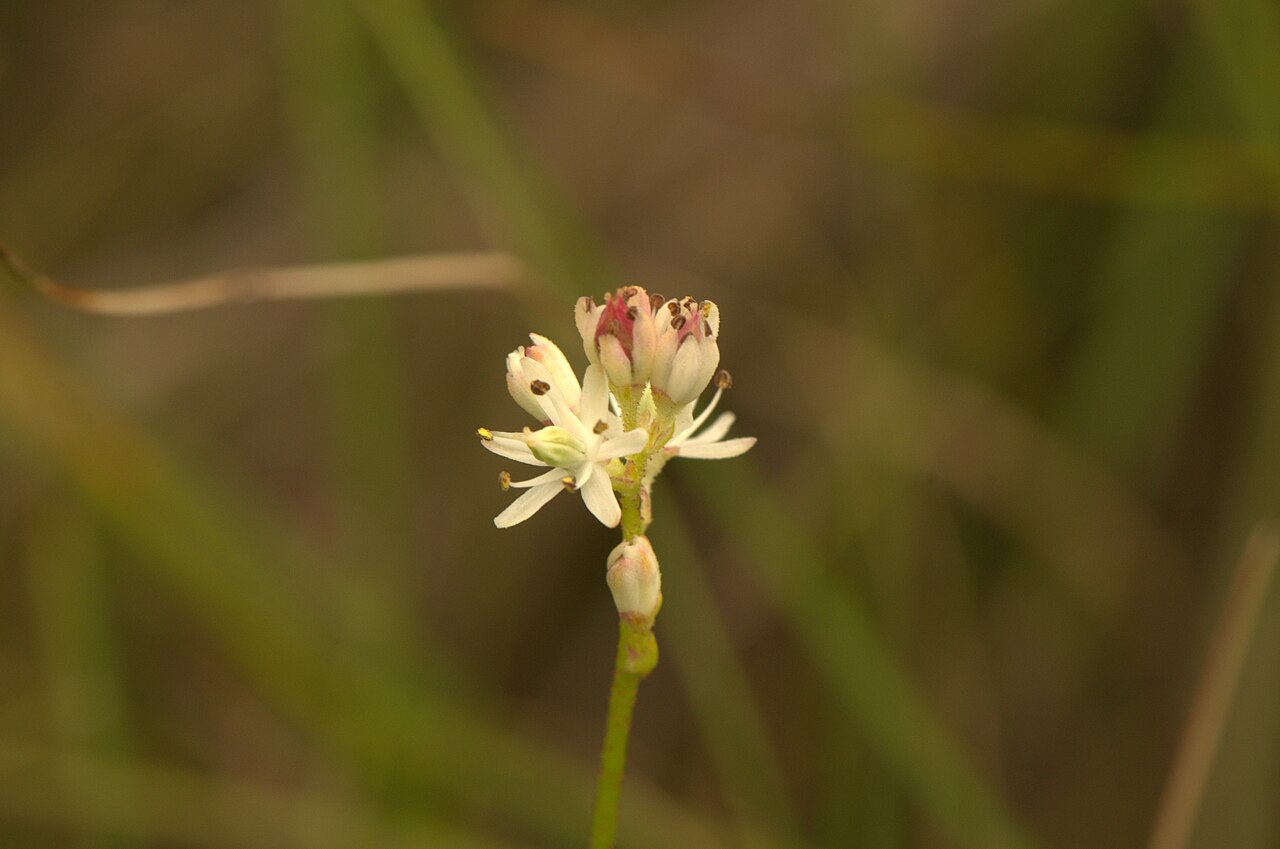
Flowers open from about June to August in a short, dense raceme, ½ to 2 inches long, at the top of the stem. They are arranged in small clusters of three (the meaning of Triantha). Each flower is about ¼ inch across, with six white tepals and six stamens with anthers that are often reddish-purple, which can give the flower head a speckled look.
Fruit & Look-alikes
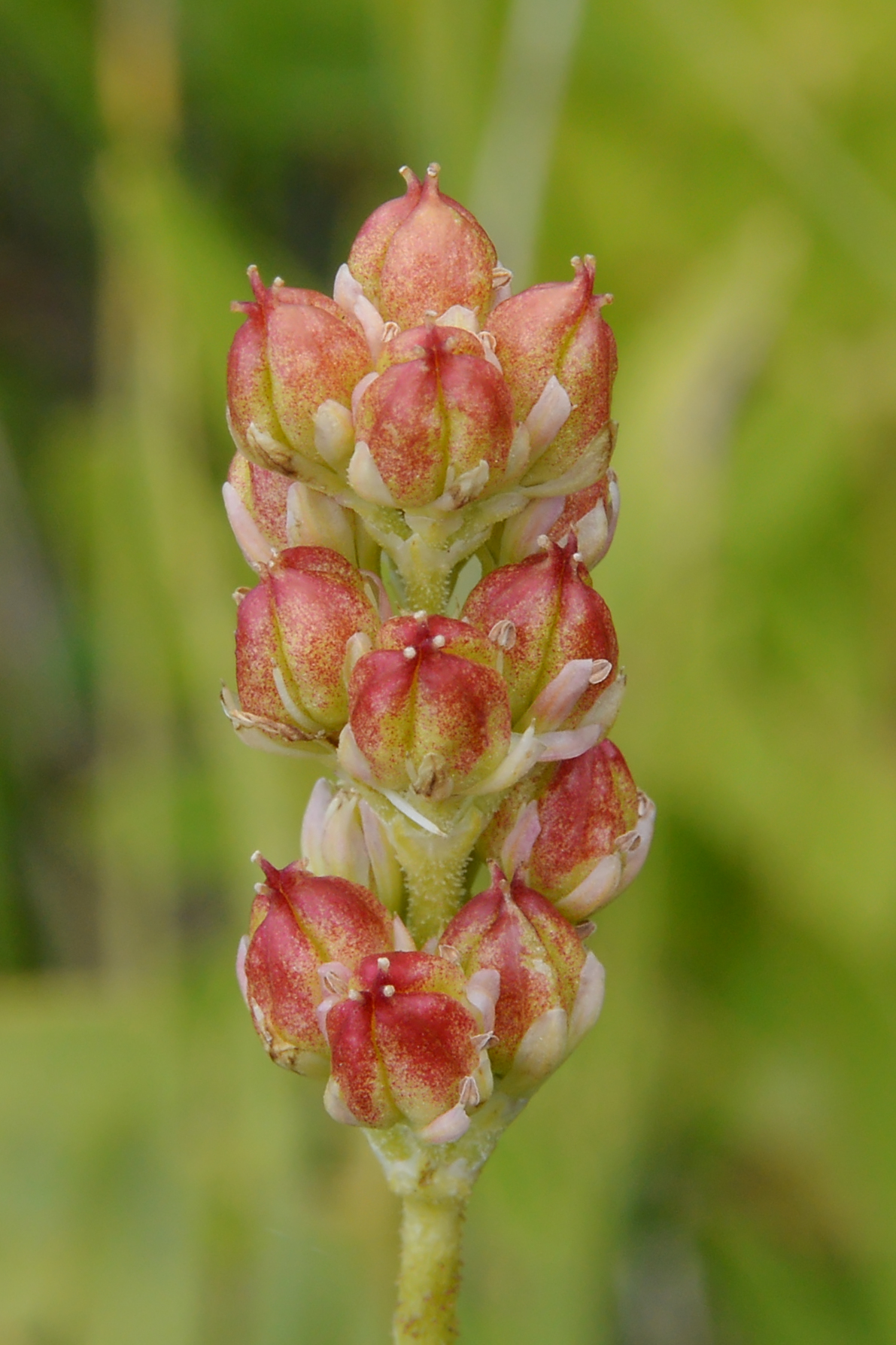
The fruit is an upright, oblong capsule that turns red to reddish-purple and then brown in late summer, with seeds bearing slender, tail-like appendages. Western False Asphodel is very similar but grows in western North America. Coastal false asphodel (Triantha racemosa) of the Southeast has a taller, more open raceme, and Tofieldia species such as Pursh’s false asphodel lack sticky stems. Grass-of-Parnassus and Fen Grass-of-Parnassus, which grow in the same fens, have single, larger, green-veined white flowers.
Quick Facts
| Scientific Name | Triantha glutinosa (Michx.) Baker (syn. Tofieldia glutinosa) |
| Family | Tofieldiaceae (false asphodel family) |
| Plant Type | Herbaceous perennial wildflower |
| Mature Height | 4–20 in |
| Mature Spread | 3–6 in |
| Growth Rate | Slow |
| Sun Exposure | Full sun to light shade |
| Water Needs | Wet; constantly moist to saturated soil |
| Soil Type | Marl, wet calcareous sand and gravel, peat over limestone, seeps |
| Soil pH | Neutral to alkaline; also some acidic mountain bogs |
| Bloom Time | June–August |
| Flower Color | White, with reddish-purple anthers |
| Fall Color | Capsules turn red to reddish-purple |
| Fruit | Upright capsule with appendaged seeds |
| Deer Resistant | Not well documented; seldom browsed in its wet habitat |
| USDA Hardiness Zones | About 2–7 |
Native Range
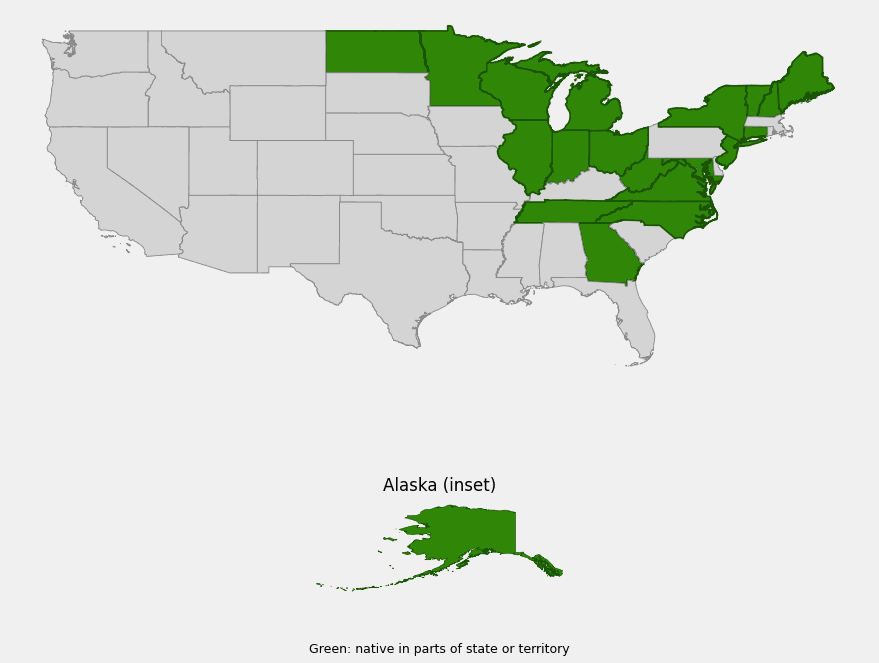
Sticky false asphodel is a northern species. USDA PLANTS lists it as native in Alaska and in Canada from British Columbia, Yukon and the Northwest Territories east to Newfoundland and Labrador. In the lower 48 it grows around the Great Lakes (Minnesota, Wisconsin, Michigan, Illinois, Indiana and Ohio), in North Dakota, and in the Northeast (Maine, New Hampshire, Vermont, Connecticut, New York and New Jersey). Southward it follows the Appalachians in scattered, disjunct populations in Maryland, Virginia, West Virginia, North Carolina, Tennessee and northern Georgia.
USDA also maps an Oregon record. Western plants were once treated as a subspecies of this species (Tofieldia glutinosa ssp. occidentalis), and plants of the Pacific Northwest are now referred to western false asphodel (Triantha occidentalis), so Oregon is not shown on the map here. Plants in the New Jersey Pine Barrens appear intermediate toward the coastal Triantha racemosa.
Its classic habitat is the calcareous fen: open, spring-fed wetlands where cold, mineral-rich groundwater keeps the soil saturated and alkaline. It also grows on wet marly shores and interdunal swales of the Great Lakes, on limestone ledges and alvars, in cedar swamps and wet meadows, and in the south in rare mountain bogs and seepage wetlands. Many of these habitats are small and vulnerable to drainage, groundwater withdrawal and invasive plants, and the species is state-listed as rare, threatened or endangered in a number of states, including Wisconsin, where it is listed as threatened.
📋 Regional plant lists featuring Sticky False Asphodel: Alaska · New Hampshire, Maine & Vermont · Connecticut, Massachusetts & Rhode Island · New York, Pennsylvania & Northern New Jersey · Delaware, Southern New Jersey & Long Island · Maryland, Virginia & West Virginia · North & South Carolina · Alabama, Georgia & Mississippi · Kentucky & Tennessee · Ohio & Indiana · Illinois, Iowa & Missouri · Michigan, Wisconsin & Eastern Minnesota · North Dakota, South Dakota & Western Minnesota
Growing & Care Guide
Sticky false asphodel is very rarely offered by nurseries, and it is difficult to keep outside its specialized habitat. Because it is rare or state-listed in many states, never dig it or collect seed from the wild; buy only nursery-propagated plants or seed from reputable native and bog-plant specialists. Gardeners who already grow fen plants or carnivorous plants outdoors in cold climates are the best candidates to try it.
Light
Full sun to light shade. In its habitat it grows in open fens and shores where taller plants are sparse.
Soil & Water
It needs constantly wet, low-nutrient soil that never dries out. Unlike most bog plants, it usually prefers neutral to alkaline conditions: a fen garden of sand, marl or limestone grit with some peat, kept saturated with cool, mineral-rich water, comes closest to its habitat. Do not fertilize.
Planting Tips
Plant in spring in a constructed fen or bog garden in a cold-winter climate (about USDA zones 2 to 7). It needs a cold winter dormancy and does poorly in hot, humid summers. Keep it away from vigorous plants that will shade or crowd it.
Pruning & Maintenance
Remove old stems in late fall or early spring. Keep taller sedges, grasses and woody seedlings from overtopping it, and never let the soil dry out.
Propagation
Sow fresh seed on the surface of moist, sandy fen mix in fall, so it gets a natural winter chill, or give it several weeks of cold, moist stratification. Seedlings grow slowly. Established clumps can be divided carefully in spring.
Landscape Uses
- Fen and bog gardens: with grass-of-Parnassus, Kalm’s lobelia and other fen plants in cold climates
- Wetland restoration: fen and calcareous shore restoration within its native range
- Carnivorous plant collections: a sticky-stemmed relative of the carnivorous western false asphodel
- Wildflower viewing: summer blooms in fens and on Great Lakes shores
Wildlife & Ecological Value
Sticky false asphodel is an indicator of high-quality fens and calcareous wetlands, some of the most species-rich and threatened plant communities in the Northeast and Great Lakes.
For Pollinators
Its small white flowers are visited by small bees, flies and other insects. The sticky zone on the stem lies below the flowers, so larger pollinators are rarely trapped.
For Birds
It is not an important food plant for birds, but the fens where it grows support insects eaten by swallows, flycatchers and warblers.
For Mammals
It has no recognized value as food for mammals and is rarely browsed.
Ecosystem Role
Its sticky glandular hairs trap small insects such as midges and gnats. In its western relative, Western False Asphodel, researchers showed in 2021 that the plant digests such prey and absorbs nitrogen from it. Whether sticky false asphodel does the same has not yet been shown, so it is best described as a sticky-stemmed plant that may be a candidate for carnivory. It is part of the specialized flora of fens, alongside sundews, butterworts and pitcher plants.
Cultural & Historical Uses
André Michaux described the plant in 1803 as Narthecium glutinosum. It was later known for many years as Tofieldia glutinosa, and the English botanist John Gilbert Baker moved it to Triantha, a genus named for its flowers in groups of three. Western plants, once treated as a subspecies of it, are now recognized as the separate species Triantha occidentalis.
The 2021 discovery of carnivory in western false asphodel, published in the Proceedings of the National Academy of Sciences by researchers at the University of British Columbia and the University of Wisconsin-Madison, drew new attention to the whole genus. Because sticky false asphodel shares the sticky, insect-catching stem, it has become a plant of interest to carnivorous plant enthusiasts, although its own diet has not been studied in the same way.
For botanists, finding sticky false asphodel is often a sign of an intact fen with healthy groundwater flow. Many of its sites in the Great Lakes and Northeast are protected in state natural areas and preserves.
Frequently Asked Questions
Is sticky false asphodel carnivorous?
Not proven. Its sticky stem traps small insects, and its western relative, Triantha occidentalis, was shown in 2021 to digest such prey and absorb nitrogen from it. Similar experiments have not demonstrated carnivory in Triantha glutinosa.
Is it the same as Tofieldia glutinosa?
Yes. Tofieldia glutinosa is an older name for this species. The western plants once included in it are now treated as Triantha occidentalis.
Where does it grow?
In fens, wet limestone shores, seeps and mountain bogs from Alaska across Canada, around the Great Lakes and in New England, with isolated populations in the Appalachians south to Georgia.
Is it rare?
It is secure in much of Canada but rare and state-listed in many U.S. states, especially at the southern edge of its range. Never collect it from the wild.
Can I grow it?
It is difficult but possible in a cold-climate fen or bog garden with constantly wet, low-nutrient, neutral to alkaline soil. Use nursery-propagated plants or seed only.

Looking for a nursery that carries Sticky False Asphodel?
Browse our native plant nursery directory: Alaska · Connecticut & Georgia · Illinois & Indiana · Maine, Maryland, Michigan & Minnesota · New Hampshire, New Jersey, New York, North Carolina, North Dakota & Ohio · Tennessee, Vermont & Virginia · West Virginia & Wisconsin

