
Strict Blue-eyed Grass (Sisyrinchium montanum)
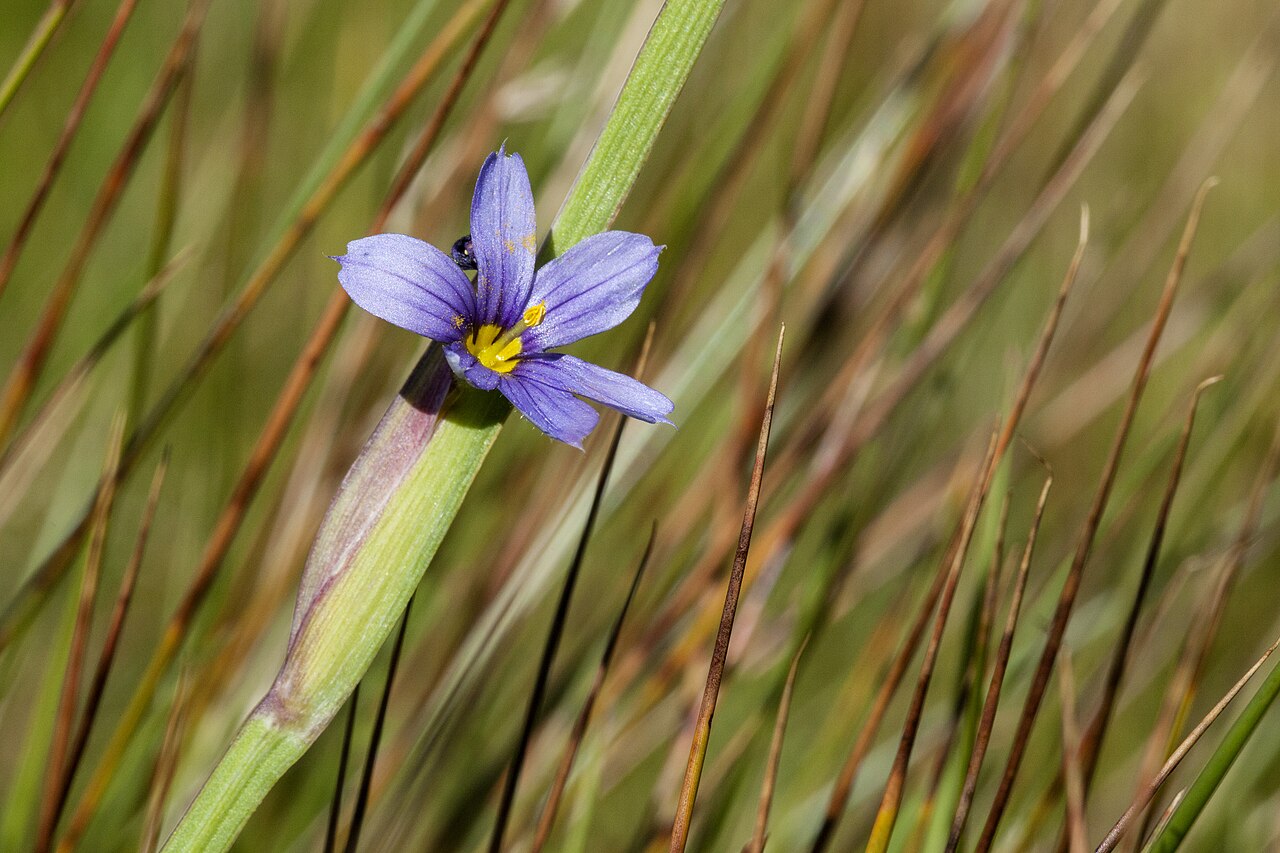
Sisyrinchium montanum, known as Strict Blue-eyed Grass, mountain blue-eyed grass or American blue-eyed grass, is a small, grass-like member of the iris family. From late spring into midsummer it opens violet-blue, star-shaped flowers with a bright yellow eye at the tips of flat, winged stems. Each flower lasts only a day, but a clump keeps producing new ones for weeks.
It is one of the most widespread blue-eyed grasses in North America, native across Canada and the northern United States from New England and the Great Lakes to the northern Great Plains and the Rocky Mountains, south to New Mexico. It grows in meadows, prairies, open woods, lakeshores, old fields and even lawns. The name “strict” refers to its stiff, upright, usually unbranched stems.
This guide explains how to identify strict blue-eyed grass and tell it from its many look-alikes, where it grows, how to use it in a native garden or rock garden, and its value for small pollinators.
Identification
Blue-eyed grasses are not true grasses but small irises with grass-like leaves. Telling the species apart takes a close look at the stems, the bracts that hold the flowers, and the seed capsules.
Stems & Leaves
Plants form small, dense tufts 4 to 20 inches tall. The leaves are basal, flat and grass-like, about 1/16 to 1/8 inch wide. The flowering stems are flattened and narrowly winged along both edges, usually about as wide as the leaves, and they are typically simple (unbranched), each ending in a single cluster of flowers.
Spathes
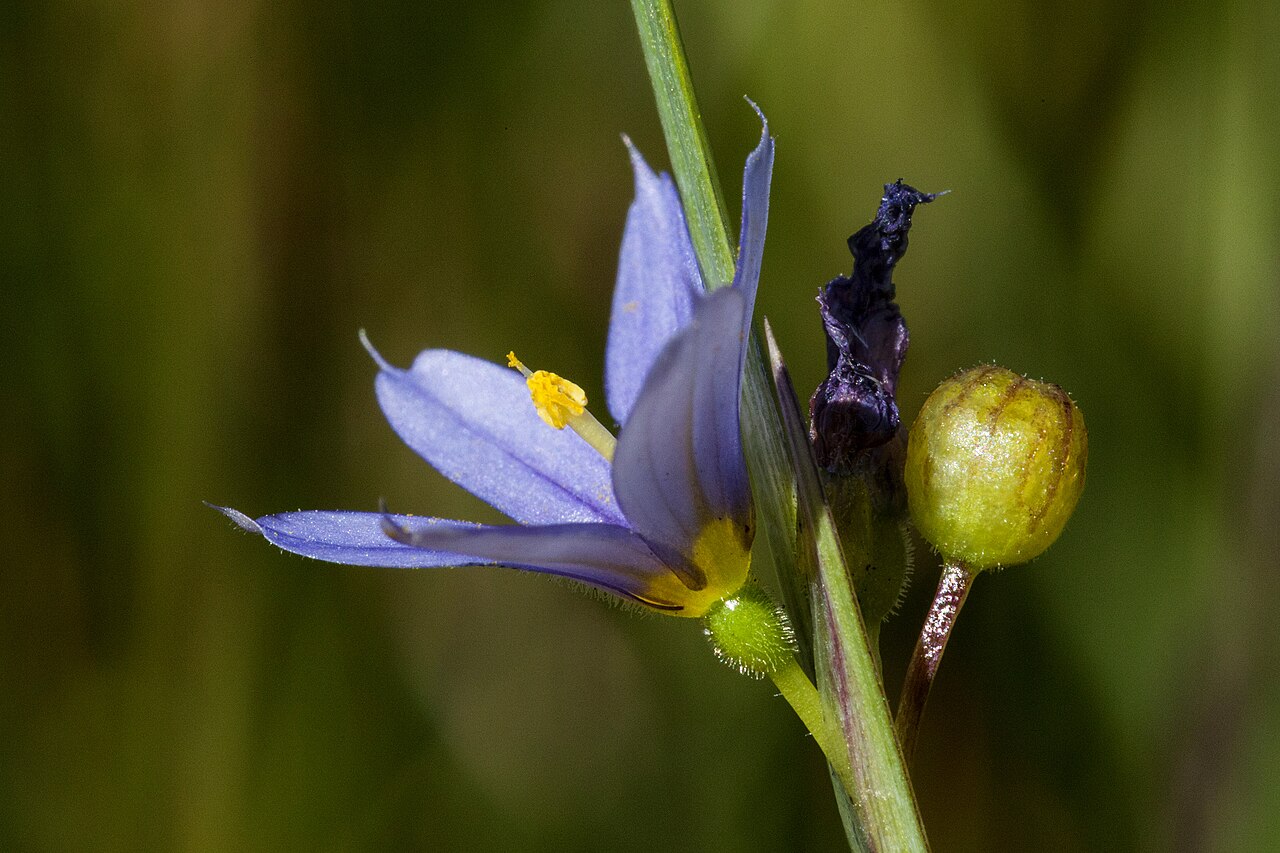
The flowers come out of a pair of leaf-like bracts (a spathe) that sits directly on the stem tip, without a stalk. The outer bract is much longer than the inner one, often one and a half to two times as long, and continues upward like an extension of the stem. This stalkless spathe on an unbranched stem is a key feature.
Flowers
The flowers are about 1/2 to 1 inch across, with six spreading tepals that are violet-blue (occasionally pale blue or white) and have a small point at the notched or rounded tip. The center is bright yellow. Flowers open in sunshine and close by afternoon or in cloudy weather. Plants bloom from about May to July, later at high elevations.
Fruit
The round capsules are about 1/6 to 1/4 inch across, pale tan to straw-colored when ripe, and split into three parts to release small black seeds.
Similar Species
Narrowleaf Blue-eyed Grass (Sisyrinchium angustifolium), common in the East, has branched stems with two or more flower clusters on stalks, and dark brown to blackish capsules. Needle-tip Blue-eyed Grass (Sisyrinchium mucronatum) has very narrow, wiry stems and purplish spathes. Idaho blue-eyed grass (S. idahoense) of the West usually has longer stalks between the spathe and the stem and darker capsules. Western Blue-eyed Grass is a Pacific Coast species with branched stems. Because blue-eyed grasses hybridize and vary, a hand lens and a regional flora help with tricky plants.
Quick Facts
| Scientific Name | Sisyrinchium montanum Greene |
| Family | Iridaceae (iris family) |
| Plant Type | Clump-forming, grass-like perennial wildflower |
| Mature Height | 4–20 in |
| Mature Spread | 3–8 in |
| Growth Rate | Moderate |
| Sun Exposure | Full sun to part shade |
| Water Needs | Moderate; moist to medium soil |
| Soil Type | Loam, sand or gravel; moist meadow and prairie soils |
| Soil pH | About 5.5–7.5 |
| Bloom Time | May–July |
| Flower Color | Violet-blue with yellow eye (rarely white) |
| Fall Color | Not significant |
| Fruit | Round pale tan capsules |
| Deer Resistant | Moderate |
| USDA Hardiness Zones | 3–8 |
Native Range
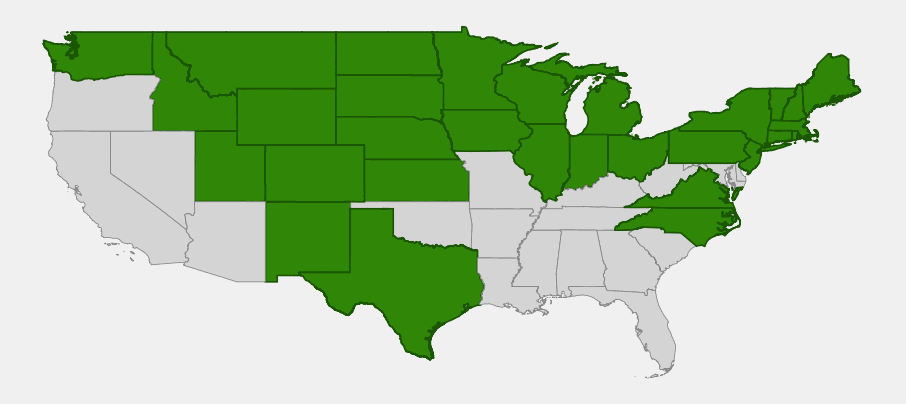
USDA PLANTS lists strict blue-eyed grass as native in 30 states: Colorado, Connecticut, Idaho, Illinois, Indiana, Iowa, Kansas, Maine, Massachusetts, Michigan, Minnesota, Montana, Nebraska, New Hampshire, New Jersey, New Mexico, New York, North Carolina, North Dakota, Ohio, Pennsylvania, Rhode Island, South Dakota, Texas, Utah, Vermont, Virginia, Washington, Wisconsin and Wyoming. It is most common in the Northeast, the Great Lakes, the northern Great Plains and the Rocky Mountains. The records from North Carolina, Virginia and Texas are outlying ones at the southern edge of its range.
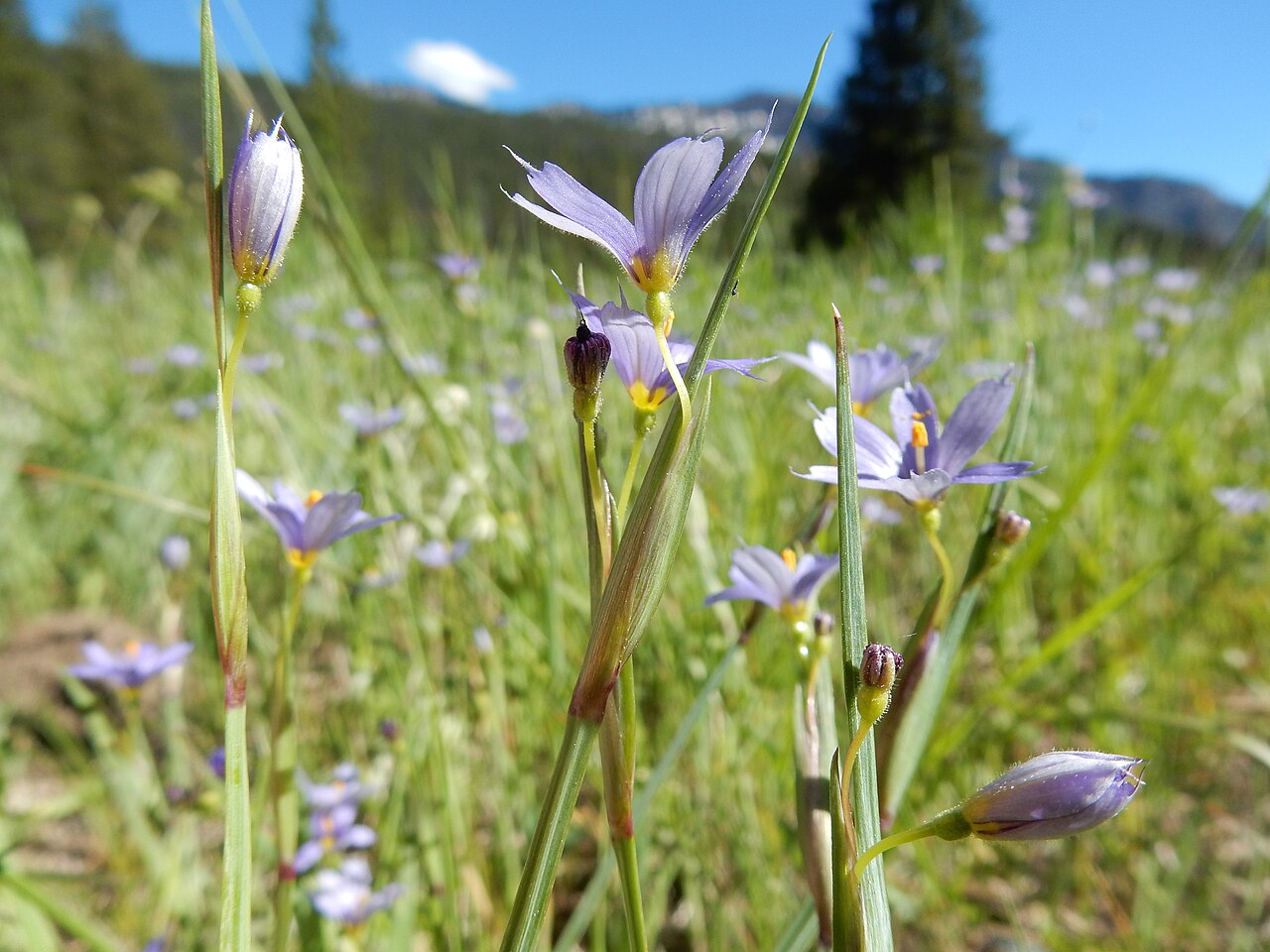
It grows in moist to fairly dry meadows, prairies, pastures, grassy openings in forests, lakeshores, streambanks and old fields, and it often turns up in mowed lawns and along roadsides. In the West it is a plant of mountain meadows and valley grasslands up to subalpine elevations.
In Canada it ranges across all provinces from British Columbia and the Yukon to Newfoundland and Labrador. It has also been introduced to Europe, where it has naturalized in meadows in several countries.
📋 Regional plant lists featuring Strict Blue-eyed Grass: New Hampshire, Maine & Vermont · Connecticut, Massachusetts & Rhode Island · New York, Pennsylvania & Northern New Jersey · Delaware, Southern New Jersey & Long Island · Maryland, Virginia & West Virginia · North & South Carolina · Ohio & Indiana · Illinois, Iowa & Missouri · Michigan, Wisconsin & Eastern Minnesota · North Dakota, South Dakota & Western Minnesota · Nebraska, Kansas & Eastern Colorado · Montana & Wyoming · Utah & Western Colorado · Idaho, Eastern Oregon & Eastern Washington · Arizona & New Mexico
Growing & Care Guide
Strict blue-eyed grass is a charming, easy little native for the front of a border, a rock garden, a meadow or a “flowering lawn.” It is sold by some native plant nurseries, sometimes under the name of another blue-eyed grass, and it often self-sows gently once established.
Light
Full sun gives the most flowers. It tolerates part shade, but the flowers open only in sun.
Soil & Water
It prefers evenly moist, well-drained soil and does well in average garden loam, sand or gravel. It tolerates short dry spells once established but looks best where the soil does not dry out completely in late spring and early summer.
Planting Tips
Plant in spring or early fall, 6 to 8 inches apart in groups of five or more so the small flowers make a show. It is effective along paths, in rock gardens and between stepping stones, and it can be planted into lawns that are mowed high and late.
Pruning & Maintenance
Little care is needed. Cut back the old foliage in late summer if it looks tired. Divide clumps every few years to keep them vigorous, since older clumps can die out in the center.
Propagation
Divide clumps in spring or early fall. It also grows easily from seed sown in fall or cold-stratified for about two months; seedlings often bloom in their second year. Plants self-sow in open soil.
Landscape Uses
- Rock gardens and path edges: small tufts with jewel-like blue flowers for close viewing
- Meadows and prairie plantings: a low early-summer flower among grasses and other wildflowers
- Flowering lawns: tolerates mowing once it has bloomed and set seed
- Pollinator gardens: pollen for small native bees and syrphid flies
- Containers: a neat, small native for pots and troughs
Wildlife & Ecological Value
Strict blue-eyed grass is small, but its flowers support small pollinators and its seeds feed other wildlife.
For Pollinators
The flowers are visited by small native bees, such as sweat bees and small carpenter bees, and by syrphid flies, which collect pollen and nectar. The yellow center guides insects to the reward.
For Birds
Small seed-eating birds may eat the seeds, and the plants are part of the grassland and meadow habitat used by ground-nesting birds.
For Mammals
Rabbits and deer occasionally nibble the leaves, but it is rarely damaged badly.
Ecosystem Role
It is part of the diverse low layer of wildflowers in meadows and prairies, adding early-summer flowers when many grasses are not yet in bloom. It also colonizes moist openings and lakeshores.
Cultural & Historical Uses
Edward Lee Greene named Sisyrinchium montanum in 1899. The name means “of the mountains,” yet the species ranges all the way to the Atlantic coast. Eastern plants are sometimes separated as var. crebrum.
Blue-eyed grasses have a confusing history in botany because the species are small, variable and hybridize. Older guides often lumped strict blue-eyed grass with S. angustifolium or S. bermudiana, and naturalized plants in Europe were long called by other names.
Some Native American groups used blue-eyed grasses in medicine, and the plants have long been admired as wild “little irises.” The genus name Sisyrinchium was used by ancient Greek writers for an iris-like plant.
Frequently Asked Questions
Is blue-eyed grass a grass?
No. Blue-eyed grasses are small members of the iris family with grass-like leaves. Their six-tepaled flowers show the family resemblance.
How do I tell strict blue-eyed grass from other blue-eyed grasses?
Look for an unbranched, winged stem ending in a single stalkless spathe whose outer bract is much longer than the inner one, and for pale tan capsules. Narrowleaf blue-eyed grass has branched stems and dark capsules.
Does strict blue-eyed grass spread?
It forms slowly expanding clumps and self-sows gently in open soil. It is not aggressive.
Where does strict blue-eyed grass grow?
Across Canada and the northern United States, from New England and the Great Lakes to the Great Plains and Rocky Mountains, in meadows, prairies, open woods and lawns.
Why do the flowers close?
Each flower opens in sunshine for a single day and closes in the afternoon or in cloudy weather. New flowers open each sunny day during the bloom season.

Looking for a nursery that carries Strict Blue-eyed Grass?
Browse our native plant nursery directory: Colorado & Connecticut · Idaho, Illinois, Indiana, Iowa & Kansas · Maine, Massachusetts, Michigan, Minnesota & Montana · Nebraska, New Hampshire, New Jersey, New Mexico, New York, North Carolina, North Dakota & Ohio · Pennsylvania, Rhode Island, South Dakota, Texas, Utah, Vermont & Virginia · Washington · Wisconsin & Wyoming

