
Wall-rue (Asplenium ruta-muraria)
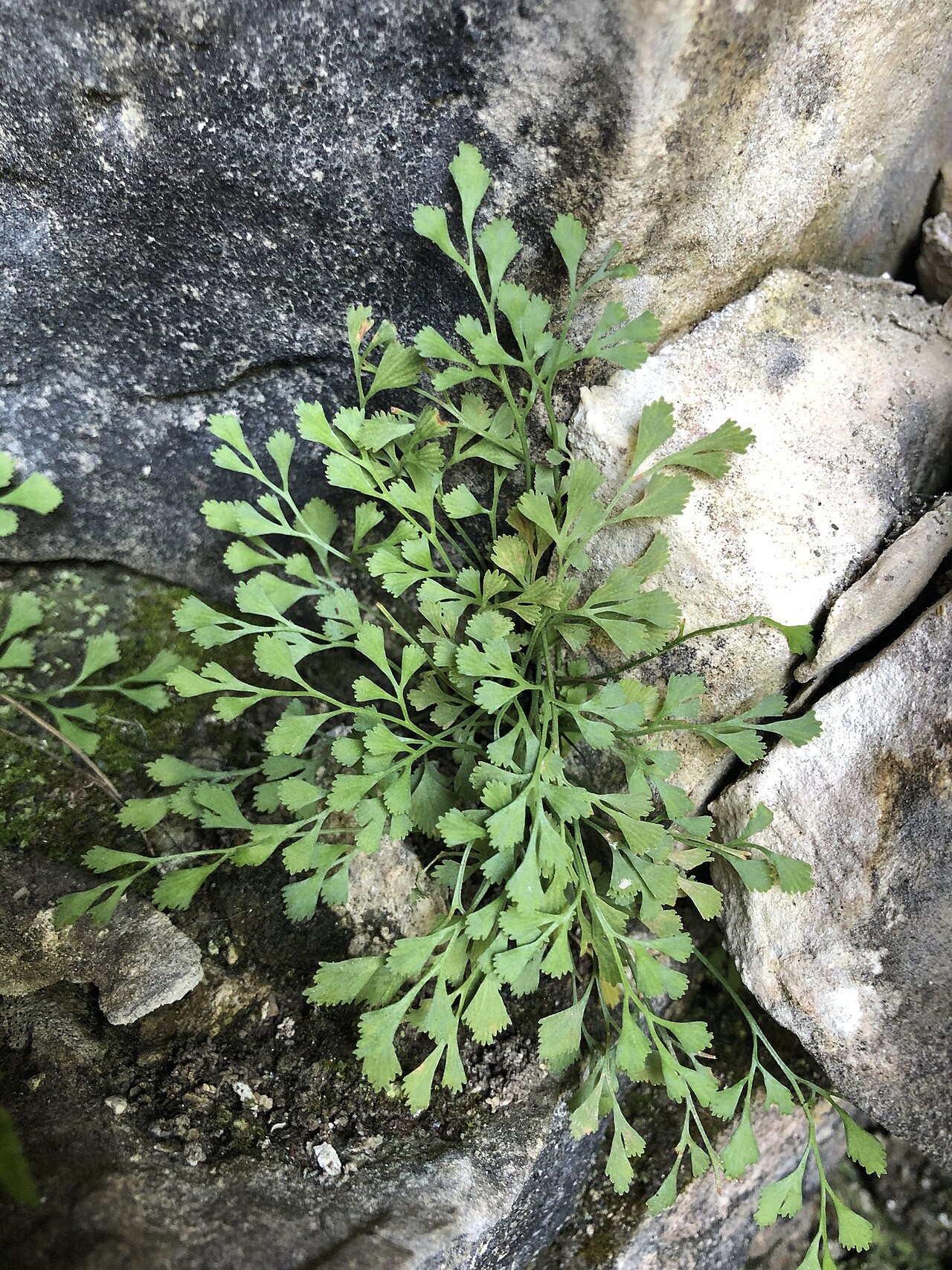
Asplenium ruta-muraria, known as Wall-rue, wall rue spleenwort or wallrue (the USDA name), is a tiny evergreen fern that grows in crevices of limestone and other lime-rich rock. Its small fronds, usually only 1 to 5 inches long, are divided into stalked, fan-shaped segments that resemble the leaves of rue (Ruta) or a sprig of flat-leaf parsley more than a typical fern. It grows in neat, compact tufts that cling to cliff faces.
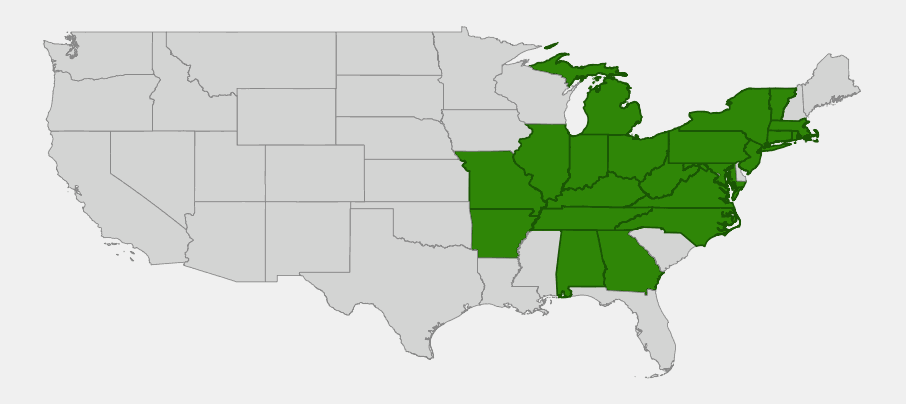
Wall-rue is found across Europe, Asia and eastern North America. In the United States it is native from Vermont, Massachusetts and Michigan south through the Appalachians and the Ohio Valley to Georgia, Alabama and the Ozarks of Missouri and Arkansas. North American plants are usually treated as var. cryptolepis, and here it is a specialist of shaded to sunny limestone and dolomite cliffs and ledges. Unlike European plants, it rarely grows on walls or mortar in North America.
Because of its narrow habitat, wall-rue is rare in many states, including Georgia, Alabama, Arkansas, North Carolina and Michigan. This page covers how to recognize it, where it grows, how it fits into rock gardens and troughs, and why wild plants should be left on their cliffs.
Identification
Wall-rue is one of the most distinctive small ferns of eastern limestone cliffs. Its dull, blue-green, fan-shaped segments and tidy tufts set it apart from the other small spleenworts that share its habitat.
Fronds
The fronds are evergreen, usually 1 to 5 inches long, and grow in a dense tuft from a short, creeping rhizome. The stalk (stipe) is green, dark brown only at the very base, and about as long as the blade or longer. The blade is triangular to oval, divided once or twice into small, stalked segments.
Leaf Segments
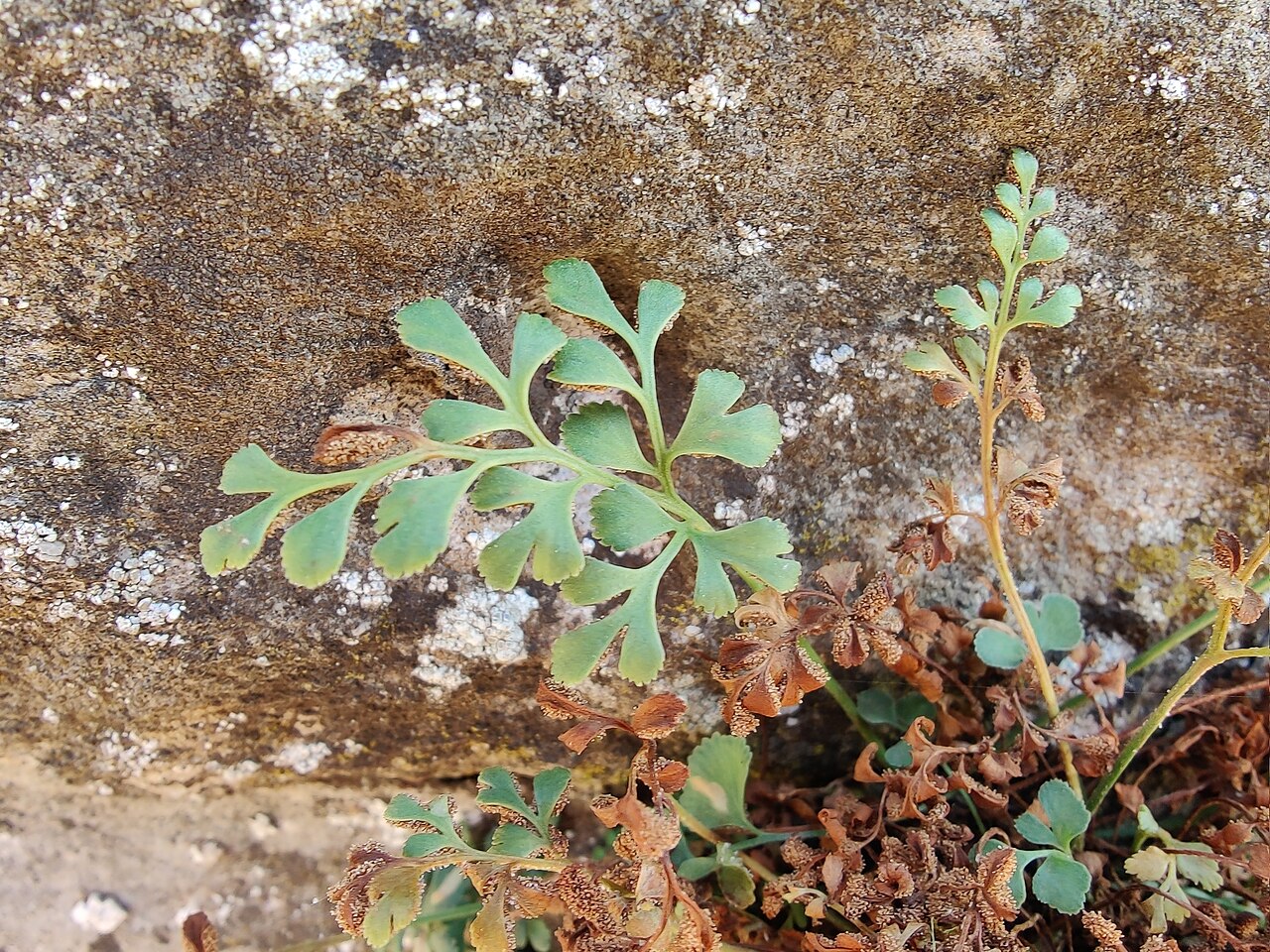
Each segment is fan-shaped, diamond-shaped or wedge-shaped, about a quarter to half an inch long, dull to bluish green, firm and somewhat leathery, with small irregular teeth along the outer edge. The veins spread out like a fan without a central midrib. Older fronds turn brown and persist at the base of the tuft.
Spores
The spore cases (sori) are narrow and linear, running along the veins on the undersides of the segments, and often merge together as they mature, covering much of the underside. In North American plants (var. cryptolepis), the thin flap of tissue covering each sorus is small and partly hidden, which is the meaning of cryptolepis (“hidden scale”).
Habitat Clue
Wall-rue grows almost exclusively on calcium-rich rock: limestone, dolomite and occasionally marble or calcareous shale. It is usually found on vertical faces, ledges and crevices, often in light shade or partial sun, where few other plants can grow.
Similar Species
Mountain Spleenwort (Asplenium montanum) has a similar-looking, finely divided frond but grows on acidic sandstone and other non-calcareous rock and has a dark stalk base and more lobed, longer segments. Maidenhair Spleenwort has once-divided fronds with rows of tiny round leaflets on a dark stalk. Walking Fern has long, undivided, tapering leaves. Purple cliffbrake (Pellaea atropurpurea) shares its limestone cliffs but is larger, with dark, wiry stalks and narrow, blue-gray leaflets.
Quick Facts
| Scientific Name | Asplenium ruta-muraria L. (North American plants var. cryptolepis (Fernald) Wherry; syn. A. cryptolepis) |
| Family | Aspleniaceae (spleenwort family) |
| Plant Type | Small evergreen rock fern |
| Mature Height | 1–5 in |
| Mature Spread | 2–6 in tufts |
| Growth Rate | Slow |
| Sun Exposure | Part shade to light shade; tolerates some sun |
| Water Needs | Low to medium; rock crevices that dry between rains |
| Soil Type | Crevices of limestone or dolomite rock; very sharp drainage |
| Soil pH | Alkaline (about 7.0–8.5) |
| Bloom Time | Does not flower; spores mature in summer and fall |
| Flower Color | None |
| Fall Color | Evergreen |
| Fruit | None; reproduces by spores |
| Deer Resistant | Yes |
| USDA Hardiness Zones | 4–8 |
Native Range
USDA PLANTS lists wall-rue as native in Alabama, Arkansas, Connecticut, Georgia, Illinois, Indiana, Kentucky, Massachusetts, Maryland, Michigan, Missouri, North Carolina, New Jersey, New York, Ohio, Pennsylvania, Rhode Island, Tennessee, Virginia, Vermont and West Virginia. It is most frequent in the limestone country of the central and northern Appalachians and the Ohio Valley, for example in Virginia, West Virginia, Pennsylvania and New York. NatureServe also tracks small populations in Iowa and Wisconsin, and it is rare toward the edges of its range, in states such as Georgia, Alabama, Arkansas, North Carolina, Michigan and Illinois.
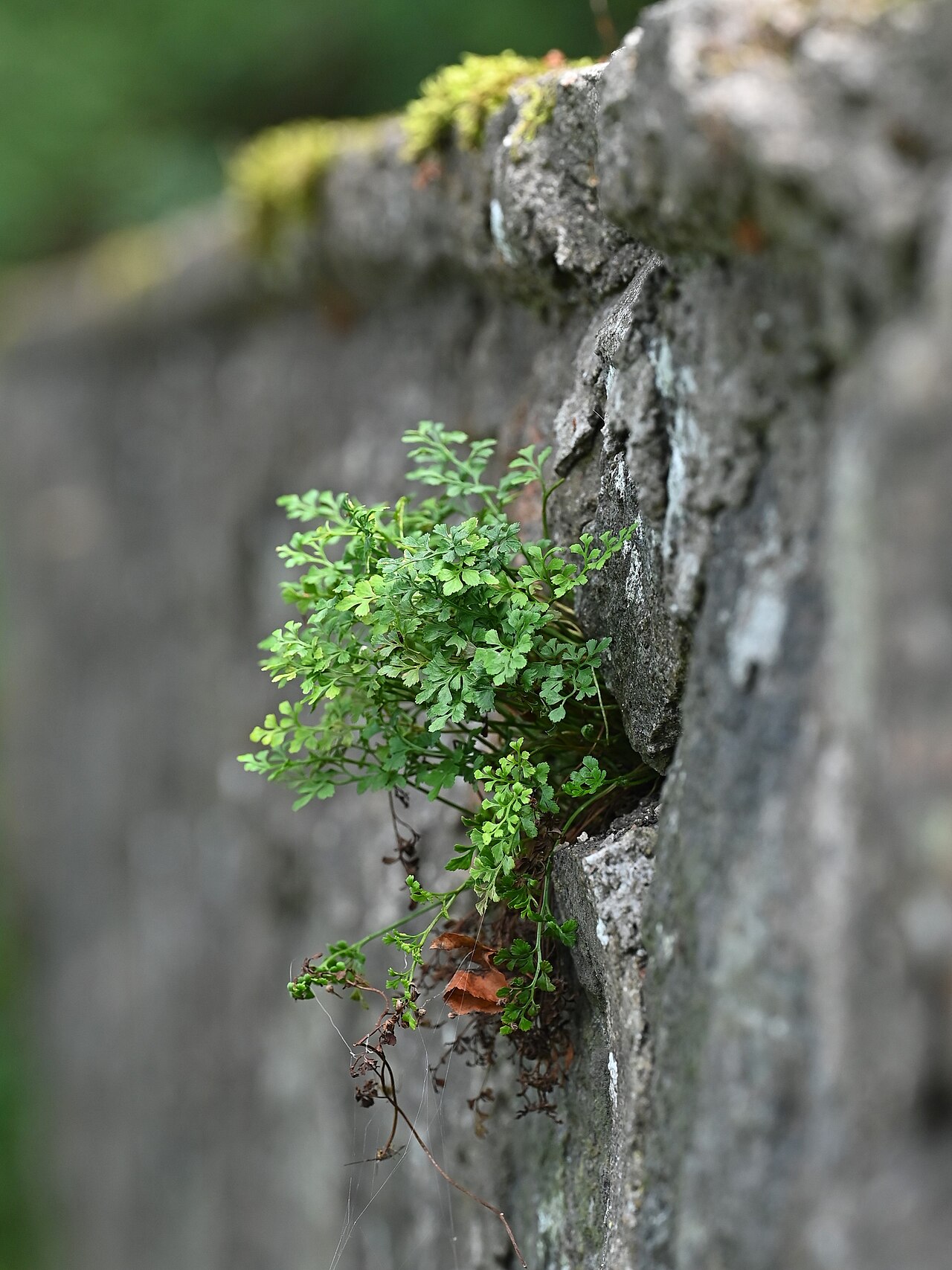
It grows on limestone and dolomite cliffs, outcrops, ledges, rock faces along streams and road cuts, and occasionally on calcareous sandstone or marble. It typically grows in crevices with very little soil, often in partial shade on cliffs facing north or east. In North America it is rarely found on walls, bridges or other masonry, though a few such sites are known.
Outside the United States, wall-rue occurs in southern Ontario, Quebec and New Brunswick in Canada. It is widespread across Europe, from Ireland and Britain to Russia, and in North Africa and much of temperate Asia. In Europe it is one of the most common ferns on old walls, churches and castles, hence its name.
📋 Regional plant lists featuring Wall-rue: New Hampshire, Maine & Vermont · Connecticut, Massachusetts & Rhode Island · New York, Pennsylvania & Northern New Jersey · Delaware, Southern New Jersey & Long Island · Maryland, Virginia & West Virginia · North & South Carolina · Kentucky & Tennessee · Alabama, Georgia & Mississippi · Arkansas, Louisiana, Eastern Oklahoma & Eastern Texas · Illinois, Iowa & Missouri · Ohio & Indiana · Michigan, Wisconsin & Eastern Minnesota
Growing & Care Guide
Wall-rue is a charming miniature fern for experienced rock gardeners, but it is slow, fussy and rarely available. Never dig it from cliffs: wild plants are often in small, isolated populations and are rare in many states, and transplants seldom survive. Look for spore-grown plants from specialist fern and alpine nurseries, or grow it from spores.
Light
Give it bright shade or morning sun with afternoon shade. A north- or east-facing crevice in a rock garden or wall works best.
Soil & Water
It needs a very gritty, lime-rich mix, such as limestone chips, coarse sand and a little loam or leaf mold, in a crevice or between stones where the roots stay cool but never waterlogged. Water during prolonged droughts. It also tolerates drying out once established, but wet soil around the crown is fatal.
Planting Tips
Plant it into a vertical crack in a limestone or tufa rock garden, a dry-stacked wall with lime mortar, or an alpine trough. Wedge the root ball firmly between stones so it does not shift, and top-dress with limestone gravel.
Pruning & Maintenance
Little care is needed. Remove fallen leaves that settle on the tufts. Old brown fronds can be left in place, since they help shade the crown.
Propagation
Grow it from spores sown on a sterile, lime-rich medium kept moist and covered in bright, indirect light. The tiny gametophytes and young plants grow slowly, and it may take two or three years to get a plant large enough to set out. Collect spores only from cultivated plants or with permission.
Landscape Uses
- Rock and crevice gardens: a tiny, evergreen fern for vertical cracks in limestone or tufa
- Alpine troughs: a miniature companion for small saxifrages, sedums and cushion plants
- Stone walls: lime-mortared walls in a shady garden, imitating its old-wall habitat in Europe
- Fern collections: an unusual miniature for collectors of native and hardy ferns
- Where to see it wild: limestone cliffs of the Appalachian Ridge and Valley, the Ohio Valley, the Niagara Escarpment and the Ozarks
Wildlife & Ecological Value
Wall-rue is part of a specialized community of plants that live on calcareous cliffs, one of the most distinctive habitats in the eastern United States.
For Pollinators
As a fern, wall-rue produces no flowers, nectar or pollen and does not support pollinators directly.
For Birds
It has little food value for birds, but it is part of the cliff vegetation that provides nesting ledges and insect prey for birds such as phoebes and wrens.
For Mammals
It is seldom eaten by deer or other mammals, partly because it grows out of reach on cliffs.
Ecosystem Role
Wall-rue is an indicator of calcareous cliffs, a rare and specialized habitat that often supports uncommon plants, snails and invertebrates. Its tufts trap a little soil and moisture, helping other small plants and mosses establish on bare rock. Rock climbing, quarrying and invasive plants can threaten its small populations.
Cultural & Historical Uses
The name ruta-muraria means “rue of the walls,” from Ruta (rue) and the Latin murus (wall). Asplenium comes from the Greek for “spleen,” because spleenworts were once thought to cure disorders of that organ.
In Europe, wall-rue has a long history as a medicinal plant and was once used as a remedy for coughs, rickets and other ailments. It is still a familiar sight on old walls, cathedrals and castles across Britain and Europe, where it grows in the lime mortar.
Wall-rue has played a role in fern research. It is a tetraploid that crosses with other spleenworts, and studies of its hybrids helped botanists understand how new fern species form through hybridization and chromosome doubling. North American plants were once named as a separate species, Asplenium cryptolepis, by the botanist Merritt Lyndon Fernald.
Frequently Asked Questions
Is wall-rue native to North America?
Yes. Wall-rue is native to eastern North America, mostly on limestone cliffs from Vermont and southern Ontario to Georgia and the Ozarks. North American plants are usually treated as var. cryptolepis. It is also native to Europe and Asia.
Does wall-rue grow on walls in North America?
Rarely. In Europe it is common on old walls and buildings, but in North America it grows almost entirely on natural limestone and dolomite cliffs. A few populations on masonry are known.
How do I identify wall-rue?
Look for a tiny fern, usually under 5 inches tall, in a crack of limestone rock. Its fronds are divided into small, stalked, fan-shaped, blue-green segments with toothed tips, and the stalks are green except at the very base.
Can I grow wall-rue?
It can be grown by experienced gardeners in a limestone crevice, wall or alpine trough with sharp drainage and light shade. Buy spore-grown plants or grow it from spores; never collect it from the wild.
Is wall-rue rare?
It is rare in many states, especially at the edges of its range such as Georgia, Alabama, Arkansas, North Carolina, Michigan and Illinois, because it grows only on calcareous rock. It is more frequent in the limestone regions of Virginia, West Virginia, Pennsylvania and New York.

Looking for a nursery that carries Wall-rue?
Browse our native plant nursery directory: Alabama & Arkansas · Connecticut & Georgia · Illinois & Indiana · Kentucky, Maryland, Massachusetts, Michigan & Missouri · New Jersey, New York, North Carolina & Ohio · Pennsylvania, Rhode Island, Tennessee, Vermont & Virginia · West Virginia

