
Clasping Venus’s Looking Glass (Triodanis perfoliata)
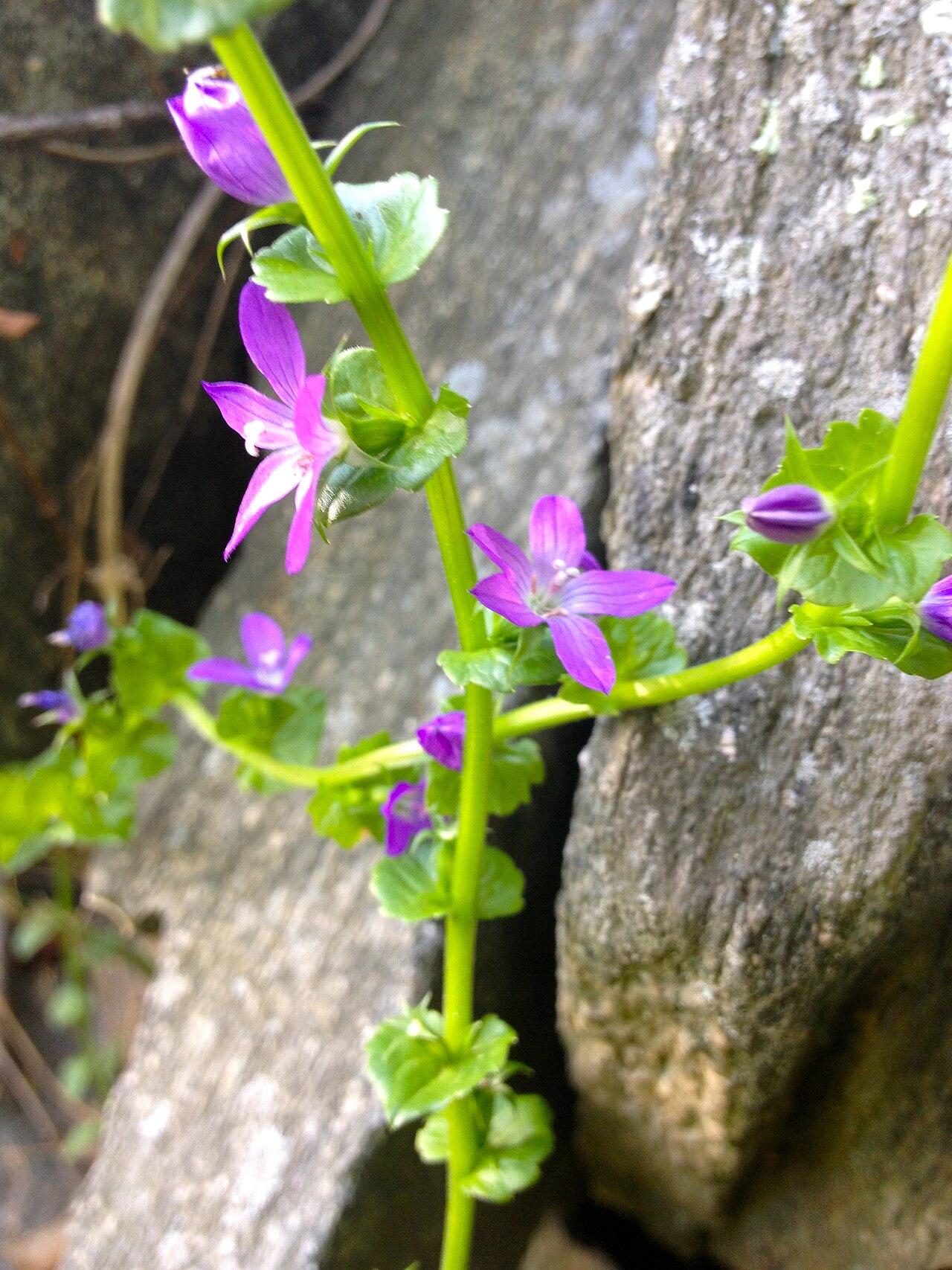
Triodanis perfoliata, known as Clasping Venus’s Looking Glass (USDA PLANTS: clasping Venus’ looking-glass), is a small native annual wildflower of the bellflower family (Campanulaceae). It grows as one or a few slender, upright stems, usually 6 to 20 inches tall, lined with rounded, scalloped leaves that wrap around the stem like little cups. In late spring, starry violet to blue-purple flowers about half an inch to three-quarters of an inch wide open in the cups of the upper leaves.
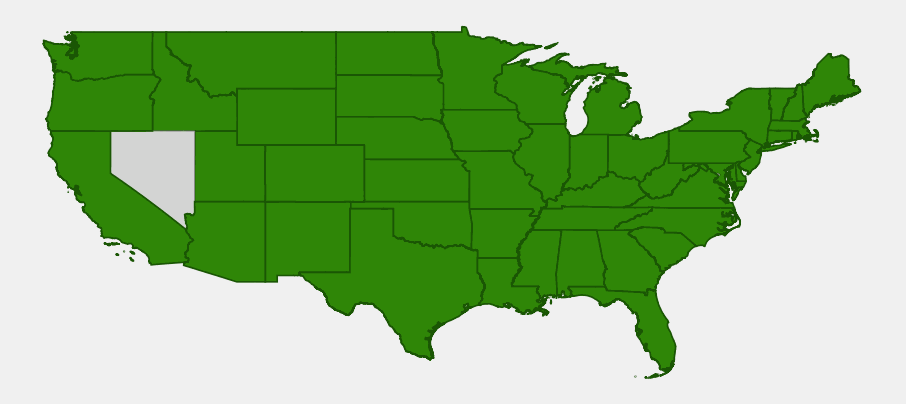
This is one of the most widespread wildflowers in North America. It grows wild in 47 of the lower 48 states (every one except Nevada) and in southern Canada, and its range continues south through Mexico into Central and South America. It is a plant of open, thin, often disturbed ground: rocky glades, sandy fields, prairies, woodland edges, roadsides, lawns and even cracks in pavement. Many people first notice it as a “weed” that turned out to be a native wildflower.
Clasping Venus’s looking glass has an unusual double flowering system. Only the upper flowers open. The lower ones stay closed and pollinate themselves, so every plant can make seed even when no insects visit. This guide explains how to identify it, where it grows, how to encourage it in a meadow or gravel garden, and how it fits into the ecology of open ground.
Identification
Look for a narrow, upright annual with a “ladder” of rounded, clasping leaves, each one cupping a flower or seed capsule. No other common wildflower in most of North America has this combination.
Stems
Plants usually have a single unbranched stem, or a few stems from the base, 6 to 20 inches tall and occasionally up to about 3 feet in rich soil. The stem is angled, and short, stiff hairs run along its ridges. Plants in poor, dry soil may flower when only a few inches tall.
Leaves
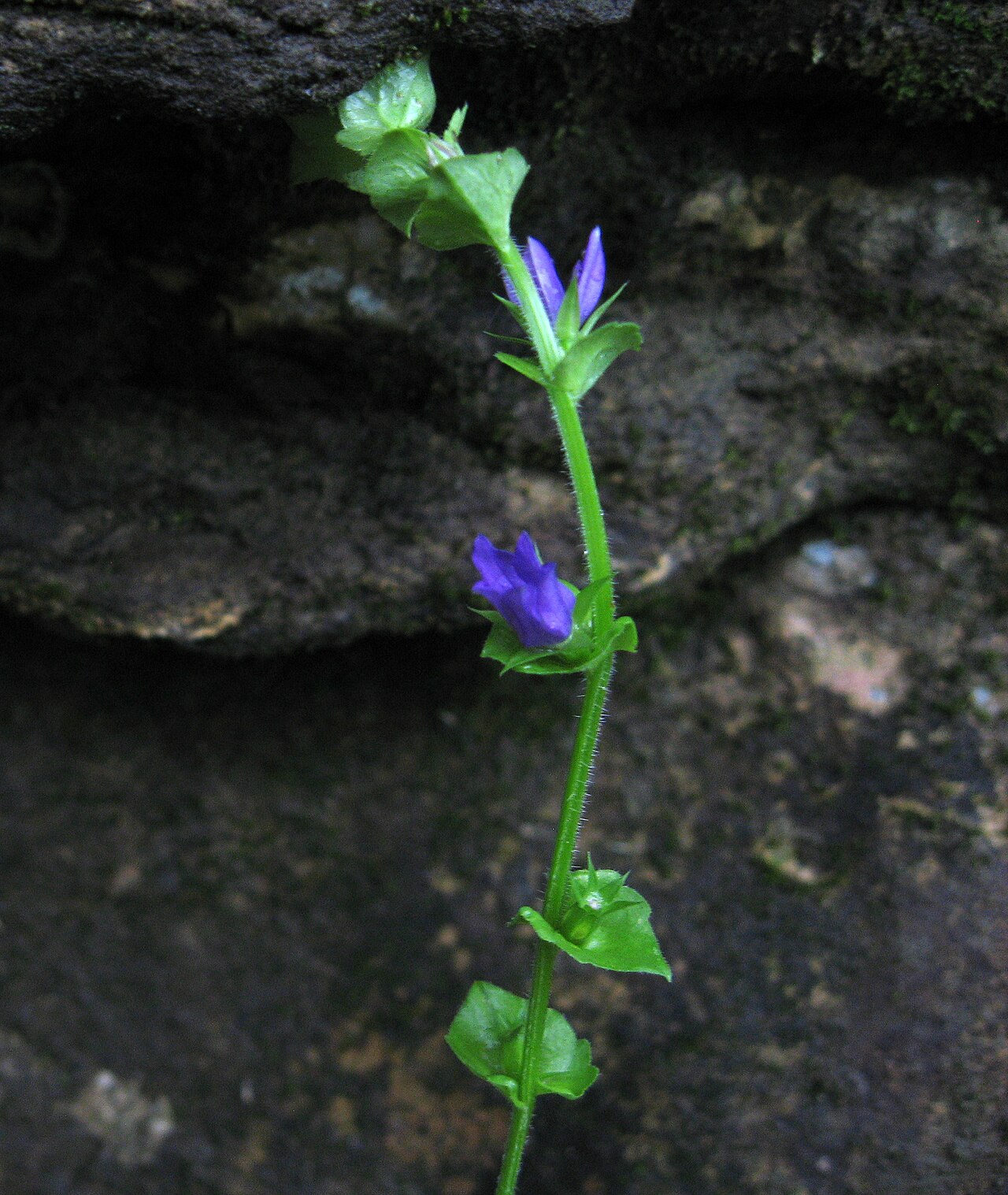
The leaves are alternate, round to broadly heart-shaped and about a quarter inch to 1 inch long, with scalloped or toothed edges. They have no stalk: the base of each leaf wraps around the stem so the stem appears to pass through it (the meaning of “perfoliata”). The cupped leaves get smaller toward the top of the stem. Seedlings form a small rosette of rounded leaves in fall or early spring.
Flowers
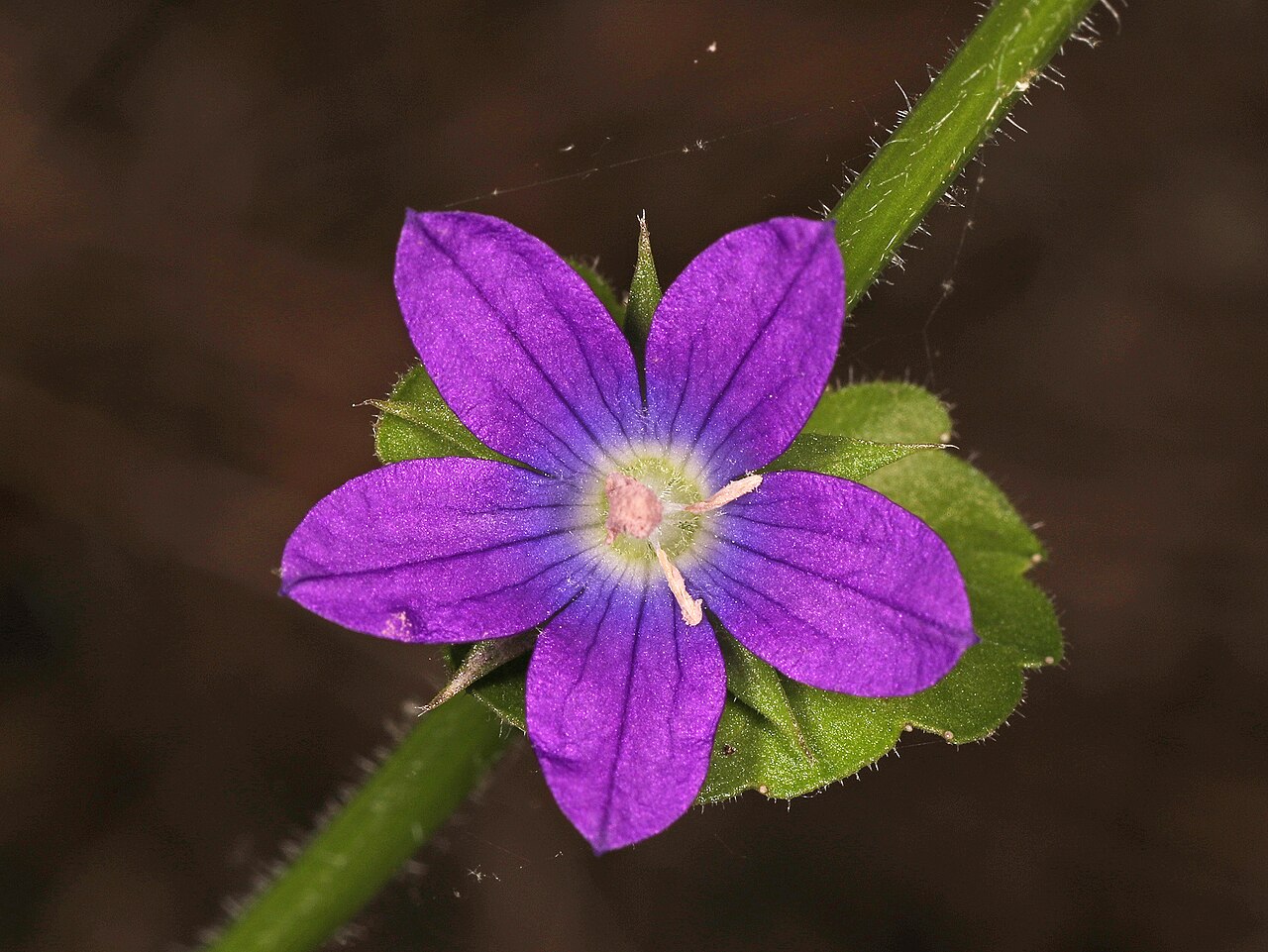
The flowers sit directly in the leaf axils, usually one to three per leaf. Upper flowers open into flat, five-lobed stars about half an inch to three-quarters of an inch across, violet, purple or blue-purple with a paler center, five stamens and a three-lobed white stigma. Flowers on the lower part of the stem are cleistogamous: small, budlike flowers that never open and pollinate themselves inside the closed bud. In the South, plants begin blooming in April, and farther north mainly in May and June, with some flowers into summer.
Fruit & Seeds
Each flower, open or closed, becomes a small cylindrical capsule topped by the sepals. The capsule releases seeds through small pores on its side that open as it dries, and the seeds sift out when the stem sways in the wind. The seeds are tiny, lens-shaped and shiny. The common name came from a related European plant, Legousia speculum-veneris, whose glossy seeds were thought to look like little mirrors.
Varieties & Look-alikes
Small Venus’s looking glass (Triodanis biflora, often treated as T. perfoliata var. biflora) is common in the South and West. It has narrower, less clasping leaves, and only one or two flowers at the very top of each stem open. Bluets and Blue-eyed Grass have similar colors but completely different leaves and flowers.
Quick Facts
| Scientific Name | Triodanis perfoliata (syn. Specularia perfoliata, Legousia perfoliata) |
| Family | Campanulaceae (bellflower family) |
| Plant Type | Annual wildflower (winter or spring annual) |
| Mature Height | 6–20 in (occasionally to about 3 ft) |
| Mature Spread | 2–6 in |
| Growth Rate | Fast; completes its life cycle in one season |
| Sun Exposure | Full sun to light shade |
| Water Needs | Low; prefers dry to moderately moist, well-drained ground |
| Soil Type | Sandy, gravelly, rocky or thin loam and clay; tolerates poor soil |
| Soil pH | About 5.5–7.5 |
| Bloom Time | April–July (mainly May–June) |
| Flower Color | Violet, purple or blue-purple; rarely white |
| Fall Color | None; plants die after setting seed |
| Fruit | Small cylindrical capsule opening by side pores; tiny shiny seeds |
| Deer Resistant | Mostly; too small and scattered to attract much browsing |
| USDA Hardiness Zones | Annual; grows wild in zones 3–10 |
Native Range
Clasping Venus’s looking glass has one of the broadest ranges of any native North American wildflower. USDA PLANTS records it as native in 47 states and the District of Columbia, from Maine to Florida and west to Washington, Oregon and California, with Nevada the only state in the lower 48 without a record. In Canada it grows in British Columbia, Ontario, Quebec and New Brunswick. It also grows in Mexico and, through closely related forms, south into Central and South America. It has been introduced to parts of Europe and Asia.
It is most common in the eastern and central states, where it turns up in almost every county in open, sunny ground. In the West it is scattered, mostly in grasslands, open woodland and disturbed ground at low to middle elevations. Because its tiny seeds travel with soil, gravel and hay, it is often found along roads, railways and lawns, but it is genuinely native to natural openings such as rock outcrops, glades, prairies, sand barrens and woodland edges.
The plant is a winter or spring annual. Seeds germinate in fall or early spring, plants flower and set seed by early to midsummer, and the parent plants die. The next generation waits in the soil as seed, so populations can appear, vanish and reappear as conditions change.
📋 Regional plant lists featuring Clasping Venus’s Looking Glass: New York, Pennsylvania & Northern New Jersey · Idaho, Eastern Oregon & Eastern Washington · Ohio & Indiana · Montana & Wyoming · Michigan, Wisconsin & Eastern Minnesota · Kentucky & Tennessee · Nebraska, Kansas & Eastern Colorado · Utah & Western Colorado · Connecticut, Massachusetts & Rhode Island · New Hampshire, Maine & Vermont · Maryland, Virginia & West Virginia · Delaware, Southern New Jersey & Long Island · Arizona & New Mexico · Illinois, Iowa & Missouri · Alabama, Georgia & Mississippi · North & South Florida
Growing & Care Guide
Clasping Venus’s looking glass is not a plant you buy in a pot. It is a self-sowing annual that you encourage by sowing seed into open ground and then leaving it alone. It suits meadows, gravel gardens, rock gardens and the thin edges of lawns, where it adds a scattering of violet stars in late spring.
Light
It flowers best in full sun or light shade. The Lady Bird Johnson Wildflower Center notes that it can also grow in shade, but in heavier shade plants are weak and produce mostly closed flowers.
Soil & Water
Lean, well-drained soil is ideal: sand, gravel, thin soil over rock or compacted clay where taller plants struggle. Rich garden soil works, but larger perennials and grasses quickly crowd it out. Once established it needs no watering beyond rainfall. Seedlings need some moisture in fall and spring, which normal rains usually supply.
Planting Tips
Scatter seed on bare or lightly disturbed soil in fall, the way the plant sows itself, and press it in gently without covering it deeply. Seed is very fine, so mixing it with dry sand makes it easier to spread evenly. Good places include gaps between paving stones, gravel paths, sunny rock gardens, newly seeded meadows and thin spots in a low-mown lawn. Seeds can also be sown in very early spring.
Pruning & Maintenance
Do not mow or pull plants until the capsules have turned brown and released their seed in early to midsummer. After that, the dead stems can be removed. A little disturbance helps, so lightly raking or leaving some bare ground each year keeps a population going. In meadows, it may fade as grasses thicken unless some open soil remains.
Propagation
It reproduces only by seed. Because the closed, self-pollinating flowers set seed reliably, a few plants usually produce plenty for the next year. To collect seed, cut stems when the lower capsules are brown and shake them in a paper bag. Seeds can be stored dry and sown in fall.
Landscape Uses
- Meadows and prairie plantings: an early-season annual that fills gaps before perennials mature
- Gravel, rock and crevice gardens: thrives in thin, dry, well-drained soil
- Lawn and path edges: a native alternative to weedy annuals in low-mown, unfertilized turf
- Pollinator gardens: small bees visit its open flowers in late spring
- Children’s and teaching gardens: an easy plant for showing clasping leaves and closed, self-pollinating flowers
Wildlife & Ecological Value
Clasping Venus’s looking glass is small, but because it is so common across the continent, it contributes to the food supply of many small pollinators in late spring.
For Pollinators
The open flowers offer nectar and pollen to small bees, including sweat bees, small carpenter bees and leafcutter bees, as well as small butterflies and skippers and bee flies. The closed lower flowers pollinate themselves, so the plant does not depend on insects, but visitors to the open upper flowers provide cross-pollination and genetic variety.
For Birds
The seeds are tiny, but seed-eating birds such as sparrows and finches sometimes pick them from the capsules or the ground. The plant’s main value to birds is indirect, through the insects it feeds.
For Mammals
It has little importance for mammals. Rabbits and deer may eat a few plants, but it is too small and scattered to be a significant food.
Ecosystem Role
As a pioneer annual, clasping Venus’s looking glass quickly covers bare soil after disturbance, fire or drought, and then gives way to perennials. Its persistent seed bank lets it reappear when new openings form. Its mixed system of open and closed flowers has made it a model for studying how plants balance cross-pollination with guaranteed self-pollination.
Cultural & Historical Uses
Linnaeus described this plant in 1753 as Campanula perfoliata. It later spent time in the genera Specularia and Legousia, with the European Venus’s looking glass, before Julius Nieuwland placed it in Triodanis in 1914. The genus name comes from the Greek for “three teeth,” referring to the three calyx lobes on many of the closed flowers. Older field guides list it as Specularia perfoliata.
The name “Venus’s looking glass” was first used in Europe for Legousia speculum-veneris, a cornfield wildflower whose shiny seeds were compared to the mirror of the goddess Venus. The name was later applied to the North American species because it is closely related and looks similar. Ethnobotanical records note limited medicinal use by some Native American peoples, including the Cherokee and Meskwaki.
Today it is mostly appreciated by naturalists and native gardeners as a cheerful sign of spring in unlikely places. It is a reminder that native plants are not only found in wild areas: many lawns, schoolyards and sidewalk cracks across the country hold populations of this small native bellflower.
Frequently Asked Questions
Is clasping Venus’s looking glass a weed?
It is a native wildflower that often grows in disturbed places such as lawns, fields and roadsides, so some people treat it as a weed. It is not invasive, does not crowd out other plants and disappears after flowering. Native gardeners often leave it to bloom.
Why don’t the lower flowers open?
The lower flowers are cleistogamous: they stay closed and pollinate themselves inside the bud. This guarantees seed even in bad weather or when pollinators are scarce. Only the upper flowers open for insects.
Is it an annual or a perennial?
It is an annual. Seeds sprout in fall or early spring, the plant blooms in late spring or early summer, sets seed and dies. Populations persist by reseeding.
How do I grow clasping Venus’s looking glass?
Scatter seed on bare, well-drained soil in fall and press it into the surface. Give it full sun to light shade and keep taller plants from crowding it. Let the plants set seed before mowing or weeding, and it will return each year.
What is the difference between this and small Venus’s looking glass?
Small Venus’s looking glass (Triodanis biflora) has narrower leaves that clasp the stem less, and only one or two open flowers at the top of each stem. Some botanists treat it as a variety of T. perfoliata.

Looking for a nursery that carries Clasping Venus’s Looking Glass?
Browse our native plant nursery directory: Alabama, Arizona & Arkansas · California · Colorado, Connecticut, Delaware, Florida & Georgia · Idaho, Illinois, Indiana, Iowa & Kansas · Kentucky, Louisiana, Maine, Maryland, Massachusetts, Michigan, Minnesota, Mississippi, Missouri & Montana · Nebraska, New Hampshire, New Jersey, New Mexico, New York, North Carolina, North Dakota, Ohio & Oklahoma · Oregon · Pennsylvania, Rhode Island, South Carolina, South Dakota, Tennessee, Texas, Utah, Vermont & Virginia · Washington · West Virginia, Wisconsin & Wyoming