
Roundleaf Ragwort (Packera obovata)
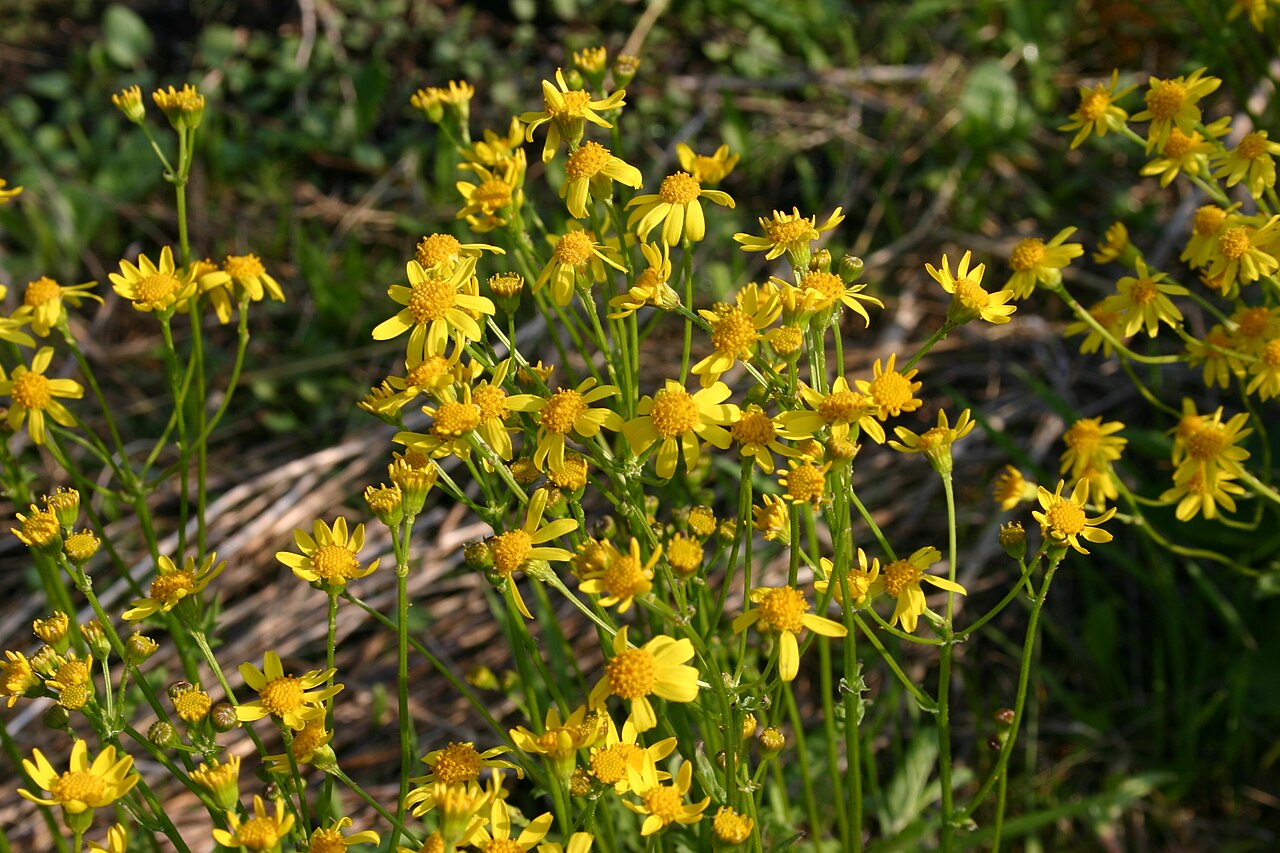
Packera obovata, known as Roundleaf Ragwort or roundleaf groundsel, is a low, spreading perennial in the aster family (Asteraceae). It forms rosettes of rounded, toothed leaves that spread by runners into colonies, and in early spring it sends up 8- to 24-inch stems topped with flat clusters of bright yellow, daisy-like flowers. It was long known as Senecio obovatus before the North American ragworts were moved to the genus Packera.
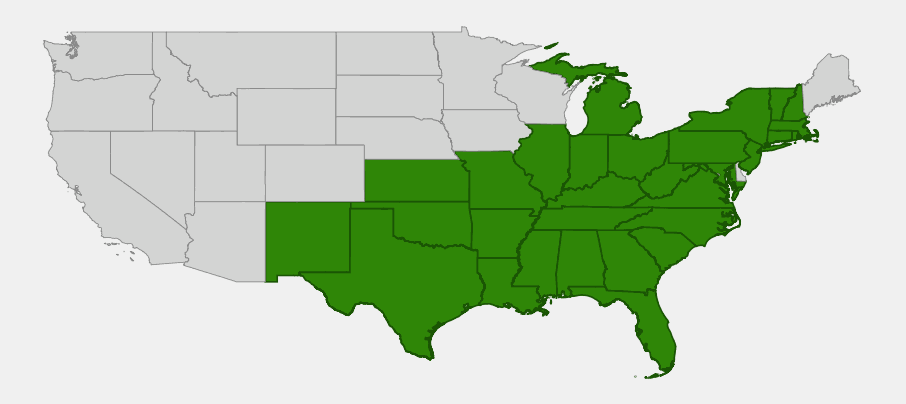
Roundleaf ragwort grows from Ontario and Quebec south through the eastern United States to Florida and Texas and into northeastern Mexico. It is rare at the northern edge of its range and common in the South. It typically grows on rocky, wooded slopes, stream banks and limestone outcrops, and it is one of the characteristic spring wildflowers of the Texas Hill Country.
In gardens it is an excellent native groundcover for part shade and dry shade, with semi-evergreen leaves and a cheerful early show of yellow flowers. Like other ragworts, it contains pyrrolizidine alkaloids and is poisonous if eaten, so it should never be used as food or as an herbal remedy.
Identification
Look for low rosettes of rounded, scalloped leaves that taper to a stalk, spreading into patches, with early-spring stems of yellow daisy-like flowers.
Growth Habit
Roundleaf ragwort is a perennial that grows from short rhizomes and slender, runner-like stolons. Each stolon ends in a new rosette, so a single plant gradually becomes a dense colony. The rosettes are only a few inches high; the flowering stems rise to about 8 to 24 inches.
Leaves
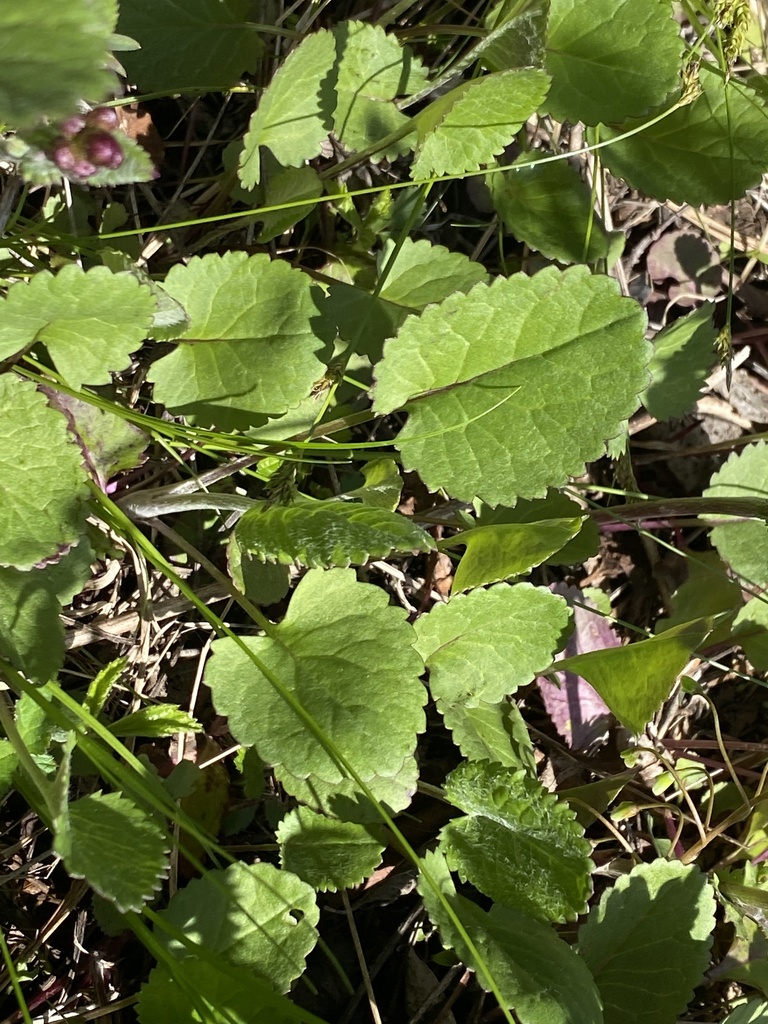
The basal leaves are oval to nearly round or broadest toward the tip (obovate, which is the source of the species name), 1 to 6 inches long including the stalk, with rounded teeth along the edge. They taper gradually into the stalk rather than having a notched, heart-shaped base. The stem leaves are much smaller and deeply cut into narrow lobes. The basal leaves often persist through mild winters and may turn purplish underneath.
Flowers
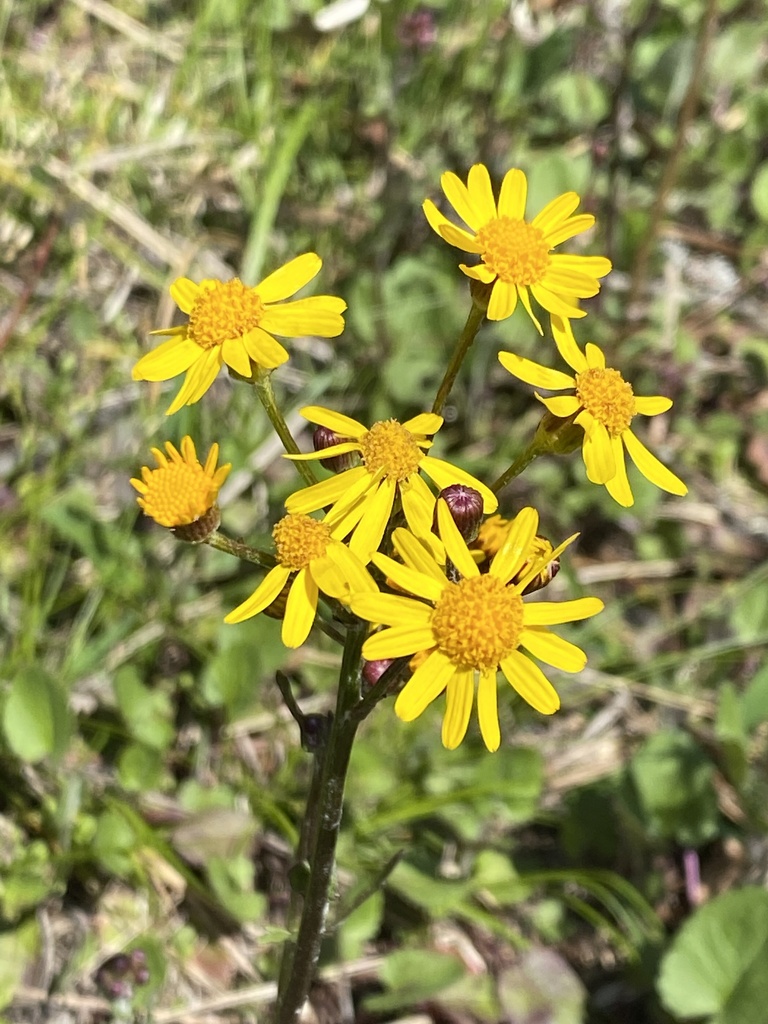
The flowering stems carry a flat-topped cluster of several to many flower heads, each about 3/4 inch across, with 8 to 13 yellow ray florets around a yellow to orange-yellow disk. Bloom time is February to April in Texas and the Deep South, and April to early June farther north.
Fruit
The small, ribbed seeds (achenes) each carry a tuft of soft white bristles and are dispersed by wind in late spring.
Look-alikes
Golden ragwort (Packera aurea) has heart-shaped basal leaves with a notched base and prefers wet woods and stream banks. Butterweed (Packera glabella) is a taller annual of wet ground, with a hollow stem and deeply divided leaves. Small ragwort (Packera paupercula) and prairie ragwort (Packera plattensis) have narrower basal leaves and grow in more open habitats.
Quick Facts
| Scientific Name | Packera obovata |
| Family | Asteraceae (aster family) |
| Plant Type | Spreading herbaceous perennial groundcover |
| Mature Height | 8–24 in (in bloom); leaves 3–6 in |
| Mature Spread | 1–2 ft, spreading by runners |
| Growth Rate | Moderate to fast |
| Sun Exposure | Part shade to shade |
| Water Needs | Low to medium |
| Soil Type | Well-drained loam, clay or rocky soil; often limestone |
| Soil pH | Slightly acidic to alkaline (about 6.0–8.0) |
| Bloom Time | February–June, depending on latitude |
| Flower Color | Bright yellow |
| Fall Color | Basal leaves semi-evergreen, sometimes purplish |
| Fruit | Small achenes with white bristles |
| Deer Resistant | Yes; rarely browsed |
| USDA Hardiness Zones | 4–9 |
Native Range
USDA PLANTS lists roundleaf ragwort as native in Ontario and Quebec and in 30 states, from Vermont, New Hampshire and Massachusetts south to Florida and west to Michigan, Illinois, Missouri, Kansas, Oklahoma and Texas. It also grows in northeastern Mexico. The USDA record from New Mexico is an outlying one; the species is rarely reported there.
It is most common in the southern Appalachians, the Ozarks and Ouachitas, the Interior Low Plateaus of Kentucky and Tennessee, and the Edwards Plateau of central Texas, where it is a familiar early-spring wildflower on limestone hillsides and in canyons. It is uncommon to rare in New England and the Great Lakes region and on the Atlantic and Gulf Coastal Plains. In Texas it ranges from the eastern forests through the Hill Country.
Typical habitats are rocky, wooded slopes, bluffs and ledges, stream banks, ravines and open woods, especially over limestone or other calcareous rock. It also grows in moist, rich woods and occasionally in old fields and lawns.
📋 Regional plant lists featuring Roundleaf Ragwort: New York, Pennsylvania & Northern New Jersey · Ohio & Indiana · Michigan, Wisconsin & Eastern Minnesota · Kentucky & Tennessee · Nebraska, Kansas & Eastern Colorado · Connecticut, Massachusetts & Rhode Island · New Hampshire, Maine & Vermont · Maryland, Virginia & West Virginia · Delaware, Southern New Jersey & Long Island · Illinois, Iowa & Missouri · Alabama, Georgia & Mississippi · North & South Florida · North & South Carolina · Arkansas, Louisiana, Eastern Oklahoma & Eastern Texas · South & West Texas
Growing & Care Guide
Roundleaf ragwort is one of the easiest native groundcovers for shady and partly shady gardens. It tolerates dry shade under trees once established, spreads steadily by runners and needs very little care.
Light
Part shade to full shade is ideal. It also grows in morning sun with afternoon shade, and in sunnier spots if the soil does not dry out completely.
Soil & Water
It grows best in well-drained loam or clay with some organic matter, and it is well suited to limestone soils. Water new plants regularly during their first season. Established colonies tolerate dry shade, but they look best with occasional water during long droughts.
Planting Tips
Set plants about 12 to 18 inches apart in spring or fall; the runners will fill the gaps within a couple of seasons. Use it under deciduous trees, on shady slopes, along woodland paths, or as a replacement for lawn in shade. Combine it with spring ephemerals, ferns and woodland phlox.
Pruning & Maintenance
Cut the flowering stems after the seeds disperse if you want a tidier look or to limit self-seeding. Otherwise, leave the rosettes alone; they stay green through much of the winter. It can spread beyond its bed in good conditions, so give it room or edge it.
Propagation
Divide rosettes and rooted runners in spring or fall; this is the simplest method. It also grows readily from fresh seed sown in late spring or early summer, and it often self-sows in suitable sites.
Landscape Uses
- Shade groundcover: semi-evergreen rosettes cover the ground under trees
- Woodland gardens: early yellow flowers among ferns and spring ephemerals
- Slopes and banks: its spreading rosettes help hold soil
- Lawn alternative: a low, mowing-free cover for shady areas
- Pollinator gardens: an early nectar source for bees and flies
Wildlife & Ecological Value
Roundleaf ragwort blooms early, when few other plants are flowering, so it is valuable for insects that emerge in early spring.
For Pollinators
Small native bees, honeybees, flies and early butterflies visit the flowers for nectar and pollen. The flat clusters of heads give insects an easy landing platform.
For Birds
Birds make little direct use of the plant, but the insects drawn to its flowers are food for spring migrants and nesting songbirds.
For Mammals
The foliage contains bitter, toxic alkaloids, so deer and rabbits usually leave it alone.
Ecosystem Role
Its dense, spreading rosettes act as a living mulch on wooded slopes and rocky ground, reducing erosion and leaving less room for invasive weeds.
Cultural & Historical Uses
The genus Packera was named for the Canadian botanist John G. Packer. Most North American ragworts were moved from the large genus Senecio to Packera in the 1970s and 1980s, so older books list this plant as Senecio obovatus.
“Ragwort” is an old English name for Senecio and its relatives, probably referring to the ragged, deeply cut leaves of many species. “Groundsel” comes from an Old English word sometimes translated as “ground-swallower,” a reference to how quickly some species spread.
Safety note: Like other ragworts, roundleaf ragwort contains pyrrolizidine alkaloids, which can cause serious liver damage in people and livestock. Do not eat any part of the plant or use it in teas or herbal remedies. It is not a risk to touch, and grazing animals usually avoid it because of its bitter taste.
Frequently Asked Questions
Is roundleaf ragwort a good groundcover?
Yes. It spreads by runners into dense colonies of semi-evergreen rosettes and is one of the best native groundcovers for part shade and dry shade.
How is roundleaf ragwort different from golden ragwort?
Roundleaf ragwort has rounded leaves that taper into the stalk and grows in drier, often rocky woods. Golden ragwort has heart-shaped leaves with a notched base and prefers moist or wet soils.
Is roundleaf ragwort poisonous?
Yes, if eaten. It contains pyrrolizidine alkaloids, which can damage the liver. Never use it as food or medicine, and keep pets and livestock from eating it.
Will roundleaf ragwort take over my garden?
It spreads steadily by runners and can self-seed, but it is easy to pull or edge. Give it a space where a spreading groundcover is welcome.
When does roundleaf ragwort bloom?
In early spring: February to April in the South and Texas, and April to early June in the North.

Looking for a nursery that carries Roundleaf Ragwort?
Browse our native plant nursery directory: Alabama & Arkansas · Connecticut, Florida & Georgia · Illinois, Indiana & Kansas · Kentucky, Louisiana, Maryland, Massachusetts, Michigan, Mississippi & Missouri · New Hampshire, New Jersey, New Mexico, New York, North Carolina, Ohio & Oklahoma · Pennsylvania, Rhode Island, South Carolina, Tennessee, Texas, Vermont & Virginia · West Virginia