
Black Snakeroot (Sanicula canadensis)
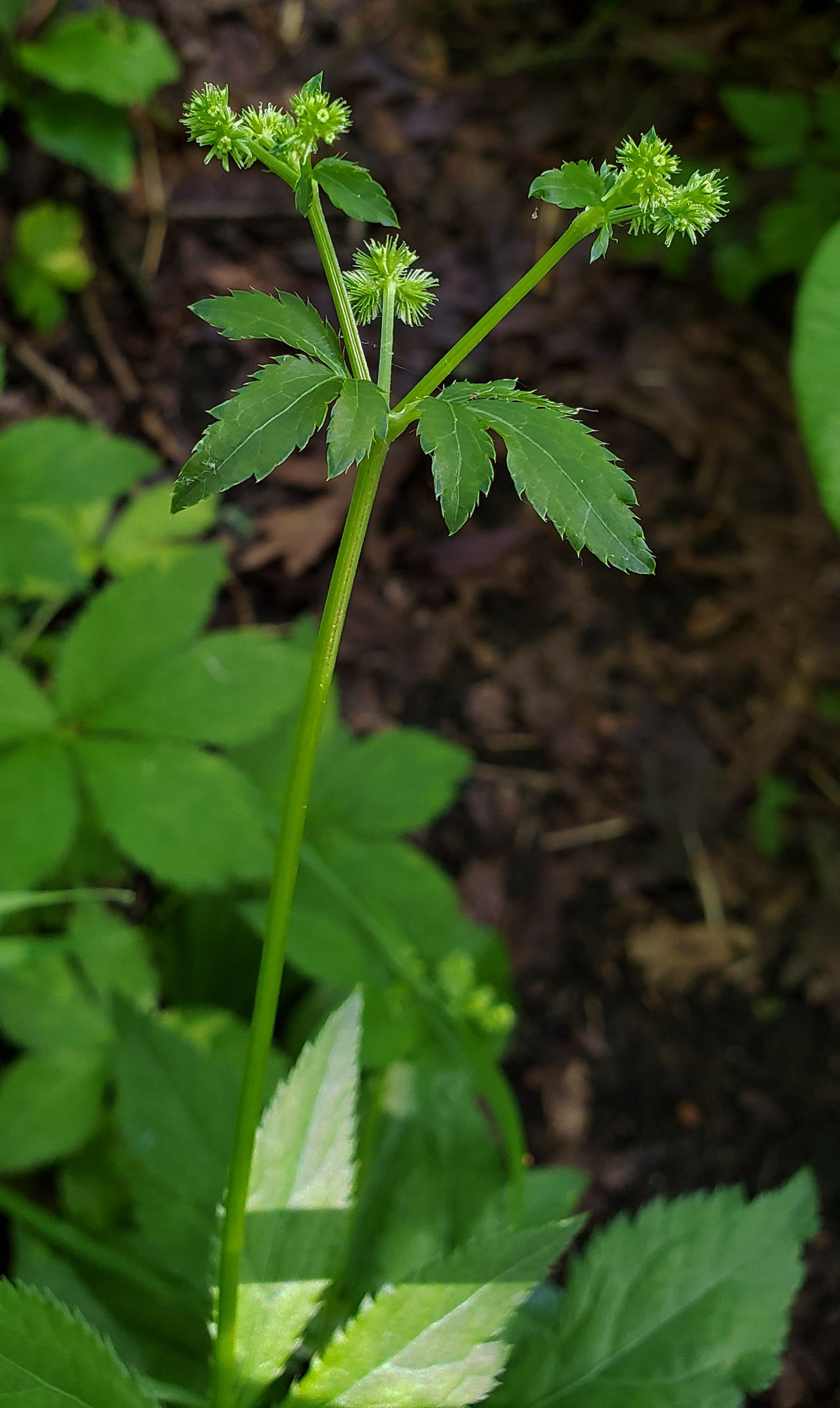
Sanicula canadensis, known as Black Snakeroot (USDA: Canadian blacksnakeroot) or Canadian sanicle, is a common woodland herb of eastern and central North America and a member of the carrot family (Apiaceae). It is a biennial, forming a low rosette of deeply divided leaves in its first year and a branched flowering stem 1 to 4 feet tall in its second.
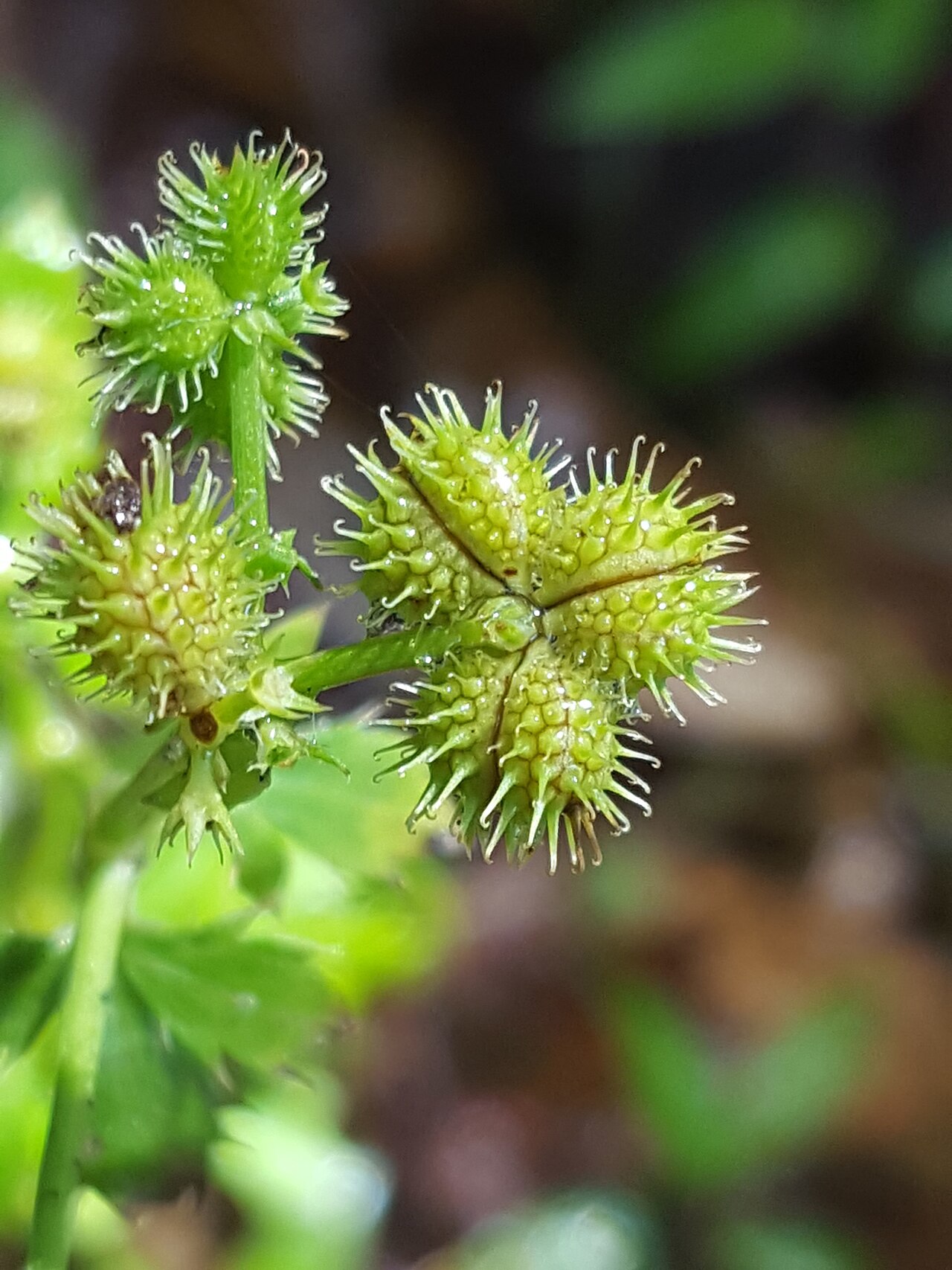
Its flowers are tiny, greenish-white and easily missed, but its fruits are not: small, round burs covered with hooked bristles that cling to socks, pant legs and dog fur in late summer and fall. It grows in dry to moist deciduous and mixed woods, woodland edges, thickets and shady disturbed ground, from New England and southern Ontario south to Florida and west to the eastern Great Plains and central Texas.
Black snakeroot is not the same as the poisonous white snakeroot (Ageratina altissima), which caused “milk sickness” in pioneer times, and it is not known to be toxic. Even so, the name “snakeroot” is applied to several unrelated plants, so do not eat it or use it as a remedy. In the garden it is a modest, self-sowing filler for informal woodland plantings.
Identification
Black snakeroot is easiest to identify by the combination of palmately divided leaves, tiny flowers in small heads at the ends of forked branches, and burred fruits with hooked bristles.
Growth Habit
First-year plants form a low rosette of long-stalked leaves. In the second year, a single stem 1 to 4 feet tall grows up and branches repeatedly into forks, giving the plant an open, airy shape. After it sets seed, the plant dies.
Leaves
The basal and lower stem leaves are palmately divided into three leaflets, with the two side leaflets often deeply cleft so the leaf looks five-parted. The leaflets are toothed, 1 to 3 inches long, and dark green. Upper stem leaves are smaller and stalkless.
Flowers
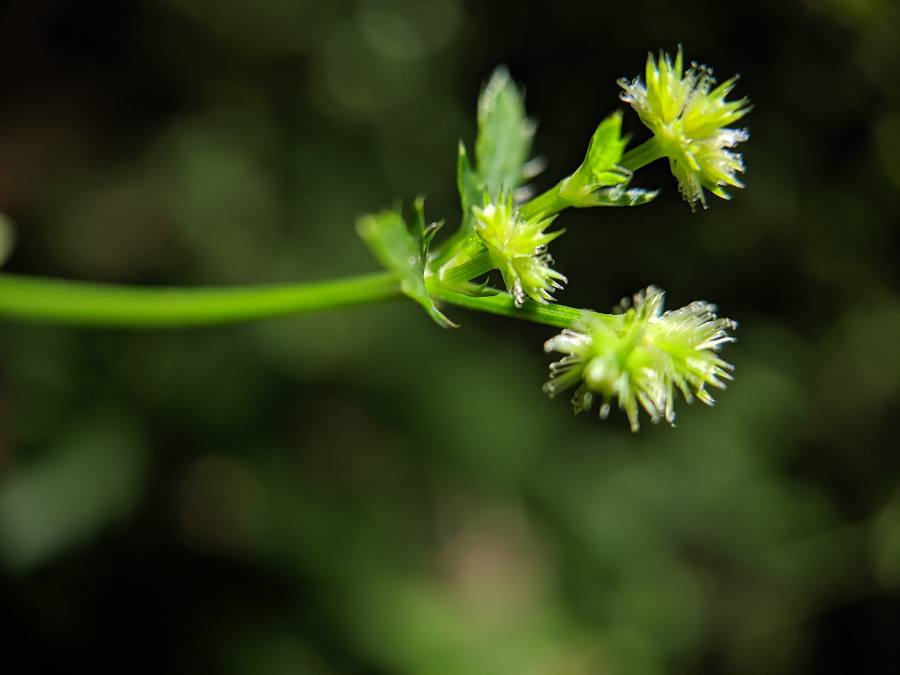
From June to August, the branches end in small, rounded heads of a few tiny flowers about 1/16 inch across, with greenish-white petals. Each head has a few bisexual flowers that produce fruit and a few short-stalked male flowers. The styles are short and do not stick out beyond the bristles of the young fruit.
Fruit
The fruits are oval burs about 1/8 inch long, covered with hooked bristles, usually in pairs that split apart when ripe. They turn brown in late summer and fall and attach to passing animals and people.
Look-alikes
Maryland black snakeroot (Sanicula marilandica) is a perennial with five- to seven-parted leaves, many long-stalked male flowers and long, curved styles that extend beyond the bristles. Clustered black snakeroot (S. odorata) has yellowish-green flowers. White snakeroot (Ageratina altissima) is an aster-family plant with simple leaves and fluffy white flower heads.
Safety
Black snakeroot is not known to be poisonous, but it is not a food plant. Several unrelated plants share the name “snakeroot,” including the toxic white snakeroot, so do not eat it or use it as an herbal remedy. The burs are a nuisance in pet fur but are otherwise harmless.
Quick Facts
| Scientific Name | Sanicula canadensis |
| Family | Apiaceae (carrot family) |
| Plant Type | Biennial herb |
| Mature Height | 1–4 ft |
| Mature Spread | 1–2 ft |
| Growth Rate | Fast; completes life cycle in two years |
| Sun Exposure | Part shade to shade |
| Water Needs | Low to medium |
| Soil Type | Loam, sandy loam, clay loam; woodland soils |
| Soil pH | About 5.5–7.5 |
| Bloom Time | June–August |
| Flower Color | Greenish-white |
| Fall Color | Not notable |
| Fruit | Small bur with hooked bristles |
| Deer Resistant | Moderately; occasionally browsed |
| USDA Hardiness Zones | 3–9 |
Native Range
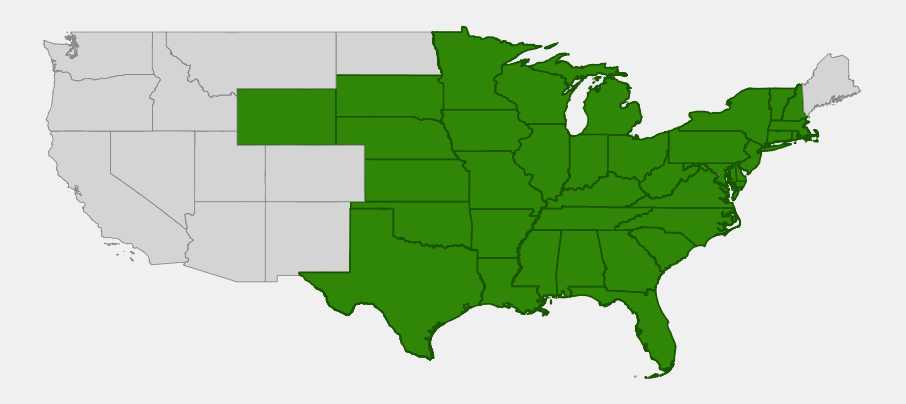
Black snakeroot is widespread in eastern and central North America. USDA PLANTS records it as native in southern Ontario and Quebec and in 36 states, from Vermont, New Hampshire and Massachusetts south to Florida and west to Minnesota, South Dakota, Nebraska, Kansas, Oklahoma and Texas. USDA also lists Wyoming, but that is an outlying record far west of the main range.
It is common through most of the eastern deciduous forest. At the western edge of its range it follows wooded river valleys and ravines onto the prairies. In Minnesota, herbarium records come mainly from the southern half of the state, west to the southwestern counties near the South Dakota border, and in South Dakota it occurs in the wooded southeast. In Texas it ranges from the eastern forests west into the Cross Timbers and the Edwards Plateau (Hill Country), where it grows in shady canyons and wooded creek bottoms.
Typical habitats are dry to moist deciduous and mixed woods, woodland edges and openings, thickets, shady stream banks and disturbed woods, including trailsides and old fields growing back to forest. It tolerates a wide range of soils and is often common in second-growth woods.
📋 Regional plant lists featuring Black Snakeroot: New York, Pennsylvania & Northern New Jersey · Ohio & Indiana · Montana & Wyoming · Michigan, Wisconsin & Eastern Minnesota · Kentucky & Tennessee · Nebraska, Kansas & Eastern Colorado · Connecticut, Massachusetts & Rhode Island · New Hampshire, Maine & Vermont · Maryland, Virginia & West Virginia · Delaware, Southern New Jersey & Long Island · Illinois, Iowa & Missouri · Alabama, Georgia & Mississippi · North & South Florida · North & South Carolina · Arkansas, Louisiana, Eastern Oklahoma & Eastern Texas · South & West Texas · North Dakota, South Dakota & Western Minnesota
Growing & Care Guide
Black snakeroot is not a showy garden plant, but it is an easy, adaptable native for informal shade gardens and woodland restoration, where it fills gaps and supports small insects.
Light
It grows best in part shade to full shade under deciduous trees, and it tolerates morning sun along woodland edges.
Soil & Water
It adapts to most well-drained woodland soils, from sandy loam to clay, moist to fairly dry. Once established it needs no watering except in severe drought, and no fertilizer.
Planting Tips
Sow seed directly in fall where you want plants, or set out small plants in spring. Because it is biennial, sow two years in a row to get flowering plants every year. Use it among ferns, woodland sedges and spring wildflowers in a naturalistic planting.
Pruning & Maintenance
Let plants set seed so that the colony continues. If burs on pets or clothing are a problem, cut the stems after flowering, before the fruits ripen, along paths. It reseeds readily and may need thinning in small gardens.
Propagation
Propagate by seed. Fresh seed sown outdoors in fall germinates the following spring after natural cold stratification. Spring-sown seed should be cold-stratified for about two months first.
Landscape Uses
- Woodland restoration: a common native component of the forest floor
- Shade gardens: an airy, self-sowing filler for informal plantings
- Natural areas and trailsides: thrives in second-growth and disturbed woods
- Small-pollinator habitat: tiny flowers for small bees, flies and wasps
- Nature education: a classic example of animal-dispersed burs
Wildlife & Ecological Value
Black snakeroot is a small but common part of the eastern woodland ecosystem, feeding small insects and hitching rides on passing mammals.
For Pollinators
The tiny flowers attract small insects, especially small bees such as sweat bees, and small flies and wasps. They are mostly self-compatible and set fruit readily.
For Birds
It has limited food value for birds, though ground-feeding birds may eat some seeds. Its stems add cover to the woodland understory.
For Mammals
Deer occasionally browse it. The hooked burs catch in the fur of deer, raccoons, foxes and other mammals, which carry the seeds to new places.
Ecosystem Role
As a quick-growing biennial, it fills gaps in the forest floor after disturbances such as treefalls and trail-making. Its burs are a textbook example of seed dispersal by animals (epizoochory).
Cultural & Historical Uses
The common name snakeroot was given to many plants once believed to treat snakebite. Several Native American peoples used black snakeroots, including this species, in traditional medicines, and the related European sanicle (Sanicula europaea) was a well-known healing herb in medieval Europe. These are historical uses, not recommendations.
The genus name Sanicula comes from the Latin sanare, “to heal,” reflecting that long medicinal reputation. The species was described by Linnaeus in 1753. Most of the related species in the genus grow in western North America, such as Pacific sanicle and purple sanicle on the West Coast, and black snakeroot is one of the few widespread in the East.
For hikers and dog owners, black snakeroot is best known for its burs, which turn up on socks and fur after a late-summer walk in the woods. Botanists value it as one of the common plants that indicate a healthy, mostly native woodland ground layer.
Frequently Asked Questions
Is black snakeroot poisonous?
It is not known to be poisonous, but it is not a food plant. Do not confuse it with the toxic white snakeroot (Ageratina altissima), and do not use either as a remedy.
How can I tell black snakeroot from Maryland black snakeroot?
Black snakeroot is a biennial with short styles that do not extend past the fruit bristles and few male flowers. Maryland black snakeroot is a perennial with long, curved styles and many long-stalked male flowers.
Why are there burs on my socks after a walk in the woods?
Black snakeroot is a common source. Its fruits are covered with hooked bristles that cling to fur and clothing, spreading the seeds.
Does black snakeroot come back every year?
Each plant lives two years, flowering and dying in its second. Colonies persist because the plants reseed readily.
Can I grow black snakeroot in a garden?
Yes, in an informal shade or woodland garden. It is easy from seed but plain and self-sowing, so it suits naturalistic plantings best.

Looking for a nursery that carries Black Snakeroot?
Browse our native plant nursery directory: Alabama & Arkansas · Connecticut, Delaware, Florida & Georgia · Illinois, Indiana, Iowa & Kansas · Kentucky, Louisiana, Maryland, Massachusetts, Michigan, Minnesota, Mississippi & Missouri · Nebraska, New Hampshire, New Jersey, New York, North Carolina, Ohio & Oklahoma · Pennsylvania, Rhode Island, South Carolina, South Dakota, Tennessee, Texas, Vermont & Virginia · West Virginia, Wisconsin & Wyoming