
Southern Adder’s Tongue (Ophioglossum vulgatum)
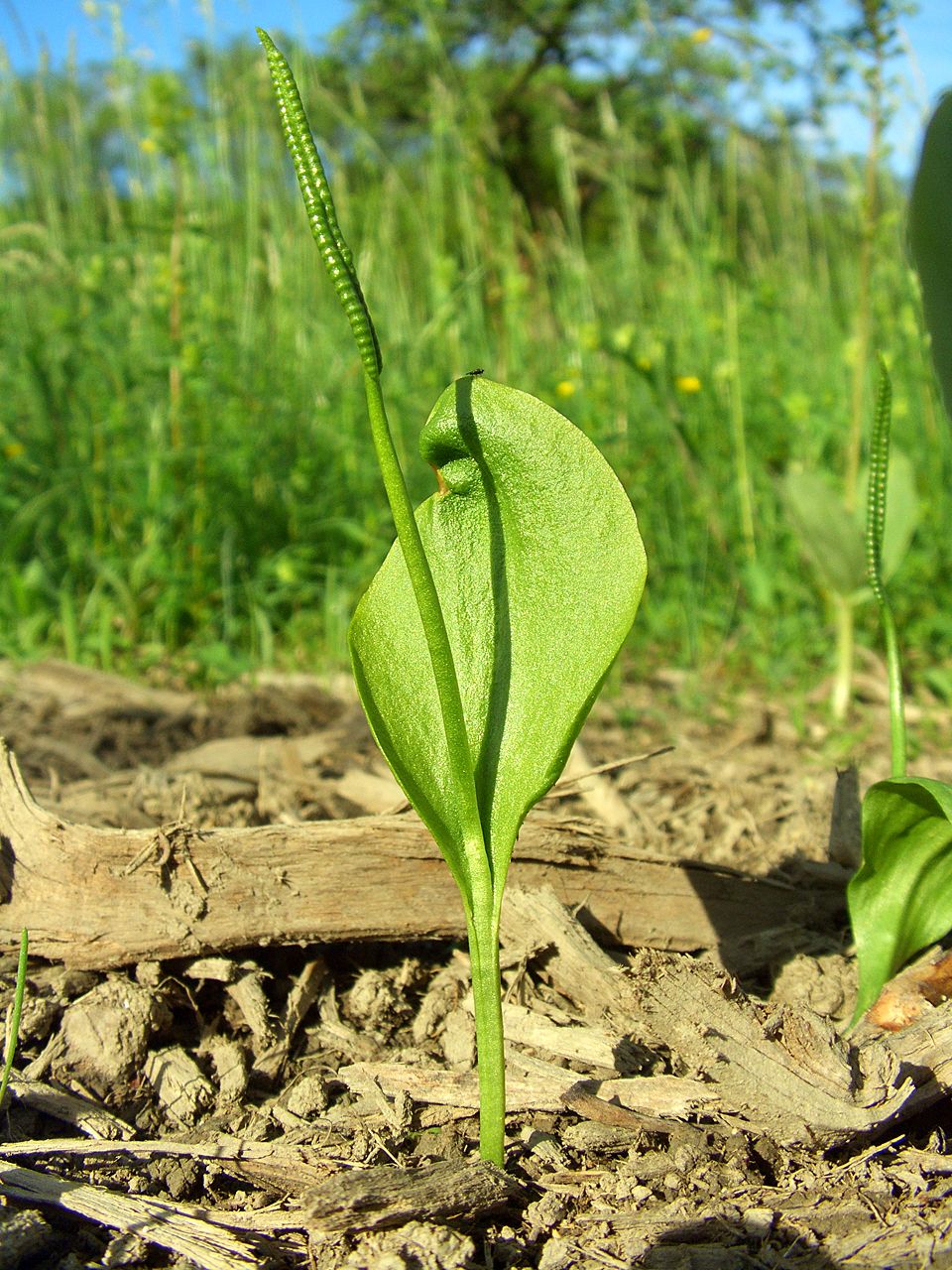
Ophioglossum vulgatum, known as Southern Adder’s Tongue (USDA: southern adderstongue), is one of the strangest ferns in North America. Each plant usually sends up a single smooth, undivided green blade, an inch or two wide, and from its base rises a slender stalk tipped with a narrow spike of spore cases. The spike looks a little like a snake’s tongue, which gives the plant both its common name and its genus name, from the Greek ophis (snake) and glossa (tongue). It belongs to the adder’s-tongue family (Ophioglossaceae), together with the grapeferns and moonworts.
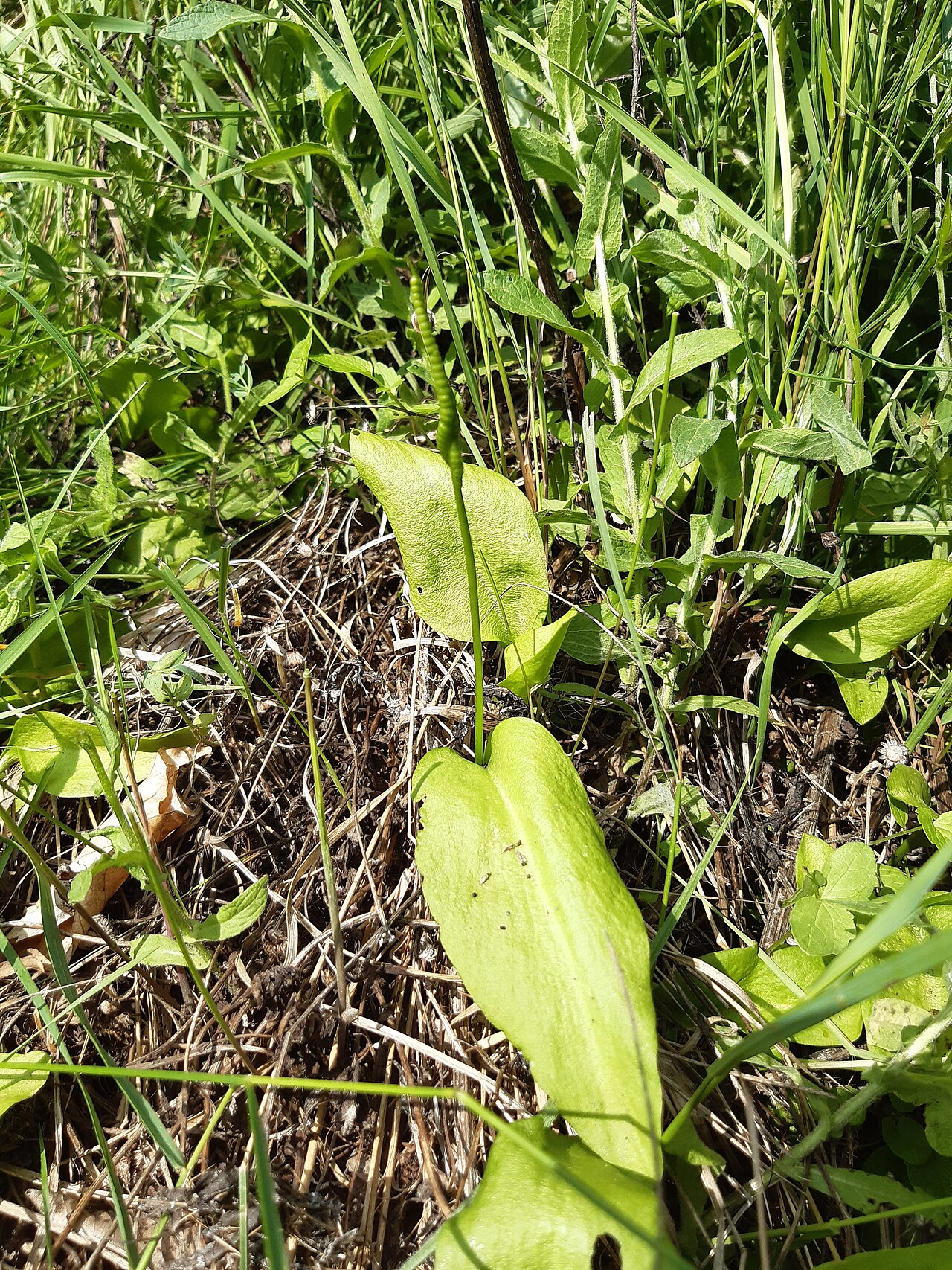
In the United States it grows from New York and Michigan south to Georgia, Louisiana and Texas, in moist meadows, wet woods and floodplains, swales, old fields and even old lawns. It is easy to walk past: the plant is only 4 to 12 inches tall, often grows among grasses, and its blade is up for just a few months in spring and early summer before it withers. Some botanists treat the American plants as Ophioglossum pycnostichum or as a variety of the Eurasian species, which USDA PLANTS lists as a synonym.
Like all adder’s-tongues, it depends on soil fungi for much of its life. Its spores germinate underground into colorless gametophytes that live on sugars from mycorrhizal fungi, and the roots of the green plant stay tied to the same fungi. It is not a nursery plant, it can’t be reliably transplanted and it should never be dug from the wild. This page is a guide to recognizing it and protecting the places where it grows.
Identification
Look in spring for a single, smooth, oval to lance-shaped leaf with no teeth or lobes, and a thin stalk rising from its base that ends in a narrow, two-ranked spike of round spore cases.
Growth Habit
Plants are small perennials that grow from a short, upright underground stem with fleshy, unbranched roots. Each year the plant usually produces one leaf, which is divided into two parts: a flat, green sterile blade and a fertile spike on its own stalk. Whole plants are usually 4 to 12 inches tall. The roots can produce buds that grow into new plants, so adder’s tongue is often found in loose colonies, sometimes of dozens or hundreds of plants.
Sterile Blade
The green blade is undivided, ovate to elliptic or lance-shaped, about 1 1/2 to 4 inches long and 1/2 to 2 inches wide, with smooth edges and a rounded to slightly pointed tip. It is soft, somewhat fleshy and often pale or yellowish green. Held up to the light, it shows a fine net of veins, unlike the forked, free veins of most ferns. In the American plants the base of the blade usually narrows gradually into the stalk, and a paler band often runs along the center of the blade.
Fertile Spike
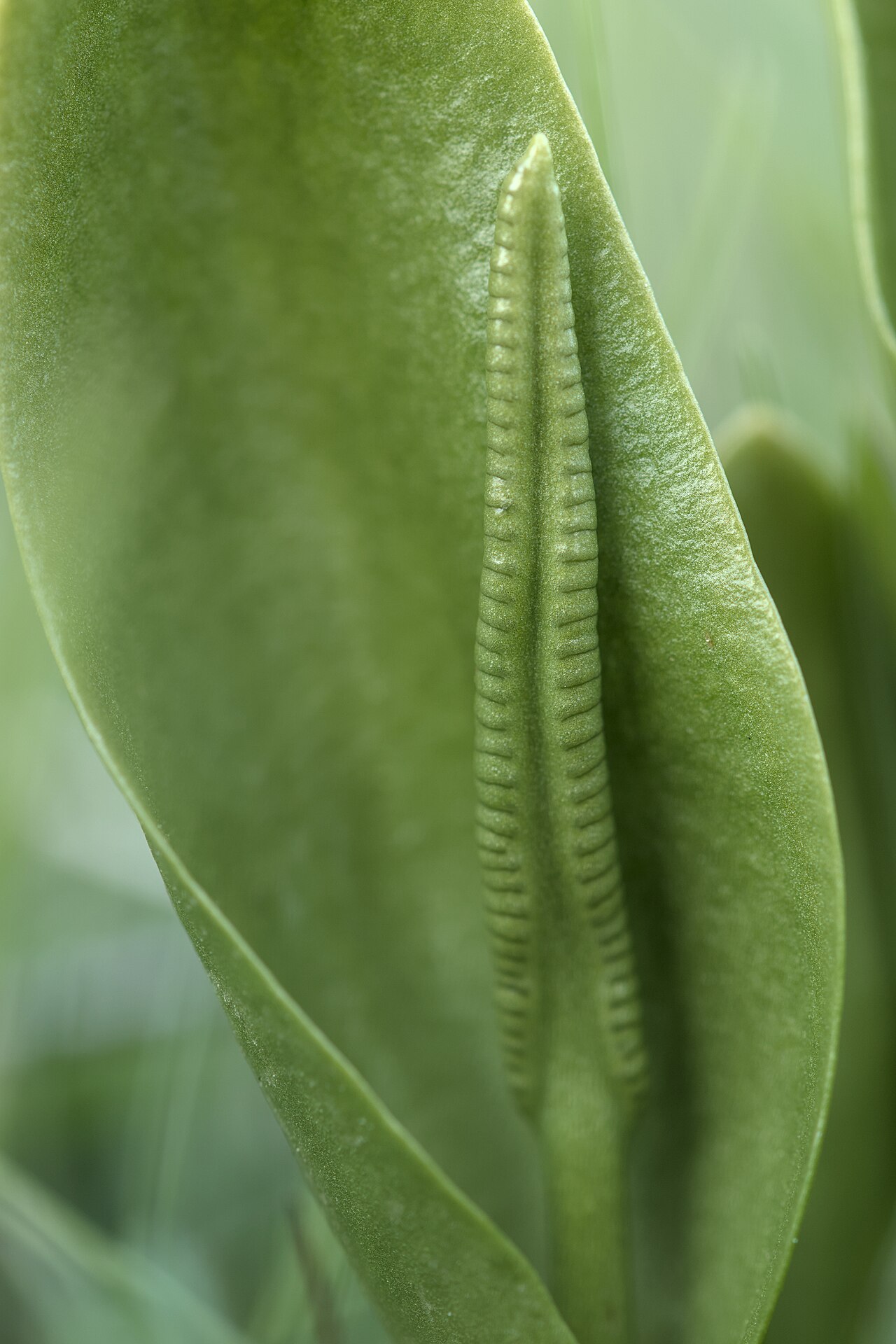
The fertile stalk arises where the blade joins the common stalk and rises above it, usually 1 to 2 1/2 times the length of the blade. Its tip is a narrow spike about 3/4 to 1 1/2 inches long, with 10 to 40 pairs of round, sunken sporangia fused in two rows along the edges. When the spores are ripe in early summer, the sporangia split open crosswise and release fine yellowish spores into the wind. Some plants produce only a sterile blade in a given year.
Season
The leaf appears in early to mid spring in the South and late spring farther north. Spores ripen from about April to July, and the blade usually yellows and disappears by midsummer, especially in dry years. Plants can skip a year above ground entirely and stay dormant underground.
Look-alikes
Northern adder’s tongue (Ophioglossum pusillum) grows farther north, has a blade that is widest near the middle and narrowed into a folded base, and lacks the pale central band. Limestone adder’s tongue (O. engelmannii) grows on thin soils over limestone in the South and Midwest, often has more than one leaf, and has a tiny sharp point at the blade tip. Grapeferns and the rattlesnake fern are close relatives, but their blades are lacy and divided. Young plantain or violet leaves can look similar from above, but they never have a spore spike.
Quick Facts
| Scientific Name | Ophioglossum vulgatum |
| Family | Ophioglossaceae (adder’s-tongue family) |
| Plant Type | Small perennial fern; one leaf per year |
| Mature Height | 4–12 in |
| Mature Spread | 1–3 in per plant; forms loose colonies |
| Growth Rate | Very slow |
| Sun Exposure | Part shade to full sun in the wild |
| Water Needs | Medium to wet in spring |
| Soil Type | Moist loam, silt or sandy soil with intact soil fungi |
| Soil pH | Slightly acidic to slightly alkaline |
| Bloom Time | None; spores ripen April–July |
| Flower Color | None (fern) |
| Fall Color | None; leaf dies back by midsummer |
| Fruit | None; spores in a narrow two-ranked spike |
| Deer Resistant | Unknown; rarely noticed by browsers |
| USDA Hardiness Zones | About 5–9 within its range (not grown in gardens) |
Native Range
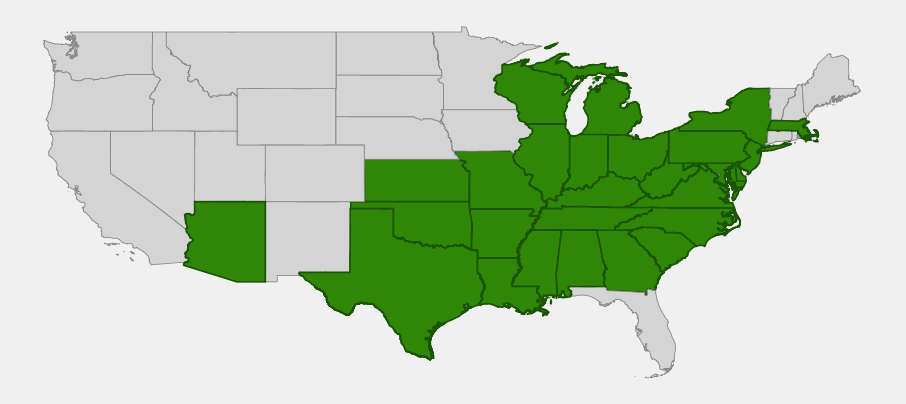
USDA PLANTS lists southern adder’s tongue as native in the lower 48 states and records it from 27 states. It is most widespread in the Southeast and the lower Midwest, from Virginia, the Carolinas and Georgia west through Tennessee, Kentucky, Alabama, Mississippi and Arkansas to Missouri, Oklahoma, Louisiana and eastern Texas. It reaches north along the Atlantic coast to New Jersey, New York and Massachusetts, and through Ohio, Indiana and Illinois to Michigan and Wisconsin, where it becomes scarce and some records may belong to northern adder’s tongue.
Arizona is an outlying record well west of the main range, and Kansas lies at its western edge in the Great Plains. In Texas it grows mainly in the moist, wooded eastern part of the state; the adder’s-tongue common in central Texas is usually limestone adder’s tongue. Outside the United States, the broader species is found across Europe, temperate Asia and parts of Africa, and the related American plants extend into Mexico.
Typical habitats are moist meadows and wet prairies, floodplain forests and bottomland hardwoods, swales, shrubby thickets, the edges of marshes and swamps, old fields, roadside ditches, cemeteries and older lawns that are mowed but rarely disturbed. It favors places that stay moist in spring and have not been plowed for a long time, where the soil fungi it depends on are well established.
📋 Regional plant lists featuring Southern Adder’s Tongue: New York, Pennsylvania & Northern New Jersey · Ohio & Indiana · Michigan, Wisconsin & Eastern Minnesota · Kentucky & Tennessee · Nebraska, Kansas & Eastern Colorado · Connecticut, Massachusetts & Rhode Island · New Hampshire, Maine & Vermont · Maryland, Virginia & West Virginia · Delaware, Southern New Jersey & Long Island · Arizona & New Mexico · Illinois, Iowa & Missouri · Alabama, Georgia & Mississippi · North & South Carolina · Arkansas, Louisiana, Eastern Oklahoma & Eastern Texas
Can You Grow It?
Not in the usual sense. Southern adder’s tongue is not sold as nursery stock, cannot be reliably transplanted, and should never be dug from the wild. Its whole life is tied to fungi in the soil. What you can do is recognize it, and protect and manage the places where it already grows.
Light
In the wild it grows in light shade under scattered trees, in floodplain woods that leaf out late, and in open meadows and old lawns. Its leaf does most of its work in spring, before tall plants and tree canopies shade it out, so early-season light matters more than summer light.
Soil & Water
It grows in moist loam, silt, clay or sandy soils that stay damp in spring and may dry out in summer when the plant is dormant. What matters most is that the soil has been left undisturbed long enough for the right mycorrhizal fungi to be present. Plowing, grading, heavy fertilizing and herbicide use destroy these conditions.
Planting Tips
Do not try to transplant it. Its fleshy roots depend completely on soil fungi, and dug plants almost always decline and die. If you find it in a lawn, meadow or woodlot, mark the spot in spring and keep foot traffic, vehicles and digging away from it.
Pruning & Maintenance
Where it grows in a lawn or meadow, delay the first mowing until the leaves have died back in early summer, or raise the mower and leave a small unmown patch in spring. Avoid fertilizers, broadleaf herbicides and lawn renovation in that area. In meadows, occasional late mowing or prescribed burning that keeps shrubs from closing in is helpful.
Propagation
Propagation is not practical. The spores germinate underground in darkness and grow into tiny, colorless gametophytes that live for years on sugars supplied by fungi. A young plant may spend several more years underground before it sends up its first green leaf. Existing colonies spread slowly by buds on the roots, and this is the best reason to protect a colony rather than try to move it.
Where to See It
- Floodplain woods and wet meadows in spring: search low, grassy openings from April to June, before the leaves wither
- Old lawns, churchyards and cemeteries: colonies often survive in old turf that has never been plowed
- Nature preserves with wet prairies: a sign of long-undisturbed, fungus-rich soil
- Fern walks and nature study: a striking example of the ancient adder’s-tongue family
- Citizen science: photograph the blade, the spike and the blade base for iNaturalist or state atlas records
Wildlife & Ecological Value
Southern adder’s tongue is a small and inconspicuous member of meadow and floodplain communities, but it is part of the underground network of plants and fungi that keeps these soils alive.
For Pollinators
As a fern, it does not flower and offers no nectar or pollen. Its spores are spread by wind.
For Birds
It provides little direct food for birds. The moist meadows and floodplains where it grows are used by sparrows, wrens and other birds that nest and forage in low vegetation.
For Mammals
Rabbits, deer and voles may nibble the soft leaves, but its small size and short season mean it is seldom an important food plant. Browsed plants usually return the next year from the underground stem.
Ecosystem Role
Adder’s tongues share sugars and nutrients with mycorrhizal fungi and help indicate soils with intact fungal networks. Because colonies persist only where the ground has not been plowed or heavily disturbed, botanists often treat them as a sign of old, stable meadows, lawns and floodplain forests.
Cultural & Historical Uses
In Europe, adder’s tongue was used in folk medicine as a wound herb. The leaves were steeped in oil to make a salve known as “Green Oil of Charity”, and the plant was also made into teas. These uses are historical; the plant should not be collected or used as a home remedy.
The genus Ophioglossum is famous among botanists for having some of the highest chromosome numbers of any living organism, the result of repeated doubling of whole sets of chromosomes over its long evolutionary history.
The adder’s-tongue family is an old lineage of ferns, quite different from the familiar leafy ferns of gardens. Its members have fleshy roots without root hairs, net or fan-like veins, and spore cases that are not grouped into the usual clusters on the backs of leaves.
Frequently Asked Questions
Is southern adder’s tongue really a fern?
Yes. It doesn’t look like a typical fern, but it reproduces by spores and belongs to the adder’s-tongue family (Ophioglossaceae), an ancient group of ferns that also includes the grapeferns and moonworts.
Can I buy southern adder’s tongue or move it to my garden?
No. It is not grown in nurseries, and transplanted plants almost always die because they depend on specific soil fungi. Never dig it from the wild. If it already grows on your land, protect the spot.
Why can’t I find the plant in late summer?
Its single leaf usually withers by midsummer, and some plants skip a year above ground. Look for it from about April to June.
How is it different from northern adder’s tongue?
Northern adder’s tongue (Ophioglossum pusillum) grows farther north, has a blade that is widest near the middle and folded at the base, and lacks the pale central band typical of southern plants. Checking blade shape and venation is often needed to tell them apart.
Is southern adder’s tongue native to Arizona?
USDA PLANTS records it from Arizona, but that record is far outside the main eastern range and is treated here as an outlying record. Most of its range is in the eastern and central United States.

Looking for a nursery that carries Southern Adder’s Tongue?
Browse our native plant nursery directory: Alabama, Arizona & Arkansas · Delaware & Georgia · Illinois, Indiana & Kansas · Kentucky, Louisiana, Maryland, Massachusetts, Michigan, Mississippi & Missouri · New Jersey, New York, North Carolina, Ohio & Oklahoma · Pennsylvania, South Carolina, Tennessee, Texas & Virginia · West Virginia & Wisconsin

