
Smooth Horsetail (Equisetum laevigatum)
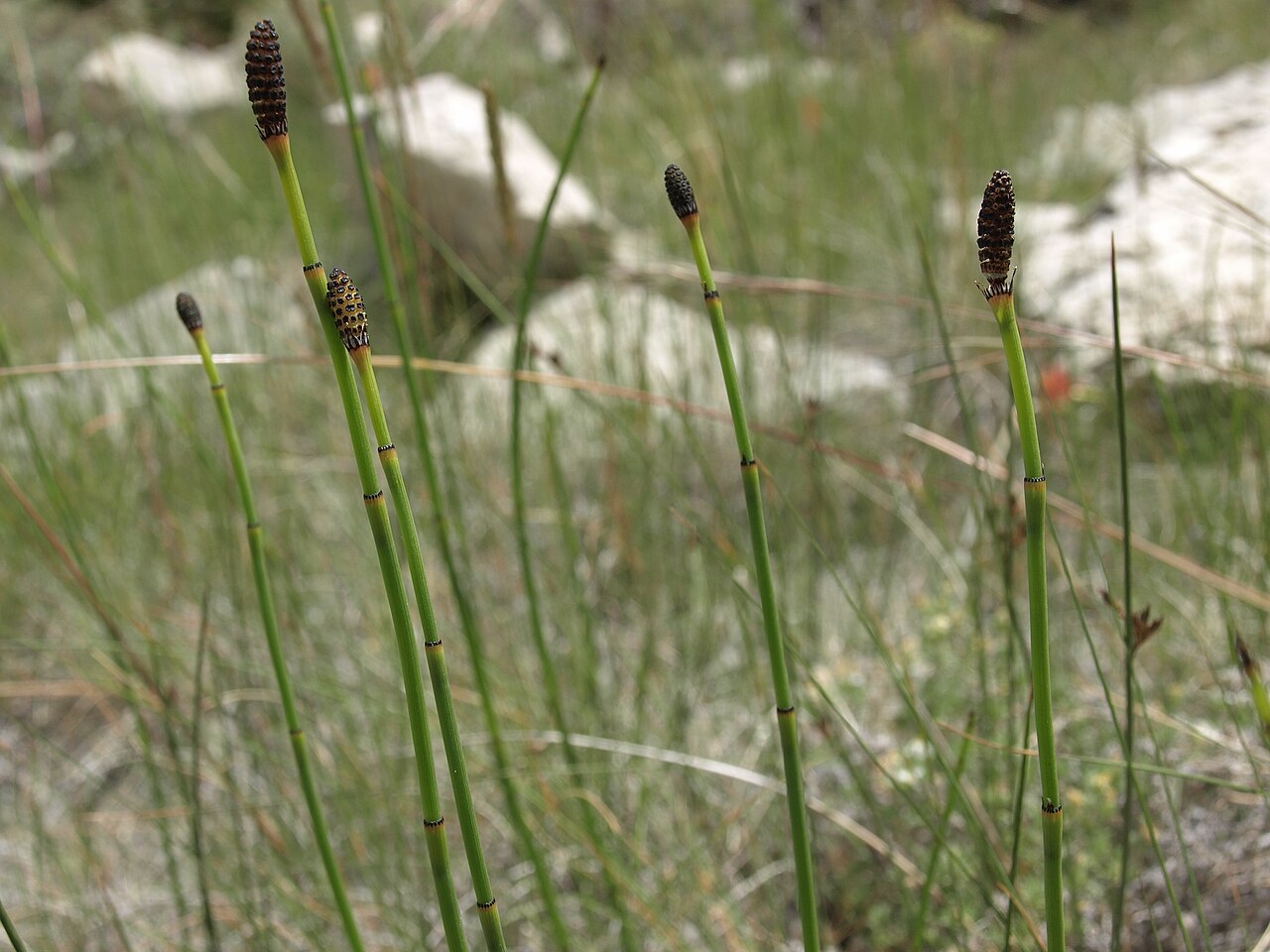
Equisetum laevigatum, known as Smooth Horsetail or smooth scouring rush, is a slender, jointed, green-stemmed plant of prairies, stream banks, meadows and roadsides across the West and the Great Plains. Its stems are hollow, ribbed and usually unbranched, standing 1 to 3 feet tall (occasionally more), and in late spring some of them carry a small, blunt, dark cone at the tip. From a distance a stand of it looks like a patch of green drinking straws pushed into the ground.
Like all horsetails, it is not a flowering plant. Horsetails belong to an ancient lineage of spore-bearing plants related to ferns, with a fossil history going back more than 300 million years. Smooth horsetail sits between two familiar relatives. It looks much like the evergreen Scouring Rush (Equisetum hyemale), but its stems are softer and smoother, and they die back to the ground each winter instead of staying green.
Smooth horsetail is one of the best horsetails for drier ground. It grows in moist places, but it also turns up on sandy prairies, railroad embankments and roadsides where the water table is only seasonally high. This guide covers how to identify it, where it grows, how to use it in a native garden without letting it take over, its value to wildlife, and the safety points every horsetail grower should know.
Identification
Smooth horsetail is a plain plant: green, jointed stems with no leaves to speak of and no flowers. The details that separate it from other horsetails are in the stem sheaths, the stem texture and the shape of the spore cone, so a close look is worthwhile.
Stems
The stems rise singly or in loose groups from creeping underground rhizomes. They are green, hollow, and usually 1 to 3 feet tall and about a quarter of an inch thick, with 10 to about 30 narrow ridges running lengthwise. The ridges feel smooth or only slightly rough, unlike the gritty, sandpapery stems of scouring rush. Most stems are unbranched, but a damaged stem may produce a few short side branches. The stems are annual: they turn yellowish or brown and die back over winter, and new ones appear in spring.
Sheaths
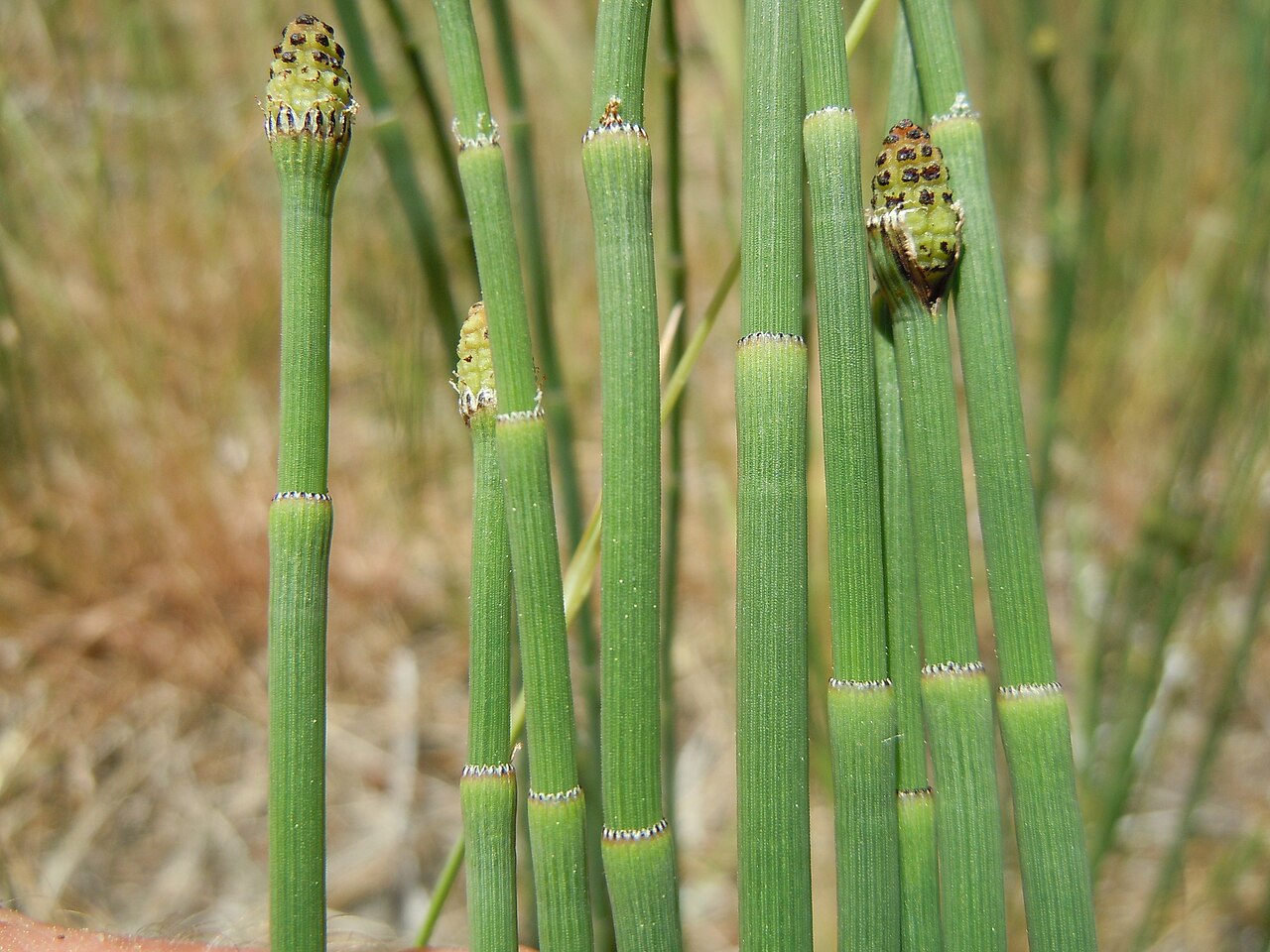
At each joint, a short tube called a sheath wraps the stem. In smooth horsetail the sheaths are noticeably longer than wide, green for most of their length, and topped by a single narrow black band. The pointed teeth at the rim are dark with pale edges, and they usually fall off early, leaving a neat dark rim. Scouring rush, by contrast, typically has two dark bands per sheath (a black band at the base as well as at the rim), with an ashy gray zone between them.
Leaves
The true leaves are tiny and are fused into the sheaths; the teeth at the sheath rim are their free tips. All the photosynthesis is done by the green stems.
Spore Cones
Fertile stems look just like the sterile ones, but they end in a cone-like strobilus about ½ to 1 inch long. The cone is rounded or blunt at the tip, without the small sharp point found on scouring rush cones. It is made of many six-sided shields, beneath which the spores develop. Cones usually mature from late spring into early summer, and the green spores are shed on the wind.
Look-alikes
Scouring Rush (Equisetum hyemale) has rough, evergreen stems, two-banded sheaths and sharp-tipped cones. The two species hybridize, and the hybrid, Equisetum × ferrissii, is common in the West and Midwest. It has intermediate features and stems that last partly through the winter, so some plants are hard to assign. Field Horsetail (Equisetum arvense) has whorls of thin green branches on its summer stems and separate, pale, short-lived fertile stems in early spring.
Quick Facts
| Scientific Name | Equisetum laevigatum A. Braun (syn. Hippochaete laevigata) |
| Family | Equisetaceae (horsetail family) |
| Plant Type | Spore-bearing perennial (horsetail), spreading by rhizomes |
| Mature Height | 1–3 ft (occasionally to about 4–5 ft) |
| Mature Spread | Spreads by rhizomes into loose colonies |
| Growth Rate | Moderate to fast |
| Sun Exposure | Full sun to light shade |
| Water Needs | Moderate to high; moist soil preferred, but tolerates seasonally dry ground |
| Soil Type | Sand, sandy loam, loam, silt or gravel; often in disturbed soil |
| Soil pH | About 6.0–8.0 |
| Bloom Time | Does not flower; spore cones mature late spring to early summer |
| Flower Color | None (small dark spore cones) |
| Fall Color | Stems turn yellowish tan and die back over winter |
| Fruit | None; reproduces by spores and rhizomes |
| Deer Resistant | Yes; rarely browsed |
| USDA Hardiness Zones | 3–9 |
Native Range
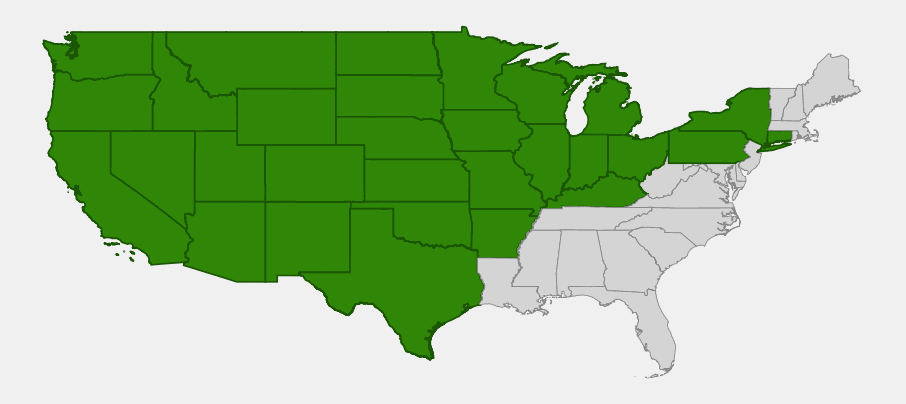
Smooth horsetail is native across much of western and central North America. USDA PLANTS and the Lady Bird Johnson Wildflower Center record it from 30 states, from Washington, Oregon and California east across the Rocky Mountain and Great Basin states and the Great Plains to Minnesota, Wisconsin, Michigan, Illinois, Indiana and Ohio, and south to Arizona, New Mexico, Texas, Oklahoma, Arkansas and Missouri. In Canada it grows in British Columbia, Alberta, Saskatchewan and Ontario.
It is most common in the Great Plains and the interior West, where it grows in prairies, along streams and irrigation ditches, and on roadsides and railroad grades. In the Midwest it is a plant of sand prairies, river terraces and lake dunes. Farther east it becomes scattered. The records from Kentucky, Pennsylvania, New York and Connecticut are outlying and the plant is rare there, so in the East it is far less familiar than scouring rush.
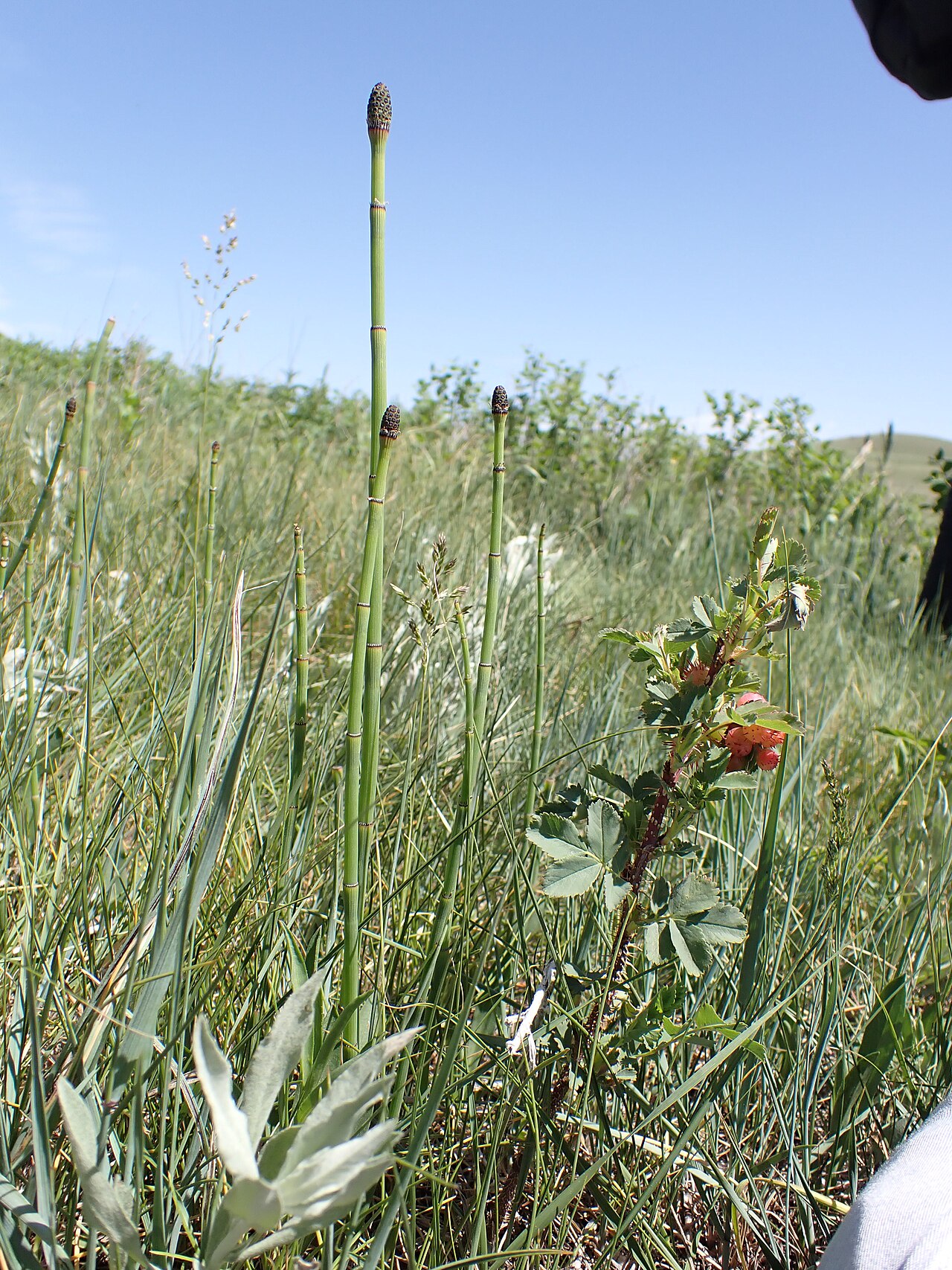
Smooth horsetail grows from low prairie elevations to high mountain meadows, reaching nearly 10,000 feet in the White Mountains of California. It favors open, sunny ground with some moisture during the growing season: moist meadows, stream banks, sandbars, seeps, swales, ditches and the edges of ponds, as well as drier sandy or gravelly prairies where the water table is high in spring.
📋 Regional plant lists featuring Smooth Horsetail: Arkansas, Louisiana, Eastern Oklahoma & Eastern Texas · South & West Texas · Arizona & New Mexico · California & Nevada · Connecticut, Massachusetts & Rhode Island · Idaho, Eastern Oregon & Eastern Washington · Illinois, Iowa & Missouri · Ohio & Indiana · Kentucky & Tennessee · Michigan, Wisconsin & Eastern Minnesota · North Dakota, South Dakota & Western Minnesota · Nebraska, Kansas & Eastern Colorado · Montana & Wyoming · Utah & Western Colorado · New York, Pennsylvania & Northern New Jersey · Delaware, Southern New Jersey & Long Island · Western Oregon & Western Washington
Growing & Care Guide
Smooth horsetail is an easy, tough plant that brings a clean vertical line to wet and semi-dry gardens. Its main drawback is the same as every horsetail’s: the rhizomes spread, and once established they are hard to remove. Plant it where it can wander, or keep it in a container.
Light
It grows best in full sun, which keeps the stems upright and dense. It tolerates light or partial shade, but stems become thinner and fewer in deep shade.
Soil & Water
Give it soil that stays moist for at least part of the growing season. Sand, sandy loam, silt and gravel all suit it, and it does well on neutral to slightly alkaline soils. It is more drought tolerant than most horsetails, and once established it will persist in a sunny bed that dries out in late summer, though it stays shorter there. It tolerates brief flooding along streams and ditches.
Planting Tips
Plant potted plants or rhizome sections in spring, setting rhizome pieces 2 to 3 inches deep in moist soil and keeping them watered until new stems appear. In mixed borders, plant it inside a deep root barrier or in a sunken container without drainage holes, since rhizomes can travel several feet a year under good conditions. In rain gardens, swales and pond margins it can be left to spread naturally.
Pruning & Maintenance
Cut the dead stems back in late winter or early spring before new growth emerges, or leave them for winter cover. To keep a colony in bounds, pull or cut unwanted stems repeatedly through the season; this slowly weakens the rhizomes. It has few pest or disease problems and needs no fertilizer.
Propagation
Divide the rhizomes in early spring, making sure each section has at least one node and a stem bud. Stem cuttings with a node sometimes root in wet sand. Spores are short-lived and must be sown within days on constantly moist, sterile soil, so spore propagation is rarely practical for gardeners.
Landscape Uses
- Rain gardens and swales: tolerates both wet springs and dry summers
- Pond and stream margins: a fine, upright texture at the water’s edge
- Erosion control: its rhizomes help hold sandy banks and ditch slopes
- Container and water gardens: contained in a pot or tub to prevent spreading
- Prairie and sand prairie restoration: a natural component of moist prairie swales in its range
Wildlife & Ecological Value
Smooth horsetail has no flowers, nectar or seeds, but its stands add structure and shelter to wet meadows, prairie swales and stream banks.
For Pollinators
As a spore-bearing plant, smooth horsetail offers no nectar or pollen. Its stems and the moist ground around them provide shelter for many small insects, spiders and other invertebrates, and dead stems are used by some insects as overwintering sites.
For Birds
Birds rarely eat horsetails, but sparrows, wrens and other small birds forage among the stems for insects, and dense stands along streams give cover to ground-nesting birds.
For Mammals
Deer and livestock generally avoid horsetails because of their silica content and compounds that can be harmful in quantity. Small mammals use the stems for cover. Horses that eat horsetail in hay can become seriously ill, so it is not a forage plant.
Ecosystem Role
Smooth horsetail is often among the first plants to colonize bare, sandy or gravelly ground along streams and roadsides, and its rhizomes help stabilize these soils. Horsetails accumulate large amounts of silica in their stems, which returns to the soil as they decay. As a survivor of an ancient plant group, it is also a living link to the vegetation of the Paleozoic coal swamps.
Cultural & Historical Uses
Horsetails have long been used as natural abrasives. Their silica-rich stems were used to polish wood, bone, metal and pottery, which is the origin of the name “scouring rush.” Smooth horsetail is less gritty than Equisetum hyemale and was used less for scouring, but many Indigenous peoples of the Plains and the West used horsetails in general for polishing, as children’s toys and whistles, and in traditional medicine.
The genus name Equisetum comes from the Latin equus (horse) and seta (bristle), referring to the bushy, tail-like look of branched species. The species name laevigatum means “smooth,” describing its stems, which feel much less rough than those of scouring rush. The species was named by the German botanist Alexander Braun in the 1840s.
Safety note: Horsetails contain thiaminase, an enzyme that destroys vitamin B1, and they have poisoned horses and other livestock that ate them in hay. Do not eat smooth horsetail or use it as a home remedy in large or prolonged amounts. Keep it out of hay fields and pastures.
Frequently Asked Questions
How do I tell smooth horsetail from scouring rush?
Feel the stem and look at the sheaths. Smooth horsetail has smoother stems that die back each winter, long green sheaths with a single black band at the top, and blunt-tipped cones. Scouring rush has rough, evergreen stems, sheaths with two dark bands, and cones with a small sharp point. Plants in between may be the hybrid Equisetum × ferrissii.
Does smooth horsetail spread?
Yes. It spreads by creeping rhizomes and can form large colonies in moist soil. Plant it in a container, behind a deep root barrier, or in a place where spreading is welcome, such as a swale or pond edge.
Can smooth horsetail grow in dry soil?
It prefers moisture, but it is one of the most drought-tolerant horsetails. It persists on sandy prairies, roadsides and railroad grades that dry out in summer, as long as the soil is moist in spring.
Is smooth horsetail poisonous?
It can be harmful in quantity. Horsetails contain thiaminase and have poisoned horses and livestock that ate them in hay. Do not eat it or feed it to animals.
Does smooth horsetail flower?
No. Horsetails reproduce by spores formed in small cones at the tips of some stems, and they spread by rhizomes. They never produce flowers or seeds.

Looking for a nursery that carries Smooth Horsetail?
Browse our native plant nursery directory: Arizona & Arkansas · California · Colorado & Connecticut · Idaho, Illinois, Indiana, Iowa & Kansas · Kentucky, Michigan, Minnesota, Missouri & Montana · Nebraska, Nevada, New Mexico, New York, North Dakota, Ohio & Oklahoma · Oregon · Pennsylvania, South Dakota, Texas & Utah · Washington · Wisconsin & Wyoming

