
Native Azaleas and Rhododendrons (Rhododendron)
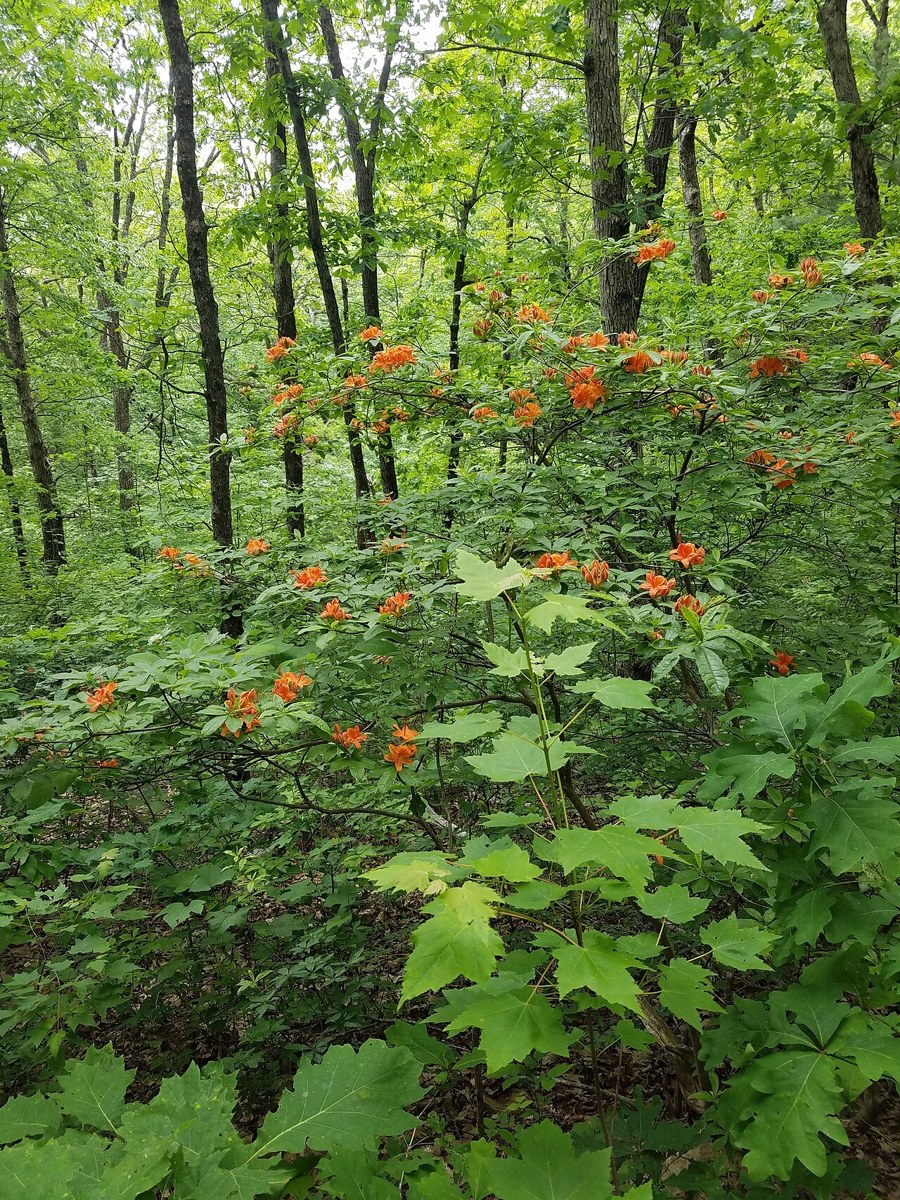
Azaleas and rhododendrons all belong to one large genus, Rhododendron, in the heath family. The United States is home to about 30 native species, including some of the most spectacular flowering shrubs in the world: the orange flame azaleas of the southern Appalachians, the fragrant white swamp and sweet azaleas, the evergreen rosebay and Catawba rhododendrons that form “laurel hells” on mountain slopes, and the Pacific rhododendron, Washington’s state flower. Most native species grow in the East, with the greatest variety in the Southeast.
Most of the azaleas planted in American yards, however, are not native. The evergreen azaleas that blanket southern gardens in pink, red and white each spring, including the Kurume, Southern Indica and Encore types, and the potted “Christmas” or florist azaleas sold in winter, come from Asian species. Our native azaleas are almost all deciduous, losing their leaves in winter, and many bloom in shades of orange, yellow and red that evergreen Asian azaleas rarely show, often with a strong, sweet fragrance.
Native azaleas and rhododendrons need the same basic conditions as their garden cousins: acidic, well-drained, humus-rich soil and protection from harsh afternoon sun. In return they offer bloom from early spring into late summer, depending on the species, and they feed native bees, butterflies and hummingbirds. Gardeners should also know that all parts of azaleas and rhododendrons are poisonous to people, pets and livestock. This guide covers how to tell azaleas from rhododendrons, which species are native where, the main non-native look-alikes, and how to grow them.
Identification
All rhododendrons are woody shrubs or small trees with alternate, simple, untoothed leaves often crowded near the branch tips, and showy flowers in clusters (trusses) at the ends of the branches. Gardeners usually split them into two groups.
Azaleas vs. Rhododendrons
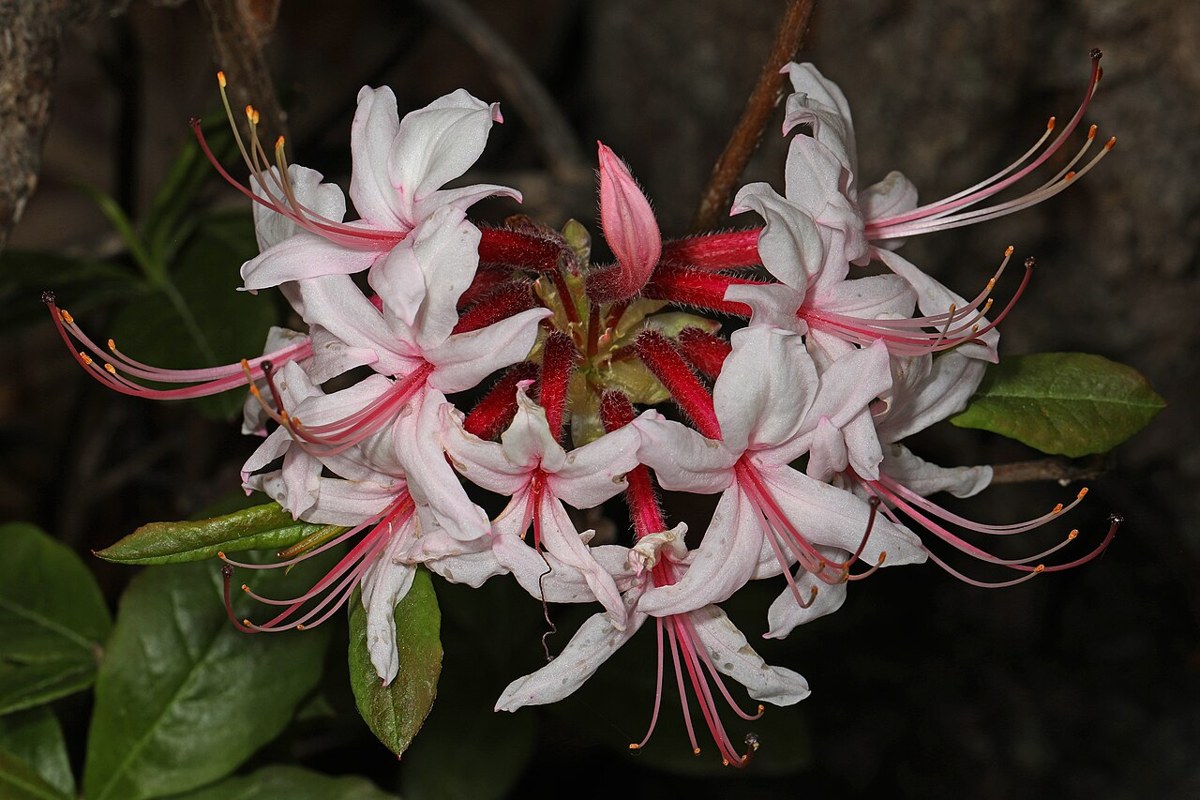
Azaleas are a subset of the genus. Native American azaleas are deciduous, with thin, often hairy leaves, and their funnel-shaped flowers usually have five stamens (and sometimes more) that stick out well beyond the petals, giving them a spidery, honeysuckle-like look. Rhododendrons in the gardener’s sense are mostly evergreen, with thick, leathery leaves, bell-shaped flowers with ten or more stamens, and dense, rounded trusses. A few native species blur the lines, but if a native shrub is deciduous with long, protruding stamens, it is almost certainly an azalea.
Leaves
Native azalea leaves are 1 to 4 inches long, elliptical, and often fringed with fine hairs along the edges. Evergreen rhododendron leaves are larger and leathery: rosebay rhododendron’s are 4 to 10 inches long and curl into tight tubes in freezing weather, a useful winter thermometer. Carolina rhododendron has smaller leaves dotted underneath with tiny rusty scales. Labrador tea (now Rhododendron groenlandicum), a northern bog shrub, has narrow leaves with rolled edges and rusty wool underneath.
Flowers
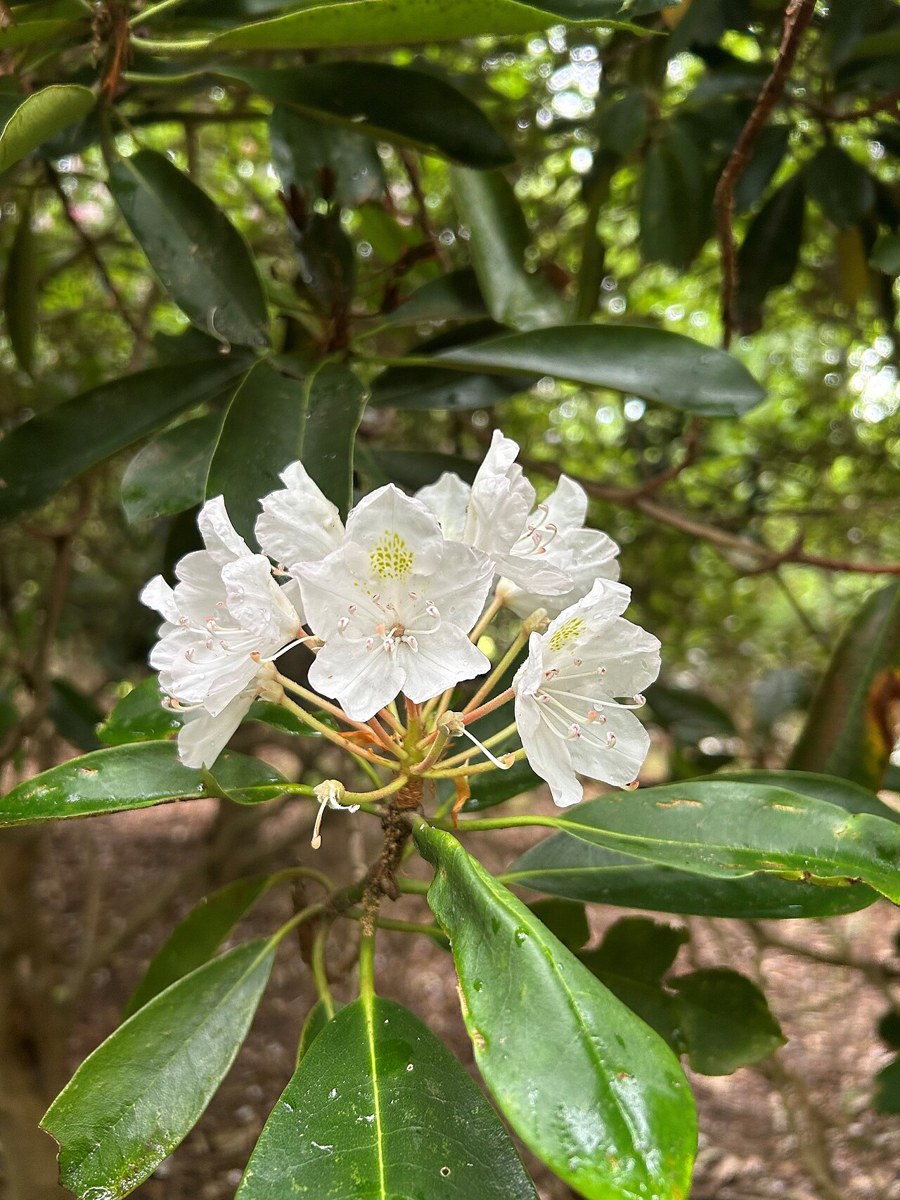
Flower color is the first thing most people notice. Native azaleas come in white (swamp, sweet, Alabama azalea), pink (pinxterbloom, Piedmont, roseshell, pinkshell), yellow to orange (Florida, flame, Oconee), and red to scarlet (plumleaf, Cumberland). Many have a yellow or orange blotch on the upper petal that guides pollinators. Native rhododendrons bear white to rose-pink (rosebay), lilac to purple (Catawba) or pink (Pacific rhododendron) bells. Bloom times are staggered: Florida and Piedmont azaleas flower in March and April, flame azalea in May and June, sweet and swamp azaleas in June and July, and plumleaf and summer azaleas from July into September.
Fruit
Both groups produce small, dry, woody capsules that split into five parts in fall and release thousands of dust-fine seeds. The old capsules often stay on the branches through winter and help identify a shrub out of bloom.
Quick Facts
| Scientific Name | Rhododendron (includes the former genera Azalea, Ledum and Menziesia) |
| Family | Ericaceae (Heath) |
| U.S. Native Species | About 30 (approximate), including roughly 17 deciduous azaleas |
| Plant Type | Deciduous and evergreen shrubs, rarely small trees |
| Mature Height | 1–3 ft (dwarf azalea, Labrador tea) to 15 ft or more (rosebay rhododendron); most azaleas 4–10 ft |
| Mature Spread | 3–10 ft; some spread by underground runners |
| Growth Rate | Slow to moderate |
| Sun Exposure | Part Shade (morning sun, afternoon shade); some azaleas take Full Sun with steady moisture |
| Water Needs | Evenly moist but well-drained; swamp azalea and Labrador tea tolerate wet soil |
| Soil Type | Loose, humus-rich, well-drained; poor in heavy clay |
| Soil pH | Acidic, about 4.5–6.0 |
| Bloom Time | March – September, depending on species |
| Flower Color | White, pink, rose, purple, yellow, orange, red |
| Fall Color | Several deciduous azaleas turn yellow, orange, red or purple |
| Fruit | Dry woody capsules with dust-like seeds |
| Toxicity | All parts poisonous (grayanotoxins) to people, dogs, cats, horses and livestock |
| Deer Resistant | No; deer browse azaleas heavily, rhododendrons somewhat less |
| USDA Hardiness Zones | 2–9, depending on species |
Native Range
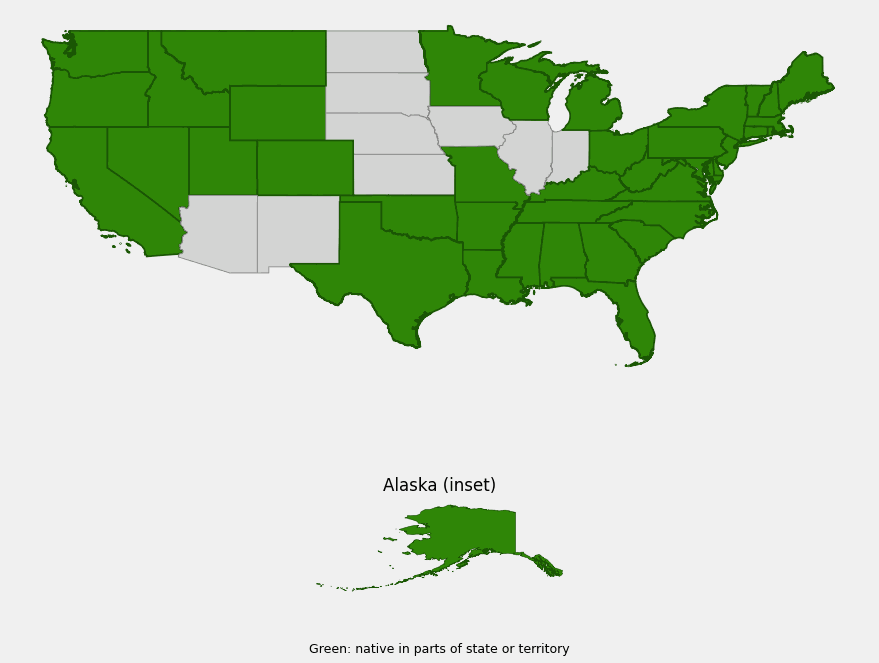
The heart of native azalea country is the southern Appalachians and the Piedmont and coastal plain of the Southeast. North Carolina, Georgia, Tennessee and Alabama each have a dozen or so native species, and in places such as Gregory Bald in the Great Smoky Mountains, flame and other azaleas grow together and hybridize in a rainbow of colors. Native species continue north through the Appalachians to New England and Maine, where rhodora and roseshell azalea grow, and west into the Ozarks and Ouachitas of Missouri, Arkansas and eastern Oklahoma and the pine woods of Louisiana and East Texas.
Farther north and west, the genus is represented by bog and mountain shrubs. Labrador tea (R. groenlandicum) grows in bogs and wet conifer forests across the northern tier from Maine to Minnesota and Alaska. In the West, Pacific rhododendron and western azalea grow in the coastal forests of California, Oregon and Washington; white-flowered rhododendron, false azalea (R. menziesii, formerly Menziesia) and western Labrador tea (R. columbianum) grow in mountain forests and wetlands from the Cascades and Sierra Nevada to the northern Rockies. Alaska adds arctic species such as Lapland rosebay.
There are no native rhododendrons in the hot, dry Southwest (Arizona and New Mexico), across most of the Great Plains, or in Iowa and Indiana, where soils are mostly too alkaline or too dry. Hawaii has no native species either. In those places, azaleas and rhododendrons are garden plants only, and they usually struggle without heavily amended, acidic soil.
📋 Regional plant lists with native azaleas and rhododendrons: New Hampshire, Maine & Vermont · Connecticut, Massachusetts & Rhode Island · New York, Pennsylvania & Northern New Jersey · Delaware, Southern New Jersey & Long Island · Maryland, Virginia & West Virginia · North Carolina & South Carolina · Georgia, Alabama & Mississippi · Kentucky & Tennessee · Ohio & Indiana · Michigan, Wisconsin & Eastern Minnesota · Illinois, Iowa & Missouri · Arkansas, Louisiana, Eastern Oklahoma & Eastern Texas · Western Oregon & Western Washington · Idaho, Eastern Oregon & Eastern Washington · Montana & Wyoming · Utah & Western Colorado · California & Nevada · Alaska
Native Species
These are the most widely grown and ecologically important native azaleas and rhododendrons. Each name links to a full profile.
Deciduous Native Azaleas
- Flame Azalea (Rhododendron calendulaceum): The showiest native azalea, with yellow, orange or red-orange flowers in May and June as the leaves expand. Native to the Appalachians from Pennsylvania and Ohio to Georgia and Alabama. Not fragrant. A good choice for North Carolina and Georgia gardens with some sun.
- Piedmont Azalea (Rhododendron canescens): The most common azalea of the Deep South, with fragrant pale to deep pink flowers in March and April before the leaves. Grows along streams and in moist woods from North Carolina to Florida and East Texas. Adaptable and heat tolerant.
- Pink Azalea or Pinxterbloom (Rhododendron periclymenoides): Pale to deep pink flowers with very long stamens in April and May, before or with the leaves. Native to dry to moist woods from New England to the Carolinas, Georgia and Tennessee.
- Roseshell Azalea (Rhododendron prinophyllum): Bright pink flowers with a clove-like fragrance in May. One of the hardiest azaleas, native from southern Maine and Quebec through the Appalachians and west to Missouri and Oklahoma.
- Swamp Azalea (Rhododendron viscosum): Small, sticky, white tubular flowers with a spicy-sweet scent in June and July, after the leaves. Grows in swamps, bogs and wet woods from Maine to Florida and Texas, and is one of the few azaleas that tolerates wet soil.
- Sweet Azalea (Rhododendron arborescens): White, intensely fragrant flowers with showy red stamens in June and July. Grows along mountain streams in the Appalachians from Pennsylvania to Georgia and Alabama.
- Rhodora (Rhododendron canadense): A low northern azalea with small rose-purple, two-lipped flowers in April and May before the leaves. Native to bogs, wet meadows and rocky barrens of New England, New York, Pennsylvania and New Jersey north into Canada.
- Florida Azalea (Rhododendron austrinum): Fragrant yellow to orange flowers in March and April before the leaves. Native to northern Florida, southern Georgia, Alabama and Mississippi, and one of the easiest native azaleas for hot southern gardens.
- Pinkshell Azalea (Rhododendron vaseyi): Delicate pink, open, bell-like flowers in May before the leaves. Found wild only in a few mountain counties of western North Carolina, but grows well in cooler gardens of the East.
- Plumleaf Azalea (Rhododendron prunifolium): Red-orange to scarlet flowers in July and August, unusually late. Rare in the wild, limited to shady ravines along the Georgia–Alabama border, but widely available from nurseries. Attracts hummingbirds and swallowtails in midsummer.
- Western Azalea (Rhododendron occidentale): The West’s only native azalea, with fragrant white to pink flowers marked with a yellow blotch in late spring and early summer. Grows along streams and in moist openings in California and southwestern Oregon.
Native Rhododendrons
- Rosebay Rhododendron (Rhododendron maximum): The largest native rhododendron, a big evergreen shrub or small tree often 10–15 ft tall with white to pale pink flowers in June and July. Forms dense thickets along streams and shady slopes in the Appalachians from Georgia north to New England.
- Catawba Rhododendron or Mountain Rosebay (Rhododendron catawbiense): Lilac to rose-purple trusses in May and June on an evergreen shrub of the southern Appalachians, famous for mass displays on high balds such as Roan Mountain. A parent of many hardy garden rhododendrons.
- Carolina Rhododendron (Rhododendron carolinianum): A compact evergreen rhododendron, usually 3–6 ft, with small, scaly leaves and pale pink to white flowers in May. Native to the southern Blue Ridge in the Carolinas, Tennessee and Georgia; often treated as part of R. minus.
- Pacific Rhododendron (Rhododendron macrophyllum): The state flower of Washington, an evergreen shrub with rose-pink trusses in May and June. Grows in coastal and Cascade forests from British Columbia to central California.
More native azalea and rhododendron profiles: Dwarf or Coastal Azalea (R. atlanticum) of the Atlantic coastal plain · Summer Azalea (R. serrulatum), a late-blooming white azalea of the Gulf coastal plain · Oconee Azalea (R. flammeum) of the Georgia and South Carolina Piedmont · Alabama Azalea (R. alabamense), white and lemon-scented · Cumberland Azalea (R. cumberlandense), a red-orange summer bloomer of the Cumberland Plateau · White-Flowered Rhododendron (R. albiflorum) of western subalpine forests
Non-Native Look-Alikes
Most azaleas and rhododendrons in garden centers are Asian species or hybrids. They are not invasive in the U.S., but they offer less to native wildlife than native species and are often what people mean by “azalea” in garden articles.
- Christmas or florist azalea (Rhododendron simsii and its hybrids): Native to China and East Asia. Sold in pots in winter with large red, pink, white or bicolor flowers, often doubled. These Belgian Indica types are tender houseplants in most of the country, and they are toxic to cats and dogs.
- Southern Indica azaleas: The big evergreen azaleas of old southern gardens, such as ‘Formosa’ and ‘George Tabor’, derived from Asian species. Hardy only in the Deep South, they bloom heavily in March and April in magenta, pink and white.
- Kurume and other Japanese evergreen azaleas: Small-leaved, compact evergreen azaleas from Japan covered in small flowers in spring. Widely used in foundation plantings from the Mid-Atlantic south.
- Encore and other reblooming azaleas: Evergreen hybrids bred in Louisiana from Asian azaleas, including the summer-blooming R. oldhamii, to flower in spring and again in late summer and fall.
- Pontic rhododendron (Rhododendron ponticum): Native to southern Europe and western Asia. Used as a rootstock and in older hybrids, and a notorious invasive in Britain and Ireland, though rarely planted or invasive in the U.S.
- Hybrids with native parents: Many “ironclad” hardy rhododendrons are Catawba hybrids, Exbury and Knap Hill azaleas include native flame and western azaleas in their ancestry, and the Northern Lights azaleas from the University of Minnesota were bred partly from roseshell azalea. These are garden hybrids, not native species, though they look closer to our natives than Asian evergreen azaleas do.
An easy rule: if an azalea keeps its leaves all winter and has small, glossy leaves and short stamens, it is almost certainly an Asian type. Native American azaleas lose their leaves in fall.
Growing & Care Guide
Native azaleas are more forgiving than their reputation suggests, as long as you get the soil right. Most failures come from heavy, alkaline or waterlogged soil, or from planting too deep.
Light
Most native azaleas and rhododendrons do best in part shade: bright morning sun with protection from hot afternoon sun, or the high, dappled shade of oaks and pines. More sun means more flowers, as long as the soil stays moist; flame, Florida and swamp azaleas handle near full sun in cooler or wetter sites. Deep shade gives lanky plants with few blooms. Evergreen rhododendrons scorch in winter sun and wind, so give them a sheltered spot.
Soil & Water
Plant in acidic soil (pH about 4.5 to 6.0) that is loose, rich in organic matter and well drained. Azalea roots are fine and shallow and rot quickly in waterlogged clay, so in heavy soils plant in a raised bed or mound mixed with composted bark. Keep the soil evenly moist through the first two summers and during droughts; a 2- to 3-inch layer of pine straw, shredded leaves or bark mulch protects the roots. Swamp azalea and Labrador tea are the exceptions that tolerate truly wet ground.
Planting Tips
Plant in spring or fall, setting the top of the root ball an inch or two above the surrounding soil, never deeper. Loosen circling roots on pot-bound plants. Space azaleas 4 to 6 feet apart and rosebay rhododendron 8 feet or more. Plant azaleas several species together to spread bloom from March to August.
Pruning & Maintenance
Prune, if needed, right after flowering, because next year’s flower buds form in summer. Native azaleas rarely need more than removal of dead wood and the occasional old stem cut to the ground to renew the shrub. Fertilize lightly, if at all, with an acid-forming fertilizer. Watch for lace bugs on sunny sites, powdery mildew on some deciduous azaleas late in summer, and root rot in poorly drained soil. Deer browse is often the biggest problem; protect young plants in deer country.
Landscape Uses
- Woodland gardens under oaks and pines, combined with ferns and mountain laurel
- Stream banks and rain-garden edges, with swamp and sweet azalea
- Hummingbird and butterfly gardens, especially flame, plumleaf and Florida azalea
- Fragrance gardens near paths and windows, with swamp, sweet, Piedmont and roseshell azalea
- Evergreen screens in shady spots, with rosebay and Catawba rhododendron
- Bog gardens, with rhodora and Labrador tea in the North
Wildlife & Ecological Value
Native azaleas and rhododendrons support a different set of animals than their Asian cousins, and their staggered bloom times make them valuable through much of the growing season.
For Pollinators
The long, protruding stamens of native azaleas are adapted to large pollinators. Studies of flame azalea and other species have found that swallowtail butterflies, which brush the stamens with their wings, are among their most effective pollinators. Bumble bees visit too, and ruby-throated hummingbirds feed at red and orange species such as flame, Cumberland and plumleaf azalea. Rosebay and Catawba rhododendrons are worked heavily by bumble bees.
For Birds
Dense evergreen rhododendron thickets give year-round cover and nesting sites to songbirds such as the black-throated blue warbler, and they shelter birds from winter weather. Native azaleas and rhododendrons also host the caterpillars of a number of native moths, which in turn feed nesting birds.
For Mammals
White-tailed deer browse azaleas, especially in winter. Ruffed grouse eat buds, and rhododendron thickets shelter deer, black bears and many small mammals. Despite the plants’ toxicity, deer eat them regularly; livestock such as goats and sheep are more often poisoned.
Ecosystem Role
Rosebay rhododendron thickets shade mountain streams, keeping water cool for brook trout and stabilizing steep banks. In some southern Appalachian forests, the thickets have expanded where fire was removed and hemlocks have died, sometimes crowding out tree seedlings. Labrador tea and rhodora are part of northern peatland communities, and western species are important understory shrubs in Pacific forests.
Cultural & Historical Uses
Native azaleas were among the first American plants sent to European gardens in the 1700s, and they quickly became prized. Flame azalea and others later became parents of the Ghent, Knap Hill and Exbury hybrid azaleas, and Catawba rhododendron gave its cold-hardiness to many of the “ironclad” rhododendrons still sold today. In his Travels, describing journeys through the Southeast in the 1770s, the naturalist William Bartram called flame azalea “fiery” and wrote that hillsides in bloom looked as if they were set on fire.
Mountain balds covered in Catawba rhododendron, such as Roan Mountain on the Tennessee–North Carolina border and Craggy Gardens on the Blue Ridge Parkway, draw thousands of visitors every June. Washington adopted Pacific rhododendron as its state flower in 1892 (made official in 1949), and West Virginia chose rosebay rhododendron as its state flower in 1903. Northern bog peoples and settlers made a tea from Labrador tea leaves, though the plant contains toxic compounds and is not recommended for use.
Honey made from rhododendron nectar, sometimes called “mad honey,” can contain grayanotoxins and cause poisoning; cases have been linked mostly to honey from Turkey’s Black Sea region, where Pontic rhododendron is abundant. The same compounds make all parts of native azaleas and rhododendrons poisonous to eat.
Frequently Asked Questions
What is the difference between an azalea and a rhododendron?
All azaleas are rhododendrons, but not all rhododendrons are azaleas. Native azaleas are deciduous, with thinner leaves and funnel-shaped flowers with long, protruding stamens. Native rhododendrons are mostly evergreen, with thick, leathery leaves and bell-shaped flowers in dense trusses.
Are azaleas native to North America?
Yes. About 17 species of deciduous azaleas are native to the U.S., most of them in the Southeast, plus the western azalea of California and Oregon. The evergreen azaleas common in southern gardens and the potted Christmas azaleas sold in winter are Asian species and hybrids, not natives.
Do native azaleas need full sun?
No. Most grow best with morning sun and afternoon shade or under high, dappled tree canopy. A few, such as flame and swamp azalea, can take more sun if the soil stays moist. Hot afternoon sun on dry soil usually leads to leaf scorch and lace bug damage.
Are azaleas poisonous to pets?
Yes. All parts of azaleas and rhododendrons contain grayanotoxins, which can cause vomiting, weakness and heart problems in dogs, cats, horses and livestock, and in people who eat them. Contact a veterinarian or poison control center if a pet chews on the plant.
Which native azaleas are fragrant?
Swamp, sweet, Piedmont, Florida, roseshell, Alabama and western azaleas are notably fragrant. Flame, Cumberland and plumleaf azaleas, the orange and red species, have little or no scent.

Looking for a nursery that carries native azaleas and rhododendrons?
Browse our native plant nursery directory: Alabama, Alaska & Arkansas · California · Colorado, Connecticut, Delaware, Florida & Georgia · Idaho · Kentucky, Louisiana, Maine, Maryland, Massachusetts, Michigan, Minnesota, Mississippi, Missouri & Montana · Nevada, New Hampshire, New Jersey, New York, North Carolina, Ohio & Oklahoma · Oregon · Pennsylvania, Rhode Island, South Carolina, Tennessee, Texas, Utah, Vermont & Virginia · Washington · West Virginia, Wisconsin & Wyoming

