
Native Coneflowers (Echinacea)
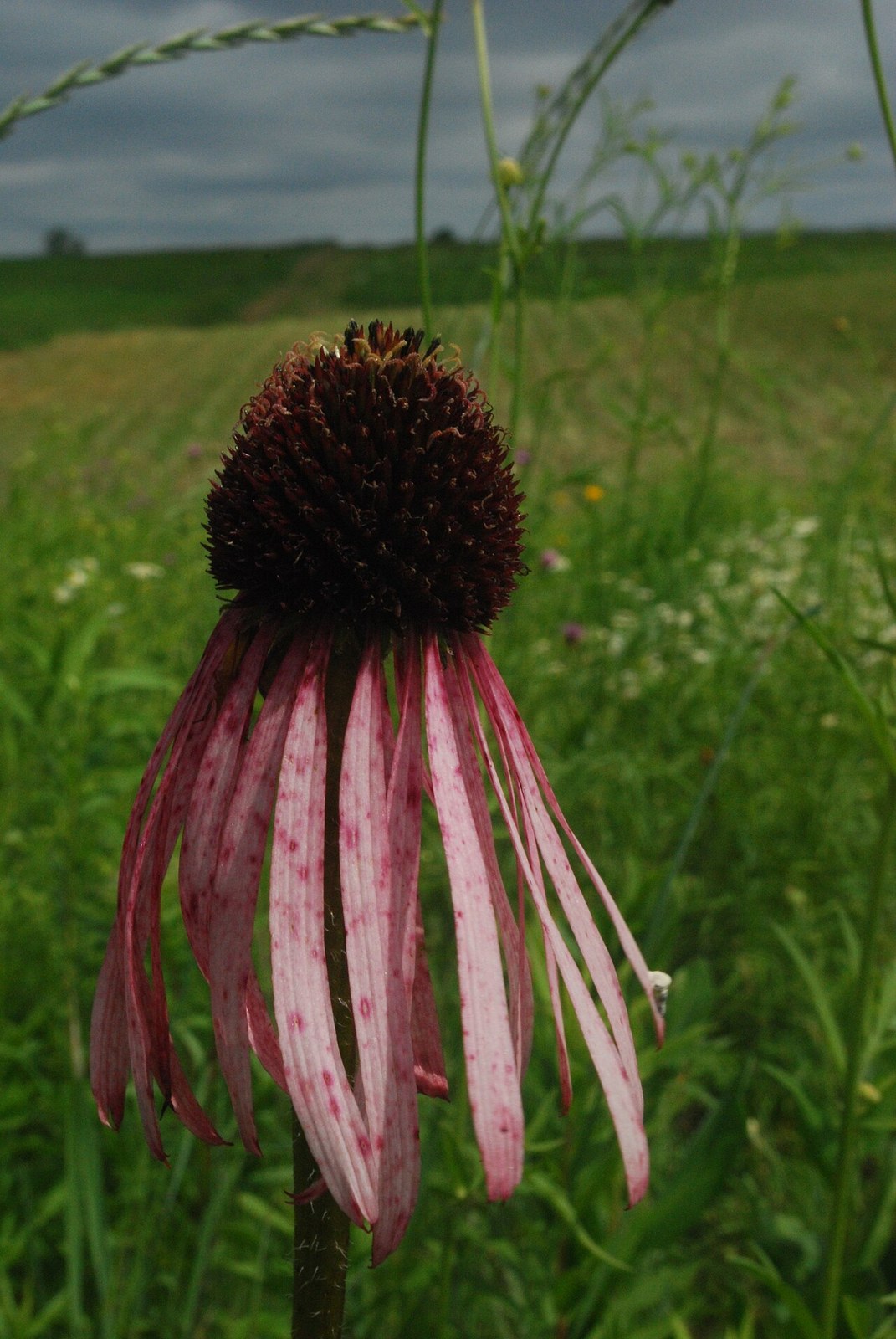
Coneflowers in the genus Echinacea are long-lived prairie and glade wildflowers in the aster family (Asteraceae). Each flower head has a raised, spiny, dome-shaped center, the “cone”, ringed by pink, purple or (in one species) yellow rays. The genus name comes from the Greek echinos, hedgehog, for the prickly cone. Coneflowers are among the most popular perennials in American gardens, loved by bees and butterflies in summer and by goldfinches when the seeds ripen.
Every one of the nine Echinacea species is native to North America, and all of them grow wild in the United States. Most are plants of the tallgrass and mixed-grass prairies of the Midwest and Great Plains, and of open glades and barrens in the Ozarks and the South. Two of them, smooth coneflower and Tennessee coneflower, are rare enough to have been protected under the federal Endangered Species Act.
What is not native is the long list of hybrid cultivars sold at garden centers, such as the Lakota, Sombrero and Kismet series. They are bred from native species, but they are garden creations rather than wild plants. If you reached this page from our perennial guide for Maine or our Colorado landscaping guide, this page explains where coneflowers really grow wild, how the hybrids differ, and which coneflower suits your garden.
Identification
Flower heads
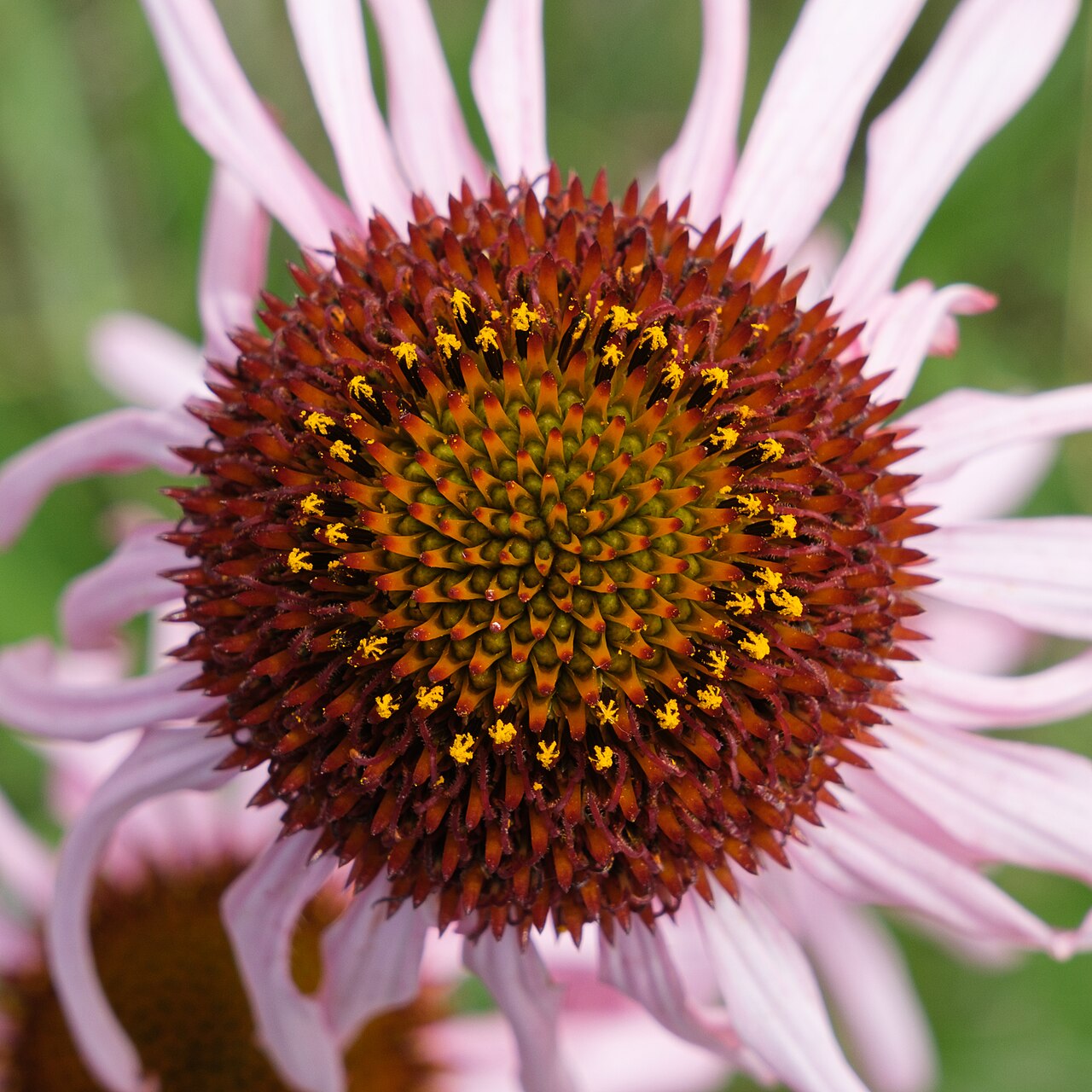
Coneflower heads are 2–5 inches across. The cone is made of many tiny disk flowers, each tucked behind a stiff, sharp-pointed bract (a chaff scale), which gives the cone its bristly feel; run your hand over it and it pricks. The cone is purplish-brown to orange-brown, and it stays on the stem after the rays drop, turning dark and seedy by late summer. The rays are pink to purple in eight of the nine species. They spread outward in purple coneflower, narrow-leaf purple coneflower and Tennessee coneflower, and droop downward like a skirt in pale purple, glade, smooth and yellow coneflowers.
Leaves, stems and roots
Most species have narrow, lance-shaped leaves, rough with stiff hairs, mostly near the base of the plant, and a thick, dark taproot. Purple coneflower is the exception: it has broad, coarsely toothed leaves along the stem and a fibrous root system, which is one reason it is the easiest species to grow and divide in gardens.
Telling the species apart
Pollen color separates the two look-alike drooping species: pale purple coneflower has white pollen, and glade coneflower has yellow pollen. yellow coneflower is the only species with yellow rays. Narrow-leaf purple coneflower is shorter than pale purple, with shorter, spreading rays. Tennessee coneflower has upturned rays that make the flower look like a shallow bowl.
Not to be confused with
Several other native wildflowers are also called coneflowers. black-eyed Susan and orange coneflower (Rudbeckia) have yellow rays and dark, smooth, soft cones without spines. gray-headed coneflower and prairie coneflower (Ratibida) have a tall, column-shaped or rounded gray-to-brown cone and drooping yellow or reddish rays. Only Echinacea has the prickly, bristly cone.
Quick Facts
| Scientific Name | Echinacea (genus) |
| Family | Asteraceae (Aster) |
| U.S. Native Species | 9, all native to the United States |
| Plant Type | Herbaceous perennial wildflowers |
| Mature Height | About 1–2 ft (narrow-leaf, Tennessee) to 2–4 ft (purple, pale purple, smooth) |
| Bloom Time | Late spring through summer, mainly June–August |
| Flower Color | Pink to purple rays; yellow in yellow coneflower |
| Sun Exposure | Full sun; purple coneflower tolerates light shade |
| Water Needs | Low to moderate; drought-tolerant once established |
| Soil Type | Well-drained loam, clay, rocky or limestone soils; dislikes wet winter soil |
| Wildlife Value | Bees, butterflies and other pollinators; seeds eaten by goldfinches |
| Deer Resistant | Moderately; deer and rabbits sometimes browse young plants |
| USDA Hardiness Zones | About 3–9 across the genus; purple coneflower 3–8 |
| Conservation | Smooth coneflower federally threatened; Tennessee coneflower recovered and delisted in 2011 |
Native Range
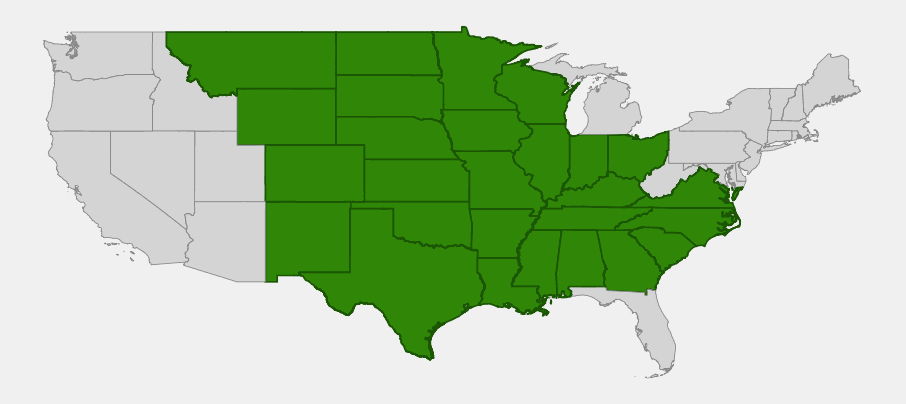
Coneflowers are plants of the middle of the country. The richest area is the Ozarks of Missouri and Arkansas, where purple, pale purple, glade and yellow coneflowers all grow wild. Pale purple and narrow-leaf purple coneflowers are classic prairie plants: pale purple in the tallgrass prairies from Iowa, southern Wisconsin and Illinois to eastern Kansas, Oklahoma and Texas, and narrow-leaf in the mixed-grass and shortgrass prairies from Minnesota and the Dakotas west to eastern Montana, Wyoming and Colorado and south to Texas and northeastern New Mexico.
purple coneflower grows wild in open woods, prairies and glades from Ohio, Indiana, Illinois and Iowa south to Georgia, Louisiana and East Texas; it is most common in the Ozarks and the Mississippi Valley. The South has two rare specialists: smooth coneflower in a few counties of Virginia, North Carolina, South Carolina and Georgia, and Tennessee coneflower in the cedar glades around Nashville, Tennessee. Two less familiar species, Topeka purple coneflower and sanguine purple coneflower, grow in Kansas, Oklahoma, Texas, Arkansas and Louisiana.
No coneflower is native to New England, New York or the Pacific states. Purple coneflower is planted everywhere and occasionally escapes from gardens, but in Maine, for example, it is a garden plant only. In Colorado, the native species is narrow-leaf purple coneflower, which grows on the eastern plains rather than in the mountains; garden purple coneflower is not native to Colorado.
📋 Regional plant lists covering native coneflower ranges: Maryland, Virginia & West Virginia · North Carolina & South Carolina · Georgia, Alabama & Mississippi · Arkansas, Louisiana, Eastern Oklahoma & East Texas · Kentucky & Tennessee · Ohio & Indiana · Illinois, Iowa & Missouri · Michigan, Wisconsin & Eastern Minnesota · North Dakota, South Dakota & Western Minnesota · Nebraska, Kansas & Eastern Colorado · South & West Texas · Montana & Wyoming · Arizona & New Mexico
Native Species
Seven of the nine species have full growing guides on Plant Native; the other two are described here.
Purple Coneflower (Echinacea purpurea)
The familiar garden coneflower, 2–4 feet tall, with broad, toothed leaves and spreading rose-purple rays around an orange-brown cone. Native to open woods and prairies of the Ozarks, the Mississippi and Ohio valleys and the South. It is the most adaptable species, tolerating clay soil and some shade, and it is the parent of most hybrid cultivars.
Pale Purple Coneflower (Echinacea pallida)
A tall, slender tallgrass prairie species, 2–3 feet, with long, narrow, drooping pale pink rays and white pollen. Long-lived and deep-rooted, it is one of the first coneflowers to bloom in early summer.
Narrow-leaf Purple Coneflower (Echinacea angustifolia)
The coneflower of the western prairies, 1–2 feet tall, with narrow, hairy leaves and short, spreading pink rays. Very drought-tolerant thanks to a deep taproot, it is the native choice for the plains of eastern Colorado, the Dakotas, Montana and Wyoming. It is the species most heavily dug from the wild for the herbal trade, which has depleted some populations.
Glade Coneflower (Echinacea simulata)
Also called wavyleaf purple coneflower. It looks almost identical to pale purple coneflower, with drooping pink rays, but has yellow pollen. It grows in rocky glades and open woods in the Ozarks and a few places in Tennessee, Kentucky, Alabama and Georgia.
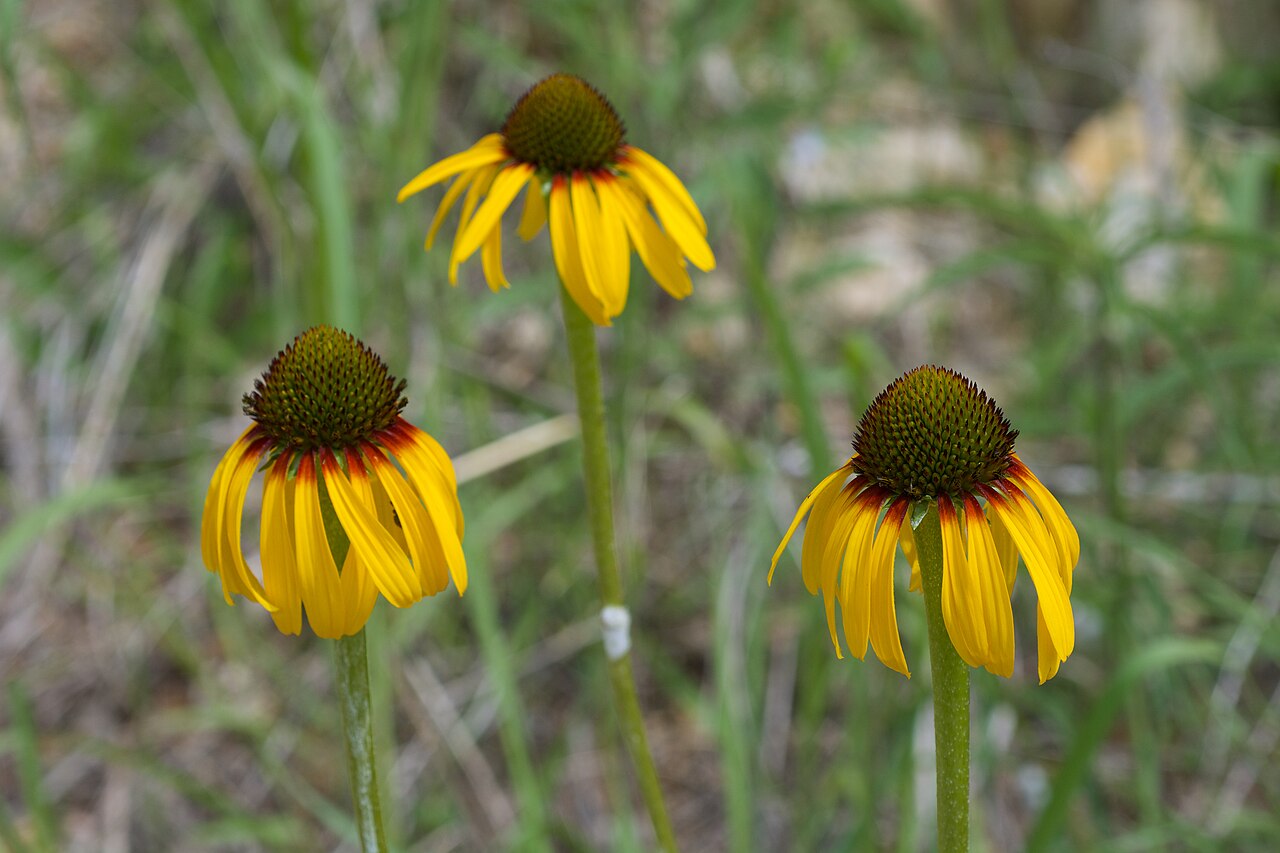
Yellow Coneflower (Echinacea paradoxa)
The only yellow-rayed Echinacea, found mainly on limestone and dolomite glades of the Ozarks in Missouri and Arkansas, with a few populations in Oklahoma. Its bright yellow, drooping rays and brown cone made it a key parent of orange, yellow and red hybrid cultivars.
Tennessee Coneflower (Echinacea tennesseensis)
A short, 1–2 foot species with upturned rose-purple rays, found only in the limestone cedar glades of the Nashville Basin. Listed as endangered in 1979, it recovered with habitat protection and was removed from the federal list in 2011. Nursery-grown plants are widely available; never dig wild plants.
Smooth Coneflower (Echinacea laevigata)
A rare species of open woods, glades and roadsides on calcium- or magnesium-rich soils in Virginia, the Carolinas and Georgia, with smooth leaves and drooping pink rays. It was listed as federally endangered in 1992 and reclassified as threatened in 2022. Grow only nursery-propagated plants.
Topeka Purple Coneflower (Echinacea atrorubens)
A prairie species of Kansas, Oklahoma and Texas with short, strongly drooping, dark reddish-purple rays. Rarely sold.
Sanguine Purple Coneflower (Echinacea sanguinea)
A slender coneflower of sandy pine and oak woodlands in East Texas, Louisiana, Arkansas and Oklahoma, with narrow, drooping pink rays. Occasionally offered by southern native plant nurseries.
Non-Native Look-Alikes
There are no non-native Echinacea species: every coneflower in the genus is a North American native. The coneflowers that are not native plants are the hybrid cultivars, which are bred in nurseries by crossing purple coneflower with yellow coneflower, pale purple coneflower and other species. None of them is invasive, but gardeners should know how they differ from the wild species.
Lakota series
Compact hybrid coneflowers, about 1 1/2–2 feet tall, bred for bright colors. ‘Lakota Santa Fe’ has rosy orange to coral rays. Like most color hybrids, it owes its orange and red tones to yellow coneflower in its ancestry. It is a garden plant: no coneflower, hybrid or wild, is native to Maine, although purple coneflower and many hybrids are hardy there.
Sombrero and Kismet series
Two more series of compact, brightly colored hybrids in shades of red, orange, yellow, salmon, white and magenta, bred to bloom in their first year in containers and garden beds. Other well-known hybrids include ‘Cheyenne Spirit’ and the double-flowered “pom-pom” types such as ‘Double Scoop’.
How hybrids differ from native coneflowers
Many hybrid coneflowers are short-lived in gardens, often fading after two or three years, while the wild species can live for many years. Double-flowered hybrids replace much of the fertile cone with petal-like florets, so they offer little pollen, nectar or seed. Single-flowered hybrids still feed bees and butterflies. If your goal is pollinators and goldfinches, plant the straight species, ideally from a seed source near you.
Other “coneflowers”
Black-eyed Susans and orange coneflower (Rudbeckia) and gray-headed and prairie coneflower (Ratibida) are also native, but they are different genera with soft, spineless cones and mostly yellow rays.
Growing & Care Guide
Light
Plant coneflowers in full sun, with at least six hours of direct sun a day. Purple coneflower blooms in light shade, but most other species flop or fade in shade.
Soil & Water
Coneflowers need well-drained soil, especially in winter, when wet, cold soil rots the crowns. Purple coneflower tolerates clay and average garden soil. Pale purple, narrow-leaf, yellow, glade and Tennessee coneflowers prefer lean, rocky, gravelly or limestone soils. Water new plants through their first summer; established plants seldom need watering except in long droughts. Avoid rich soil and fertilizer, which make plants floppy.
Planting Tips
Plant in spring or early fall, 1–2 feet apart. Coneflowers combine well with prairie grasses such as big bluestem and with wild bergamot and blazing star. To grow from seed, sow outdoors in fall or give seeds 1–2 months of cold, moist stratification before spring sowing; seedlings often bloom in their second year.
Pruning & Maintenance
Deadhead early flowers to extend bloom if you wish, but leave the last seed heads standing through fall and winter for goldfinches and for winter interest. Cut back old stems in early spring. Purple coneflower can be divided every few years; the taprooted species resent disturbance and are best left in place. Aster yellows, a disease spread by leafhoppers, causes deformed green flowers; remove affected plants.
Wildlife & Ecological Value
For Pollinators
Coneflowers bloom for weeks in midsummer and are visited by bumble bees, many small native bees, honey bees, butterflies such as fritillaries, swallowtails and monarchs, and other insects. The tiny disk flowers open in rings from the bottom of the cone upward, so each head offers fresh nectar and pollen over a long period.
For Birds
American goldfinches pick the seeds from the ripe cones from late summer into winter. Leaving the stems standing feeds them and other seed-eating birds.
Ecosystem Role
Coneflowers are long-lived, deep-rooted members of prairie and glade plant communities, helping to hold soil and returning year after year with grasses and other wildflowers.
Cultural & Historical Uses
Early ethnographers recorded narrow-leaf purple coneflower as one of the most widely used plants among the peoples of the Great Plains. Echinacea later became a popular herbal product, which led to heavy digging of wild narrow-leaf and pale purple coneflowers. This is history, not health advice. Buy plants and seed from nurseries, and never dig wild coneflowers.
Frequently Asked Questions
Are all Echinacea species native to the United States?
Yes. All nine species are native to North America and grow wild in the United States, mainly in the Midwest, Great Plains, Ozarks and South. Hybrid cultivars such as Lakota, Sombrero and Kismet are bred garden plants, not wild species.
Is purple coneflower native to Maine?
No. No coneflower is native to Maine or the rest of New England. Purple coneflower and many hybrids are hardy and grow well in Maine gardens, but they are garden plants there.
Which coneflower is native to Colorado?
narrow-leaf purple coneflower, which grows on the eastern plains of Colorado. It is shorter and more drought-tolerant than purple coneflower and does well in dry, sunny gardens.
Are hybrid coneflowers good for pollinators?
Single-flowered hybrids are visited by bees and butterflies, but double-flowered types offer little pollen, nectar or seed, and many hybrids are short-lived. For wildlife, the native species are the better choice.
Why did my coneflowers die after a couple of years?
The usual causes are wet winter soil, which rots the crowns, too much shade, or short-lived hybrid cultivars. Native species in full sun and well-drained soil often live for many years.
Should I cut back coneflowers in fall?
Leave the seed heads standing over winter. Goldfinches eat the seeds, and the stems add winter interest. Cut them back in early spring before new growth starts.

Looking for a nursery that carries Native Coneflowers?
Browse our native plant nursery directory: Alabama & Arkansas · Georgia & Colorado · Indiana, Illinois, Iowa & Kansas · Mississippi, Louisiana, Kentucky, Missouri, Minnesota & Montana · North Carolina, Ohio, North Dakota, Nebraska, Oklahoma & New Mexico · Virginia, South Carolina, Tennessee, South Dakota & Texas · Wisconsin & Wyoming

