
Dwarf Glasswort (Salicornia bigelovii)
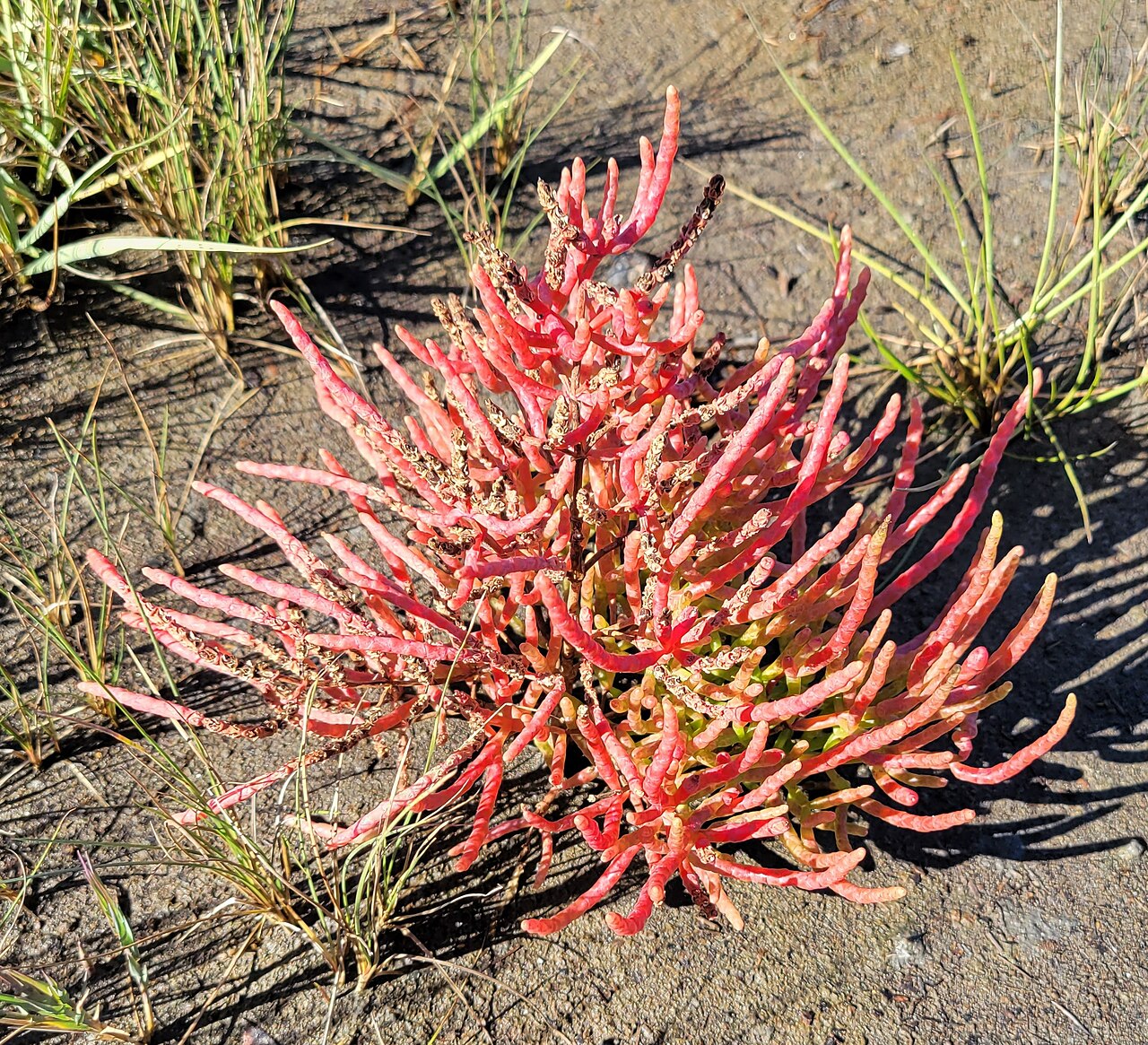
Salicornia bigelovii, known as Dwarf Glasswort, dwarf saltwort (the USDA name) or Bigelow’s glasswort, is a small, succulent annual of salt marshes and coastal flats. It has fleshy, jointed, seemingly leafless stems that look like tiny green fingers or strings of beads, and it turns brilliant red to purple in late summer and fall. Like its relatives, it is often called samphire, sea bean or pickleweed.
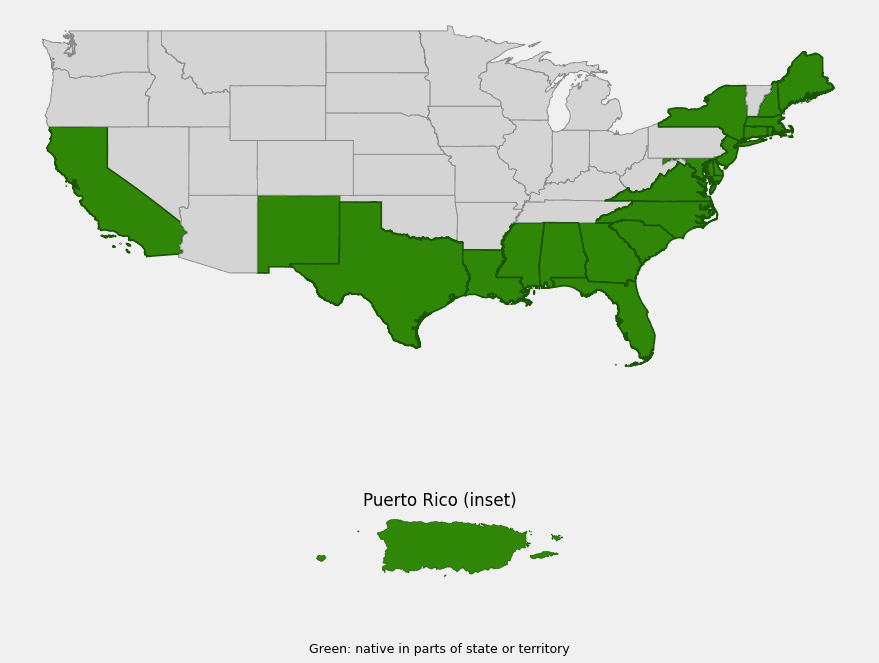
Dwarf glasswort is native along the Atlantic Coast from Maine to Florida, along the Gulf Coast to Texas, on the coast of southern California, and in Puerto Rico. It also has an outlying inland record in New Mexico. It grows in the saltiest parts of the marsh: bare salt pannes, the edges of tidal flats and high-marsh openings where seawater evaporates and leaves the soil crusted with salt.
This species is also famous beyond the marsh. Its seeds are rich in oil and protein, and it has been studied and grown as a seawater-irrigated crop in deserts. This guide covers how to identify dwarf glasswort, where it grows, its role in coastal ecosystems and food webs, and how it is used as food and as a crop.
Identification
Glassworts are among the most unusual-looking plants of the salt marsh. Several similar species grow on the same coasts, and dwarf glasswort is best told from them by its stout, pointed flower spikes and the arrangement of its tiny flowers.
Growth Habit & Stems
Dwarf glasswort is an annual that grows from seed each spring. Plants are usually 4 to 16 inches tall, with an upright main stem and a few to many ascending branches. The stems are succulent, smooth and jointed, made up of short, cylindrical segments. They are bright green in summer and turn yellow, orange, red or purple in late summer and fall before the plant dies.
Leaves
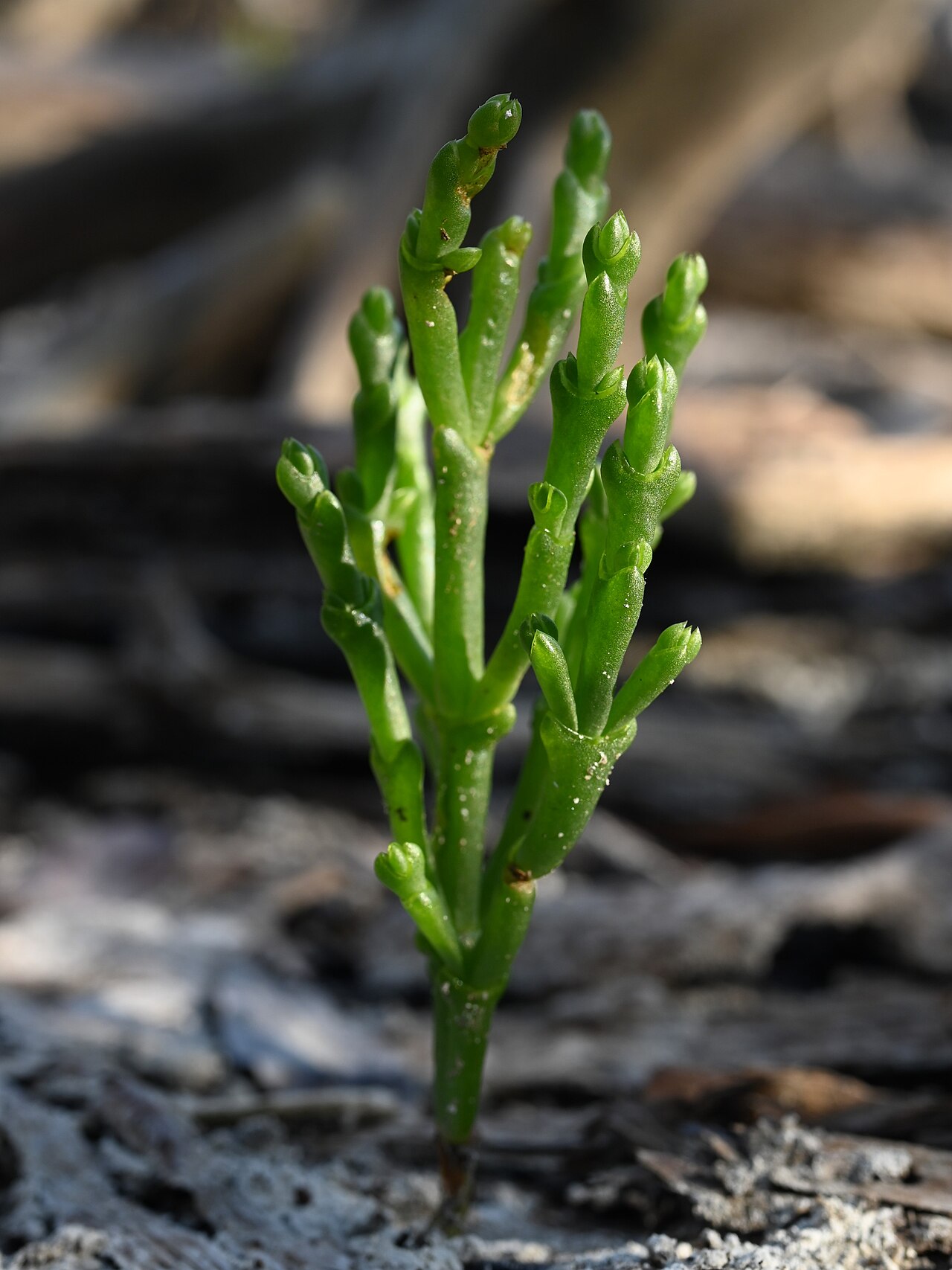
The leaves are reduced to tiny, opposite scales fused around the stem at each joint, so the plant looks leafless. In dwarf glasswort these scale-leaves have short, sharp points.
Flowers & Spikes
From late summer into fall, the upper branch segments thicken into fleshy flowering spikes about 1 to 3 inches long and relatively thick, about an eighth to a quarter inch. Tiny flowers sit sunken in the spike in groups of three at each joint. In dwarf glasswort the central flower of each group is clearly larger and reaches higher than the two side flowers. The flowers have no petals; only the tiny stamens and feathery stigmas peek out.
Seeds
Each flower produces a single small seed, covered with short, hooked or curved hairs, which is released when the spike breaks apart in late fall and winter. The seeds float and are carried by tides.
Similar Species
Slender glasswort (Salicornia depressa, often listed as S. maritima or S. europaea) is common in the same marshes, but its spikes are thinner and its three flowers at each joint are nearly equal in size. Pickleweed (Sarcocornia pacifica) and perennial glasswort (S. ambigua) are perennials with woody bases and creeping stems. Herbaceous Seepweed has small, fleshy, separate leaves. Saltwort (Batis maritima) is a shrubby perennial with distinct, club-shaped leaves.
Quick Facts
| Scientific Name | Salicornia bigelovii Torr. |
| Family | Amaranthaceae (amaranth family; formerly Chenopodiaceae) |
| Plant Type | Succulent annual herb; halophyte |
| Mature Height | 4–16 in |
| Mature Spread | 4–12 in |
| Growth Rate | Fast (completes its life cycle in one season) |
| Sun Exposure | Full sun |
| Water Needs | High; regularly flooded or saturated saline soils |
| Soil Type | Salty mud, sand or marl; tidal flats and salt pannes |
| Soil pH | About 6.5–8.5 |
| Bloom Time | August–November |
| Flower Color | Inconspicuous; tiny green flowers sunken in fleshy spikes |
| Fall Color | Bright red, orange or purple |
| Fruit | Tiny hairy seeds released from the spikes |
| Deer Resistant | Yes; rarely browsed |
| USDA Hardiness Zones | Annual; grows on coasts from zone 5 to 11 |
Native Range
USDA PLANTS lists dwarf glasswort as native in Alabama, California, Connecticut, Delaware, Florida, Georgia, Louisiana, Massachusetts, Maryland, Maine, Mississippi, North Carolina, New Hampshire, New Jersey, New Mexico, New York, Rhode Island, South Carolina, Texas and Virginia, and in Puerto Rico. Along the Atlantic it is common from the mid-Atlantic south and becomes rare toward its northern limit in Maine and New Hampshire. The New Mexico record is an outlying inland one, from saline flats far from the sea.
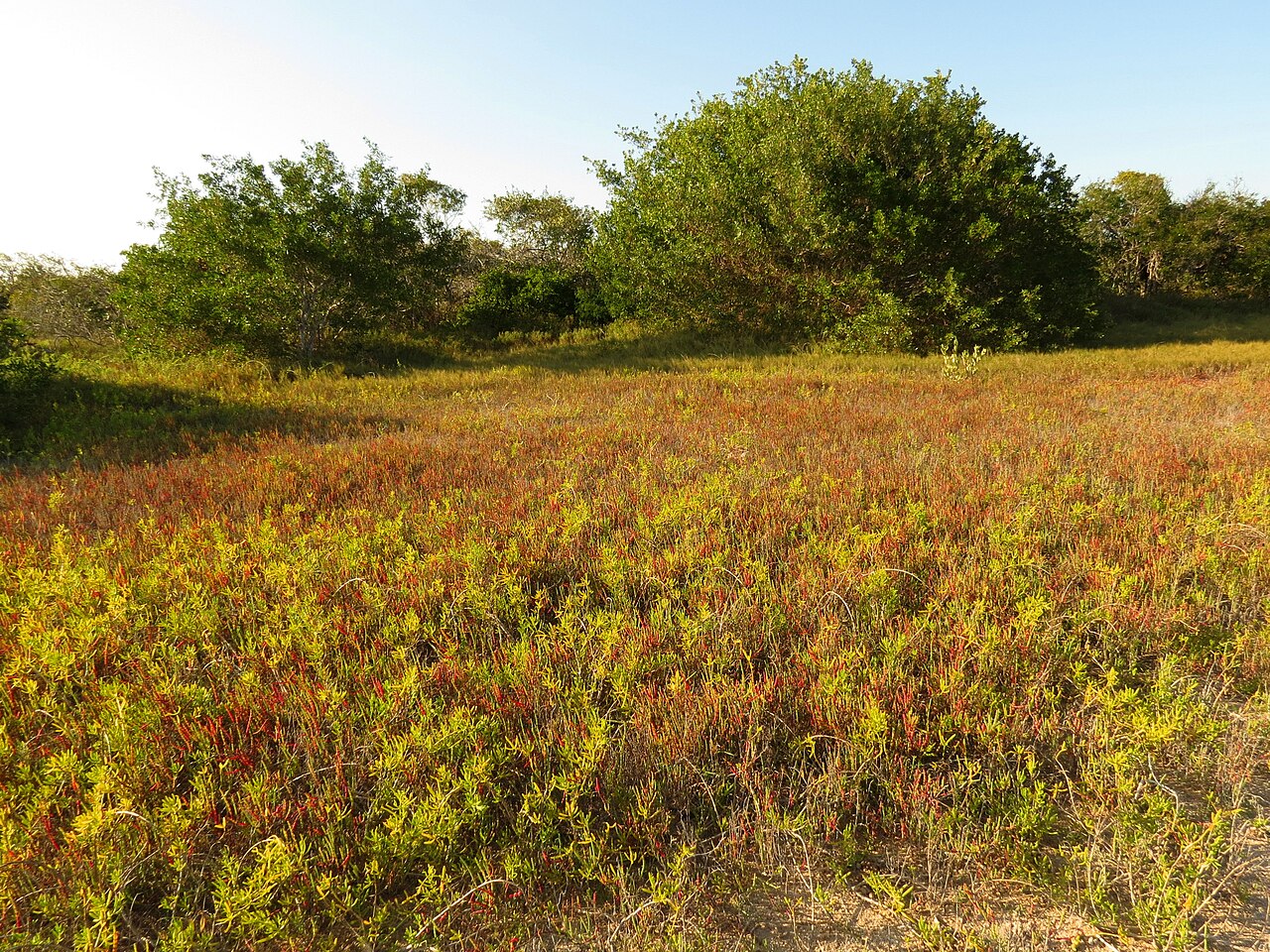
It grows in the highest-salinity parts of coastal marshes: salt pannes and pools in the high marsh, bare patches left by ice or wrack, the upper edges of tidal flats and mangrove margins, and the flats around salt ponds and lagoons. It is a pioneer that colonizes bare, salty ground, and its numbers can vary greatly from year to year.
Outside the United States, dwarf glasswort grows along the coasts of Mexico, including both the Gulf and Pacific coasts, around the Caribbean and the Bahamas, and in parts of Central and South America. It has been introduced as a crop and trial plant in arid coastal regions of the Middle East, Africa and Asia.
📋 Regional plant lists featuring Dwarf Glasswort: New Hampshire, Maine & Vermont · Connecticut, Massachusetts & Rhode Island · Delaware, Southern New Jersey & Long Island · New York, Pennsylvania & Northern New Jersey · Maryland, Virginia & West Virginia · North & South Carolina · Alabama, Georgia & Mississippi · North & South Florida · Arkansas, Louisiana, Eastern Oklahoma & Eastern Texas · South & West Texas · Arizona & New Mexico · California & Nevada · Puerto Rico
Growing & Care Guide
Dwarf glasswort is not a typical garden plant, because it needs salty, wet soil to thrive. It is grown in coastal restoration projects, in saltwater aquaculture and in experimental seawater farms, and occasionally by gardeners who want to grow “sea beans” for the kitchen. Seed is available from a few specialty suppliers. Do not collect plants from protected marshes.
Light
It needs full sun. In shade it becomes weak and lanky.
Soil & Water
It grows best in sandy or muddy soil kept constantly moist with brackish or salt water. It can be grown in containers with a sandy mix watered with dilute sea salt solution, but it is outcompeted by other plants in ordinary, freshwater conditions.
Planting Tips
Sow seed in spring on the surface of moist, sandy soil and keep it wet; it germinates best in low-salt conditions and then tolerates salt as it grows. In restoration, it often appears on its own on bare, salty mud once tidal flow is restored.
Pruning & Maintenance
No pruning is needed. For eating, pick the tender green tips in late spring and summer before the stems become woody. Leave some plants to flower and set seed, since it is an annual and returns only from seed.
Propagation
It is grown only from seed. Collect ripe spikes in late fall from cultivated plants, dry them and rub out the tiny seeds, then store them dry and sow in spring.
Landscape Uses
- Coastal restoration: a pioneer for bare salt pannes and restored tidal marshes, where few other plants can establish
- Edible garden: the young green tips are a crunchy, salty vegetable known as sea beans or samphire
- Seawater agriculture: its oil-rich seeds have been studied as a crop irrigated with seawater in coastal deserts
- Education and observation: look for its fall color in salt pannes from New England to Florida and on the Gulf Coast
- Salt-tolerant containers: an unusual container plant for coastal gardeners willing to water it with brackish water
Wildlife & Ecological Value
Dwarf glasswort is a small annual, but it is an important part of the salt marsh food web.
For Pollinators
Its tiny flowers are wind-pollinated and also self-pollinating, so it offers little to pollinators. Small insects shelter among its fleshy stems.
For Birds
Ducks, geese and shorebirds eat its seeds and the fleshy stems, especially in fall and winter, and salt pannes with glasswort are important feeding areas for migrating waterfowl.
For Mammals
Muskrats, rabbits and other marsh mammals nibble the succulent stems. Deer seldom eat it.
Ecosystem Role
As one of the few plants that can colonize bare, hypersaline soil, dwarf glasswort helps stabilize salt pannes and tidal flats and adds organic matter to the marsh. It also takes up and stores salt in its tissues, and its decaying stems feed the detritus food web that supports crabs, snails and fish in coastal marshes.
Cultural & Historical Uses
The name Salicornia comes from the Latin sal (salt) and cornu (horn), describing the salty, horn-like branches. The name “glasswort” comes from England, where the ashes of glassworts and related plants were once burned to make soda ash for glass and soap making.
Glassworts have long been eaten along coasts around the world, raw, steamed or pickled, under names such as sea beans, samphire, sea asparagus and pickleweed. The tender young tips are crisp and salty. They are high in salt and should be eaten in moderation, and they should only be gathered from clean waters and places where harvesting is allowed.
In the 1980s and 1990s, researchers in Arizona and Mexico developed dwarf glasswort as a seawater-irrigated crop. Its seeds contain a high proportion of edible oil and protein, and it has been grown on trial farms in Mexico, the Middle East and Africa, as well as studied as a source of biofuel. The species is named for John Milton Bigelow, a 19th-century physician and botanist on U.S. boundary surveys.
Frequently Asked Questions
Is dwarf glasswort edible?
Yes. The young green tips are edible raw, steamed or pickled and are sold as sea beans or samphire. They are very salty, so eat them in moderation, and only gather them from clean waters where harvesting is permitted.
Why does glasswort turn red?
In late summer and fall, as the annual plants mature and day length shortens, red pigments (betacyanins) build up in the fleshy stems, turning whole salt pannes red, orange or purple.
How do I tell dwarf glasswort from other glassworts?
Dwarf glasswort has thick flowering spikes in which the middle flower of each group of three is clearly larger and higher than the two side flowers. In slender glasswort the three flowers are about equal. Perennial glassworts and pickleweed have woody bases and creeping stems.
Where does dwarf glasswort grow?
It grows in salt marshes and on coastal salt flats along the Atlantic Coast from Maine to Florida, the Gulf Coast to Texas, the coast of southern California, and in Puerto Rico, with an outlying inland record in New Mexico.
Is dwarf glasswort a crop?
It has been developed as an experimental crop irrigated with seawater, because its seeds are rich in oil and protein. Trial farms have been established in several arid coastal regions around the world.

Looking for a nursery that carries Dwarf Glasswort?
Browse our native plant nursery directory: Alabama · California · Connecticut, Delaware, Florida & Georgia · Louisiana, Maine, Maryland, Massachusetts & Mississippi · New Hampshire, New Jersey, New Mexico, New York & North Carolina · Rhode Island, South Carolina, Texas & Virginia

