Fringetree Near a Patio: Planning for Canopy, Roots, and Fallen Fruit
Last updated: November 6, 2026
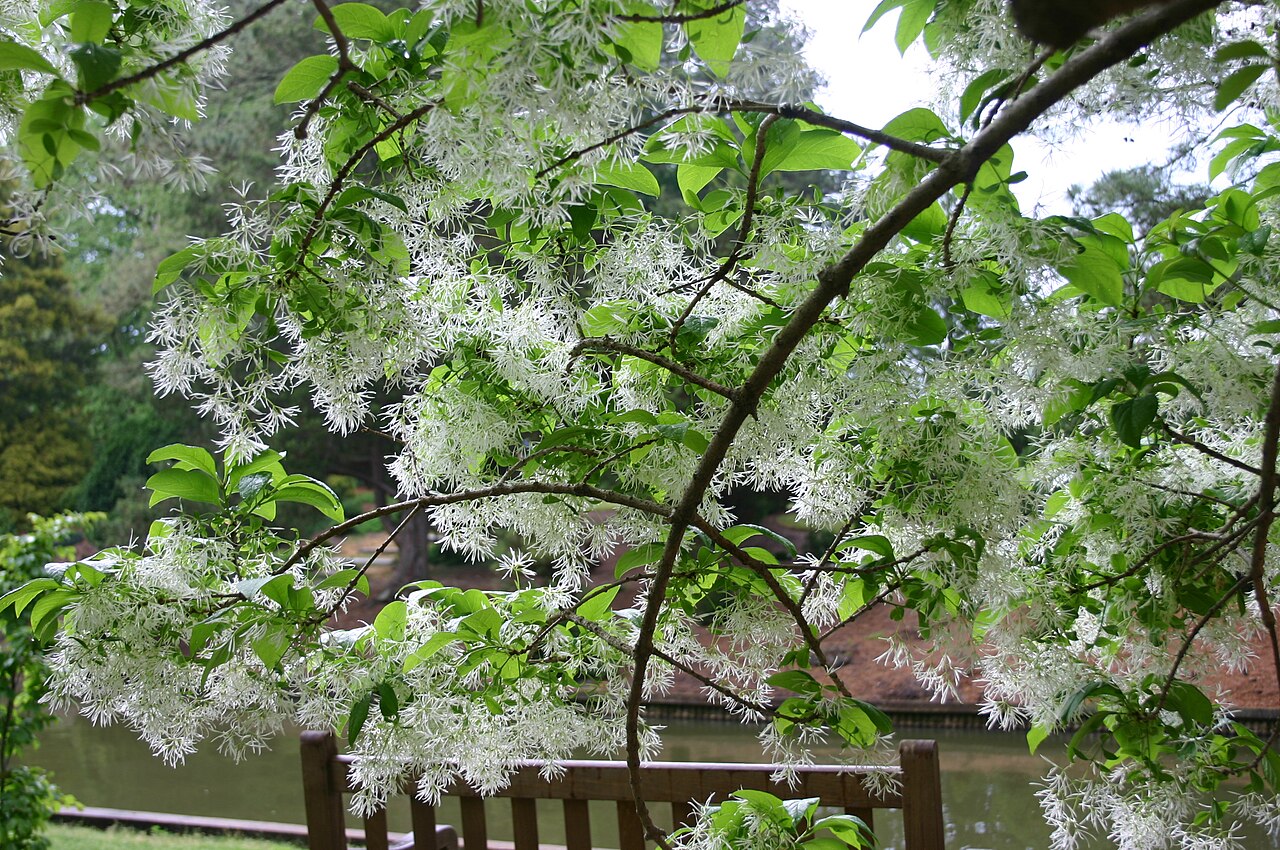
A fringetree beside a patio gives you a cloud of fragrant white flowers at eye level in spring, light shade in summer and yellow leaves in fall. It is one of the best native small trees for sitting areas.
It still needs planning. A patio is a fixed hard surface, and a tree keeps growing above and below ground for decades. Where you put the trunk decides how much shade you get, how much the roots and paving interact, and whether fruit ends up underfoot.
This guide covers the three issues people ask about most: canopy, roots and fallen fruit. It then gives a layout, companion plants and a three-year care plan.
Plan at a Glance
| Site | Beside a patio, deck or seating area, with good drainage and no overhead lines |
| Size | 12 to 20 feet tall and wide in gardens (Clemson); up to about 30 feet tall (NC State) |
| Sun | Full sun for the most flowers; part shade for the best foliage (NC State) |
| Soil | Average to rich, well drained; avoid soggy spots and salted pavement edges |
| Maintenance | Low: slow growth, light pruning for headroom, occasional sweeping |
| Best regions | Eastern U.S. from Florida to east Texas, north to New Jersey, southern Ohio, southern Missouri and Oklahoma |
Assess the Patio Site First
Start with what is already there. Note the patio’s material and edge, which way it faces, where roof and paving runoff goes, and whether the paving is salted in winter.
Drainage matters more than most people expect. Clemson Extension warns that Phytophthora root rot can occur in poorly drained soil. Do not plant where patio runoff collects in a low spot.
Salt matters too. Clemson notes that fringetrees are not salt tolerant. If you use deicing salt on the patio or a nearby walk, keep the tree well back from where salty meltwater and plowed snow end up.
Look up and down. NC State lists a mature height of up to 30 feet, so keep the tree away from overhead wires. Have underground utilities marked before digging; in the United States, call 811 a few days ahead.
Planning for the Canopy
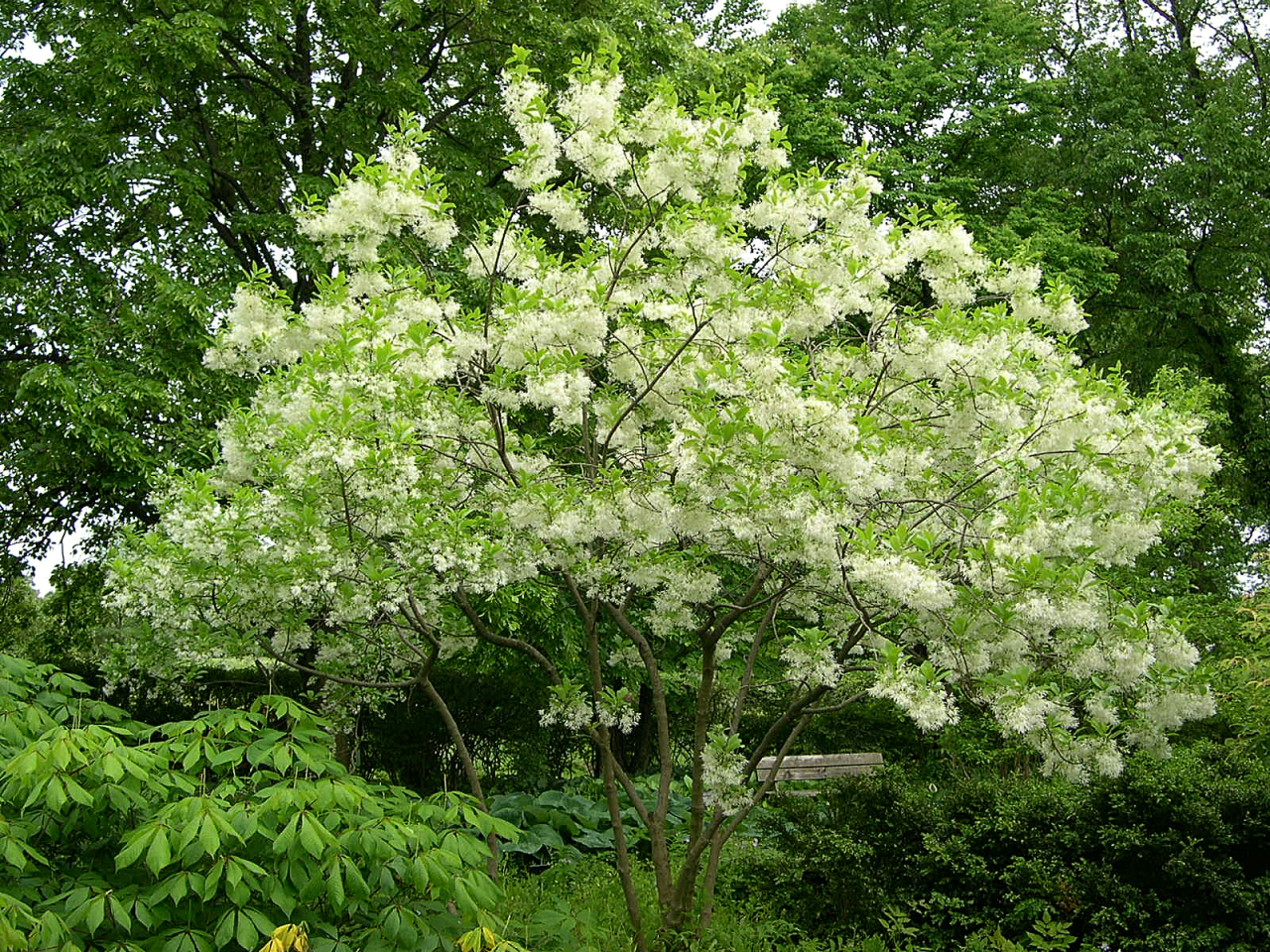
Clemson describes native white fringetree as maturing at 12 to 20 feet tall and 12 to 20 feet wide, with a spreading, open crown. It usually grows with several stems but can be trained to a single trunk.
That width is the number to plan around. A tree 12 to 20 feet wide has a canopy that reaches roughly 6 to 10 feet out from the trunk in every direction.
Decide what you want the canopy to do. For light shade over part of the patio, plant so one side of the crown will reach over the paving. To keep branches off the patio, set the trunk at least half the mature spread back from the edge.
Growth is slow, which helps. Clemson says fringetrees usually add only 6 to 10 inches a year, or up to about a foot in ideal conditions. You will have years to guide the shape before it reaches full size.
Single trunk or multi-stem?
A multi-stemmed fringetree is fuller and looks more like a large shrub. A single trunk is easier to walk and sit under. If you want headroom over part of the patio, choose a nursery tree with one strong leader or train it early; our guide to pruning a young fringetree shows which branches to keep.
Roots and Paving
We could not find fringetree-specific research on root spread or pavement damage, so plan conservatively using what is known about tree roots in general.
University of Illinois Extension notes that over 90 percent of tree root biomass is in the upper 18 inches of soil, and that root systems are shallow and wide, often extending well past the canopy. Roots growing next to a patio will run under its base and the soil beside it.
Two practical rules follow. First, build or repair the patio before you plant, not after. Digging a new patio base inside an established tree’s root zone cuts roots that the tree depends on.
Second, give the tree a generous unpaved planting area. NC State notes that larger fringetrees resent root disturbance, so a bed that you never need to dig up again is better than a small cutout in the paving.
If you already have a mature tree next to a patio that needs work, talk to a certified arborist before cutting roots. Large shade trees raise the stakes; see our guide to sweetgum in a residential yard for a tree whose roots are known to lift paving.
Fallen Fruit and Flowers
Fringetrees are mostly dioecious, meaning male and female flowers grow on separate plants. Clemson notes that occasional trees carry both. Female trees bear fruit if male plants are nearby.
The fruit is blue-black, olive-shaped and about ½ to ⅔ inch long, according to Clemson, and it ripens in late summer to early autumn. Birds eat it, and NC State adds that small mammals do too.
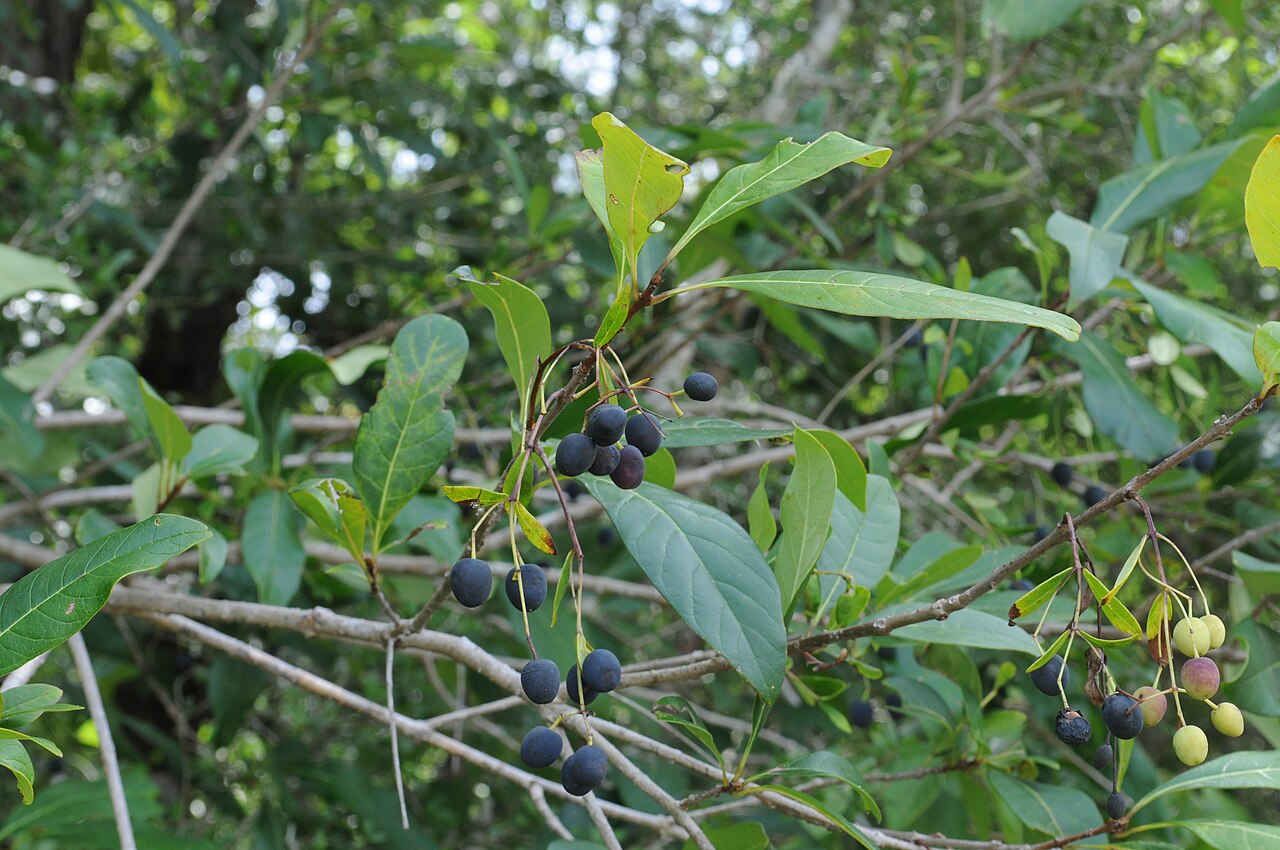
On a patio, that means a female tree may drop some fruit onto the paving, and birds visiting the tree may leave droppings. Many gardeners value the birds; others want clean paving.
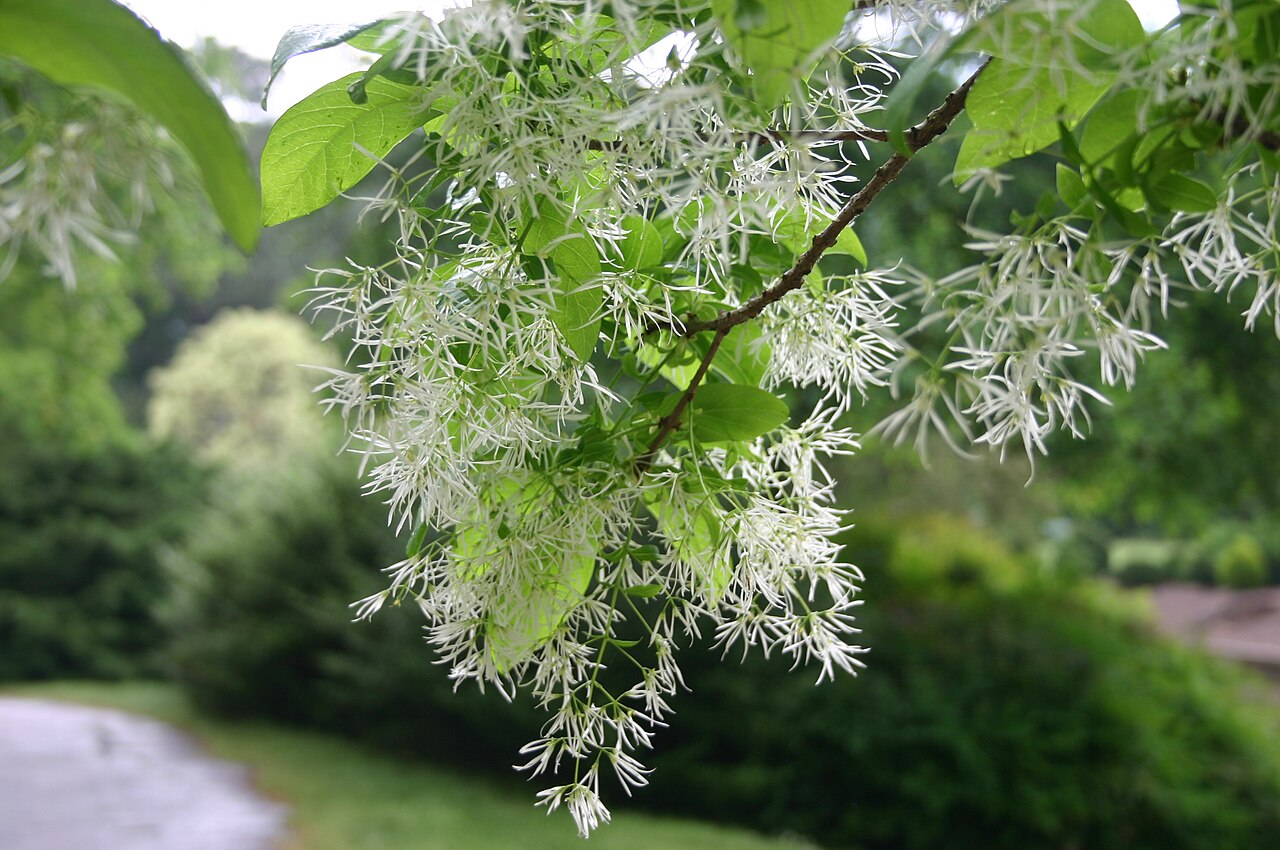
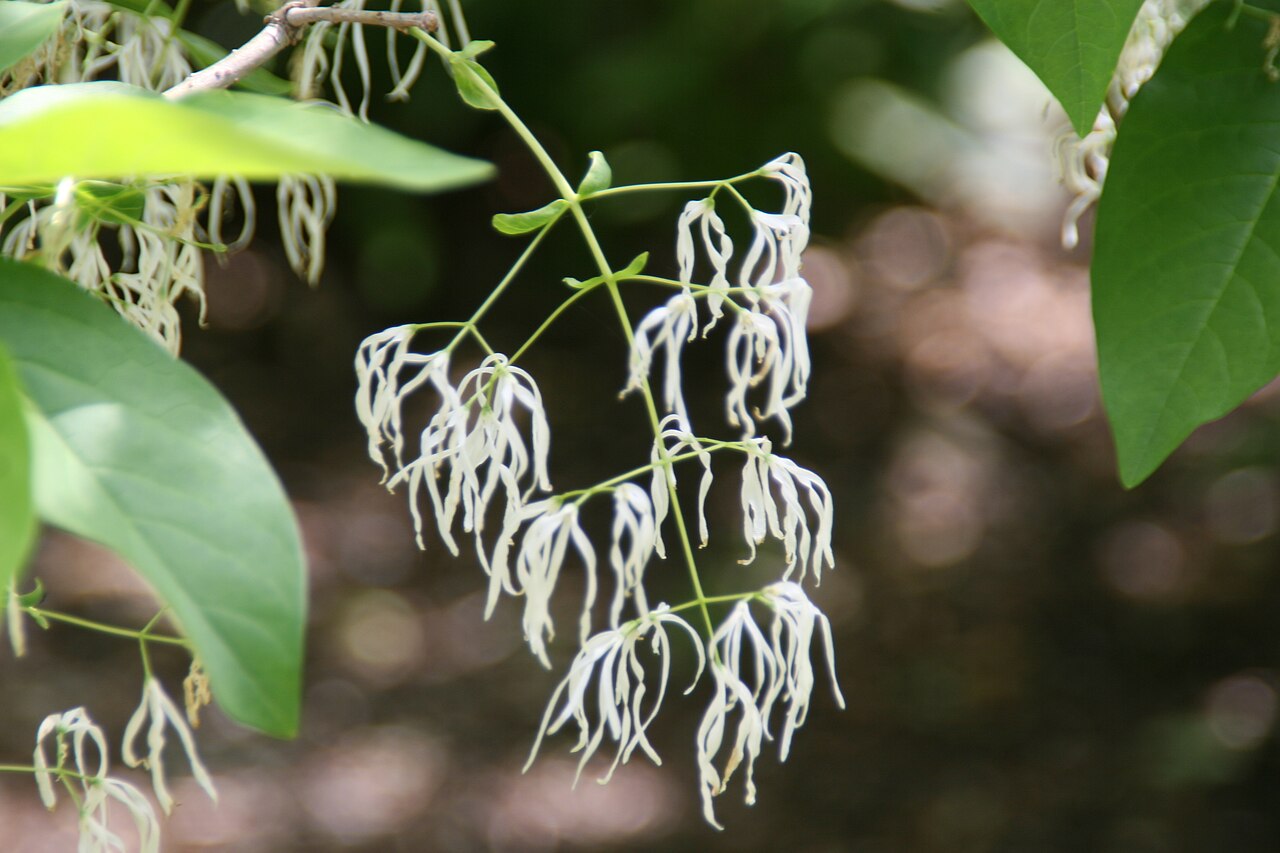
If clean paving matters most, look for a male tree. Clemson warns that fringetrees are rarely labeled by sex, so the only reliable way to know is to buy one in bloom or with fruit on it. Male flowers have longer petals and are showier.
If you already have a fruiting tree, see our guide to fringetree fruit for what to expect. The University of Arkansas Extension notes that fruit tends to form toward the inside of the shrub, where foliage hides it.
Flowers drop too. Clemson says the bloom covers the tree for about two weeks in spring. Expect a short period of sweeping after that.
A Sample Patio Layout
For a typical 12 × 16-foot patio, place a single fringetree off one corner on the side that gets afternoon sun. Set the trunk 6 to 10 feet from the paving edge so the crown just reaches the patio at maturity.
Make the planting bed at least as wide as the tree’s eventual crown on the unpaved side. Fill it with low shade-tolerant natives so you are not mowing or digging over the roots.
Leave a clear mulch ring around the trunk. Put seating where the crown will be, not right at the trunk.
Plant Palette
| Plant | Role | Height | Sun / moisture | Native range |
|---|---|---|---|---|
| Fringetree (Chionanthus virginicus) | Focal small tree | 12–20 ft in gardens | Sun to part shade; well drained | FL to e. TX, north to NJ, s. OH, s. MO and OK |
| Virginia sweetspire (Itea virginica) | Shrub at the bed edge | Usually 3–6 ft | Part shade; moist | S. NJ to KY, s. IL, MO and OK, south to FL and TX |
| Wild geranium (Geranium maculatum) | Spring flowers under the canopy | Up to about 3 ft | Part shade to shade; moist | ME to GA, west to Man., se. SD, e. KS and AR |
| Foamflower (Tiarella cordifolia) | Low groundcover in the shadiest spot | Up to about 16 in | Shade; moist | N.B. to s. Ont. and MI, south to GA and MS |
Fringetree size from Clemson Extension; other heights and all ranges from the Lady Bird Johnson Wildflower Center. Choose companions native to your area.
Setback Quick Reference
| Mature spread | 12–20 ft (Clemson), so about 6–10 ft from trunk to canopy edge |
| Branches over the patio | Trunk 6–10 ft from the edge, plus pruning for headroom |
| No branches over the patio | Trunk at least 10 ft from the edge for larger trees |
| Overhead lines | Keep well away; trees can reach about 30 ft (NC State) |
| Salted paving | Keep the tree out of meltwater and snow piles; not salt tolerant (Clemson) |
Setbacks are our arithmetic from published mature widths, not engineering standards.
Installation Steps
Step 1: Finish hardscape first. Complete any patio, edging or drainage work before planting.
Step 2: Choose the tree. NC State notes that small plants transplant best because larger plants resent root disturbance. If you want a male tree, buy in bloom.
Step 3: Plant at the right depth. Clemson’s planting guidance says to set the topmost roots level with the soil surface, remove any excess soil over the root ball, and build a 3-inch-high water ring around its edge.
Step 4: Mulch, then water. Spread mulch over the bed, keep it off the trunk, and water slowly and deeply. Our guide to watering a new fringetree covers the first season week by week.
Step 5: Add companions. Plant the groundcovers and sweetspire at the bed’s outer edges, not over the root ball.
First Three Years of Care
- Year 1: water the root ball regularly through the first summer, then widen watering as roots spread. Do no structural pruning yet.
- Year 2: water in dry spells. Begin light pruning to choose a leader or main stems and to lift branches that will hang over seating.
- Year 3: keep the mulch ring and companions in place. Check bark and leaves each summer; NC State notes scale and borers can attack drought-stressed trees.
- Each spring: enjoy the bloom, then sweep fallen petals. On female trees, rake or sweep fruit in late summer if needed.
If leaves brown or scorch in the first years, start with the root ball and site checks in our guide to fringetree leaves turning brown.
Mistakes to Avoid
Planting on the drainage line. Water from paving and gutters can keep the root zone wet, and Clemson links poor drainage with root rot.
Ignoring winter salt. Fringetree is not salt tolerant, per Clemson.
Planting first, paving later. New construction next to an established tree cuts its shallow roots.
Assuming a tree is male. Unlabeled trees may be female, so buy in bloom or with fruit if fruit matters to you.
Forgetting borers. NC State notes that fringetree is sometimes attacked by emerald ash borer. If that pest is in your area, ask your extension office what to watch for.
Regional Fit
The Lady Bird Johnson Wildflower Center lists fringetree’s native range as Florida to east Texas, north to New Jersey, southern Ohio, southern Missouri and Oklahoma, and naturalized farther north.
Clemson also describes Chinese fringetree (Chionanthus retusus), which is native to eastern Asia. For a native planting, choose C. virginicus. North of fringetree’s range, consider a locally native small tree such as a serviceberry; our pawpaw vs. serviceberry guide compares regional serviceberry species.
📋 Fringetree appears on our regional native plant lists for Georgia, Alabama and Mississippi, North and South Carolina, Maryland, Virginia and West Virginia, Delaware, southern New Jersey and Long Island, Ohio and Indiana and Arkansas, Louisiana, eastern Oklahoma and eastern Texas.
Frequently Asked Questions
How close to a patio can I plant a fringetree?
For a crown that just reaches the patio, set the trunk 6 to 10 feet from the edge. That is half of Clemson’s 12- to 20-foot mature spread.
Will fringetree roots crack my patio?
We found no fringetree-specific data. Tree roots in general are shallow and wide, per Illinois Extension, so give the tree a large unpaved bed and finish paving work before planting.
Do all fringetrees drop fruit?
No. Fruit forms on female trees, and occasionally on trees with both flower types, when a male is nearby. Male trees do not fruit.
Is fringetree fruit messy?
It is small, about ½ to ⅔ inch, and birds eat much of it. Some may fall onto the paving in late summer and early fall.
Does fringetree grow fast enough to shade a patio soon?
No. Clemson says it grows about 6 to 10 inches a year, so expect several years before it casts useful shade.
Sources
- Clemson Cooperative Extension HGIC, Fringetree: size, growth rate, sexes, fruit, urban and salt tolerance, root rot; and Planting Trees Correctly.
- NC State Extension Gardener Plant Toolbox, Chionanthus virginicus: light, soil, transplanting, height, pests including emerald ash borer, wildlife.
- University of Arkansas Cooperative Extension, Fringetree: fruit position on the plant.
- University of Illinois Extension, Clearing misconceptions around tree roots: root depth and spread.
- Lady Bird Johnson Wildflower Center plant pages for fringetree, Virginia sweetspire, wild geranium and foamflower.