
Shinleaf (Pyrola elliptica)
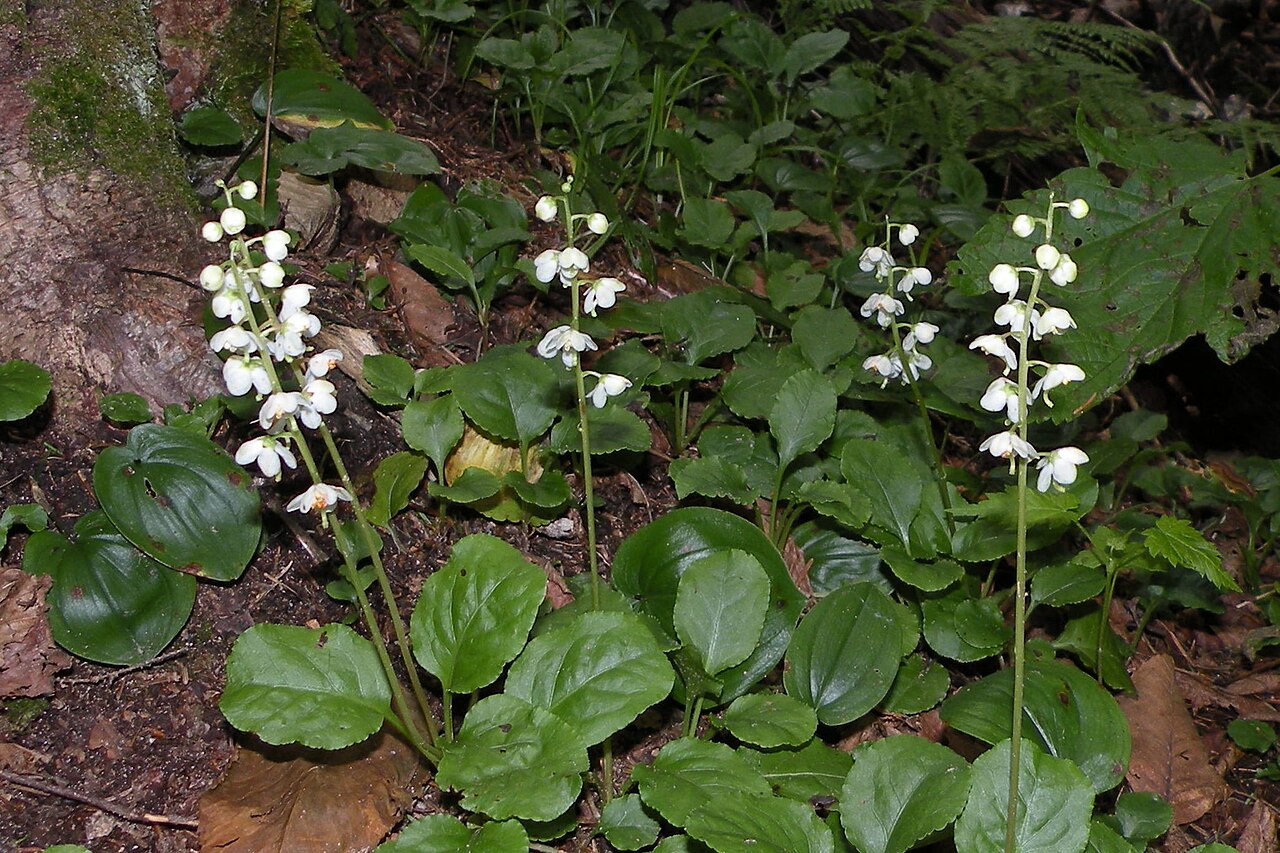
Pyrola elliptica, the Shinleaf, is a small evergreen wildflower of northern woods. A low rosette of oval, dark green leaves sits on the forest floor, and in early to midsummer it sends up a slender stalk of nodding, waxy white flowers that smell faintly sweet. It is one of the few woodland plants that blooms in deep summer shade, long after the spring wildflowers have finished. USDA PLANTS calls it waxflower shinleaf, and it is also known as common shinleaf and elliptic-leaved shinleaf.
Shinleaf belongs to the heath family (Ericaceae), in the same subfamily as pipsissewa and the other wintergreens, and like them it lives in close partnership with fungi in the soil. Its dust-like seeds need fungi to germinate, and adult plants are thought to take part of their food from the fungal network as well as from their own green leaves. That partnership is why shinleaf is so hard to transplant and why it is rarely offered by nurseries.
Shinleaf grows from New England and the Appalachians west across the Great Lakes and northern Plains to the northern Rocky Mountains, with outlying populations in the mountains of Arizona and New Mexico. This page covers how to identify it, where it grows and how to protect it. Never dig it from the wild: dug plants almost always die.
Identification
Several wintergreens in the genus Pyrola grow in North American woods. Shinleaf can be told from its relatives by its thin, dull leaves, its white flowers and the shape of its sepals.
Leaves
The leaves grow in a basal rosette of three to eight. Each blade is oval to elliptic, about 1 1/2 to 3 inches long, thin, dull dark green and often slightly toothed, on a stalk usually shorter than the blade. The leaves are evergreen. American wintergreen (Pyrola americana) has thicker, glossy, rounder leaves on stalks that are usually longer than the blade.
Flowers
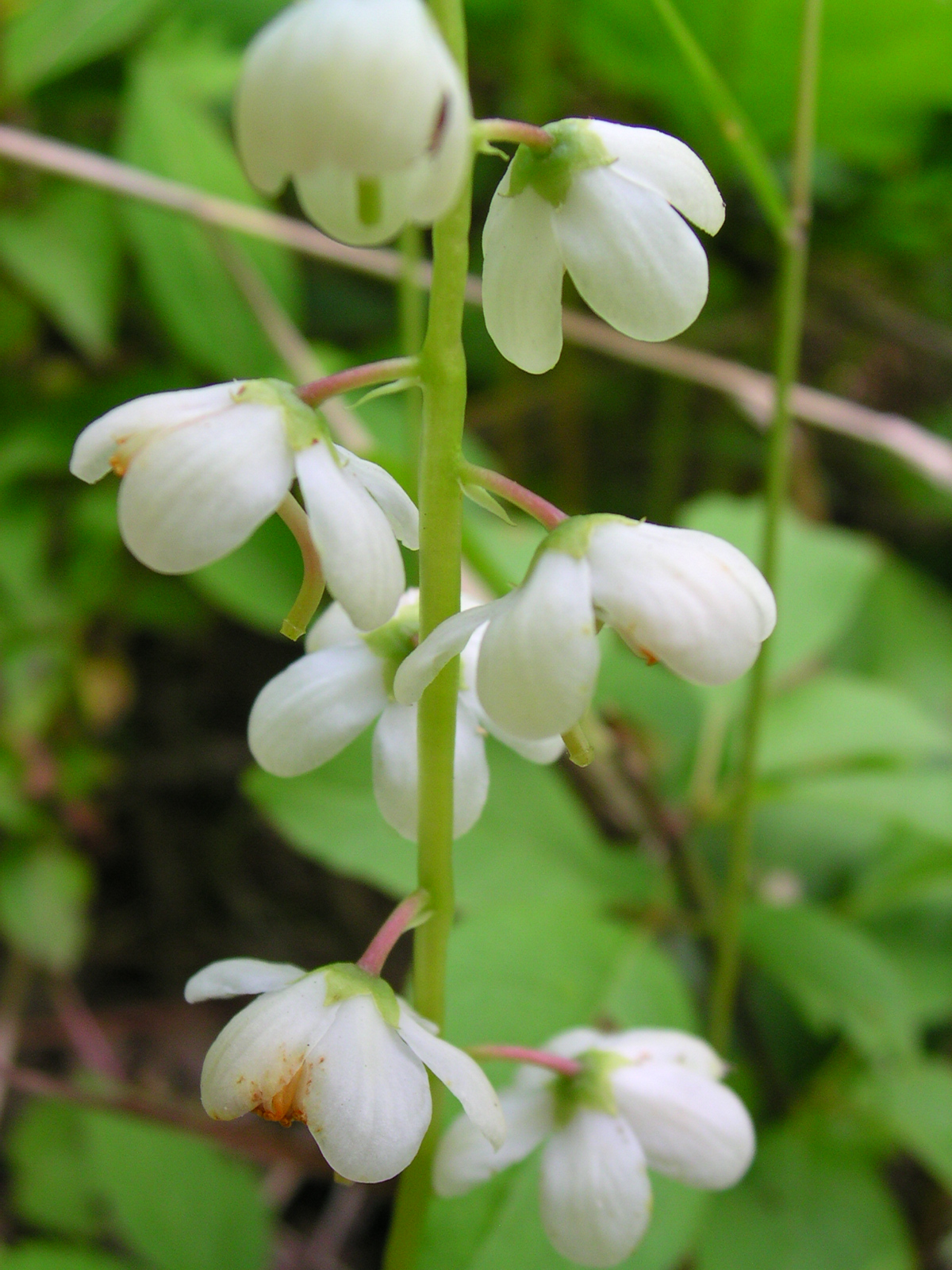
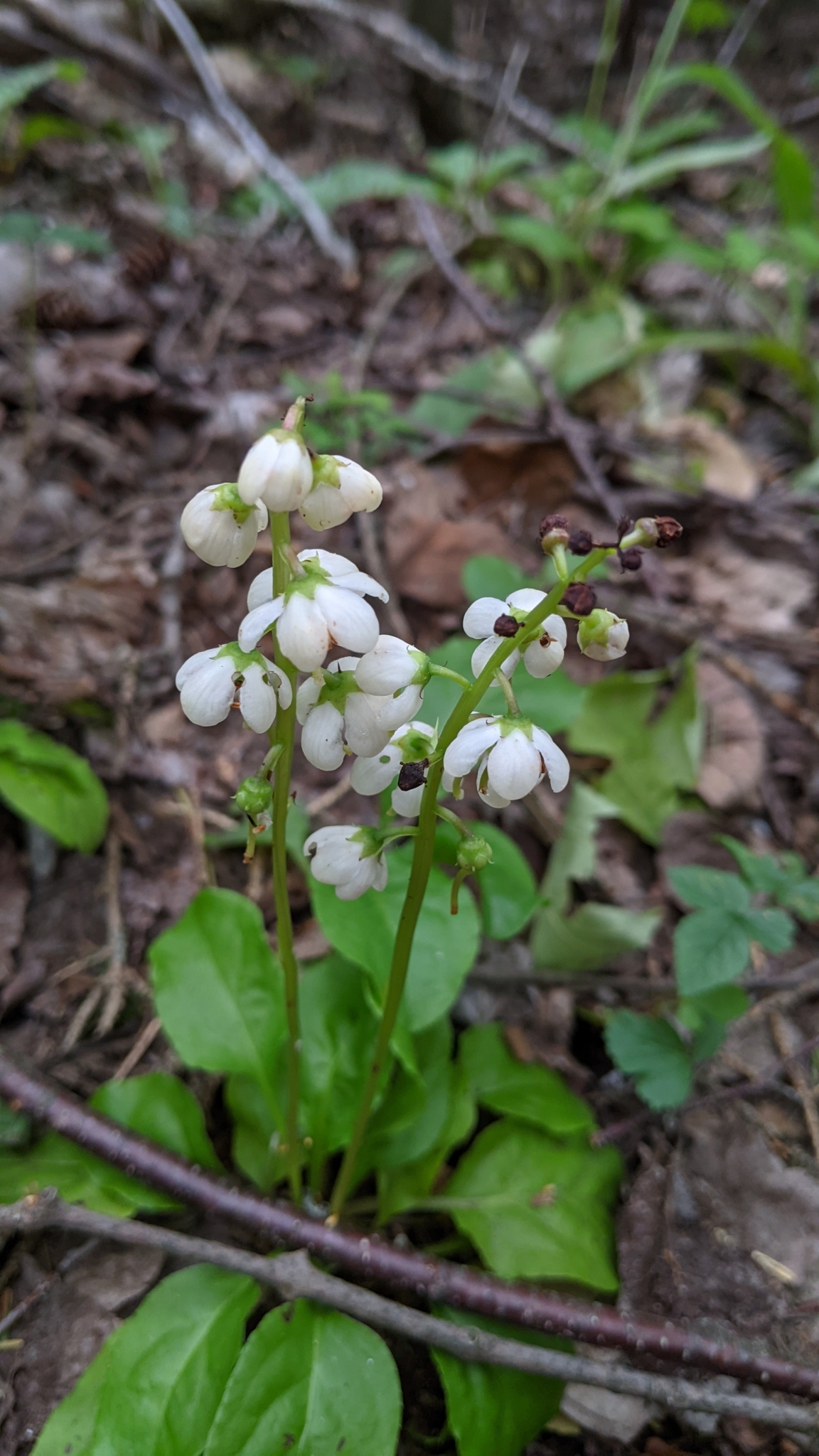
A leafless stalk 6 to 12 inches tall carries a loose spike of roughly 3 to 20 nodding flowers in June, July and August. The flowers are white, sometimes tinged with green or pink, waxy and about 1/2 inch across, with five rounded petals, ten stamens with orange-yellow anthers, and a long style that curves down and out below the petals. The sepals are very short and triangular, about as long as they are wide, which separates it from American wintergreen, whose sepals are longer.
Fruit & Seeds
After flowering, each flower forms a small, round, five-parted capsule that turns brown and splits open in late summer and fall. The capsules release thousands of minute, dust-like seeds that are carried by wind. Dried flower stalks with their capsules often remain standing into winter.
Roots
Shinleaf spreads slowly by thin underground stems (rhizomes) that produce new rosettes, so plants often grow in small patches. The roots are closely associated with mycorrhizal fungi, which connect the plant to trees and other plants nearby.
Quick Facts
| Scientific Name | Pyrola elliptica |
| Common Names | Shinleaf, waxflower shinleaf (USDA), common shinleaf, elliptic-leaved shinleaf |
| Family | Ericaceae (heath family) |
| Plant Type | Evergreen perennial wildflower (subshrub) |
| Mature Height | Leaves 2–4 in; flower stalks 6–12 in |
| Mature Spread | 6–12 in; slowly forms small patches |
| Growth Rate | Slow |
| Sun Exposure | Part shade to full shade |
| Water Needs | Medium; dry to moist woodland soil |
| Soil Type | Humus-rich forest soil with leaf litter, loamy or sandy |
| Soil pH | Acid to near neutral (about 5.0–7.0) |
| Bloom Time | June–August |
| Flower Color | White, sometimes tinged green or pink |
| Fall Color | None; evergreen leaves |
| Fruit | Small round brown capsule with dust-like seeds |
| Deer Resistant | Moderate; not a favored browse |
| USDA Hardiness Zones | 3–7 |
Native Range
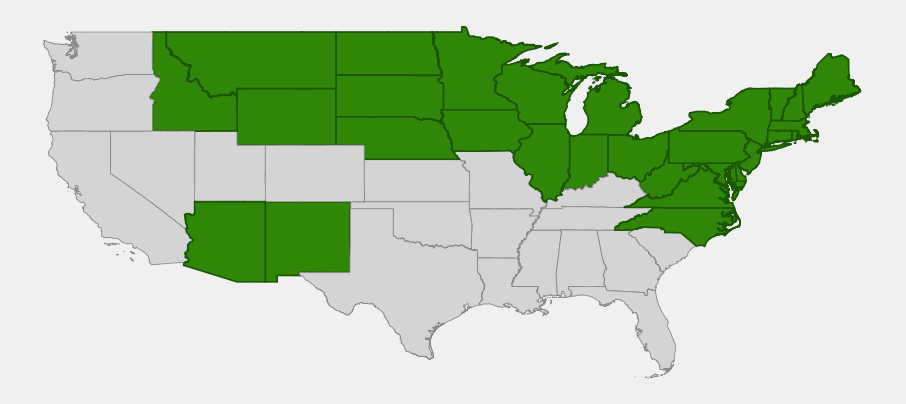
Shinleaf is native to the northern United States and southern Canada. USDA PLANTS records it from 29 states and the District of Columbia: throughout New England, New York, New Jersey and Pennsylvania, south in the Appalachians to Virginia, West Virginia and North Carolina, west through Ohio, Indiana, Illinois, Iowa and the upper Great Lakes states, across the northern Plains to North Dakota, South Dakota and Nebraska, and in the northern Rocky Mountains of Montana, Idaho and Wyoming. Outlying populations grow in the mountains of Arizona and New Mexico. In Canada it ranges from British Columbia to Newfoundland.
It is most common in the northern forests of New England, New York, Michigan, Wisconsin and Minnesota and in the Appalachian Mountains. Toward the south and onto the Plains it becomes local, found mainly in cool ravines, wooded river valleys and hills such as the Black Hills.
Shinleaf grows in dry to moist deciduous, mixed and conifer woods, often in second-growth forests of aspen, birch, maple and pine, and in wooded ravines and thickets. It favors soil with a thick layer of leaf litter and humus and is often found in woods that have been left undisturbed for many years.
📋 Regional plant lists featuring Shinleaf: New York, Pennsylvania & Northern New Jersey · Idaho, Eastern Oregon & Eastern Washington · Ohio & Indiana · Montana & Wyoming · Michigan, Wisconsin & Eastern Minnesota · Nebraska, Kansas & Eastern Colorado · Connecticut, Massachusetts & Rhode Island · New Hampshire, Maine & Vermont · Maryland, Virginia & West Virginia · Delaware, Southern New Jersey & Long Island · Arizona & New Mexico · Illinois, Iowa & Missouri · North & South Carolina · North Dakota, South Dakota & Western Minnesota
Growing & Care Guide
Shinleaf is a lovely plant to find but a very difficult one to grow. It depends on fungi in the forest soil, it does not survive transplanting, and it is rarely available from nurseries. Enjoy and protect it where it already grows, and never dig it from the wild. The notes below describe its natural conditions and how to look after plants on your land.
Light
In the wild it grows in light to deep shade under deciduous and conifer trees. It is one of the few wildflowers that blooms in the dense shade of a summer canopy.
Soil & Water
It grows in loose, humus-rich forest soil with a layer of decaying leaves or needles, usually acid to near neutral. It tolerates both fairly dry and moist woods but not waterlogged ground, compacted soil or fertilizer. The fungal partners it depends on live in undisturbed forest soil.
Planting Tips
Shinleaf is not a practical garden plant. Dug plants lose their fungal connections and almost always die. If shinleaf grows on your land, protect the spot: keep foot traffic and equipment away, leave the leaf litter in place, avoid mulching over the rosettes, and do not fertilize. For evergreen ground cover in shady woodland gardens, partridgeberry and foamflower are native and easy to buy.
Pruning & Maintenance
No pruning is needed. Leave the dried flower stalks so their seeds can disperse, and leave fallen leaves in place around the plants. Removing invasive shrubs and groundcovers that crowd a patch is helpful.
Propagation
In the wild shinleaf spreads slowly by rhizomes and by dust-like seeds that need specific soil fungi to germinate. It is not practical to propagate at home. Seed sown in ordinary potting mix will not grow, and divisions seldom survive. Leave wild plants in place.
Landscape Uses
- Woodland stewardship: an indicator of mature, undisturbed forest soil worth protecting on wooded properties
- Wildflower walks: one of the few native plants in bloom on a shady forest floor in midsummer
- Photography: nodding white flowers that glow in deep shade
- Nature study: an accessible example of plants that partner with soil fungi
Wildlife & Ecological Value
Shinleaf is a modest plant but a useful midsummer nectar and pollen source in shaded woods, where few other plants bloom at that time.
For Pollinators
The fragrant flowers are visited by bees, including bumblebees, and other small insects. Its anthers release pollen through small pores, and bees can shake the pollen loose by vibrating their flight muscles while hanging from the flower.
For Birds
The tiny, dust-like seeds are of little value to birds. Patches of evergreen leaves add some cover on the forest floor for ground-feeding birds.
For Mammals
Deer and other browsers eat it occasionally, but it is not a favored food. Its small size and woodland habitat keep it out of the way of most grazing animals.
Ecosystem Role
Shinleaf is linked through mycorrhizal fungi to the trees around it, and research on its relatives has shown that wintergreens can draw part of their carbon from this shared fungal network. It is part of the evergreen ground layer of northern forests, along with pipsissewa, partridgeberry and clubmosses.
Cultural & Historical Uses
The name shinleaf comes from the old practice of laying the leaves on bruises, sores and injuries, including sore shins. Such leaf dressings were called “shin plasters”. Wintergreens of this genus are reported to contain compounds related to the active ingredient of aspirin, which may explain their use for aches and bruises.
Several Native American peoples used Pyrola species as medicine, including leaf poultices and teas for sores, swellings and other ailments. These are historical uses, and shinleaf should not be used as a home remedy.
The genus name Pyrola means “little pear”, for the pear-shaped leaves of some species, and elliptica refers to the elliptic leaf blades. Because shinleaf is slow-growing and cannot be transplanted, the best way to enjoy it is to visit it in the woods in July when it is in bloom.
Frequently Asked Questions
Can I grow shinleaf in my garden?
It is very difficult. Shinleaf depends on fungi in the forest soil, does not survive transplanting, and is rarely sold. If it grows on your land, protect it. Never dig it from the wild.
How do I tell shinleaf from American wintergreen?
Shinleaf has thin, dull, oval leaves on stalks shorter than the blade and very short, triangular sepals. American wintergreen has thick, glossy, rounded leaves on longer stalks and longer, pointed sepals.
When does shinleaf bloom?
Mainly from June to August, depending on latitude and elevation. It is one of the few woodland wildflowers that blooms in summer shade.
Why is it called shinleaf?
The leaves were once applied to bruises and sores as “shin plasters”, and the name stuck. The plant is reported to contain compounds related to the active ingredient of aspirin.
Is shinleaf evergreen?
Yes. The basal leaves stay green through the winter, often under snow, and the plant can photosynthesize in early spring before the trees leaf out.

Looking for a nursery that carries Shinleaf?
Browse our native plant nursery directory: Arizona · Connecticut & Delaware · Idaho, Illinois, Indiana & Iowa · Maine, Maryland, Massachusetts, Michigan, Minnesota & Montana · Nebraska, New Hampshire, New Jersey, New Mexico, New York, North Carolina, North Dakota & Ohio · Pennsylvania, Rhode Island, South Dakota, Vermont & Virginia · West Virginia, Wisconsin & Wyoming