
Hooded Ladies’ Tresses (Spiranthes romanzoffiana)
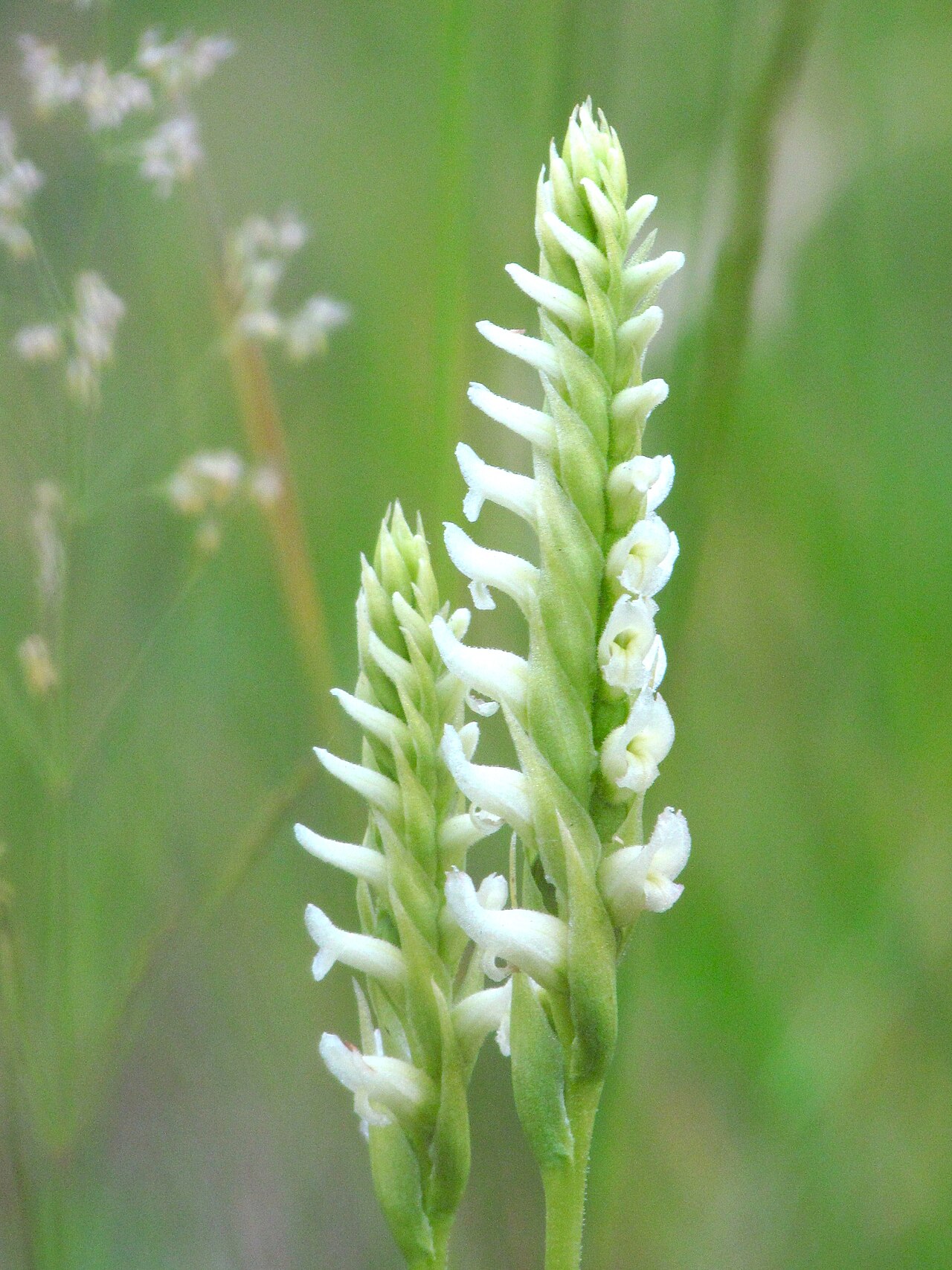
Spiranthes romanzoffiana, known as Hooded Ladies’ Tresses, is a small native orchid of wet meadows, fens, bogs and lakeshores across the northern half of North America. From a tuft of narrow, grass-like leaves it sends up a single stem 4 to 20 inches tall, crowded at the top with creamy white flowers arranged in three tight, spiraling rows, like a braid of hair. Each flower is hooded over its lip, and on warm late-summer days the spikes give off a sweet scent often compared to vanilla or almond.
It is the most widespread ladies’ tresses in North America, ranging from Alaska and the Yukon across Canada to Newfoundland, south through the western mountains to California and Arizona, and in the East through the Great Lakes states and New England. It also grows in Ireland and western Scotland, where it is known as Irish lady’s tresses, a famous example of a North American plant with an outpost in Europe.
Like all orchids, it depends on soil fungi for its whole life. Its dust-like seeds cannot germinate without the right fungus, and it does not survive digging. This page is an identification and appreciation guide: how to recognize it, where to see it, and why it should be left in the wild.
Identification
Ladies’ tresses are easy to recognize as a group by their spiraling spikes of small white flowers. Telling hooded ladies’ tresses from its relatives depends on the shape of the flower, the tightness of the spiral, and the habitat.
Stems & Growth Habit
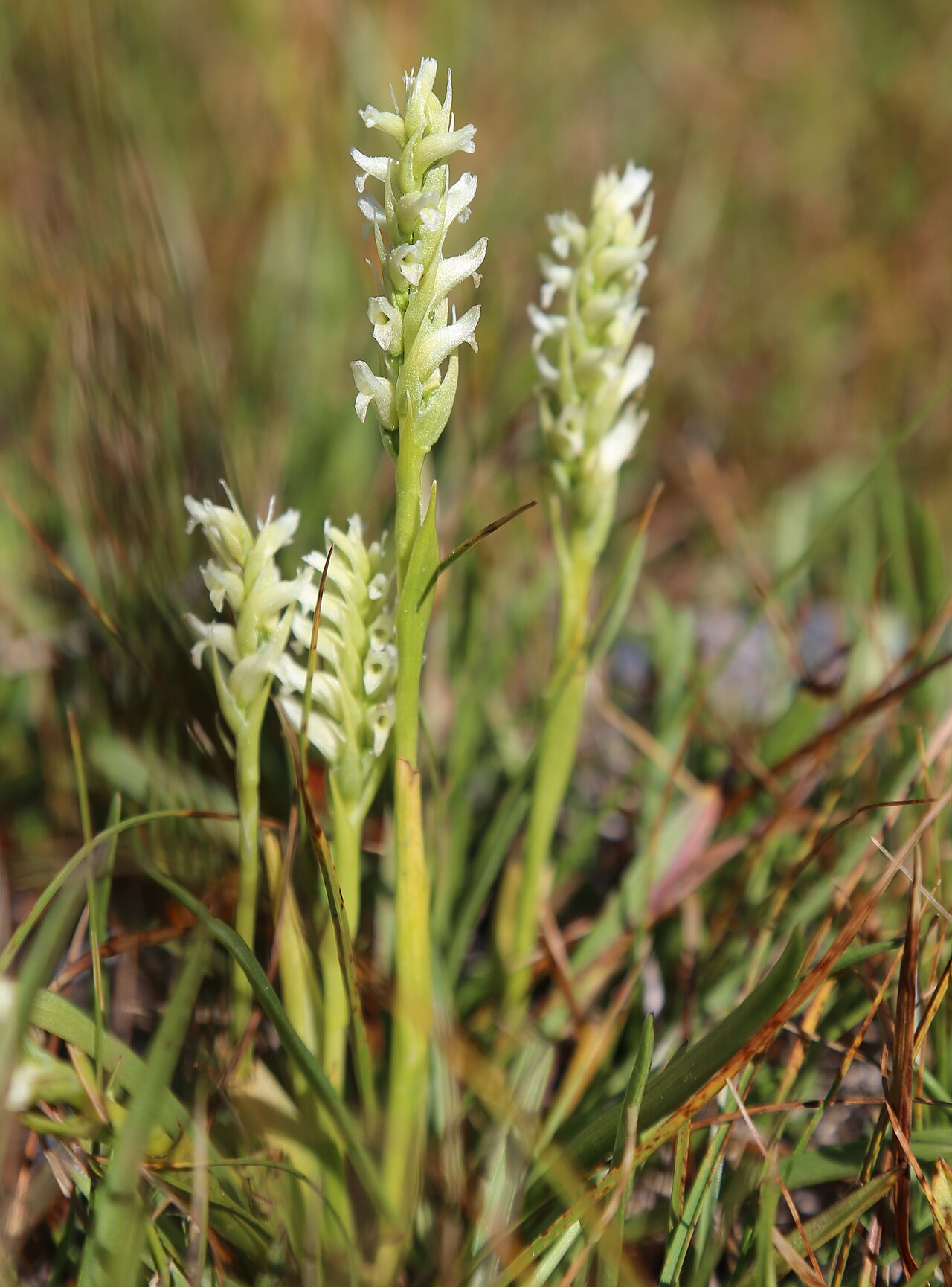
Plants grow from a cluster of thick, fleshy roots. Each plant produces a single upright flowering stem, usually 4 to 20 inches tall, smooth below and slightly hairy near the top. It often grows singly or in small, scattered groups.
Leaves
Two to several leaves grow from the base and lower stem. They are narrow, grass-like to lance-shaped, 2 to 10 inches long, and usually still green at flowering time, unlike some ladies’ tresses whose leaves wither before bloom. Smaller, sheathing leaves clasp the stem higher up.
Flowers
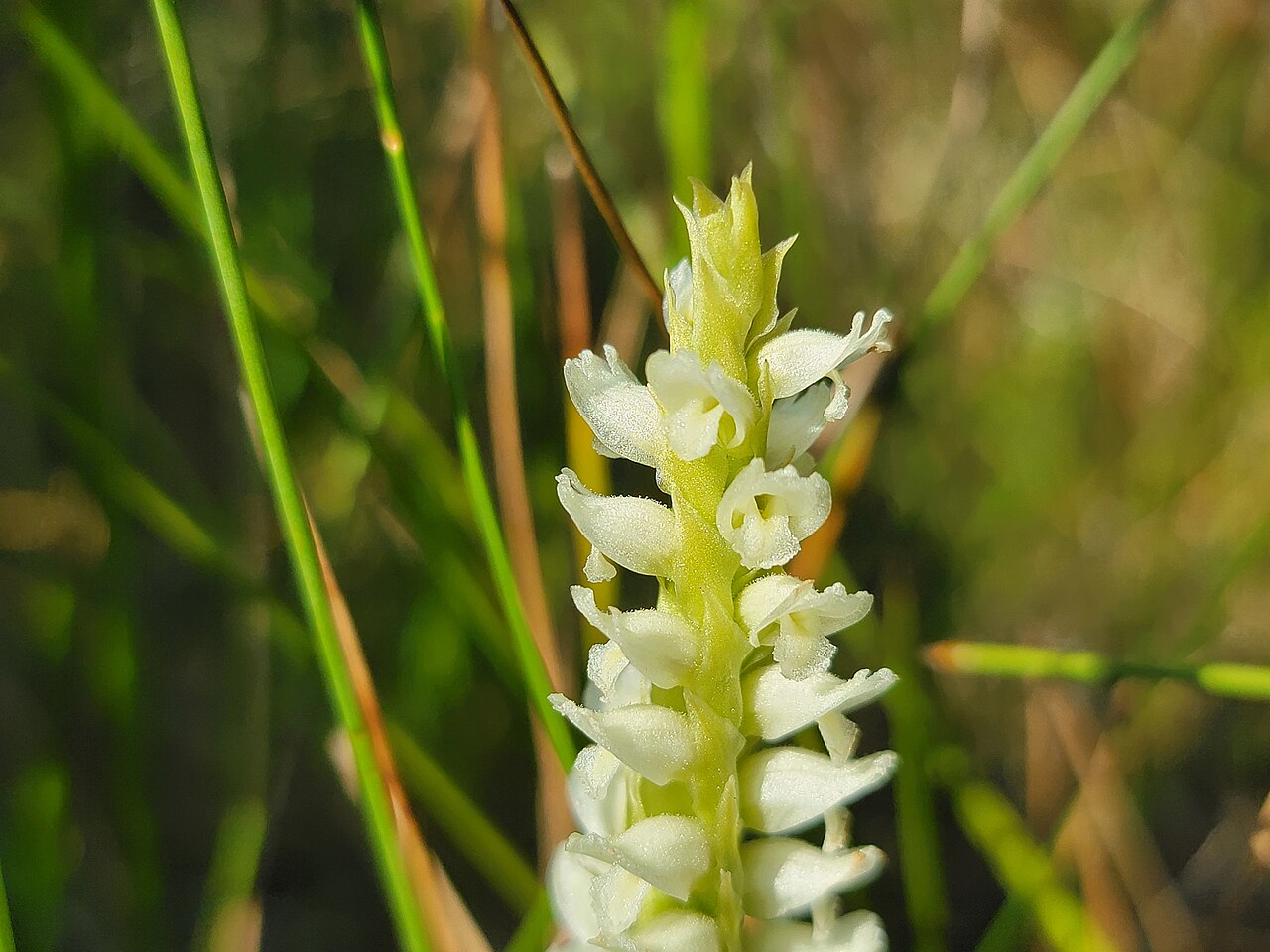
The flowers are packed into a dense spike 1½ to 4 inches long, in three tight spiraling rows so close together that the spike looks thick and almost cylindrical. Each flower is about ⅓ to ½ inch long, creamy white to greenish white. The upper sepal and the petals join to form a hood that arches over the lip, giving the species its name. The lip is distinctive: narrowed in the middle and widened toward the tip, like a fiddle. Bloom is from July to September, later than most other orchids in its range, and the flowers are fragrant.
Fruit & Seeds
Each pollinated flower becomes a small capsule packed with thousands of dust-like seeds. The seeds have almost no stored food and spread on the wind; they germinate only where they meet a suitable soil fungus.
Look-alikes
Fragrant ladies’ tresses (S. odorata) of southeastern wetlands is taller and blooms in fall. Spring ladies’ tresses (S. vernalis) blooms earlier, has a single, often loose spiral of flowers and grows in drier fields. Nodding ladies’ tresses (S. cernua) has flowers that droop and a lip without the fiddle shape. Hybrids with other Spiranthes also occur, which can make identification tricky.
Quick Facts
| Scientific Name | Spiranthes romanzoffiana |
| Family | Orchidaceae (orchid family) |
| Plant Type | Terrestrial perennial orchid; depends on mycorrhizal fungi |
| Mature Height | 4–20 in |
| Mature Spread | 2–4 in |
| Growth Rate | Slow |
| Sun Exposure | Full sun to part shade |
| Water Needs | High; moist to wet |
| Soil Type | Wet peat, sand, gravel or mineral soil in meadows and fens |
| Soil pH | Acidic to slightly alkaline (about 5.0–8.0) |
| Bloom Time | July–September |
| Flower Color | Creamy white to greenish white |
| Fall Color | None of note |
| Fruit | Small capsule with dust-like seeds |
| Deer Resistant | Low (flower spikes are sometimes grazed) |
| USDA Hardiness Zones | 2–7 |
Native Range
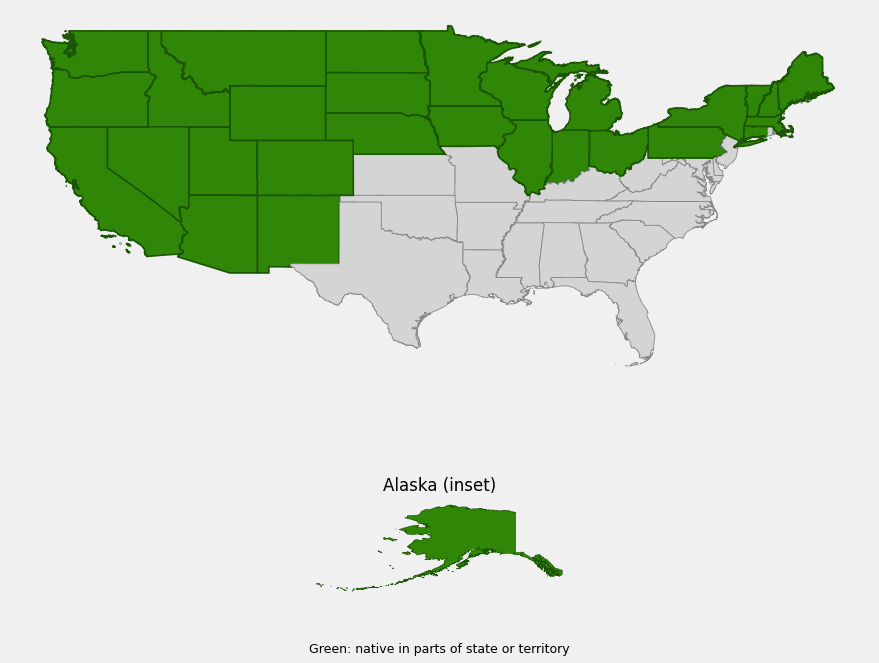
Hooded ladies’ tresses has one of the largest ranges of any North American orchid. USDA PLANTS lists it as native in 29 states: Alaska; the western states of Washington, Oregon, California, Nevada, Idaho, Montana, Wyoming, Utah, Colorado, Arizona and New Mexico; the northern plains states of North Dakota, South Dakota and Nebraska; the Midwest from Minnesota, Iowa and Wisconsin to Illinois, Indiana, Michigan and Ohio; and the Northeast from New York and Pennsylvania through Vermont, New Hampshire, Maine, Massachusetts and Connecticut. It grows across nearly all of Canada.
In the West it is mainly a mountain plant, growing in wet meadows, seeps, fens and streambanks from mid elevations to above 10,000 feet in the Sierra Nevada and the Rockies; in Alaska and western Washington and Oregon it also grows near sea level in coastal bogs and wet meadows. In the Midwest and Northeast it is a plant of fens, bogs, wet sandy shores and wet meadows, and it becomes scarce toward the southern edge of its range.
Outside North America, it grows in Ireland and in western Scotland and its islands. Botanists have long debated how it got there, and the European plants are now usually considered native rather than introduced.
📋 Regional plant lists featuring Hooded Ladies’ Tresses: New York, Pennsylvania & Northern New Jersey · Idaho, Eastern Oregon & Eastern Washington · Ohio & Indiana · Montana & Wyoming · Michigan, Wisconsin & Eastern Minnesota · Nebraska, Kansas & Eastern Colorado · Utah & Western Colorado · Connecticut, Massachusetts & Rhode Island · New Hampshire, Maine & Vermont · Delaware, Southern New Jersey & Long Island · Arizona & New Mexico · Illinois, Iowa & Missouri · Alaska · North Dakota, South Dakota & Western Minnesota · Western Oregon & Western Washington · California & Nevada
Can You Grow It?
Hooded ladies’ tresses is not a practical garden plant. Like all orchids, it depends on specific soil fungi for germination and for much of its nourishment, and it needs the constant moisture and open conditions of a wet meadow or fen. Plants dug from the wild almost always die, and digging destroys the fungal partnership they rely on. Never dig, pick or transplant wild orchids. Where it is legal to buy, any plant offered for sale should be laboratory-propagated, not wild-collected.
Light
In the wild it grows in full sun or light shade in open meadows, fens and shores. It disappears where shrubs or trees close in and shade the ground.
Soil & Water
It needs soil that stays moist to wet through the growing season, usually peat, wet sand, gravel or mineral soil kept wet by springs, snowmelt or a high water table. Draining, filling or drying out its wetlands removes it.
Planting Tips
It is not offered by ordinary nurseries. A few specialist growers raise ladies’ tresses from seed in the laboratory, and experienced bog gardeners in cool climates sometimes grow those plants in constantly moist, sunny bog beds. Success is uncertain, and wild plants should never be used.
Pruning & Maintenance
If it appears on your land, protect it: keep the wetland wet, avoid mowing the meadow until after seed has dispersed in fall, keep livestock and heavy foot traffic out during the bloom season, and remove encroaching shrubs and invasive plants by hand.
Propagation
In nature, it spreads only by seed. The tiny seeds must land where a compatible mycorrhizal fungus is present, and the young plant can spend a year or more underground before producing leaves. Propagation in cultivation requires sterile laboratory culture or symbiotic culture with fungi, techniques used by orchid conservation programs.
Where to See It
- Mountain meadows of the West: wet subalpine meadows at Mount Rainier, Yellowstone, Yosemite and the Rocky Mountain parks in late summer
- Alaska: wet meadows and roadside seeps in south-central and southeast Alaska
- Great Lakes and New England: fens, wet sandy shores and sedge meadows in July and August
- Boreal and coastal bogs: open bogs and fens across Canada and the Pacific Northwest coast
- Photography: look closely for the hooded flowers and the triple spiral; stay on trails and avoid trampling the wet ground around the plants
Wildlife & Ecological Value
Hooded ladies’ tresses is a quiet but meaningful part of wetland communities, and its presence is a good sign of a healthy, intact wet meadow or fen.
For Pollinators
Its fragrant, nectar-producing flowers are pollinated mainly by bumblebees, which work each spike from the bottom up. The flowers open in sequence up the spiral, so the older, lower flowers are in their female stage while the younger, upper ones offer pollen, an arrangement that helps promote cross-pollination between plants.
For Birds
It has no direct value to birds, but the wet meadows and fens where it grows support many nesting and migrating birds.
For Mammals
Deer, elk and livestock sometimes graze the flower spikes, and heavy grazing can keep plants from setting seed.
Ecosystem Role
As an orchid, it lives in partnership with soil fungi, which supply it with nutrients, especially when young. It is often considered an indicator of good-quality wetland habitat, since it disappears where wetlands are drained, heavily grazed or overgrown.
Cultural & Historical Uses
The genus name Spiranthes comes from the Greek speira, a coil, and anthos, a flower, describing the spiraling flower spikes. The species is named for Count Nikolai Rumyantsev (Romanzoff), a Russian statesman who sponsored the Rurik expedition of 1815–1818, on which the naturalist Adelbert von Chamisso collected the type specimen. The common name ladies’ tresses compares the spiral of flowers to braided hair.
Its presence in Ireland and Scotland has fascinated botanists for more than a century. It is one of a small group of North American plants that also grow in western Europe, and theories about how it got there range from long-distance seed dispersal on the wind or by birds to survival from a time when the continents’ floras were more connected.
Like all native orchids, hooded ladies’ tresses is vulnerable to wetland loss, drainage, overgrazing and collecting. It becomes rare toward the southern and eastern edges of its range, and native orchids are protected by law in many states and provinces. The best way to enjoy it is to find it in bloom in late summer and leave it in place.
Frequently Asked Questions
Can I grow hooded ladies’ tresses in my garden?
Not realistically. It depends on soil fungi and the constant moisture of wet meadows and fens, it is not sold by ordinary nurseries, and wild plants die when dug. Never dig or transplant wild orchids.
Where can I see hooded ladies’ tresses?
In wet mountain meadows, fens, bogs and lakeshores across Alaska, Canada, the western mountains, the Great Lakes states and New England, from July to September.
Why is it called hooded ladies’ tresses?
The upper sepal and petals form a hood over the lip of each flower, and the spiraling rows of flowers look like braided hair, or “tresses.”
Is it fragrant?
Yes. The flowers have a sweet scent, often described as vanilla- or almond-like, especially on warm afternoons.
Does it really grow in Ireland?
Yes. It grows in Ireland and western Scotland, where it is called Irish lady’s tresses. It is one of the few North American plants with native populations in Europe.

Looking for a nursery that carries Hooded Ladies’ Tresses?
Browse our native plant nursery directory: Alaska & Arizona · California · Colorado & Connecticut · Idaho, Illinois, Indiana & Iowa · Maine, Massachusetts, Michigan, Minnesota & Montana · Nebraska, Nevada, New Hampshire, New Mexico, New York, North Dakota & Ohio · Oregon · Pennsylvania, South Dakota, Utah & Vermont · Washington · Wisconsin & Wyoming