
Native Solomon’s Seals (Polygonatum)
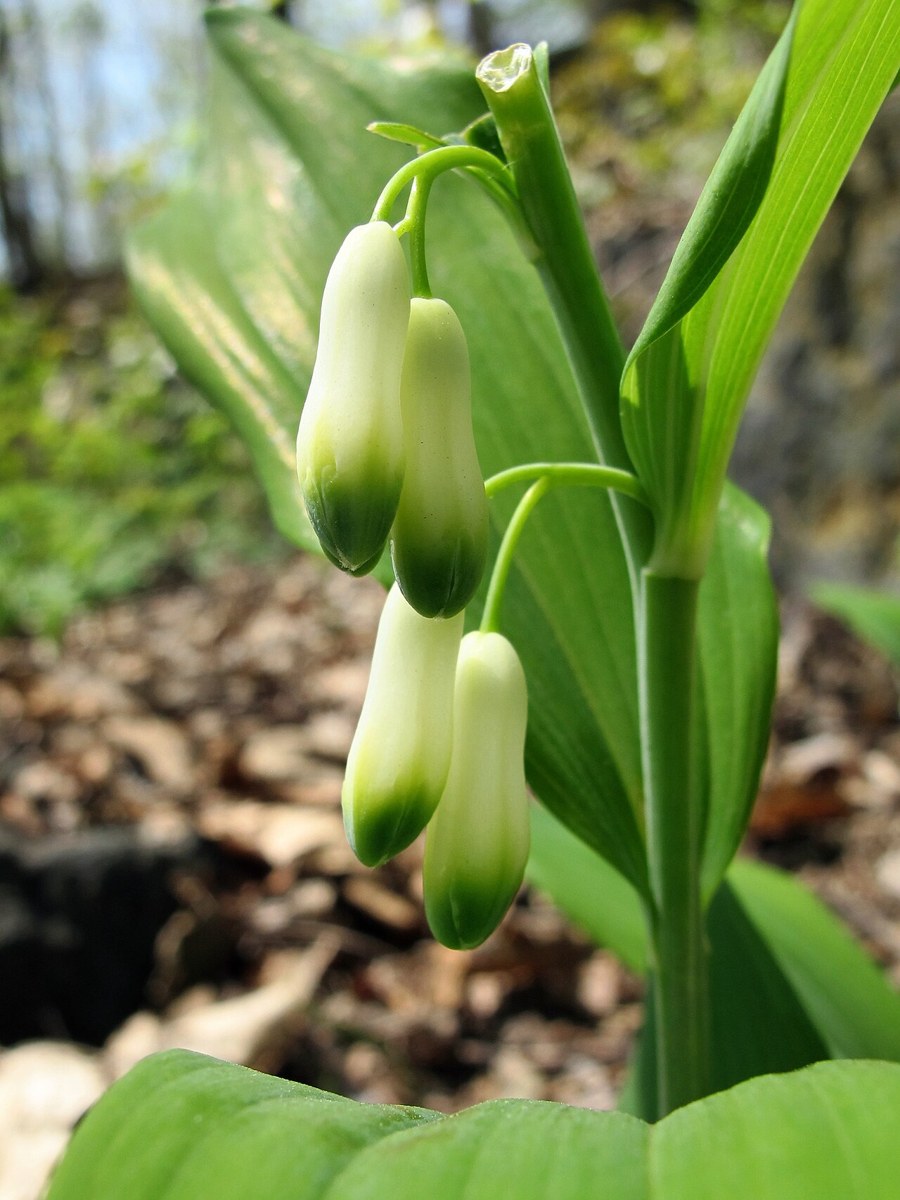
Solomon’s seals (genus Polygonatum) are woodland perennials with graceful, arching stems, two neat rows of parallel-veined leaves, and small, tubular, greenish-white bells that dangle beneath the stem in spring, followed by blue-black berries. The genus has around 60 species, most of them in eastern Asia. Three are native to the United States: smooth Solomon’s seal (Polygonatum biflorum), including the tall form often called giant Solomon’s seal, hairy Solomon’s seal (Polygonatum pubescens), and the rare southwestern Solomon’s seal (Polygonatum cobrense).
Solomon’s seals are some of the most reliable native perennials for shade. They grow slowly into handsome colonies, tolerate dry shade under trees once established, and look good from the time their shoots unfurl in April until their leaves turn butter-yellow in fall. Several Eurasian species and hybrids, especially the variegated Solomon’s seal, are sold just as often, and they look much alike at a glance.
In our article on flowers that look like lily of the valley, Solomon’s seal is named as the best native substitute, and that holds up: the hanging white bells are similar, but unlike lily of the valley, native Solomon’s seals spread slowly and politely and do not take over a bed. This guide covers how to recognize the native species, where each grows, how to grow them, and how to tell them from the Eurasian Solomon’s seals and from other woodland plants with similar leaves.
Identification
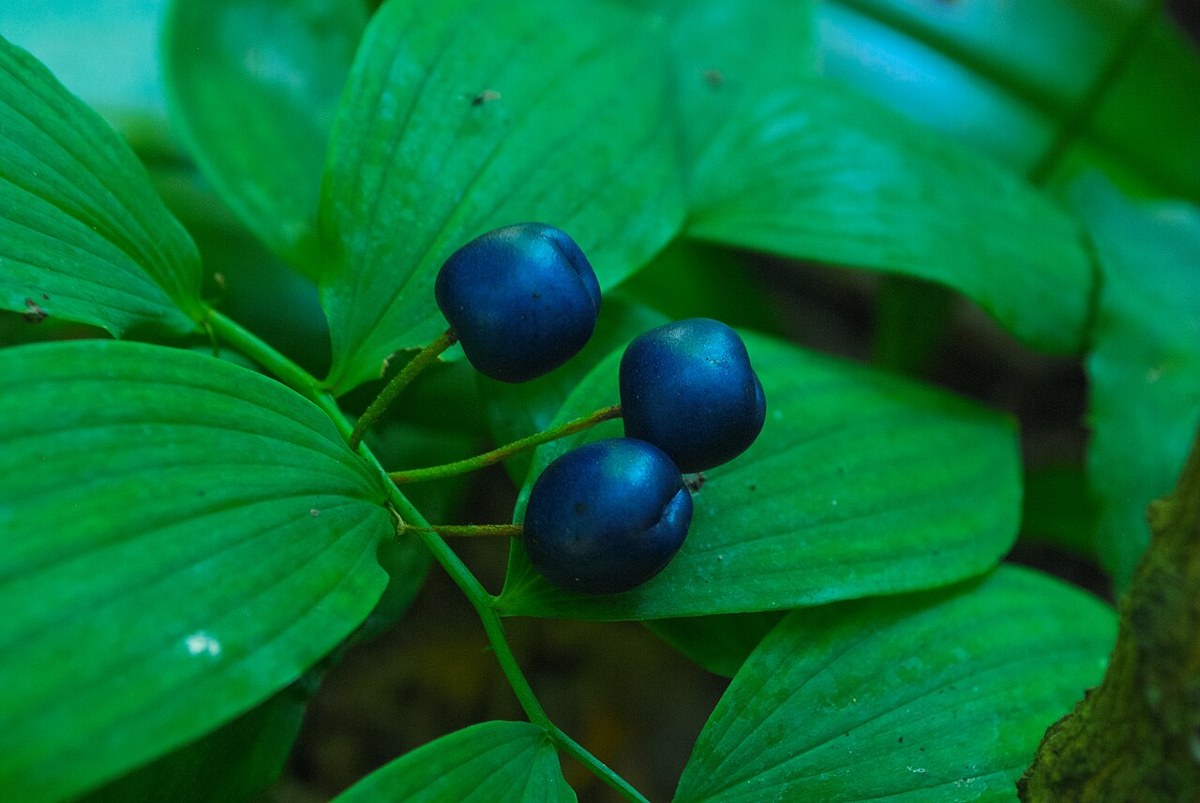
A Solomon’s seal is easy to recognize in spring. A single, unbranched stem rises from the ground and arches over, carrying alternate, stalkless leaves with conspicuous parallel veins, arranged in two flat rows along the stem. From the leaf joints, bell-shaped flowers hang below the stem on thin stalks, singly or in small clusters. In late summer the flowers become round berries that ripen from green to dark blue-black.
Flowers
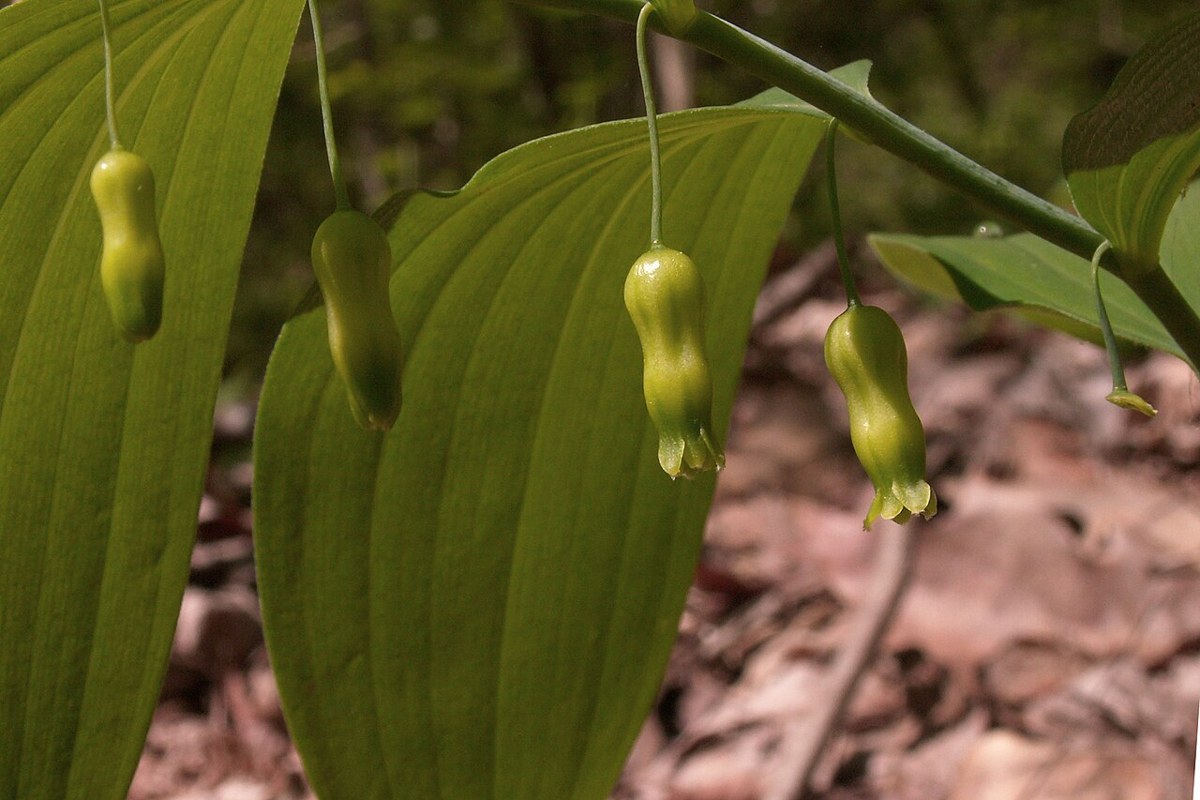
The flowers are narrow tubes about ½–1 inch long, creamy white to greenish, with six small, green-tipped lobes at the mouth. Smooth Solomon’s seal usually has 2 flowers per cluster (the “biflorum” in its name), though large plants may carry 3 to 10. Hairy Solomon’s seal usually has 1 or 2 smaller flowers per cluster. Solomon’s seals bloom in April to June depending on latitude.
Leaves & Stems
Smooth Solomon’s seal has hairless leaves, pale and slightly whitish underneath, on round, smooth stems. Hairy Solomon’s seal has leaves with short hairs along the veins on the underside (run a finger along them) and a slight zigzag to the stem. Stems are usually 1–3 ft long, but the giant form of smooth Solomon’s seal, sometimes separated as var. commutatum, can reach 5–7 ft.
Rhizome
The name comes from the thick, white, knotted rhizome. Each year’s stem leaves a round scar on it when it dies back, and the scars were said to look like the wax seal of King Solomon. You can count the scars to estimate how old a piece of rhizome is.
Look-Alikes Among Natives
False Solomon’s seal or Solomon’s plume (Maianthemum racemosum) has the same arching stem and leaves, but its flowers form a fluffy white plume at the tip of the stem and its berries are speckled, then red. Twisted stalks (Streptopus) have zigzag stems with branches and single flowers on kinked stalks, ripening into red berries. Bellworts (Uvularia) have yellow, drooping flowers and leaves that the stem seems to pierce.
Quick Facts
| Genus | Polygonatum |
| Family | Asparagaceae (Asparagus family; formerly placed in the lily family) |
| U.S. Native Species | 3: smooth Solomon’s seal (P. biflorum), hairy Solomon’s seal (P. pubescens) and southwestern Solomon’s seal (P. cobrense) |
| Plant Type | Herbaceous perennials spreading slowly by rhizomes |
| Mature Height | About 1–3 ft; the giant form of smooth Solomon’s seal 3–7 ft |
| Mature Spread | Forms colonies 2–4 ft wide or more over time |
| Growth Rate | Slow to moderate |
| Sun Exposure | Part Shade to Full Shade |
| Water Needs | Moist; established plants tolerate dry shade |
| Soil Type | Humus-rich woodland soil; adaptable to loam, clay and sandy soils |
| Soil pH | Acidic to neutral (about 5.0–7.0) |
| Bloom Time | April–June |
| Flower Color | Greenish white to creamy white |
| Fruit | Blue-black berries in late summer and fall (not edible) |
| Fall Color | Clear yellow |
| Deer Resistant | Moderately; deer sometimes browse the shoots |
| USDA Hardiness Zones | 3–9 |
Native Range
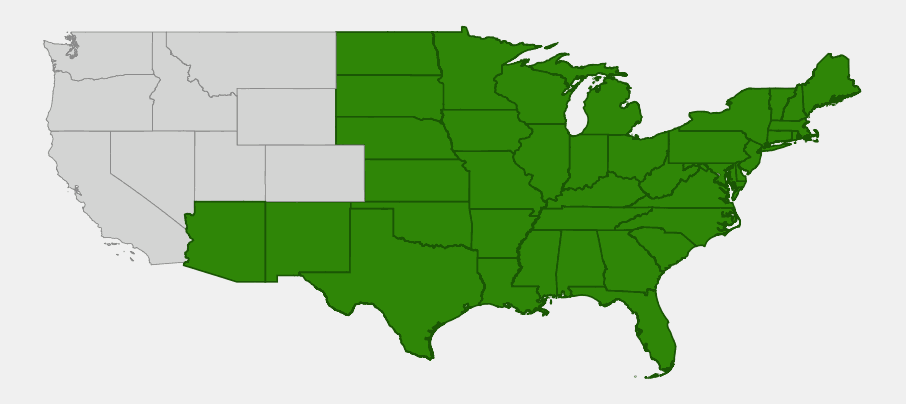
Smooth Solomon’s seal is the widespread native species, growing in rich woods, thickets, stream banks and woodland edges across the eastern half of the country, from Maine and Minnesota south to Florida and Texas and west into the Dakotas, Nebraska, Kansas and Oklahoma. The giant form grows mainly in rich, moist bottomlands and on stream terraces in the Midwest and South, with smaller plants on drier upland sites.
Hairy Solomon’s seal is a plant of cooler, moist hardwood forests in the Northeast, the Great Lakes region and south along the Appalachians to Georgia, Alabama and South Carolina. It is the more common species in the woods of New England, New York and the northern Appalachians, where both species often grow together.
Southwestern Solomon’s seal, also called McKittrick’s Solomon’s seal, is a rare plant of shaded mountain canyons in Arizona, New Mexico and the Guadalupe Mountains of west Texas. No Polygonatum is native to the Pacific states, the Great Basin or the northern and central Rocky Mountains.
📋 Find native Solomon’s seals on our regional plant lists: NH, ME, VT · CT, MA, RI · NY, PA, NJ north · DE, NJ south, NY Long Island · MD, VA, WV · NC, SC · GA, AL, MS · AR, LA, OK east, TX east · KY, TN · OH, IN · IL, IA, MO · MI, WI, MN east · ND, SD, MN west · NE, KS, CO east · TX south/west/central · AZ, NM
Native Species
The United States has three native Solomon’s seals. The two eastern species have full Plant Native profiles.
Smooth Solomon’s Seal (Polygonatum biflorum)
The common native Solomon’s seal of the East and Midwest, 1–3 ft tall in most forms, with hairless leaves and greenish-white flowers usually in pairs. Its tall form, giant Solomon’s seal (var. commutatum, sometimes treated as a separate species), reaches 5–7 ft with clusters of up to ten flowers and is one of the most architectural native perennials for shade. Tolerant of dry shade, clay and root competition once established.
Hairy Solomon’s Seal (Polygonatum pubescens)
A slightly smaller plant, 1–3 ft, of cool northeastern and Appalachian woods, with leaves hairy along the veins beneath and smaller flowers usually hanging singly or in pairs. Its leaves turn a clean, bright yellow in fall. Best in moist, acidic, humus-rich soil in part to full shade.
Southwestern Solomon’s Seal (Polygonatum cobrense)
A rare species of moist, shaded canyons and coniferous forests in the mountains of Arizona, New Mexico and west Texas, and in northern Mexico. Similar in form to smooth Solomon’s seal. It is rarely available and should not be collected from the wild.
Non-Native Look-Alikes
Many Solomon’s seals in garden centers are Eurasian or Asian. They are not considered invasive in the United States, but a native species supports the native insects and wildlife that evolved with it.
Variegated Solomon’s Seal (Polygonatum odoratum ‘Variegatum’)
The most popular Solomon’s seal in American gardens, a selection of fragrant Solomon’s seal, a species of Europe and Asia. Its leaves have creamy white edges, its stems are angled rather than round, and its flowers are sweetly scented. Plain green P. odoratum is also sold.
Eurasian Solomon’s Seal (Polygonatum multiflorum) and Common Garden Solomon’s Seal (Polygonatum × hybridum)
The traditional Solomon’s seal of European gardens and its hybrid with P. odoratum. They look very much like smooth Solomon’s seal, with round stems and clusters of 2–5 flowers. Garden hybrids spread faster than the natives and can persist in old gardens. If a plant is labeled only “Solomon’s seal” without a species name, ask before you buy.
Lily of the Valley (Convallaria majalis)
Not a Solomon’s seal, but the plant these are often compared with. European lily of the valley has two or three broad basal leaves and an upright stalk of fragrant white bells, and it spreads aggressively by rhizomes into lawns and woods. A very similar native lily of the valley grows in the southern Appalachian mountains. All parts of lily of the valley are highly poisonous, affecting the heart.
Growing & Care Guide
Light
Part shade to full shade. Morning sun with afternoon shade is ideal. In more sun, leaves scorch unless the soil stays moist.
Soil & Water
Solomon’s seals prefer moist, well-drained soil rich in leaf mold, but smooth Solomon’s seal is remarkably tolerant once established and is one of the best native plants for dry shade under trees. Water new plantings through their first summer, and mulch with shredded leaves each fall.
Planting Tips
Plant rhizome divisions or potted plants in early spring or fall, setting rhizomes horizontally about 1–2 inches deep with the bud pointing up. Space plants 1–2 ft apart; they fill in slowly over several years. Combine them with ferns, wild ginger, wild geranium, trilliums and other woodland plants. Plant giant Solomon’s seal at the back of a shade border or along a woodland path where its arching stems can be seen.
Pruning & Maintenance
Little is needed. Leave the stems standing until they yellow and collapse in fall, then let the leaves decay in place or cut the stems down. Slugs occasionally chew young leaves. Divide crowded clumps in early spring or fall by cutting the rhizome into pieces, each with at least one bud.
Propagation
Division is the easiest method. Seed is slow: the berries’ seeds have a double dormancy and often take two growing seasons to come up, and seedlings need several more years to flower. Sow cleaned, fresh seed outdoors in fall and be patient.
Landscape Uses
- Woodland and shade gardens, including dry shade under trees
- Native alternative to lily of the valley and variegated Solomon’s seal
- Edging for shaded paths and the back of shade borders (giant form)
- Stabilizing shaded slopes and stream banks
- Pollinator gardens for spring-flying bumble bees
Wildlife & Ecological Value
For Pollinators
The long, narrow flowers are pollinated mainly by bumble bees, especially queens foraging in spring, which hang beneath the flowers to reach the nectar. Ruby-throated hummingbirds also visit them.
For Birds and Mammals
Some birds, such as thrushes and grouse, and small mammals eat the berries in late summer and fall and spread the seeds. White-tailed deer browse the young shoots in some areas, though Solomon’s seal is less favored than many woodland wildflowers.
Ecosystem Role
Solomon’s seals are long-lived members of the woodland ground layer. Their slowly spreading rhizomes help hold soil on slopes and stream banks, and their presence often signals a mature, relatively undisturbed forest floor.
Cultural & Historical Uses
Native peoples of eastern North America used the rhizomes of Solomon’s seal in various traditional preparations, and the plant appears in old European herbals as well. These are historical uses, not recommendations: the berries are considered poisonous, and no part of the plant should be eaten or used as a home remedy.
The common name has several explanations. Most point to the round scars on the rhizome, which resemble a seal impressed in wax, while some old authors pointed to six-pointed star shapes seen in a cut section of the root.
Solomon’s seals have been cultivated in European gardens for centuries, and they are long-standing plants in Japanese and Chinese gardens too. American native species have become popular in shade gardens as gardeners look for alternatives to aggressive European groundcovers.
Frequently Asked Questions
Is Solomon’s seal a good native substitute for lily of the valley?
Yes. Smooth and hairy Solomon’s seal have similar hanging white bells, grow in the same shady conditions and spread slowly rather than aggressively. Their flowers are not as fragrant, but they are native and support native bumble bees.
How can I tell native Solomon’s seal from variegated Solomon’s seal?
Variegated Solomon’s seal has cream-edged leaves and angled stems. The native species have plain green leaves on round stems. Plain green Eurasian species are harder to separate; buy plants labeled with the scientific name Polygonatum biflorum or P. pubescens.
What is the difference between Solomon’s seal and false Solomon’s seal?
Solomon’s seal hangs its bell flowers beneath the stem along its length and has blue-black berries. False Solomon’s seal carries a plume of tiny white flowers at the stem tip and has red berries.
Is Solomon’s seal poisonous?
The berries are considered poisonous and can cause vomiting and diarrhea, and the plant should be kept away from children and pets who might chew it. Lily of the valley, often grown nearby, is far more toxic.
Will Solomon’s seal grow in dry shade?
Smooth Solomon’s seal is one of the best native plants for dry shade once established. Water it through its first summer and mulch with leaves.

Looking for a nursery that carries native Solomon’s seals?
Browse our native plant nursery directory: Alabama, Arizona & Arkansas · Connecticut, Delaware, Florida & Georgia · Illinois, Indiana, Iowa & Kansas · Kentucky, Louisiana, Maine, Maryland, Massachusetts, Michigan, Minnesota, Mississippi & Missouri · Nebraska, New Hampshire, New Jersey, New Mexico, New York, North Carolina, North Dakota, Ohio & Oklahoma · Pennsylvania, Rhode Island, South Carolina, South Dakota, Tennessee, Texas, Vermont & Virginia · West Virginia & Wisconsin

