
Hairy Evening Primrose (Oenothera villosa)
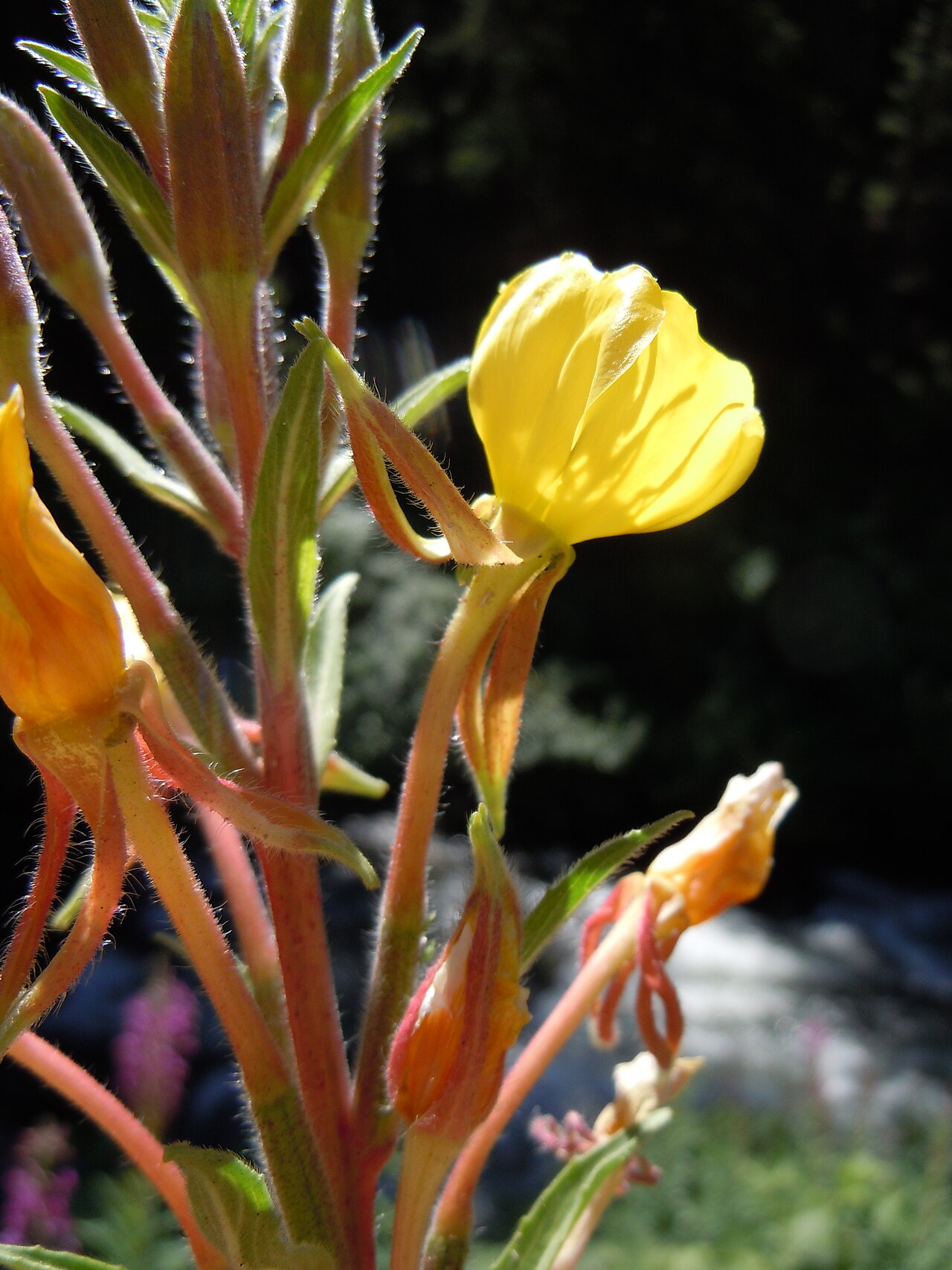
Oenothera villosa, the Hairy Evening Primrose (also called villous evening primrose), is a tall biennial wildflower of open, sunny ground across most of North America. It grows in nearly every state of the lower 48 and in every Canadian province, and is especially common on roadsides, prairies, gravel bars, old fields and other disturbed, open sites in the West and the Great Plains.
It is a close relative of the familiar Common Evening Primrose (O. biennis), and the two are often confused. Hairy evening primrose has grayish, densely hairy leaves and stems and a mostly unbranched, spike-like stem. Its fragrant, lemon-yellow flowers open in the evening and are pollinated by night-flying moths.
Like other evening primroses, it spends its first year as a flat rosette of leaves and sends up a 2- to 6-foot flowering stem in its second summer. This guide covers how to identify it, where it grows, how to grow it in a meadow or pollinator garden and its value to wildlife.
Identification
Hairy evening primrose is a tall, stiffly upright biennial with grayish-green, hairy, lance-shaped leaves, a reddish stem and yellow, four-petaled flowers that open at dusk.
Rosette & Stem
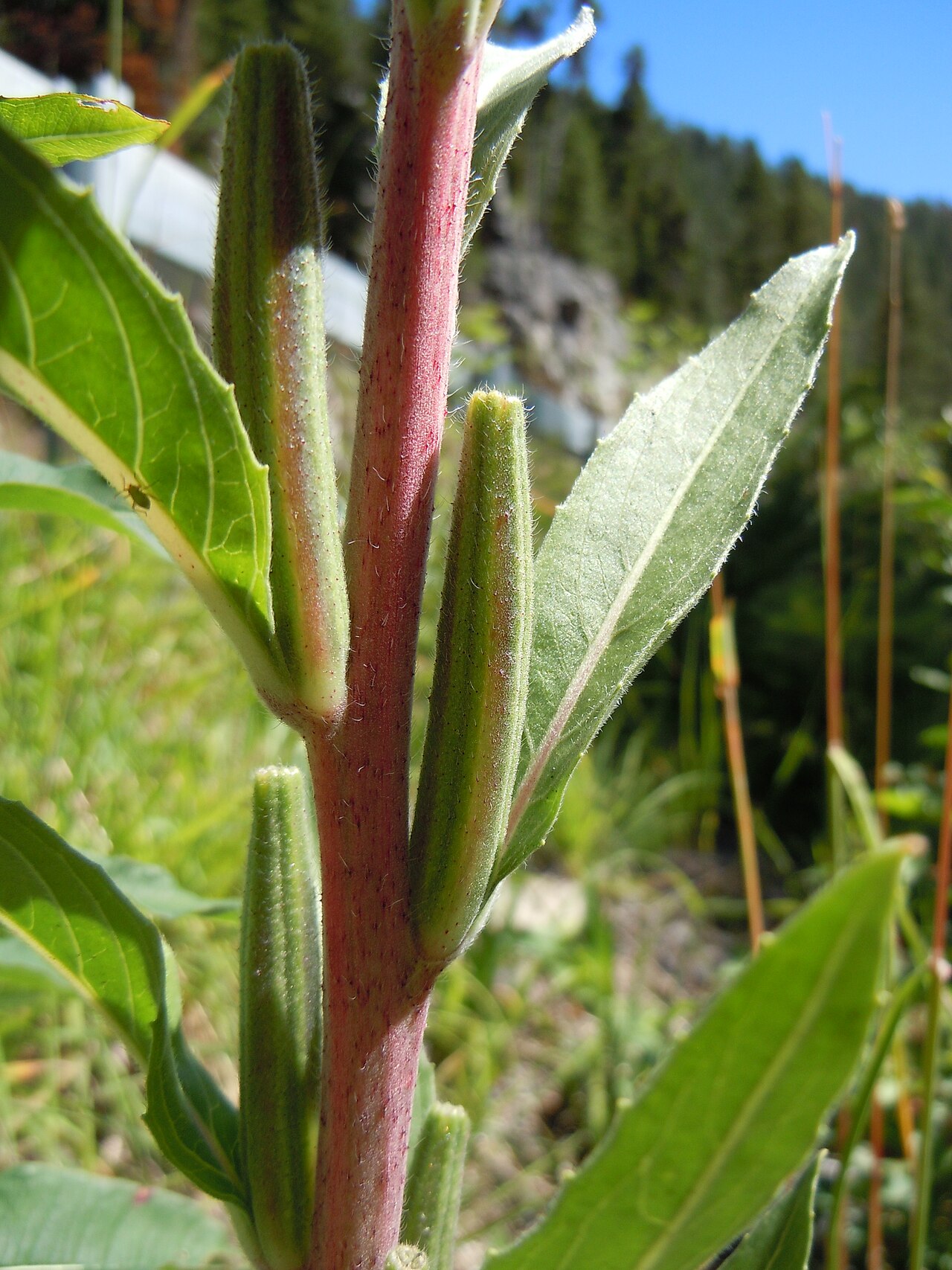
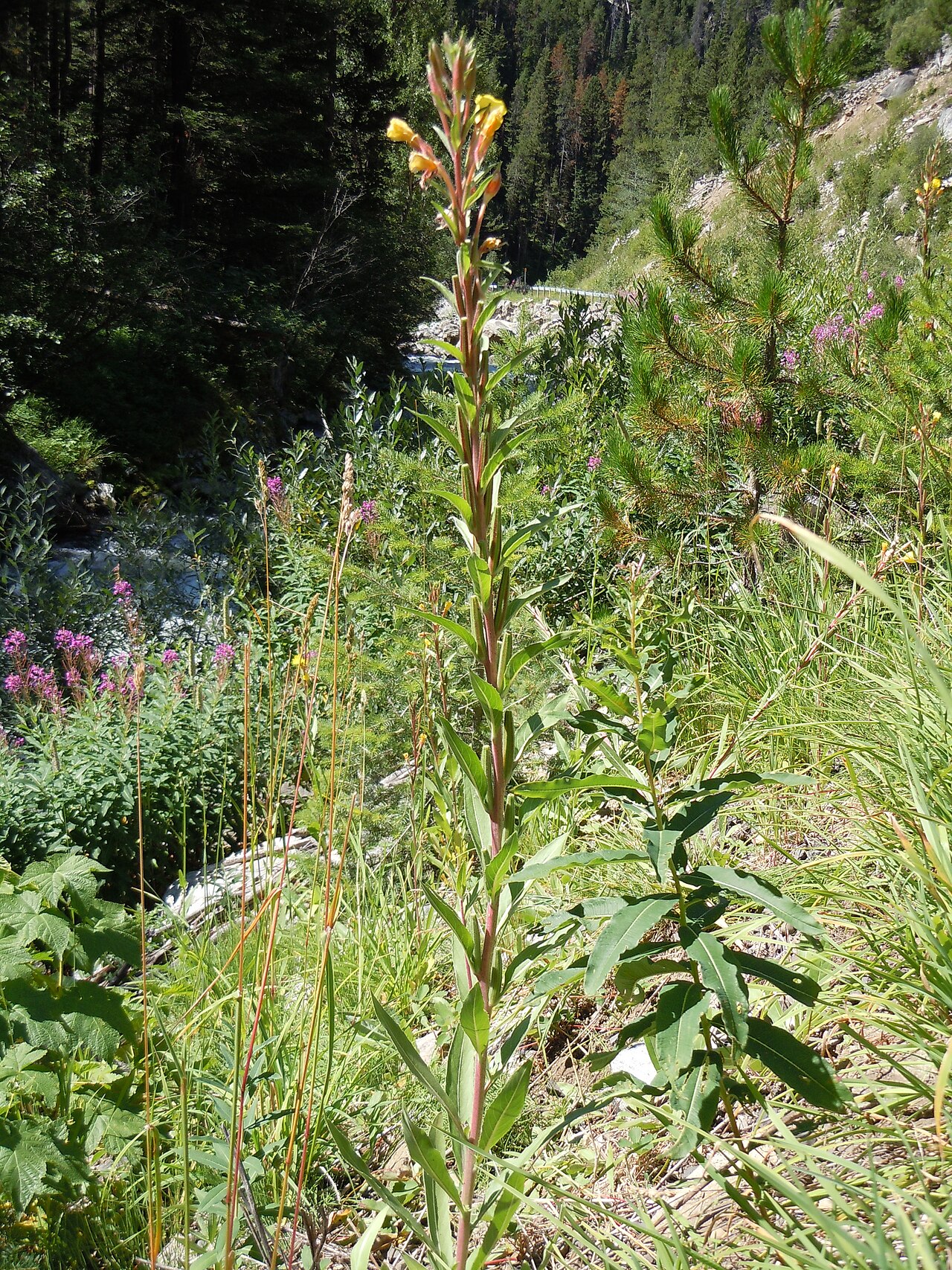
In its first year it forms a flat basal rosette of narrow, lance-shaped leaves. In its second year it sends up a single stout stem, sometimes with a few branches near the base, usually 2 to 5 feet tall and occasionally taller. The stem is often reddish and covered in short, pressed and spreading hairs.
Leaves
The stem leaves are alternate, lance-shaped to narrowly elliptic, 1 to 4 inches long, with smooth or slightly toothed edges. They are grayish-green and densely covered in fine hairs on both sides, which gives the plant a dusty look. This gray hairiness is the main feature that separates it from common evening primrose, whose leaves are greener and less hairy.
Flowers
From June to September, the upper stem forms a spike of flowers that open one or a few at a time in the evening and close by the next midday. Each flower has four broad, lemon-yellow petals about ½ to 1 inch long, a cross-shaped stigma, eight stamens and a long, slender floral tube. The buds and sepals are often streaked with red.
Fruit
The seed capsules are narrow, cylindrical and hairy, about ½ to 1¼ inches long, held upright against the stem in the leaf axils. They split open from the top in fall and release many small seeds. The dry stalks with open capsules often stand through the winter.
Quick Facts
| Scientific Name | Oenothera villosa Thunb. |
| Family | Onagraceae (evening primrose family) |
| Plant Type | Biennial wildflower |
| Mature Height | 2–6 ft |
| Mature Spread | 1–2 ft |
| Growth Rate | Fast |
| Sun Exposure | Full sun |
| Water Needs | Low to moderate; drought tolerant |
| Soil Type | Sandy, gravelly, loamy or clay; tolerates poor soil |
| Soil pH | About 6.0–8.0 |
| Bloom Time | June–September |
| Flower Color | Lemon yellow |
| Fall Color | Rosette leaves often turn reddish |
| Fruit | Narrow, hairy capsule with many small seeds |
| Deer Resistant | Moderate |
| USDA Hardiness Zones | 3–9 |
Native Range
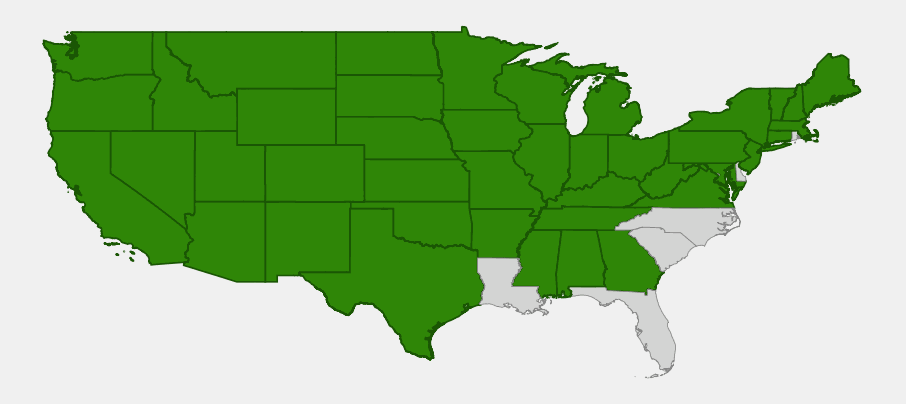
Hairy evening primrose has one of the widest ranges of any evening primrose. USDA PLANTS lists it as native in 42 states of the lower 48, from Washington, Oregon and California east across the Rocky Mountains and Great Plains to the Midwest, the Northeast and the Southeast as far as Georgia, Alabama and Mississippi. It also grows in every Canadian province and the Northwest Territories.
It is most common and widespread in the West and on the Great Plains, where two subspecies are recognized: subsp. villosa and subsp. strigosa, the latter with flatter-lying hairs and often treated in older books as Oenothera strigosa. In the East it is more scattered, mostly along roads, railroads and riverbanks. It is absent as a native from Florida, Louisiana and the Carolinas.
It favors open, sunny, disturbed ground: roadsides, railroad embankments, prairies, pastures, old fields, gravel bars and river terraces, sandy flats and forest clearings, from low elevations to the mountains. It has been introduced to Europe and other temperate regions, where it is often a weed of waste places.
📋 Regional plant lists featuring Hairy Evening Primrose: New York, Pennsylvania & Northern New Jersey · Idaho, Eastern Oregon & Eastern Washington · Ohio & Indiana · Montana & Wyoming · Michigan, Wisconsin & Eastern Minnesota · Kentucky & Tennessee · Nebraska, Kansas & Eastern Colorado · Utah & Western Colorado · Connecticut, Massachusetts & Rhode Island · New Hampshire, Maine & Vermont · Maryland, Virginia & West Virginia · Delaware, Southern New Jersey & Long Island · Arizona & New Mexico · Illinois, Iowa & Missouri · Alabama, Georgia & Mississippi · Arkansas, Louisiana, Eastern Oklahoma & Eastern Texas · South & West Texas · North Dakota, South Dakota & Western Minnesota · California & Nevada · Western Oregon & Western Washington
Growing & Care Guide
Hairy evening primrose is easy to grow from seed and is a good choice for meadow plantings, prairie restorations and informal pollinator gardens in full sun. As a biennial, it flowers in its second year, sets seed and dies, but it reseeds readily, so a patch maintains itself if some bare ground is left.
Light
Full sun gives the strongest stems and the most flowers. It tolerates light shade but becomes leggy and flowers less.
Soil & Water
It thrives in average to poor, well-drained soil, including sand, gravel and clay, and tolerates drought once established. Rich, moist soil makes it floppy. Water only to get seedlings established.
Planting Tips
Sow seed on the surface of bare soil in fall or early spring, since the seeds need light to germinate. Thin seedlings or plant rosettes 1 to 2 feet apart. Place it toward the back of a border or among grasses, where its tall stems are supported.
Pruning & Maintenance
Little care is needed. Leave the seed stalks standing over winter for birds, and then cut them down in spring. To limit reseeding, cut the stalks after flowering. Remove extra seedlings where they are not wanted.
Propagation
Grow from seed. Fresh seed germinates easily with no treatment, although a few weeks of cold, moist stratification can improve germination. First-year rosettes can be moved in fall or early spring; older plants have a deep taproot and transplant poorly.
Landscape Uses
- Meadows and prairie plantings: tall summer color and seed for birds
- Night gardens: fragrant yellow flowers open at dusk
- Pollinator gardens: nectar for hawk moths and bees
- Revegetation: fast cover on roadsides and disturbed ground
Wildlife & Ecological Value
Hairy evening primrose provides nectar at night, food for several specialist insects and abundant seed for birds through the winter.
For Pollinators
The fragrant flowers open in the evening and are pollinated mainly by sphinx (hawk) moths, which hover in front of the flowers with their long tongues. Bees, including specialist evening-primrose bees, visit the flowers in the early morning for pollen. The leaves feed the caterpillars of several moths, including the pink-and-yellow primrose moth, which often rests inside the closed flowers by day.
For Birds
Goldfinches and other finches eat the small seeds from the open capsules in fall and winter, which is a good reason to leave the stalks standing.
For Mammals
Deer and rabbits sometimes browse the rosettes and young stems, but the hairy leaves are not a preferred food.
Ecosystem Role
As a pioneer of bare, disturbed soil, it is one of the first plants to cover roadsides, gravel bars and burned or cleared ground, holding soil and feeding insects until longer-lived prairie and meadow plants take over.
Cultural & Historical Uses
The Swedish botanist Carl Peter Thunberg described Oenothera villosa, and its name means “hairy evening primrose.” The genus Oenothera is famous in genetics: studies of its odd chromosome behavior in the late 1800s and early 1900s helped shape early ideas about mutation and heredity.
Seed of evening primroses is the source of evening primrose oil, which is rich in gamma-linolenic acid. Commercial oil comes mostly from common evening primrose and its relatives.
Several Indigenous peoples used evening primrose roots and leaves as food and medicine. The first-year roots of evening primroses are edible when cooked, but positive identification is essential before eating any wild plant.
Frequently Asked Questions
How do I tell hairy evening primrose from common evening primrose?
Hairy evening primrose has grayish, densely hairy leaves and stems and narrow, hairy capsules. Common evening primrose (O. biennis) is greener and less hairy, with broader leaves. They hybridize, so some plants are hard to place.
Is hairy evening primrose a perennial?
It is usually a biennial: a rosette the first year, flowering the second year, then dying after setting seed. It reseeds readily, so a patch persists.
When does hairy evening primrose bloom?
From about June to September. Each flower opens in the evening and lasts until the next morning or midday.
Does hairy evening primrose attract pollinators?
Yes. Sphinx moths visit the fragrant flowers at night, and bees collect pollen in the early morning. Its seeds also feed goldfinches.
Where does hairy evening primrose grow?
In open, sunny, often disturbed places such as roadsides, prairies, old fields and gravel bars in most of the lower 48 states and throughout Canada.

Looking for a nursery that carries Hairy Evening Primrose?
Browse our native plant nursery directory: Alabama, Arizona & Arkansas · California · Colorado, Connecticut & Georgia · Idaho, Illinois, Indiana, Iowa & Kansas · Kentucky, Maine, Maryland, Massachusetts, Michigan, Minnesota, Mississippi, Missouri & Montana · Nebraska, Nevada, New Hampshire, New Jersey, New Mexico, New York, North Dakota, Ohio & Oklahoma · Oregon · Pennsylvania, South Dakota, Tennessee, Texas, Utah, Vermont & Virginia · Washington · West Virginia, Wisconsin & Wyoming

