
Native Wild Geraniums (Geranium)
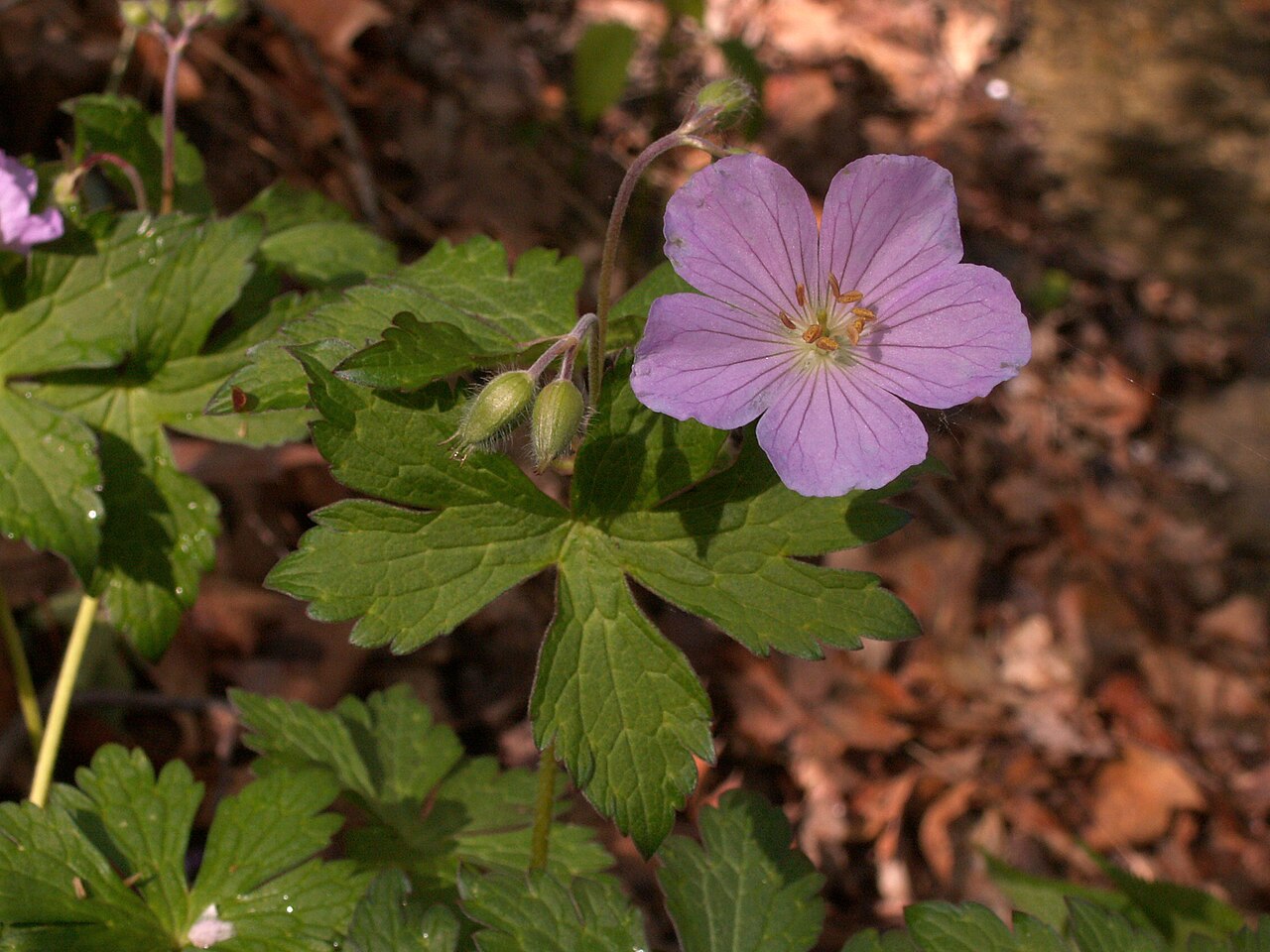
The word “geranium” means two very different plants. In garden centers, window boxes and on most flower lists, “geraniums” are the bright red, pink and white bedding plants that bloom all summer on a sunny porch. Those are pelargoniums (Pelargonium), tender plants from South Africa that are not native anywhere in North America. The true geraniums, genus Geranium, are the hardy cranesbills, and the United States has its own native ones: wild geranium in the eastern woods, sticky geranium and Richardson’s geranium in western mountain meadows, pineywoods geranium in the ponderosa pine forests of the Southwest, and a handful of rare shrubby geraniums found only in Hawaiʻi.
Geranium is a large genus of about 400 species in the geranium family (Geraniaceae), found in temperate regions and tropical mountains worldwide. Roughly 25 to 30 species are native to the United States (an approximate count; botanists split and lump some western species differently), and at least one native species grows wild in every state. They are perennials and annuals with five-petaled, saucer-shaped flowers in pink, purple, lavender or white, deeply lobed leaves, and a long, beaked seed capsule that gives the genus its common name.
This guide covers the main native species, where each grows, how to grow them, and how to tell them from pelargoniums and the Eurasian cranesbills sold as perennials. If you came here from a Colorado landscaping list, the native geraniums of Colorado are pineywoods geranium and Richardson’s geranium, both summer-flowering perennials of mountain forests, not annuals. If you came from a general flower list, the sun-loving “geraniums” described there are almost certainly pelargoniums.
Identification
True geraniums are herbaceous plants, mostly perennials from a thick rootstock, with a few annual or biennial species. They are easy to recognize once you know the flower and fruit.
Leaves & Stems
Leaves are palmately lobed or divided, like a hand with five or more deeply cut fingers, and usually hairy. Most grow from the base of the plant on long stalks, with a pair of smaller, opposite leaves on the flowering stems. Stems and leaves of several western species, especially sticky geranium, are covered in glandular hairs that feel tacky and catch small insects. In fall, wild geranium and many others turn red or bronze.
Flowers
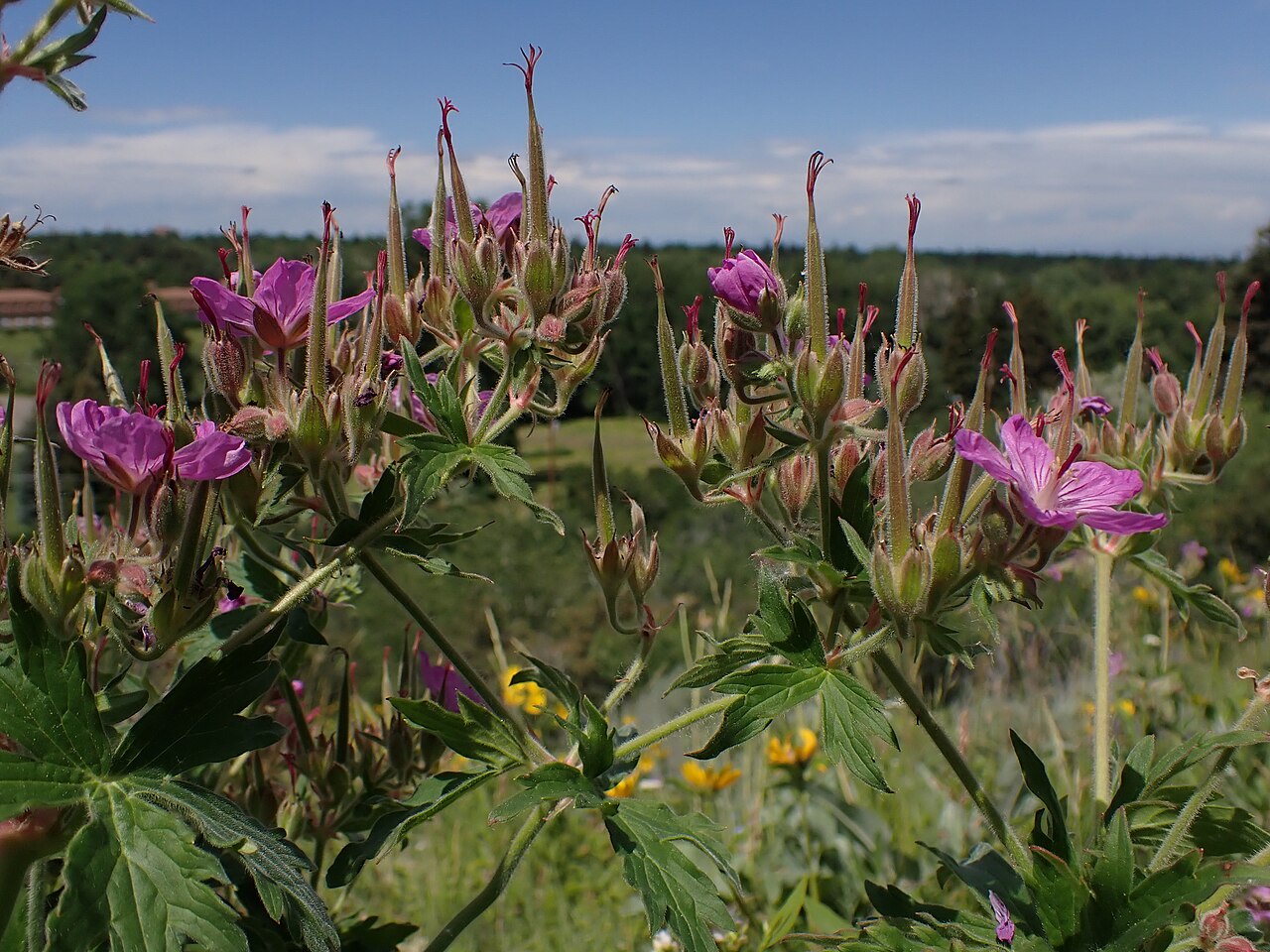
The flowers are radially symmetrical: five equal, rounded petals, five sepals, ten stamens and a central style that splits into five branches. They are usually 1 to 1.5 inches across in the perennial species and much smaller in the annuals. Many have darker veins, called nectar guides, that lead bees to the center. Wild geranium is pale pink to lavender, sticky geranium bright magenta-pink with purple veins, Richardson’s geranium white to pale pink with purple veins, and pineywoods geranium rose-purple.
Fruit & Seeds
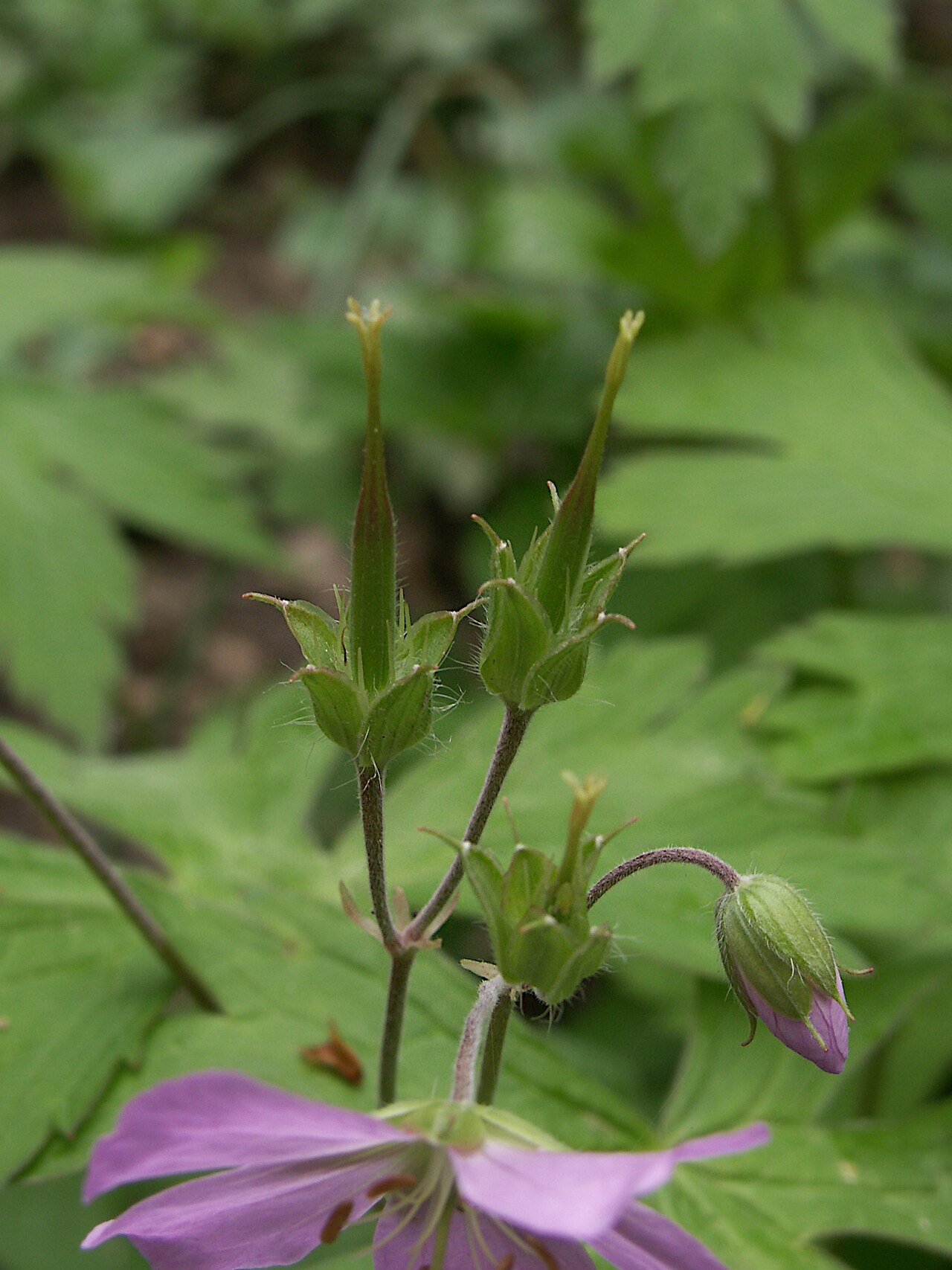
After flowering, the style lengthens into a pointed beak an inch or more long, the “crane’s bill.” When ripe, the capsule splits into five sections that curl upward suddenly and fling the seeds several feet. This catapult fruit is the most reliable field mark of the genus.
Quick Facts
| Scientific Name | Geranium L. (genus) |
| Family | Geraniaceae (Geranium) |
| US-Native Species | Roughly 25–30 (approximate), including several endemic to Hawaiʻi |
| Growth Forms | Clump-forming perennials and small annuals; Hawaiian species are shrubs |
| Mature Height | 6 in (annual cranesbills) to 1–3 ft (wild, sticky and Richardson’s geranium) |
| Growth Rate | Moderate |
| Sun Exposure | Full Sun to Part Shade; wild geranium Part Shade to Shade |
| Water Needs | Average; western meadow species tolerate dry summers |
| Soil Type | Humus-rich loam in woods; well-drained loam or gravel in mountain meadows |
| Bloom Time | April–June (wild geranium); June–August (western mountain species) |
| Flower Color | Pink, lavender, magenta, purple or white |
| Fruit | Beaked capsule that flings seeds when ripe |
| Wildlife Value | Nectar and pollen for native bees, including specialist bees; seeds eaten by birds; deer browse lightly |
| Deer Resistant | Mostly; wild geranium is usually left alone |
| USDA Hardiness Zones | 3–8 (wild geranium); most western species 3–7 |
Native Range
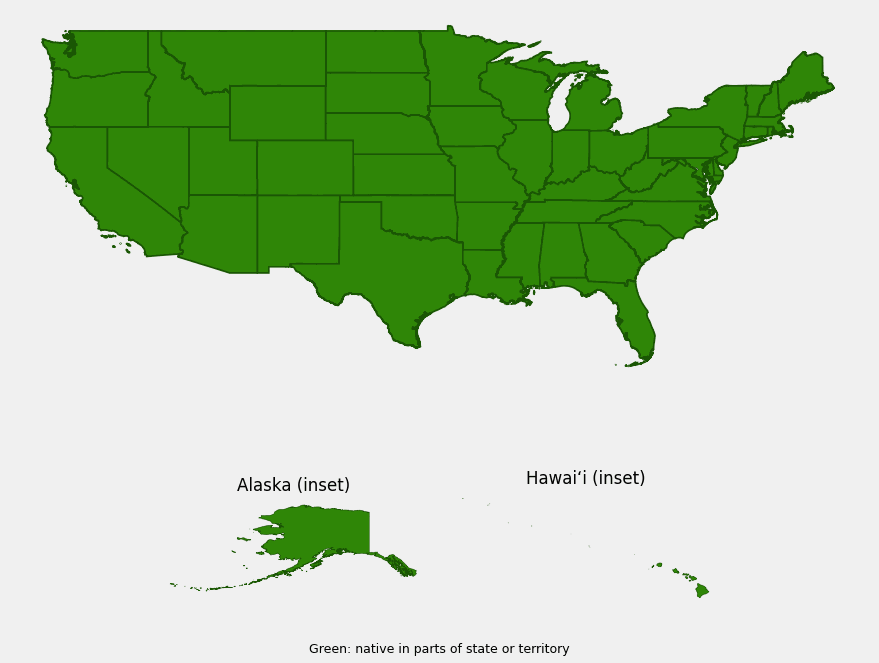
Every state has at least one native Geranium. In the East and Midwest, wild geranium is the common woodland species, growing in deciduous forests, wooded slopes and shady roadsides from Maine and southern Canada south to Georgia and Alabama and west to Minnesota, eastern Kansas and eastern Oklahoma. Carolina crane’s-bill, a small native annual, grows across almost the entire country in sandy fields, lawns and disturbed ground, and Bicknell’s cranesbill appears after fires and logging in the northern states.
The West has the most species. Sticky geranium is a plant of sagebrush steppe, aspen groves and mountain meadows from British Columbia and Alberta south to California, Nevada and Wyoming. Richardson’s geranium follows shady streambanks and moist aspen and conifer forests from Washington, Montana and South Dakota’s Black Hills south to California, Arizona and New Mexico. Pineywoods geranium grows in ponderosa pine and mixed conifer forests of the southern Rockies, from Wyoming through Colorado and Utah to Arizona, New Mexico and western Texas. Western geranium (G. oreganum) and California cranesbill grow in the Pacific states, and northern geranium reaches Alaska.
Hawaiʻi has its own geraniums, called nohoanu, found nowhere else. They are shrubs of high-elevation bogs and volcanic slopes, and several are rare and federally listed as endangered. Pelargoniums, the “geraniums” of window boxes, are not native anywhere in the United States, and the Eurasian cranesbills common in perennial borders are introduced. Some, including herb Robert and shiny geranium, have escaped into forests in the Pacific Northwest.
📋 Regional plant lists covering native geranium country: New Hampshire, Maine & Vermont · Connecticut, Massachusetts & Rhode Island · New York, Pennsylvania & Northern New Jersey · Maryland, Virginia & West Virginia · Kentucky & Tennessee · Ohio & Indiana · Illinois, Iowa & Missouri · Michigan, Wisconsin & Eastern Minnesota · North Dakota, South Dakota & Western Minnesota · Nebraska, Kansas & Eastern Colorado · Utah & Western Colorado · Montana & Wyoming · Idaho, Eastern Oregon & Eastern Washington · Western Oregon & Washington · California & Nevada · Arizona & New Mexico · Alaska · Hawaii
Native Species
These are the US-native geraniums most often grown in gardens or met in the wild. Follow the links for full growing profiles.
Eastern Species
Wild Geranium (Geranium maculatum): Also called spotted geranium or wood geranium. The classic spring wildflower of eastern and midwestern woods, native from Maine to Georgia and west to the eastern Great Plains. A clump-forming perennial 1 to 2 feet tall with deeply lobed leaves and pink to lavender flowers from April to June. Easy in part shade and moist, rich soil, and one of the best native perennials for a woodland garden. ‘Espresso’ (bronze leaves) and white-flowered forms are sold.
Carolina Crane’s-Bill (Geranium carolinianum): A small, bushy annual or biennial, usually under a foot tall, with finely divided leaves and pale pink flowers about half an inch across. It is native across nearly the whole United States and often comes up on its own in sandy fields, gardens and lawns. Not a garden perennial, but a harmless native that early bees visit.
Western Mountain Species
Sticky Geranium (Geranium viscosissimum): The showiest western geranium, with bright magenta-pink flowers about 1.5 inches across, veined in purple, from late spring into summer. Native to sagebrush steppe, aspen stands and mountain meadows from British Columbia south to California and east to Montana and Wyoming. Grows 1 to 3 feet tall; the whole plant is covered with sticky glandular hairs. Tolerant of dry summers once established.
Richardson’s Geranium (Geranium richardsonii): Also called white geranium. A perennial 1 to 3 feet tall with white to pale pink flowers marked with fine purple veins, growing along shady streams and in moist aspen and conifer forests across the western mountains, including Colorado. Needs more moisture and shade than sticky geranium.
Pineywoods Geranium (Geranium caespitosum): Also called purple geranium. A low, sprawling perennial 1 to 2 feet tall with rose-purple flowers whose petals often bend backward. Native to ponderosa pine and mixed conifer forests of the southern Rockies and Southwest, from Wyoming and Colorado to Arizona, New Mexico and western Texas. A good choice for dry, part-shade gardens along Colorado’s Front Range.
Northern Geranium (Geranium erianthum): Also called woolly geranium. A northern species of Alaska, northwestern Canada and northeastern Asia, with lavender-blue to purple flowers on stems 1 to 2 feet tall in subalpine meadows, open woods and tundra edges. One of the few native geraniums suited to gardens in Alaska.
Other native species without their own profile yet include western geranium (G. oreganum), a large, purple-flowered perennial of Oregon, Washington and northern California meadows; California cranesbill (G. californicum) of Sierra Nevada meadows; Bicknell’s cranesbill (G. bicknellii), an annual that sprouts after fire in the northern states; Texas geranium (G. texanum), a small annual of Texas; and the shrubby nohoanu of Hawaiʻi, such as the endangered red-flowered G. arboreum of Maui.
Non-Native Look-Alikes
Most plants sold as “geraniums” in the United States are not native. Some are not even true geraniums.
Bedding and Window-Box “Geraniums” (Pelargonium)
The red, pink, salmon and white geraniums of patio pots and summer beds are pelargoniums from South Africa: zonal geraniums (Pelargonium × hortorum), ivy geraniums (P. peltatum), Martha Washington or regal geraniums, and the scented geraniums grown for their fragrant leaves. Linnaeus originally placed them in Geranium, and the old common name stuck after botanists separated the two genera in the late 1700s.
They are easy to tell apart. Pelargonium flowers are slightly irregular, with the two upper petals shaped or marked differently from the three lower ones, and they come in tight, ball-like clusters. Their leaves are often rounded and scalloped, sometimes with a dark horseshoe band. True geraniums have five equal petals. Pelargoniums are frost-tender perennials grown as annuals in most of the country; they love full sun, as most flower lists say, but offer little to native wildlife.
Eurasian Cranesbills
Hardy perennial geraniums sold for borders are mostly European and Asian species and hybrids. None are native, though they are not considered invasive in most of the country:
- Bloody cranesbill (Geranium sanguineum): Low, mounding, with magenta flowers and finely cut leaves that turn red in fall. From Europe and western Asia.
- ‘Rozanne’ (Geranium ‘Gerwat’): A popular hybrid of Asian species with violet-blue, white-centered flowers that bloom from early summer to frost. It rarely sets seed.
- Bigroot geranium (Geranium macrorrhizum): A spreading, aromatic ground cover from southern Europe with pink or white flowers, often used in dry shade.
- Meadow cranesbill (G. pratense), G. × cantabrigiense and ‘Johnson’s Blue’: Other common border cranesbills, all Eurasian in origin.
Weedy Introduced Geraniums
- Herb Robert (Geranium robertianum): A strong-smelling annual with small pink flowers and ferny, often reddish leaves. It has spread aggressively through forests in the Pacific Northwest, where it is listed as a noxious weed in Washington. Its native status in parts of eastern North America is debated.
- Shiny geranium (Geranium lucidum): A small European annual with glossy, rounded leaves, spreading in western Oregon and Washington and listed as a noxious weed in both states.
- Dovefoot geranium (G. molle), cutleaf geranium (G. dissectum) and small-flowered cranesbill (G. pusillum): Small European annuals common in lawns, pastures and roadsides. They resemble native Carolina crane’s-bill; check a regional flora to tell them apart.
Growing & Care Guide
Light
Wild geranium grows best in part shade: the dappled light under deciduous trees, or morning sun and afternoon shade. It tolerates full sun in the North if the soil stays moist, but its leaves may scorch. Sticky geranium and pineywoods geranium prefer full sun to light shade, and Richardson’s geranium likes part shade near water.
Soil & Water
Give wild geranium rich, moist, well-drained soil with leaf litter, like the forest floor it comes from. It tolerates some drought once established, especially after it goes partly dormant in late summer. Western meadow species want well-drained loam or gravelly soil and moderate water in spring, with drier conditions later in the summer. Avoid heavy, waterlogged soil for all of them.
Planting Tips
Plant in spring or early fall, 12 to 18 inches apart. Wild geranium spreads slowly from thick rhizomes and also self-sows, eventually forming drifts. Mix it with spring ephemerals and ferns so the bed stays full when its foliage thins in late summer.
Pruning & Maintenance
Little is needed. Cut back tired foliage after flowering if it looks ragged; fresh leaves usually follow. Leave fallen tree leaves in place as mulch. Divide crowded clumps every few years in early spring or fall.
Propagation
Divide established clumps in early spring or fall, keeping a piece of rhizome with each division. Seed must be collected just before the capsules split, or bag the seed heads so the catapulted seed is not lost. Fresh seed sown in fall germinates the following spring; stored seed needs a period of cold, moist stratification.
Landscape Uses
- Eastern woodland gardens with Virginia bluebells, woodland phlox, wild columbine and mayapple
- Shady borders with Jacob’s ladder and Solomon’s seal, as a native replacement for Eurasian border cranesbills
- Rocky Mountain gardens with sticky or pineywoods geranium, Rocky Mountain penstemon, showy fleabane and western yarrow
- Moist, shady streamside plantings in the West with Richardson’s geranium
- Pollinator gardens, where native geraniums provide early nectar and pollen for spring bees
Wildlife & Ecological Value
For Pollinators
Native geraniums are excellent bee plants. Their open, saucer-shaped flowers with nectar guides attract bumble bees, mason bees, sweat bees, small carpenter bees and syrphid flies. Wild geranium is the host flower of a specialist bee, the cranesbill mining bee (Andrena distans), which collects pollen almost entirely from Geranium. Western species are an important summer nectar source in mountain meadows.
For Birds
Mourning doves, quail and other ground-feeding birds eat the seeds, and grouse use the leaves and seeds of western species. The flowers attract insects that feed nesting songbirds.
For Mammals
Elk, deer and bears graze sticky and Richardson’s geranium in mountain meadows. In gardens, deer and rabbits usually leave wild geranium alone, though they may nibble young growth.
Ecosystem Role
Wild geranium is a characteristic part of the spring flora of eastern deciduous forests, blooming after the earliest ephemerals and before the tree canopy closes. In the West, sticky geranium is a common forb of sagebrush steppe and aspen communities and an indicator of healthy mountain meadows. The catapult fruits spread seed a short distance from the parent, so colonies expand slowly over many years.
Cultural & Historical Uses
The name Geranium comes from the Greek geranos, crane, for the long, beaked fruit, and the common name cranesbill means the same thing. Wild geranium’s thick rhizome is rich in tannins and was dried and sold in the 1800s under the name “alum root,” used historically as an astringent. That is history, not a recommendation.
Native peoples of the West used sticky geranium and Richardson’s geranium in various ways, and settlers in the Rocky Mountains knew the bright pink sticky geranium as one of the signature wildflowers of June meadows. It remains a familiar sight in Yellowstone and Glacier National Parks.
The window-box geraniums have a separate history. South African pelargoniums reached Europe in the 1600s and became hugely popular in Victorian gardens. Because they were sold as “geraniums,” the name spread with them, and today far more Americans know the pelargonium than the native cranesbills that grow wild in their own woods and mountains.
Frequently Asked Questions
Are geraniums native to the United States?
True geraniums (Geranium) are. Wild geranium grows in eastern woods, and sticky, Richardson’s and pineywoods geraniums grow in western mountains. The bedding and window-box “geraniums” sold as annuals are pelargoniums from South Africa and are not native.
What is the difference between a geranium and a pelargonium?
True geraniums (cranesbills) have five equal petals and are hardy perennials or annuals. Pelargoniums have irregular flowers, with the upper two petals different from the lower three, and are frost-tender plants from southern Africa grown as annuals or houseplants.
Which geraniums are native to Colorado?
Pineywoods geranium (Geranium caespitosum) and Richardson’s geranium (G. richardsonii) are both native in Colorado’s mountains and foothills. Both are perennials that bloom in summer, unlike the annual bedding geraniums sold in garden centers.
Do native geraniums need sun or shade?
It depends on the species. Wild geranium prefers part shade and moist soil. Sticky and pineywoods geraniums like full sun to light shade, and Richardson’s geranium likes moist part shade.
Is ‘Rozanne’ geranium native?
No. ‘Rozanne’ is a hybrid of Asian cranesbills. It is a long-blooming garden plant, but if you want a native, plant wild geranium in the East or sticky or pineywoods geranium in the West.

Looking for a nursery that carries Native Wild Geraniums?
Browse our native plant nursery directory: Alabama, Alaska, Arizona & Arkansas · California · Colorado, Connecticut, Delaware, Florida, Georgia & Hawaii · Idaho, Illinois, Indiana, Iowa & Kansas · Kentucky, Louisiana, Maine, Maryland, Massachusetts, Michigan, Minnesota, Mississippi, Missouri & Montana · Nebraska, Nevada, New Hampshire, New Jersey, New Mexico, New York, North Carolina, North Dakota, Ohio & Oklahoma · Oregon · Pennsylvania, Rhode Island, South Carolina, South Dakota, Tennessee, Texas, Utah, Vermont & Virginia · Washington · West Virginia, Wisconsin & Wyoming

