
Common Bladderwort (Utricularia macrorhiza)
Utricularia macrorhiza, known as Common Bladderwort or greater bladderwort, is a free-floating, rootless carnivorous plant of ponds, lakes, bogs and slow streams across most of North America. Its long, branching stems drift just below the surface, covered with finely divided, thread-like leaves that carry hundreds of tiny bladders. Each bladder is a suction trap that catches water fleas, copepods, mosquito larvae and other tiny animals.
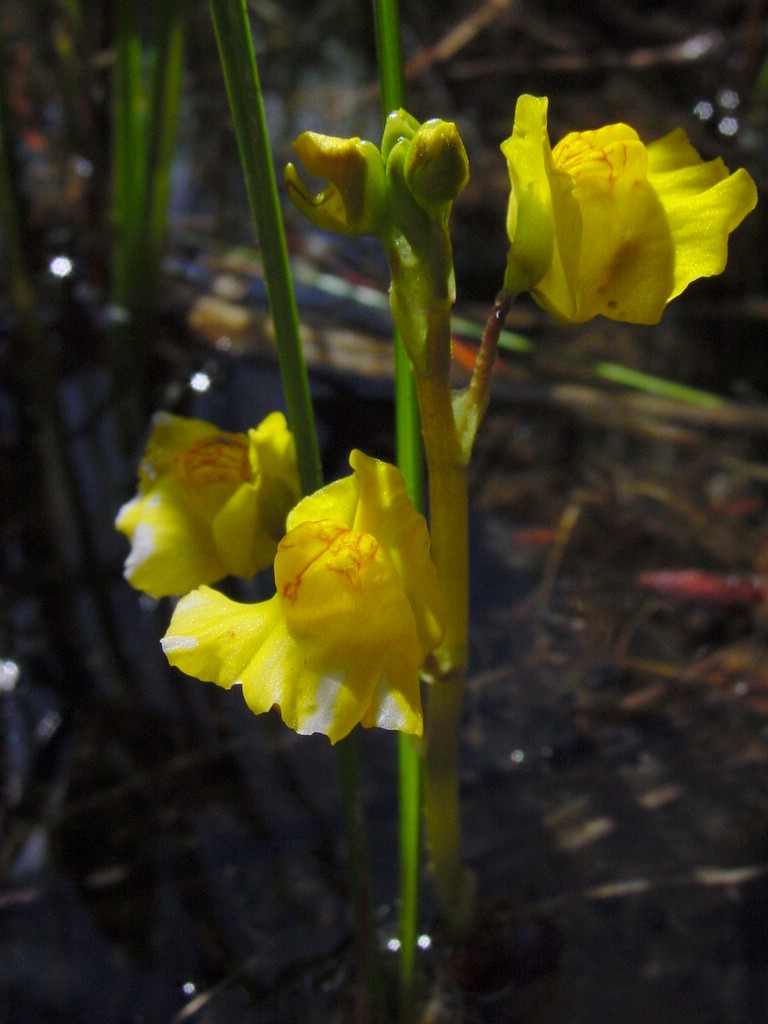
In summer, stout stalks rise a few inches above the water, each topped with several bright yellow, snapdragon-like flowers. It belongs to the bladderwort family (Lentibulariaceae), with the butterworts. Older books treat it as part of the Eurasian Utricularia vulgaris, as Utricularia vulgaris subsp. macrorhiza; North American botanists now recognize it as a separate species, which also grows in northeastern Asia.
Common bladderwort is the most widespread bladderwort in the United States, found from Alaska to Florida and from Maine to California. It is an excellent native plant for wildlife ponds, where it shelters small aquatic animals and adds a summer show of yellow flowers. This guide covers how to identify it, how its traps work, where it grows, and how to grow it.
Identification
Common bladderwort is often noticed first as a tangle of fine, feathery green stems in the water, or as yellow flowers that seem to rise straight out of a pond. Lift a stem and look for the tiny, round bladders on the leaves.
Growth Habit
It is a perennial, rootless aquatic plant that floats freely just below the surface. The main stems are often 1 to 3 feet long, and sometimes much longer, branching to form loose mats. In fall the stem tips form dense, bristly winter buds (turions) that sink to the bottom and sprout again in spring.
Leaves & Traps
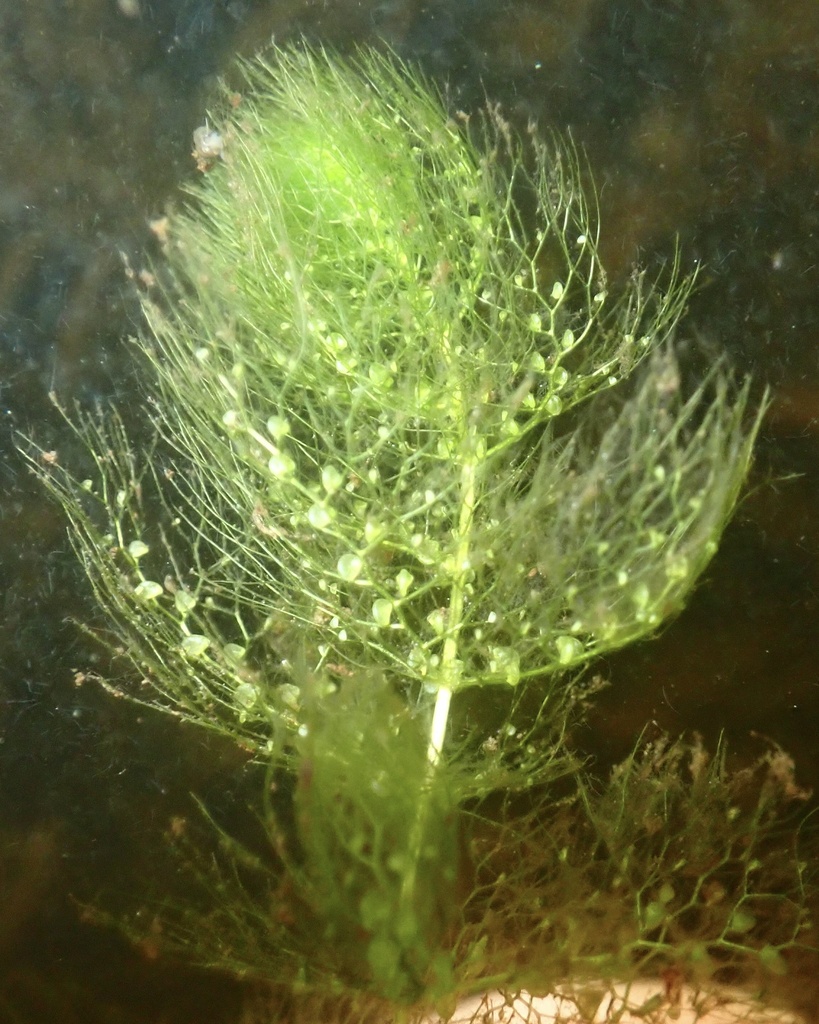
The leaves are alternate, about 1/2 to 2 inches long, and divided many times into hair-like segments with tiny bristles along the edges. Many small, round bladders, mostly 1/16 to 1/8 inch across, are attached to the leaf segments. Each bladder has a trapdoor surrounded by trigger hairs: when a tiny animal touches them, the door opens and water rushes in, sucking the prey inside in a fraction of a second.
Flowers
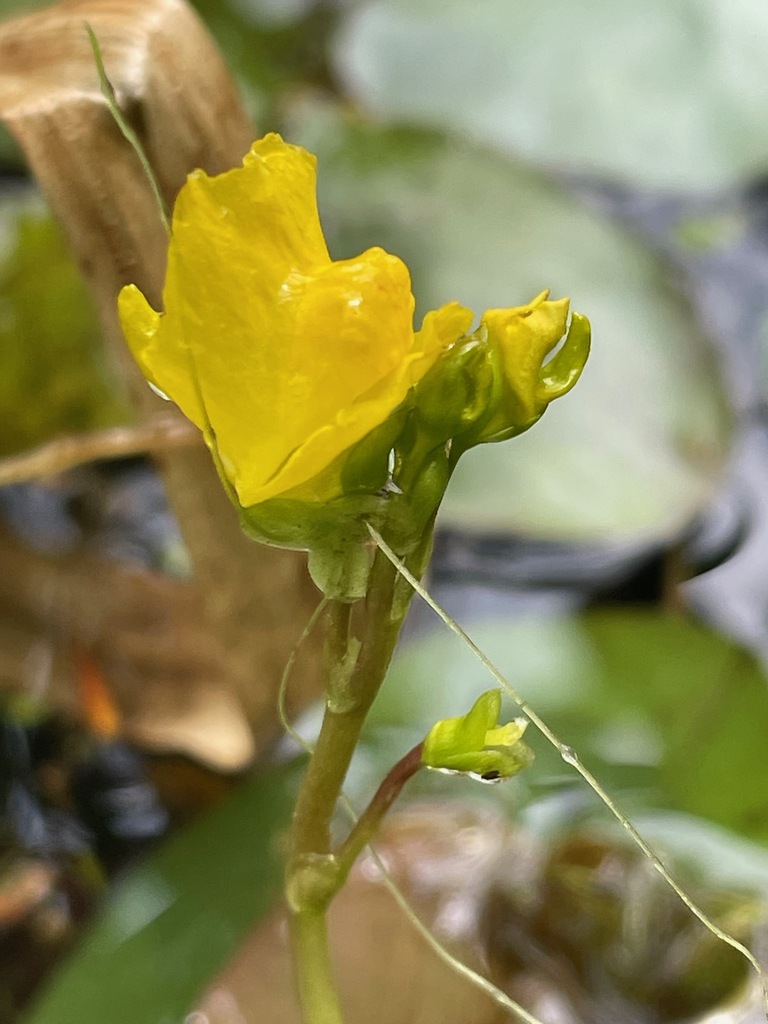
The flowers are held on a stout, leafless stalk 2 to 10 inches above the water, usually with 6 to 20 flowers. Each flower is bright yellow, about 1/2 to 3/4 inch long, with a broad lower lip, a raised palate often streaked with reddish brown, and a curved spur beneath. Bloom time is mainly June to August, into September in the south.
Fruit & Seeds
The flowers are followed by small, round capsules on curved stalks, containing many tiny seeds. Seed production varies, and the plant spreads mainly by stem fragments and winter buds.
Look-alikes
Purple bladderwort (Utricularia purpurea) has purple flowers and leaves in whorls. Smaller yellow bladderworts, such as flatleaf and lesser bladderwort (Utricularia intermedia and U. minor), have much smaller flowers and fewer, finer leaves, and humped bladderwort (U. gibba) forms fine, thread-like mats. Swollen bladderwort (U. inflata) has a float of swollen, spoke-like branches under the flower stalk. Non-carnivorous water plants such as coontail and water-milfoil have similar feathery leaves but no bladders.
Quick Facts
| Scientific Name | Utricularia macrorhiza Leconte |
| Family | Lentibulariaceae (bladderwort family) |
| Plant Type | Free-floating carnivorous aquatic perennial |
| Mature Height | Flower stalks 2–10 in above water |
| Mature Spread | Stems 1–3 ft or more; forms floating mats |
| Growth Rate | Fast |
| Sun Exposure | Full sun to part shade |
| Water Needs | Aquatic; still or slow-moving water |
| Soil Type | None needed; floats in water over mucky or sandy bottoms |
| Soil pH | Acidic to neutral water, about 5.5–7.5 |
| Bloom Time | June–August (to September in the south) |
| Flower Color | Bright yellow, often with reddish-brown streaks |
| Fall Color | None; forms winter buds that sink in fall |
| Fruit | Small round capsule with many tiny seeds |
| Deer Resistant | Yes; an aquatic plant that deer rarely reach |
| USDA Hardiness Zones | 2–10 |
Native Range
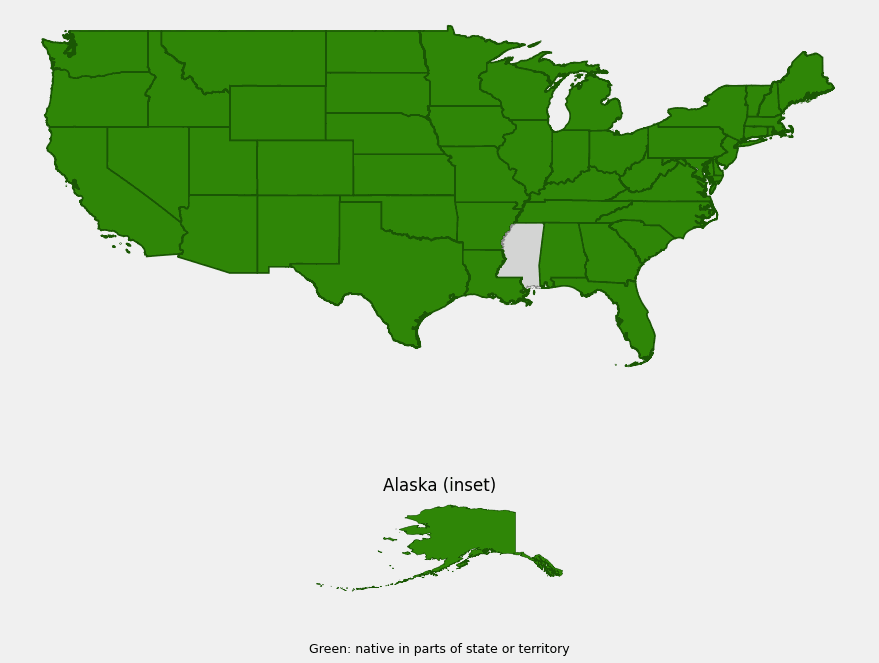
Common bladderwort has one of the widest ranges of any North American aquatic plant. USDA PLANTS lists it as native in Alaska and 47 of the lower 48 states, every one except Mississippi, and in nearly every Canadian province and territory, from British Columbia and the Yukon to Labrador and Newfoundland. It also grows in northeastern Asia.
It is most common in the glaciated North, from New England and the Great Lakes across the northern Plains to the Rocky Mountains, the Pacific Northwest and Alaska, where it grows in countless lakes, ponds and beaver wetlands. Farther south it is more scattered, in mountain lakes of the West, natural ponds of the Southeast, and oxbows and reservoirs on the coastal plain.
It grows in still or slowly moving fresh water, usually less than about 6 feet deep: ponds, lake margins, marshes, bogs and fens, beaver ponds, ditches and quiet backwaters of streams. It is found from sea level to high mountain lakes in the West, and it often grows with water lilies, pondweeds and other floating-leaved plants.
📋 Regional plant lists featuring Common Bladderwort: New York, Pennsylvania & Northern New Jersey · Idaho, Eastern Oregon & Eastern Washington · Ohio & Indiana · Montana & Wyoming · Michigan, Wisconsin & Eastern Minnesota · Kentucky & Tennessee · Nebraska, Kansas & Eastern Colorado · Utah & Western Colorado · Connecticut, Massachusetts & Rhode Island · New Hampshire, Maine & Vermont · Maryland, Virginia & West Virginia · Delaware, Southern New Jersey & Long Island · Arizona & New Mexico · Illinois, Iowa & Missouri · Alabama, Georgia & Mississippi · Alaska · North & South Florida · North & South Carolina · Arkansas, Louisiana, Eastern Oklahoma & Eastern Texas · North Dakota, South Dakota & Western Minnesota · Western Oregon & Western Washington · California & Nevada
Growing & Care Guide
Common bladderwort is one of the easiest carnivorous plants to grow, as long as you have a pond or a large, still water container. It needs no soil and no feeding; it catches its own food from the tiny animals that live in the water. Plants are occasionally sold by native aquatic and carnivorous plant nurseries. Never collect it from protected wetlands, and avoid moving plants between water bodies outside your area, since fragments can carry other organisms.
Light
It grows and flowers best in full sun to part shade. In shady water it grows thinly and seldom flowers.
Soil & Water
It floats freely and needs no soil, but it does best in clean, still or slowly moving water with a muddy or peaty bottom, which supports the small animals it eats. Soft, slightly acidic to neutral water is ideal. Avoid adding fertilizer: it doesn’t need it, and the algae that fertilizer encourages can smother the plant.
Planting Tips
Simply place a healthy section of stem, or a few winter buds, in a pond or a tub at least 1 to 2 feet deep. It grows well among water lilies, which shade out algae without blocking the plant. In a small container, add some pond water or mud to bring in the tiny animals it feeds on.
Pruning & Maintenance
No pruning is needed. If it spreads too thickly, scoop out excess stems with a net and add them to compost. In cold climates it forms winter buds and sinks to the bottom in fall; leave them in the pond, where they survive the winter under the ice and sprout again in spring.
Propagation
It is easiest to propagate from stem fragments, which grow into new plants, or from winter buds collected in fall and kept cool in water over winter. It can also be grown from seed, but this is rarely necessary.
Landscape Uses
- Wildlife ponds: cover for tadpoles, small fish and aquatic insects
- Water gardens: summer yellow flowers rising from the water
- Carnivorous plant collections: a hardy, easy-to-grow aquatic carnivore
- Education: a fascinating plant for studying trapping under a hand lens
- Natural mosquito control: its traps catch mosquito larvae in still water
Wildlife & Ecological Value
Common bladderwort is both a predator and a home for small aquatic animals, and its flowers feed pollinators above the water.
For Pollinators
The yellow flowers are pollinated mainly by bees, which land on the lower lip and push past the raised palate to reach nectar in the spur. Smaller insects such as flies also visit the flowers.
For Birds
Ducks and other waterfowl eat bladderwort stems and the invertebrates that live among them. Its tangled mats are rich feeding grounds for ducklings and wading birds.
For Mammals
Muskrats and moose feed on submerged aquatic plants, including bladderworts, in northern lakes and ponds.
Ecosystem Role
Its dense, feathery stems shelter tadpoles, small fish, insect larvae and other invertebrates, and support algae and microscopic organisms that are food for many other animals. Its traps catch water fleas, copepods and mosquito larvae, recycling nutrients in nutrient-poor water.
Cultural & Historical Uses
The genus name Utricularia comes from the Latin utriculus, a small bag or bladder, after the traps. The species name macrorhiza means “large root”, even though the plant has no true roots; the name probably refers to the long, root-like stems. It was described by John Eatton Le Conte in the early nineteenth century.
Bladderworts puzzled naturalists for a long time. In the 1870s, Charles Darwin and his contemporaries studied how their bladders captured prey, and Darwin described them in his book Insectivorous Plants. In the 1880s, naturalists in Britain and the United States reported that bladderworts could even trap newly hatched fish fry, and a U.S. Fish Commission illustration of a “fish-catching bladderwort” from that era is still widely reproduced.
Today the bladderwort trap is known as one of the fastest movements in the plant kingdom: the trapdoor opens and closes in about a millisecond. Common bladderwort is often the first carnivorous plant that people in the North discover for themselves, in a farm pond or a canoe-country lake.
Frequently Asked Questions
Is common bladderwort carnivorous?
Yes. Its underwater leaves carry many tiny bladder traps that suck in water fleas, copepods, mosquito larvae and other tiny animals, which are then digested.
Does common bladderwort have roots?
No. It is a free-floating, rootless plant. The long stems drift just below the surface, and only the flower stalks rise above the water.
Is common bladderwort the same as Utricularia vulgaris?
It was long treated as part of the Eurasian Utricularia vulgaris, but North American botanists now recognize it as a separate species, Utricularia macrorhiza.
Can I grow common bladderwort in my pond?
Yes. Place a stem section or winter buds in still, sunny water. It needs no soil or fertilizer and survives cold winters as winter buds on the pond bottom.
Where does common bladderwort grow?
It grows in ponds, lakes, bogs and slow streams across almost all of the United States, Alaska and Canada, and also in northeastern Asia.

Looking for a nursery that carries Common Bladderwort?
Browse our native plant nursery directory: Alabama, Alaska, Arizona & Arkansas · California · Colorado, Connecticut, Delaware, Florida & Georgia · Idaho, Illinois, Indiana, Iowa & Kansas · Kentucky, Louisiana, Maine, Maryland, Massachusetts, Michigan, Minnesota, Missouri & Montana · Nebraska, Nevada, New Hampshire, New Jersey, New Mexico, New York, North Carolina, North Dakota, Ohio & Oklahoma · Oregon · Pennsylvania, Rhode Island, South Carolina, South Dakota, Tennessee, Texas, Utah, Vermont & Virginia · Washington · West Virginia, Wisconsin & Wyoming

