
Common Mare’s Tail (Hippuris vulgaris)
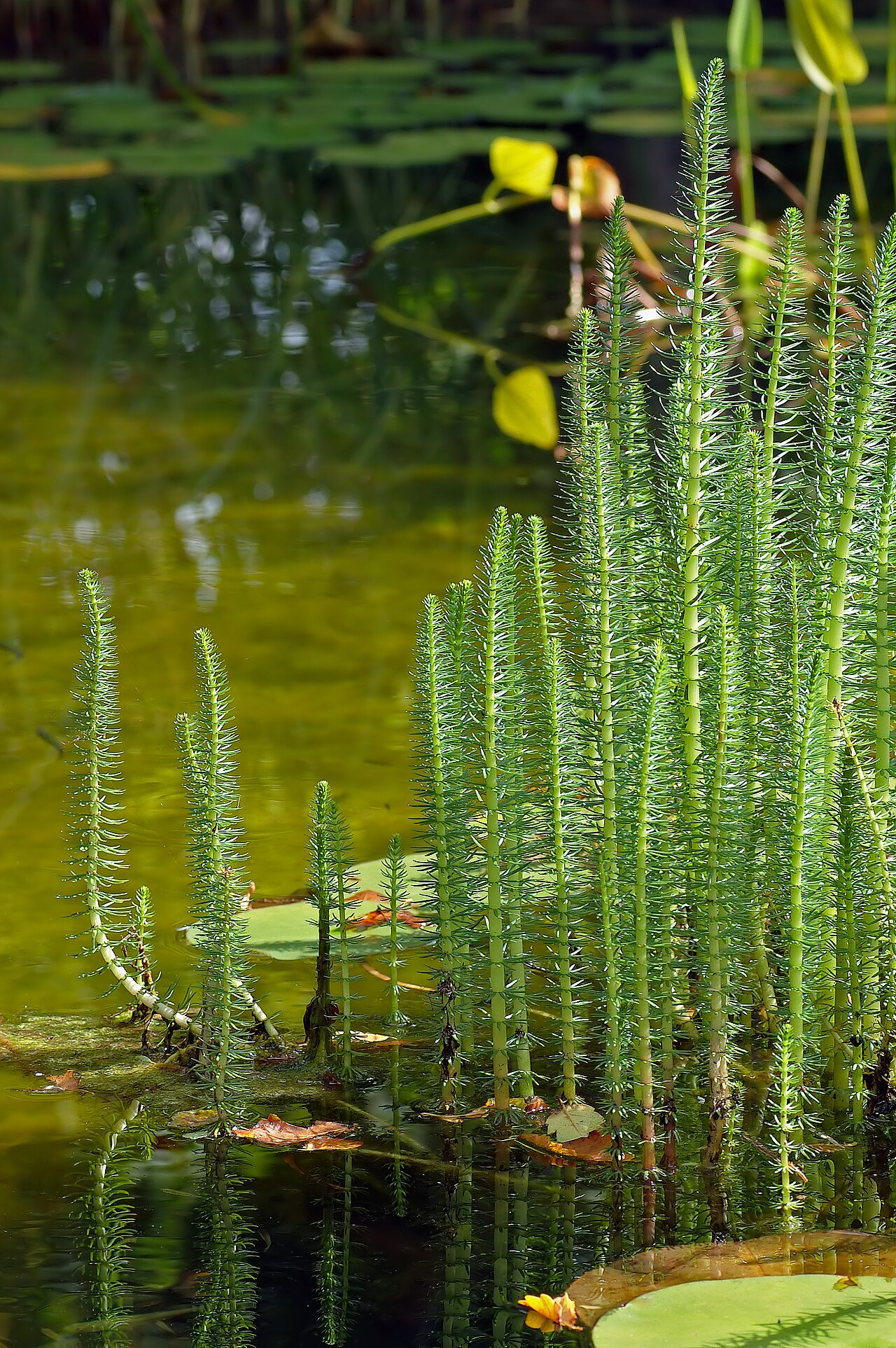
Hippuris vulgaris, Common Mare’s Tail (also written mare’s-tail or marestail), is a native aquatic perennial of cold and temperate wetlands around the Northern Hemisphere. It grows from creeping rhizomes in the mud of ponds, lake margins, slow streams and marshes, and sends up unbranched stems ringed with tight whorls of narrow, needle-like leaves. Above the water the stems stand stiffly upright, looking like little green bottlebrushes or miniature fir trees; below the water they carry longer, limp leaves that sway in the current.
Despite the look-alike stems, mare’s tail is not a horsetail. Horsetails (Equisetum) are spore-bearing relatives of ferns, while mare’s tail is a true flowering plant. Its flowers are tiny and petal-less, tucked into the leaf axils, and it is now placed in the plantain family (Plantaginaceae), a long way from the horsetails. The name Hippuris comes from Greek hippos (horse) and oura (tail).
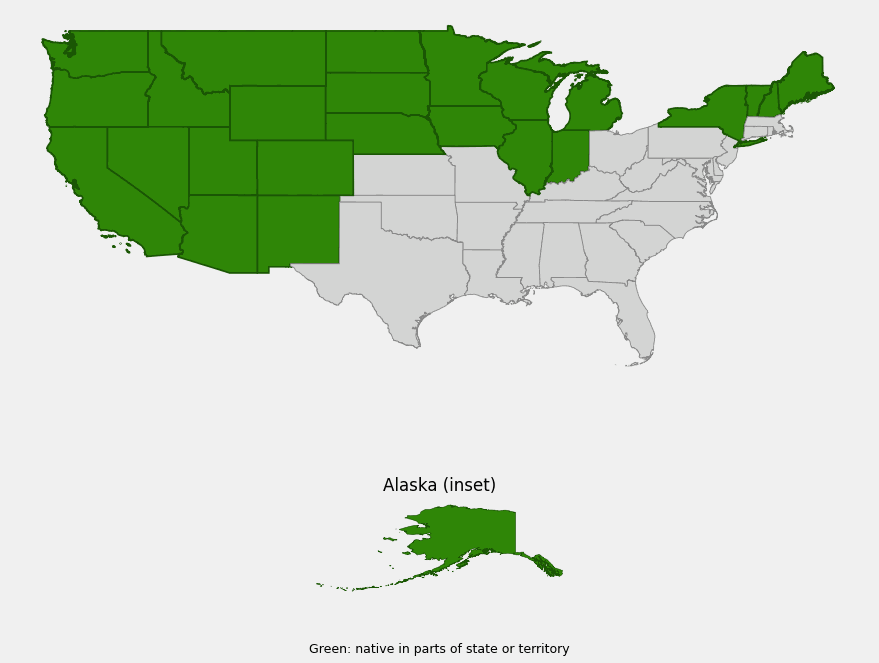
In the United States it grows in Alaska, across the West from Washington and California to New Mexico, and through the northern tier of states from the Dakotas to Maine. This guide explains how to identify it, how it differs from horsetails and water milfoils, where it grows, how to use it in a pond or wetland garden without letting it take over, and why it matters to waterfowl and other wetland wildlife.
Identification
Mare’s tail is easy to identify once you look closely at the leaves. The stems carry true leaves in whorls, and it has tiny flowers. These two features separate it from horsetails, which it resembles at a glance.
Stems & Rhizomes
The plant spreads by stout, creeping rhizomes buried in soft mud, which root at the nodes and send up many erect stems. The stems are unbranched, round and somewhat spongy, usually 8 to 24 inches long. In shallow water they stand about 8 to 12 inches above the surface; in deeper or flowing water they may be longer and partly or entirely submerged. Stems are bright green and sometimes flushed reddish toward the base.
Leaves
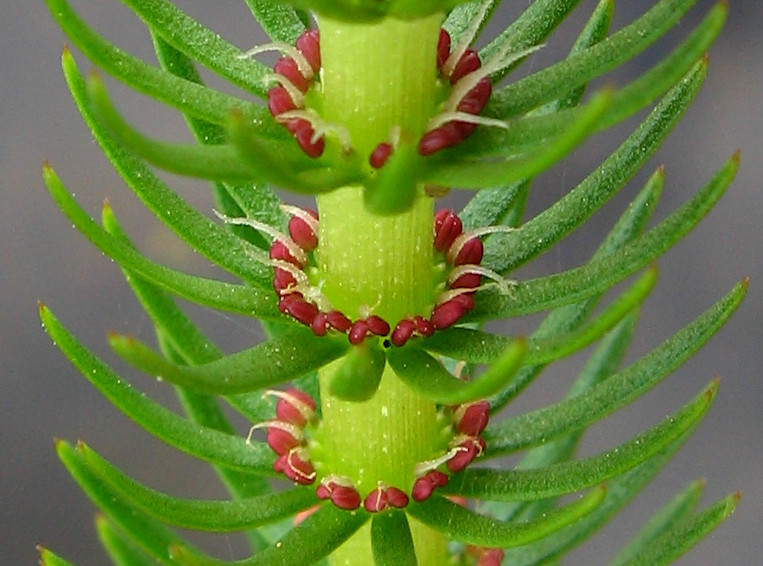
Narrow, linear leaves grow in whorls of 6 to 12 at each node, giving the stem its bottlebrush look. Emergent leaves are stiff, about 1/4 to 1 inch long and only a few millimeters wide, with a smooth margin and a slightly pointed tip. Submerged leaves are longer, thinner and limp, and plants in streams can look quite different from plants on a muddy pond edge. The leaves are simple and undivided, which separates mare’s tail from water milfoils (Myriophyllum), whose whorled leaves are finely divided like a feather.
Flowers
Flowers appear from about June to August on the emergent part of the stem, one in the axil of each leaf. They are among the simplest flowers of any North American plant: there are no petals, the calyx is reduced to a faint rim, and each flower has a single stamen with a reddish anther and a single slender style. They are pollinated by wind. Not every stem flowers, and submerged plants often stay sterile.
Fruit
Each fertilized flower becomes a tiny, one-seeded, nutlet-like fruit about 1/16 inch (roughly 2 mm) long. The fruits sit in the leaf axils and drop into the water in late summer and fall, where they may float and are eaten and spread by waterfowl.
Look-alikes
Horsetails such as Field Horsetail and Smooth Horsetail also have jointed-looking stems, sometimes with whorls of green branches. But horsetail stems are hollow and ridged, the only true leaves are tiny scales fused into a toothed sheath at each joint, the whorled “needles” are actually branches, and the plants reproduce from cone-like spore heads, never flowers. Water milfoils have feathery, divided leaves. Two other Hippuris species grow in Alaska and the far north: four-leaf mare’s tail (H. tetraphylla) of coastal salt marshes has whorls of only 4 to 6 broad leaves, and mountain mare’s tail (H. montana) is a small, delicate plant of wet mountain seeps in Alaska and the Pacific Northwest. Finally, “marestail” is also a farm name for horseweed, an unrelated weedy aster of dry fields.
Quick Facts
| Scientific Name | Hippuris vulgaris |
| Family | Plantaginaceae (plantain family); formerly Hippuridaceae |
| Plant Type | Emergent to submerged aquatic herbaceous perennial with creeping rhizomes |
| Mature Height | 8–24 in stems; usually 8–12 in above the water surface |
| Mature Spread | Spreads indefinitely by rhizomes; forms colonies |
| Growth Rate | Moderate to fast |
| Sun Exposure | Full sun to partial shade |
| Water Needs | Aquatic; shallow standing or slow-moving water, or saturated mud |
| Soil Type | Soft mud, silt or peat; often over marl or other mineral-rich substrates |
| Soil pH | About 6.0–8.5 (prefers neutral to alkaline water) |
| Bloom Time | June–August |
| Flower Color | Inconspicuous; greenish with reddish anthers, no petals |
| Fall Color | None notable; emergent stems die back in fall |
| Fruit | Tiny one-seeded nutlet in each leaf axil |
| Deer Resistant | Rarely browsed by deer; waterfowl eat the shoots and fruit |
| USDA Hardiness Zones | 2–8 |
Native Range
Common mare’s tail is circumboreal, native across northern Europe, Asia and North America, south to the Tibetan Plateau and north into Greenland and the Arctic. In North America it ranges throughout Alaska and Canada. USDA PLANTS records it from 25 U.S. states: Alaska; the western states of Washington, Oregon, California, Nevada, Idaho, Montana, Wyoming, Utah, Colorado, Arizona and New Mexico; the northern plains of North and South Dakota and Nebraska; the Great Lakes states and upper Midwest (Minnesota, Wisconsin, Michigan, Iowa, Illinois and Indiana); and the Northeast in New York, Vermont, New Hampshire and Maine.
Its range follows cold water and glaciated or mountain country. In Alaska and Canada it is common in tundra ponds, beaver ponds, lake margins and slow streams. In the lower 48 states it is most frequent in the northern prairie pothole region, the Great Lakes area and the mountains of the West, where it grows in subalpine lakes and spring-fed streams. At the southern edge of its range in Arizona, New Mexico, Iowa, Illinois and Indiana it is local, usually found in fens, spring runs and cold mountain ponds.
Mare’s tail prefers clear, cool, mineral-rich water that is neutral to alkaline, and it is often found in calcareous fens and marl lakes. It is less common in strongly acidic bog water. It grows from the shoreline mud out to water about 3 feet deep, and in some cold, clear streams it forms long, fully submerged streamers.
📋 Regional plant lists featuring Common Mare’s Tail: Alaska · Arizona & New Mexico · California & Nevada · Nebraska, Kansas & Eastern Colorado · Illinois, Iowa & Missouri · Idaho, Eastern Oregon & Eastern Washington · Western Oregon & Western Washington · Ohio & Indiana · New Hampshire, Maine & Vermont · Michigan, Wisconsin & Eastern Minnesota · Montana & Wyoming · North Dakota, South Dakota & Western Minnesota · New York, Pennsylvania & Northern New Jersey · Delaware, Southern New Jersey & Long Island · Utah & Western Colorado
Growing & Care Guide
Mare’s tail is an easy, hardy plant for natural ponds and wetland gardens in cool climates, and it looks good from spring to fall. It does spread steadily by rhizomes, so give it a contained spot or a pond big enough to share.
Light
Full sun gives the densest, most upright stems. It tolerates partial shade along a wooded shore but grows thinner and leggier there.
Soil & Water
Plant it in mud or in shallow water from about 2 to 12 inches deep; it will tolerate up to about 3 feet. It prefers clear, cool, still or slow-moving water that is neutral to alkaline, and a muddy, silty or peaty bottom. Warm, stagnant water in hot-summer climates suits it poorly, and it does best where summers are cool. No fertilizer is needed and nutrient-rich water mainly encourages algae.
Planting Tips
Plant rhizome sections or potted divisions in spring, pressing them into the mud or setting them in an aquatic basket of heavy loam topped with gravel. Containers are the easiest way to keep it in bounds in a small pond. In a larger natural pond, plant it in the shallows where it can form a band between the shore plants and open water.
Pruning & Maintenance
Cut back or pull dead stems in late fall or early spring if you want a tidy pond; otherwise leave them as winter cover for aquatic insects. In a small pond, divide and thin the colony every two or three years by lifting and cutting the rhizomes. Remove any spread you don’t want before it roots deeply.
Propagation
Division is the easiest method: cut rhizome pieces with a few stems in spring and replant them. Stem cuttings also root readily when pressed into mud. Seed germinates slowly and unevenly and is rarely used.
Landscape Uses
- Natural ponds and water gardens: a fine-textured vertical accent for shallow margins in cool climates
- Wetland and pond restoration: in cold, mineral-rich ponds and fens within its native range
- Wildlife ponds: cover for aquatic insects, amphibian larvae and small fish, and food for waterfowl
- Stormwater and shallow basins: in cool northern regions, where the water stays fairly clear
- Containers and tub ponds: a contained way to grow it without letting the rhizomes spread
Wildlife & Ecological Value
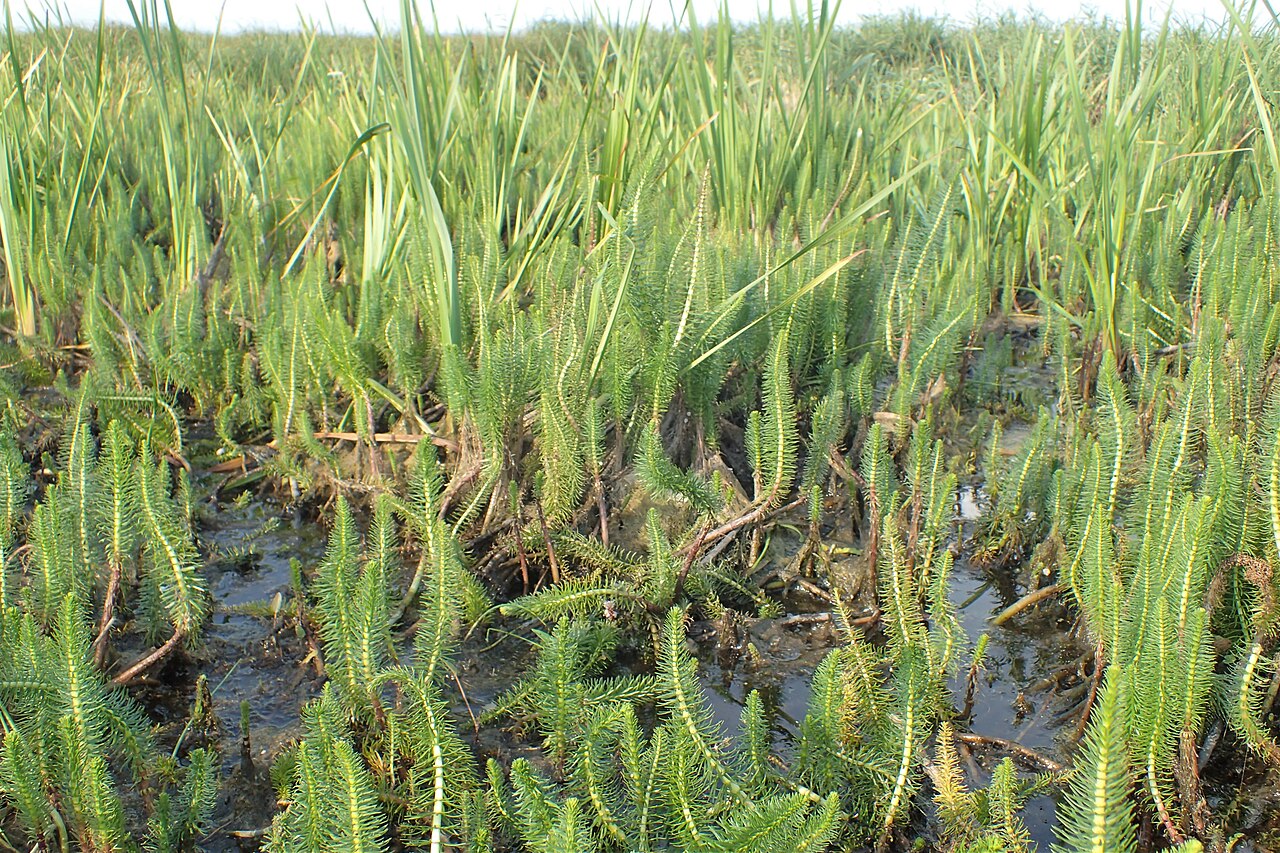
Mare’s tail is a modest-looking plant, but in northern wetlands it is an important part of the shallow-water habitat where waterfowl, moose and aquatic insects feed.
For Pollinators
Mare’s tail is wind-pollinated and offers little to bees or butterflies. Its underwater stems, however, are covered with a film of algae and tiny invertebrates, and they shelter the larvae of dragonflies, damselflies, mayflies, caddisflies and other aquatic insects.
For Birds
Ducks, geese and swans eat the fruits and the tender shoots, and waterfowl help spread the seeds between ponds. Dense stands give cover to young waterbirds, and in the prairie pothole region they are part of the mix of emergent plants that breeding ducks use.
For Mammals
In Alaska and Canada, moose wade into shallow ponds in summer to feed on aquatic plants, and the shallow, plant-filled water where mare’s tail grows is typical moose feeding habitat. Muskrats graze a wide range of emergent plants in the same shallows.
Ecosystem Role
The tight stands slow water movement, trap silt and stabilize soft mud along shorelines. Like many wetland plants, mare’s tail carries air through spongy tissue to its roots. Research on the Tibetan Plateau found that stands of it are a major pathway for methane to escape from wetland mud to the air. In nutrient-rich ditches and canals it can sometimes become dense enough to slow the flow of water.
Cultural & Historical Uses
Carl Linnaeus named Hippuris vulgaris in 1753, and the plant has been known to European botanists for centuries. Its stems inspired the common names mare’s tail and, in some older European works, water horsetail, which reflects the long confusion with Equisetum. For much of the twentieth century it was placed in its own small family, Hippuridaceae, before DNA studies placed it in the plantain family, together with plantains, speedwells and, surprisingly, many former figwort-family plants.
In northern regions where mare’s tail is abundant, it has been gathered as a wild green by people living close to the land, and young shoots appear in some wild-food references. Anyone collecting it should be sure of the identification and the water quality, since aquatic plants take up whatever is in the water around them.
For botanists and ecologists, mare’s tail is mainly an indicator of cold, clear, mineral-rich water. Its presence in a pond or fen at the southern edge of its range often marks a spring-fed or groundwater-fed site, so those scattered southern stands are worth protecting.
Frequently Asked Questions
Is mare’s tail the same as horsetail?
No. Horsetails (Equisetum) are spore-bearing plants related to ferns, with hollow, ridged stems and tiny scale leaves fused into sheaths. Mare’s tail is a flowering plant with spongy stems, true leaves in whorls, and tiny flowers in the leaf axils. They often grow in similar wet places, which is part of the confusion.
Is mare’s tail invasive?
Not in North America, where it is native. It spreads steadily by rhizomes and can fill a small pond or a ditch, so it is best grown in containers or in larger ponds. Don’t move it into water bodies outside its native range.
How deep should I plant mare’s tail?
From wet mud at the edge down to about 12 inches of water is ideal. It will tolerate water up to about 3 feet deep, but deeper plants are often fully submerged with limp leaves.
Is mare’s tail the same as the weed called marestail?
No. Farmers use “marestail” for horseweed, a tall, weedy plant in the aster family that grows in dry fields and is known for herbicide resistance. Common mare’s tail is an aquatic plant of ponds and marshes.
Does mare’s tail grow in warm climates?
It does best in cool and cold climates and is native mainly to the northern and mountain states. In warm southern regions it usually struggles in summer heat and warm, still water.

Looking for a nursery that carries Common Mare’s Tail?
Browse our native plant nursery directory: Alaska & Arizona · California · Colorado · Idaho, Illinois, Indiana & Iowa · Maine, Michigan, Minnesota & Montana · Nebraska, Nevada, New Hampshire, New Mexico, New York & North Dakota · Oregon · South Dakota, Utah & Vermont · Washington · Wisconsin & Wyoming

