
Tapered Rosette Grass (Dichanthelium acuminatum)
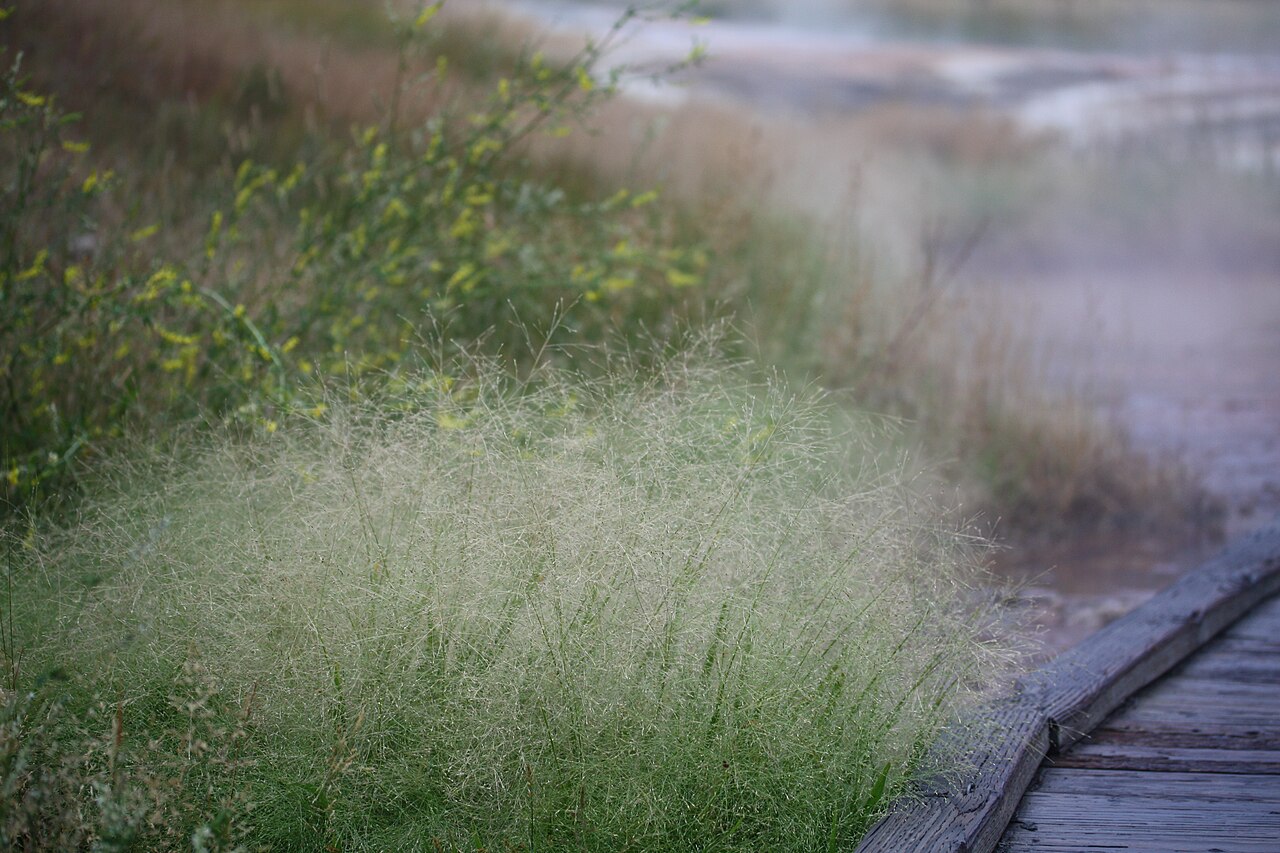
Dichanthelium acuminatum, known as Tapered Rosette Grass, woolly rosette grass or western panicgrass, is one of the most widespread native grasses in the Americas. It is a small, soft-haired, cool-season bunchgrass that grows in every one of the lower 48 states, in Puerto Rico, across southern Canada, and south through Mexico and the Caribbean to South America. Most people walk past it without noticing, but botanists know it as one of the most variable grasses on the continent, and ecologists know one form of it as the grass that grows in the scalding soil around hot springs.
Like other members of the rosette grass genus Dichanthelium, it has a three-part year. In fall and winter it rests as a flat rosette of short, broad leaves pressed to the ground. In late spring it sends up leafy stems topped with an open, airy panicle of tiny rounded spikelets. Then in summer and fall those stems branch from the lower joints into a bushy clump that carries small, hidden panicles which pollinate themselves. The genus name comes from the Greek for “twice-flowering,” a reference to this habit.
Tapered rosette grass belongs to the grass family (Poaceae) and was long included in the big panicgrass genus Panicum, so older field guides list it as Panicum acuminatum, P. lanuginosum or one of dozens of other names. This guide explains how to identify it, where it grows, and why this modest grass is useful in meadows, woodland edges, restoration seed mixes and wildlife plantings.
Identification
Rosette grasses are notoriously hard to tell apart, and D. acuminatum is the hardest of all because it varies so much from place to place. Look for a combination of features: a winter rosette of short, broad leaves, soft spreading hairs on the stems and leaf sheaths, and small spikelets in an open spring panicle.
Growth Habit
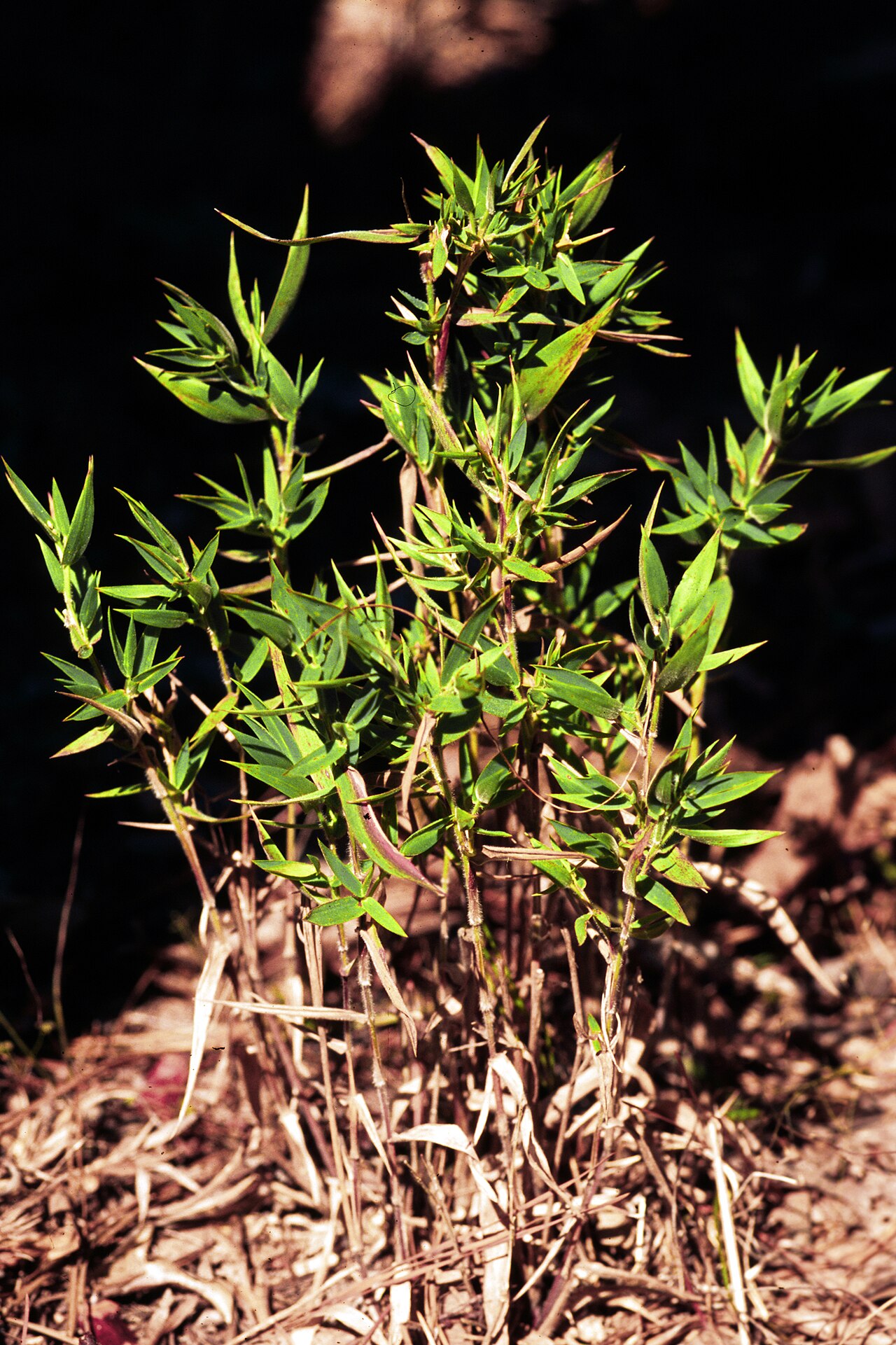
Plants form loose to dense tufts usually 8 to 30 inches tall, occasionally to about 3 feet. The spring (vernal) stems are erect or arching and unbranched, with a single terminal panicle. After that first flowering, the stems branch repeatedly at the middle and lower nodes, so a single clump looks very different in June than it does in September. By late fall the plant has produced a new basal rosette that stays green or purplish through the winter in mild climates.
Leaves
The winter rosette leaves are short, broad and lance-shaped, often only 1 to 3 inches long. Stem leaves are larger, typically 2 to 4 inches long and about ¼ to ½ inch wide, tapering to a sharp point, which gives the plant its common name. In most forms the leaf sheaths, stems and at least the lower leaf surfaces are covered with soft, spreading or slightly woolly hairs, and the ligule is a fringe of hairs. Some varieties, especially in the West, are nearly hairless or velvety rather than shaggy.
Flowers & Panicle
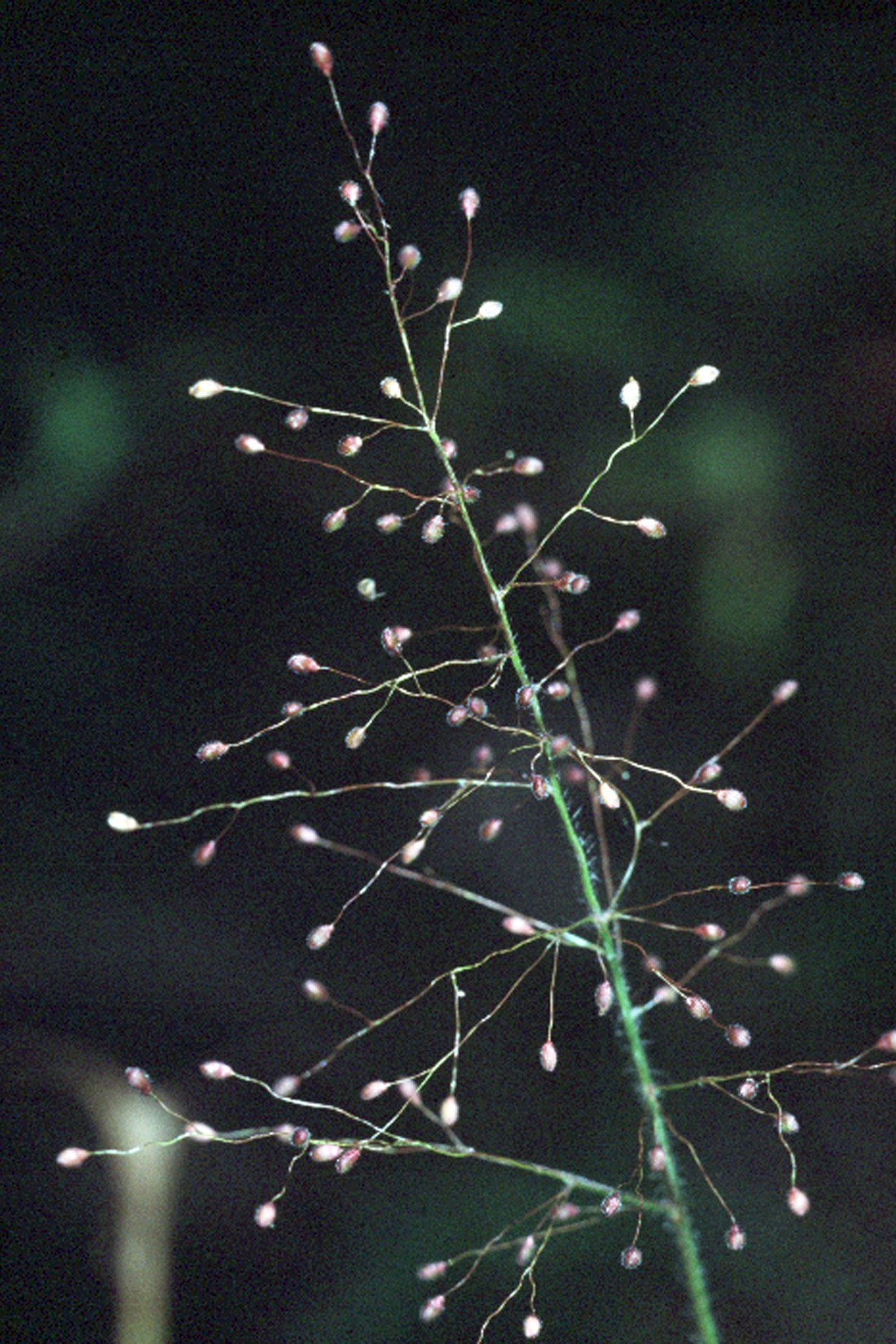
The spring panicle is open and diffuse, about 1½ to 4 inches long, with slender branches that hold small, egg-shaped spikelets only 1 to 2 millimeters long. The spikelets are green to dark purple when fresh and turn straw-colored as they ripen. Like other rosette grasses, the plant produces these “open” (chasmogamous) flowers mainly in spring. The later panicles on the branched summer stems are smaller and partly hidden in the leaf sheaths, and their flowers often stay closed and self-pollinate.
Look-alikes
Several other rosette grasses grow in the same places. Deertongue has much broader leaves and rough, warty sheaths. Bosc’s Panicgrass has broad leaves and larger spikelets about 4 millimeters long. Velvet Panicum is velvety, with sticky bands below the stem joints. Many specimens of D. acuminatum can only be named with a hand lens and a technical key, and even experts disagree about where to draw the lines between its varieties.
Quick Facts
| Scientific Name | Dichanthelium acuminatum (syn. Panicum acuminatum, P. lanuginosum, Dichanthelium lanuginosum) |
| Family | Poaceae (grass family) |
| Plant Type | Cool-season perennial bunchgrass |
| Mature Height | 8–30 in (occasionally to about 3 ft) |
| Mature Spread | 6–12 in |
| Growth Rate | Moderate |
| Sun Exposure | Full sun to partial shade |
| Water Needs | Low to moderate; tolerates both dry sand and seasonally wet soil |
| Soil Type | Sandy, loamy or gravelly soils; also peaty wet ground and thermal soils |
| Soil pH | About 4.5–7.5 |
| Bloom Time | Open panicles mostly April–July; closed flowers into fall |
| Flower Color | Inconspicuous; tiny green to purple spikelets turning straw-colored |
| Fall Color | Tan to purplish; green to purple winter rosette |
| Fruit | Small grain (caryopsis) in a rounded spikelet |
| Deer Resistant | Moderately; deer graze the winter rosettes |
| USDA Hardiness Zones | 3–11 |
Native Range
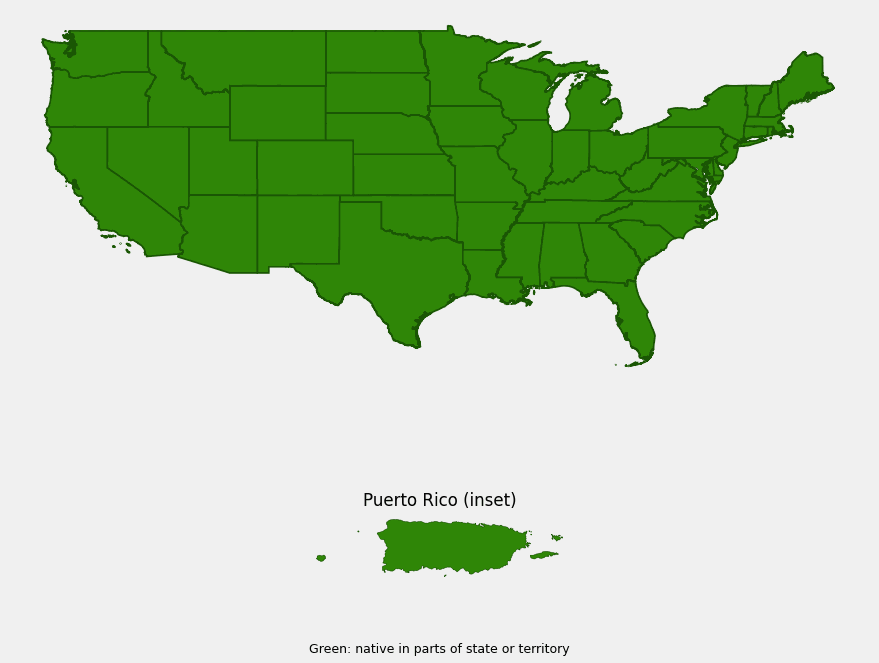
USDA PLANTS records tapered rosette grass as native in all 48 contiguous states, Puerto Rico and nine Canadian provinces from British Columbia to Nova Scotia. It is also native through Mexico, Central America and the West Indies into South America; the species was first described by Olof Swartz from Jamaica. In Hawaii it is an introduced grass, so Hawaii is not part of its native range.
Across this huge area it grows in a wide range of open or lightly shaded places: dry sandy oak and pine woods, old fields, prairies, savannas, pine barrens, sandhills, roadsides and clearings, as well as damp meadows, shores and the edges of bogs. In the East and South it is one of the commonest grasses of poor, sandy soil. In the West it is more often found near water, in moist meadows, along streams, and around warm springs.
Botanists have divided the species into many varieties or subspecies, and the Flora of North America recognizes about ten. Some of the best known are the widespread eastern var. acuminatum, var. fasciculatum (often called western panicgrass, the most widespread form in USDA records), var. lindheimeri of moist sandy places, and the thermal forms that grow around geothermal features in Yellowstone National Park and at The Geysers in northern California. The varieties overlap and intergrade, which is why a single “species” covers so much variation.
📋 Regional plant lists featuring Tapered Rosette Grass: North & South Florida · Alabama, Georgia & Mississippi · North & South Carolina · Maryland, Virginia & West Virginia · Kentucky & Tennessee · Arkansas, Louisiana, Eastern Oklahoma & Eastern Texas · South & West Texas · Illinois, Iowa & Missouri · Ohio & Indiana · Nebraska, Kansas & Eastern Colorado · North Dakota, South Dakota & Western Minnesota · Michigan, Wisconsin & Eastern Minnesota · New York, Pennsylvania & Northern New Jersey · Delaware, Southern New Jersey & Long Island · Connecticut, Massachusetts & Rhode Island · New Hampshire, Maine & Vermont · Idaho, Eastern Oregon & Eastern Washington · Western Oregon & Western Washington · California & Nevada · Arizona & New Mexico · Utah & Western Colorado · Montana & Wyoming · Puerto Rico
Growing & Care Guide
Tapered rosette grass is rarely sold as an ornamental, but it is easy to grow and often appears on its own in lawns, meadows and woodland edges. It is offered by some native seed companies as part of meadow and restoration mixes, and it is worth keeping when it volunteers, because it fills gaps between taller grasses and stays green through much of the winter.
Light
Full sun gives the densest clumps and the most flowering, but the plant also does well in the light shade of open oak and pine woods. In deep shade it becomes sparse.
Soil & Water
It prefers lean, well-drained sandy or loamy soil and tolerates poor, acidic ground where many other grasses struggle. Some forms also grow in damp or seasonally wet soil, so it suits rain gardens and swales as long as water does not stand for long periods. Once established it needs no watering in most regions. Do not fertilize; rich soil favors taller, more aggressive grasses that crowd it out.
Planting Tips
Sow seed on bare, lightly raked soil in fall or very early spring, or set out plugs in spring or fall. Because it is a cool-season grass, it grows mostly in spring and fall and can look tired during summer heat. Plant it with warm-season grasses such as little bluestem and with spring and fall wildflowers, so the planting has something growing in every season.
Pruning & Maintenance
Little care is needed. Leave the clumps standing through the growing season so the late, self-pollinated seeds ripen. Mow or cut meadows in late winter or very early spring, above the winter rosettes. Occasional burning or mowing keeps woody plants from shading it out, as fire did in its native savannas.
Propagation
The easiest method is seed, which the plant produces generously from both its spring and its later, closed flowers. Self-sown seedlings are common on bare soil. Established clumps can also be divided in early spring or fall.
Landscape Uses
- Meadows and prairie plantings: a low, cool-season grass that fills gaps between taller warm-season grasses
- Woodland edges and open shade: for the dappled light under oaks and pines
- Restoration and erosion control: on poor sandy soils, old fields, roadsides and reclaimed sites
- Rain gardens and swales: forms adapted to moist soil tolerate brief flooding
- Wildlife plantings: seed for ground-feeding birds and food for skipper caterpillars
Wildlife & Ecological Value
Small as it is, tapered rosette grass is a useful wildlife plant, largely because it grows almost everywhere and stays green when most other grasses are dormant.
For Pollinators
Grasses are wind-pollinated and the later flowers of rosette grasses pollinate themselves, so it offers no nectar. It matters to butterflies as a caterpillar food plant: the Lady Bird Johnson Wildflower Center lists it as a larval host of the northern broken-dash and southern broken-dash skippers, and rosette grasses in general feed the caterpillars of several other grass skippers.
For Birds
The small grains ripen over a long season, from early summer into fall, and are eaten by ground-feeding birds such as northern bobwhite, wild turkey, sparrows and juncos. The tufts also give cover to ground-nesting birds in open woods and old fields.
For Mammals
The green winter rosettes are grazed by white-tailed deer and rabbits at a time of year when little other green forage is available. Small mammals eat the seeds.
Ecosystem Role
Tapered rosette grass is an early colonizer of bare and disturbed sandy ground, where it helps hold soil. Its thermal forms have become famous in science: in Yellowstone National Park they grow in soils that can reach well over 100°F, and researchers found that this heat tolerance depends on a partnership with a fungus (Curvularia protuberata) living inside the grass, which is itself infected by a virus. Neither the grass nor the fungus survives such heat alone. This three-way partnership, described in the journal Science in 2007, is one of the best-known examples of a plant depending on its microbes for stress tolerance.
Cultural & Historical Uses
Olof Swartz described the species from Jamaica in 1788 as Panicum acuminatum. During the early twentieth century, grass specialists such as A. S. Hitchcock and Agnes Chase split North American rosette grasses into a very large number of species, and many of the names now treated as varieties of D. acuminatum (for example Panicum lanuginosum, P. implicatum, P. lindheimeri and P. huachucae) were described then. Frank Gould and C. A. Clark moved the species to Dichanthelium in 1978, and later botanists lumped most of the earlier species back together.
There is little record of specific traditional uses of this grass, which is not surprising for a small, common plant mixed into many grasslands. Like other native grasses, it was part of the forage that supported elk, deer and bison, and later livestock, on open range and in woodland pastures.
Today its main human value is ecological. It is one of the native grasses that land managers and restoration ecologists count on to recolonize disturbed sandy soils, and the thermal Yellowstone forms have made it a model plant for research on how microbes help plants survive heat. That research has influenced work on fungal partners that help crop plants tolerate heat and drought.
Frequently Asked Questions
Why is it called rosette grass?
In fall it produces a flat rosette of short, broad leaves at ground level, which stays green or purplish through the winter in many areas. In spring the rosette sends up the flowering stems. This winter rosette is the easiest way to recognize members of the genus Dichanthelium.
Is tapered rosette grass the same as “western panicgrass” or “woolly rosette grass”?
They are names for forms of the same species. USDA uses “western panicgrass” for var. fasciculatum and “tapered rosette grass” for the species as a whole, while “woolly rosette grass” and “woolly panicgrass” refer to hairy forms once called Panicum lanuginosum.
Is it a weed in lawns?
It often appears in thin, sandy lawns because it tolerates mowing and poor soil, but it is a native grass and causes no harm. If you want a uniform turf lawn, improving soil and mowing a little higher usually lets turf grasses outcompete it. In a meadow or native lawn, it is a welcome addition.
Does it really grow in hot springs?
Thermal forms grow in warm, steaming soil around hot springs and geysers in Yellowstone National Park and at The Geysers in California. Their heat tolerance depends on a fungus living inside the grass and on a virus that infects the fungus.
Is tapered rosette grass good for wildlife?
Yes. Ground-feeding birds such as bobwhite, turkeys and sparrows eat its seeds, deer and rabbits graze its winter rosettes, and it is a caterpillar food plant for broken-dash skippers.

Looking for a nursery that carries Tapered Rosette Grass?
Browse our native plant nursery directory: Alabama, Arizona & Arkansas · California · Colorado, Connecticut, Delaware, Florida & Georgia · Idaho, Illinois, Indiana, Iowa & Kansas · Kentucky, Louisiana, Maine, Maryland, Massachusetts, Michigan, Minnesota, Mississippi, Missouri & Montana · Nebraska, Nevada, New Hampshire, New Jersey, New Mexico, New York, North Carolina, North Dakota, Ohio & Oklahoma · Oregon · Pennsylvania, Rhode Island, South Carolina, South Dakota, Tennessee, Texas, Utah, Vermont & Virginia · Washington · West Virginia, Wisconsin & Wyoming

