
Smooth Blackberry (Rubus canadensis)
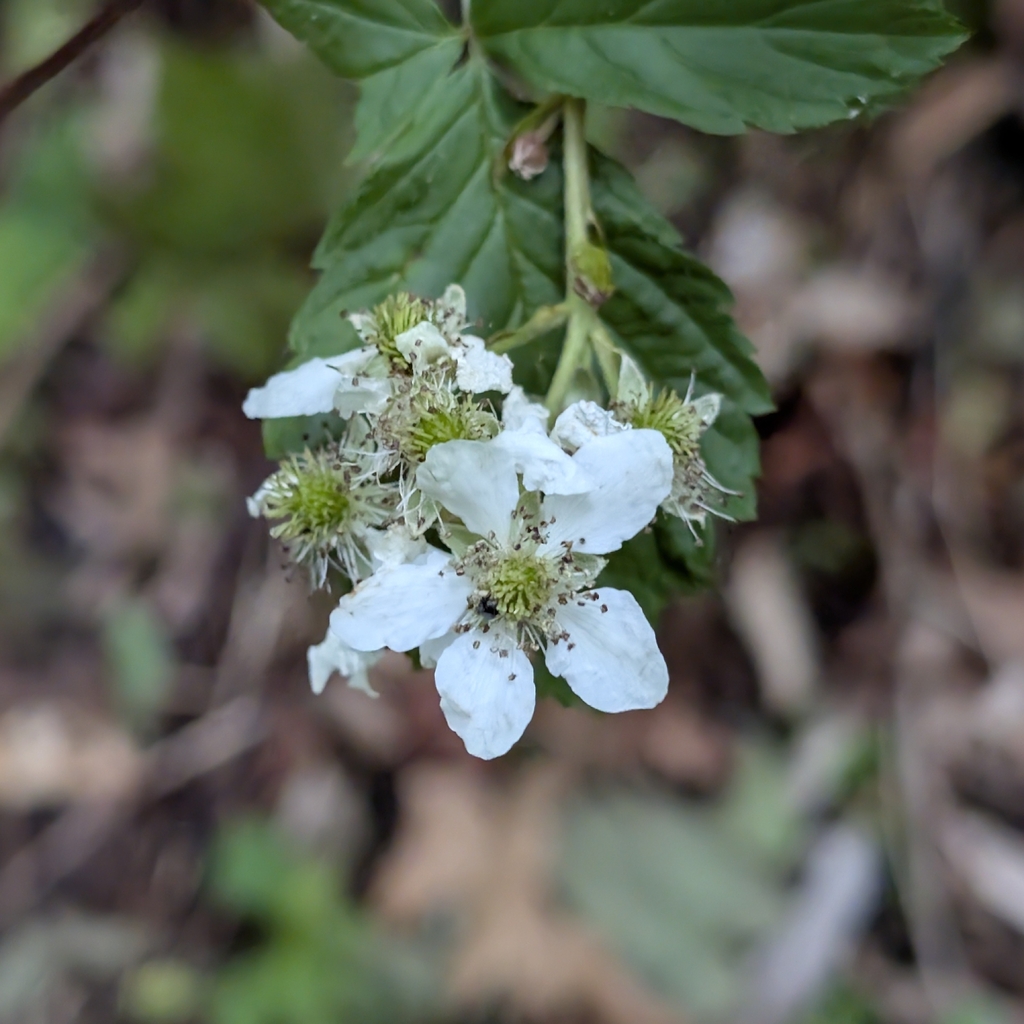
Rubus canadensis, the Smooth Blackberry or thornless blackberry, is a tall native bramble whose canes are nearly or completely free of prickles, a welcome difference from most wild blackberries. It forms thickets of arching canes 3 to 8 feet tall, flowers in late spring and early summer, and produces sweet, juicy black berries from midsummer into early fall.
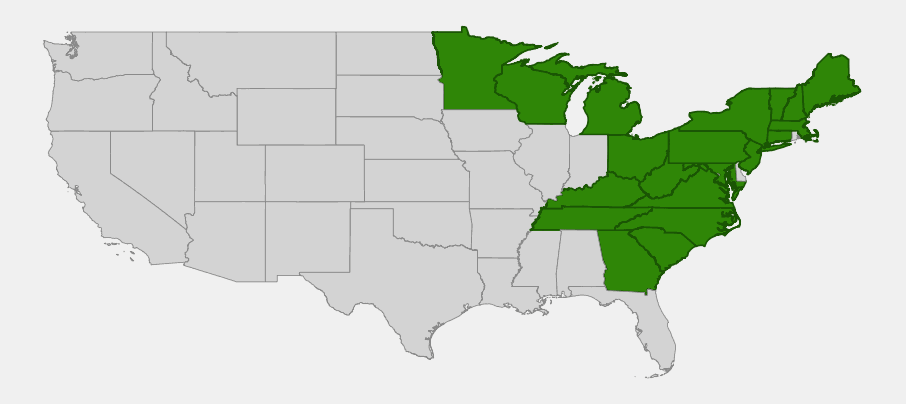
It is a northern and mountain species, native from Maine and the Great Lakes states south through New England, New York and Pennsylvania, and along the Appalachian Mountains to North Carolina, Tennessee, South Carolina and northern Georgia. It is also native across eastern Canada. In the southern Appalachians it is a plant of high elevations, common on grassy balds, along the Blue Ridge Parkway and the Appalachian Trail, and in clearings in spruce-fir and northern hardwood forest.
Smooth blackberry is a pioneer of logged, burned and disturbed ground, where it provides food and cover for wildlife. Its near-thornless canes make it easier to pick than other brambles. This page covers how to identify it, where it grows, how to grow it, and its value to wildlife and people.
Identification
Blackberries are notoriously hard to identify, with many similar species and hybrids. Smooth blackberry is one of the easier ones: look for tall canes with few or no prickles, long-stalked leaflets that are smooth or nearly so beneath, and no sticky glandular hairs.
Canes
Like all brambles, smooth blackberry has biennial canes from a perennial root crown. First-year canes (primocanes) grow tall and arching, up to about 8 feet or more, and are green to reddish purple. They are smooth or carry only a few scattered, small prickles, especially near the base. Second-year canes (floricanes) produce flowers and fruit, then die.
Leaves
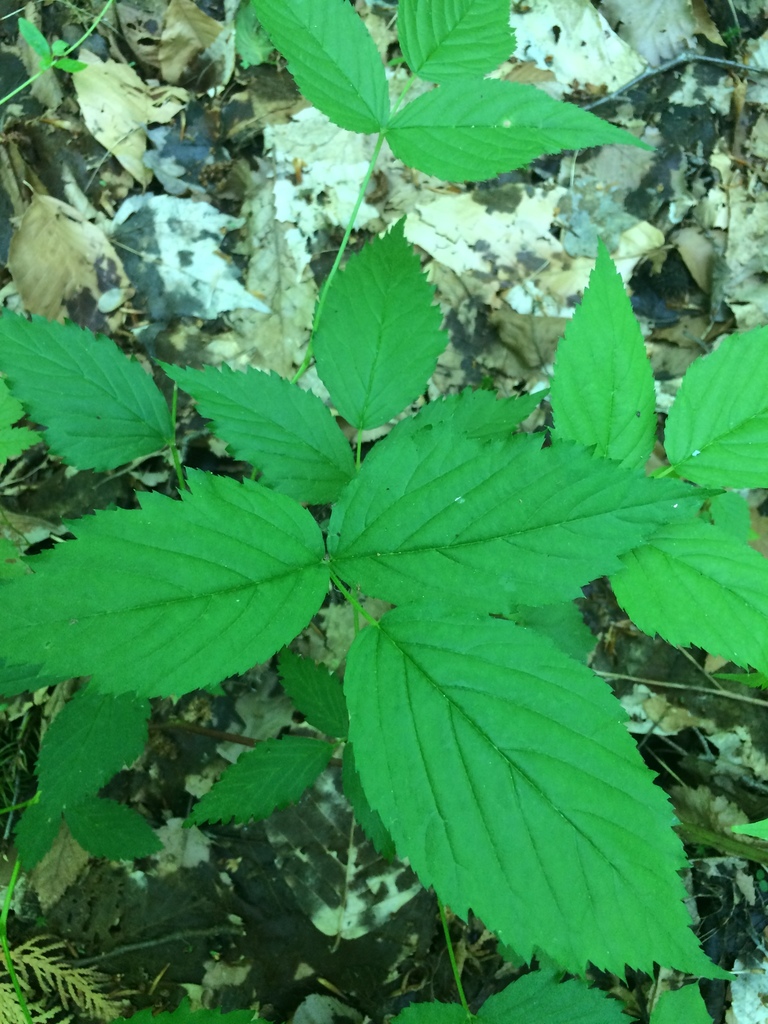
The leaves are alternate and palmately compound. On first-year canes they usually have five leaflets, each on its own short stalk; on flowering canes there are usually three. The leaflets are large, oval to lance-shaped, with long-pointed tips and sharply double-toothed edges. They are smooth or only slightly hairy underneath, not felted or white beneath.
Flowers
The flowers are white, about an inch across, with five petals and many stamens. They grow in loose, elongated clusters at the ends of short side branches on second-year canes, mostly from late May to early July depending on latitude and elevation.
Fruit
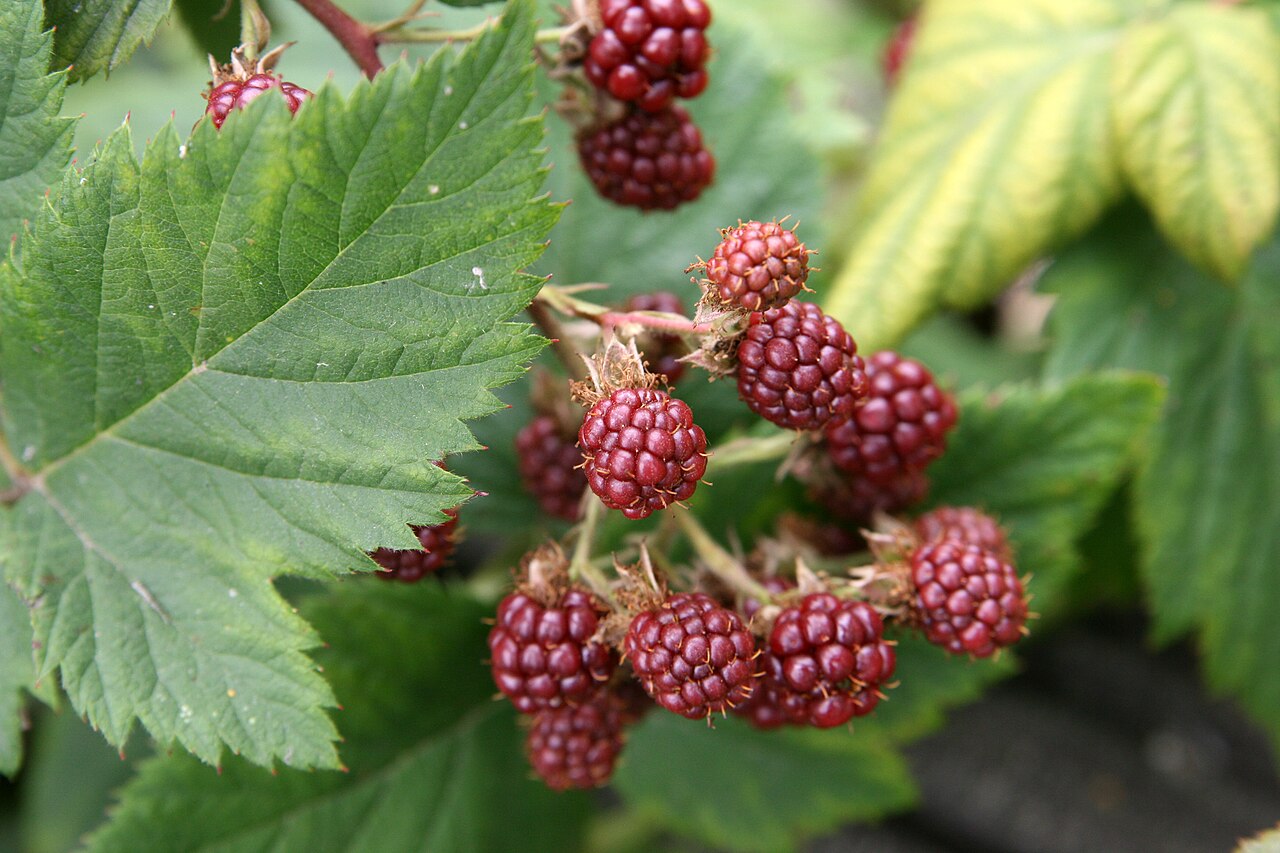
The fruit is a blackberry: an aggregate of many small, juicy drupelets that turns from green to red to glossy black. Unlike raspberries, the fruit keeps its core when picked. The berries are sweet when fully ripe, typically from late July to September.
Similar Species
Allegheny Blackberry has many stout, hooked prickles and sticky glandular hairs on the flower stalks. Dewberries such as Northern Dewberry trail along the ground. American Red Raspberry has whitish undersides on the leaves and fruit that comes off the core like a cap. Black Raspberry has whitish, waxy canes with hooked prickles.
Quick Facts
| Scientific Name | Rubus canadensis L. |
| Family | Rosaceae (rose family) |
| Plant Type | Deciduous shrub (bramble) with biennial canes |
| Mature Height | 3–8 ft (occasionally taller) |
| Mature Spread | 3–6 ft; forms thickets |
| Growth Rate | Fast |
| Sun Exposure | Full sun to part shade |
| Water Needs | Medium |
| Soil Type | Well-drained, acidic loam, rocky or sandy soils |
| Soil pH | About 4.5–6.5 |
| Bloom Time | Late May–early July |
| Flower Color | White |
| Fall Color | Leaves often turn reddish to purple |
| Fruit | Sweet black blackberries, late July–September |
| Deer Resistant | No; deer browse the leaves and canes |
| USDA Hardiness Zones | 3–7 |
Native Range
USDA PLANTS records smooth blackberry as native in Connecticut, Georgia, Kentucky, Maine, Maryland, Massachusetts, Michigan, Minnesota, New Hampshire, New Jersey, New York, North Carolina, Ohio, Pennsylvania, South Carolina, Tennessee, Vermont, Virginia, West Virginia and Wisconsin. In the North it grows at low to middle elevations; south of Pennsylvania it is mostly a mountain plant of the Appalachians. The records from Kentucky, Ohio, Maryland, New Jersey, South Carolina and Georgia are near the edges of its range and mostly from the mountains or cool uplands.
It grows in open, sunny places with acidic, well-drained soil: forest clearings and edges, logged and burned areas, old fields, roadsides, rocky slopes, and, in the southern Appalachians, high-elevation grassy balds and openings in spruce-fir and northern hardwood forest, up to about 6,000 feet.
In Canada it is native from Ontario east to Quebec, the Maritime Provinces and Newfoundland, and on the French islands of Saint-Pierre and Miquelon. It hybridizes with other blackberries, and botanists have described many forms and segregate species over the years.
📋 Regional plant lists featuring Smooth Blackberry: New York, Pennsylvania & Northern New Jersey · Ohio & Indiana · Michigan, Wisconsin & Eastern Minnesota · Kentucky & Tennessee · Connecticut, Massachusetts & Rhode Island · New Hampshire, Maine & Vermont · Maryland, Virginia & West Virginia · Alabama, Georgia & Mississippi · North & South Carolina
Growing & Care Guide
Smooth blackberry is a good choice for a wild edible hedge or a wildlife thicket in cool, northern and mountain gardens. It needs room to spread and is best suited to informal areas, woodland edges and larger properties. Native plant nurseries in the Northeast occasionally carry it, and a few thornless selections have been grown for fruit.
Light
Fruiting is best in full sun. It tolerates part shade at woodland edges but produces fewer berries. Under a closing forest canopy it gradually dies out.
Soil & Water
Give it moist but well-drained, acidic soil rich in organic matter. It does not like soggy ground or hot, dry, alkaline sites. Mulch around plants to keep roots cool and moist, especially toward the southern edge of its range.
Planting Tips
Plant dormant root crowns or potted plants in early spring, 3 to 4 feet apart, in rows or a loose thicket. It is best suited to USDA zones 3 to 7 and to cool summers; in the South, it grows only at high elevations.
Pruning & Maintenance
Each cane lives two years. After fruiting, cut the second-year canes to the ground. In late winter, thin the first-year canes to the strongest few per foot of row and shorten very long canes to 4 to 5 feet to make picking easier. Remove suckers that spread beyond where you want them.
Propagation
Propagate by digging rooted suckers in early spring, by tip-layering arching canes, or by root cuttings. Seed needs warm and then cold stratification and germinates slowly and unevenly.
Landscape Uses
- Edible landscapes: sweet blackberries from a near-thornless native bramble
- Wildlife thickets: dense cover and fruit for birds and mammals
- Woodland edges: a natural transition between forest and meadow
- Restoration: quick cover on logged, burned or disturbed acidic soils in the North and mountains
- Erosion control: spreading canes and roots help stabilize slopes
Wildlife & Ecological Value
Wild blackberries rank among the most important wildlife plants in eastern North America, and smooth blackberry fills that role in northern forests and the mountains.
For Pollinators
The white flowers are visited by many bees, including bumblebees, mining bees, sweat bees and small carpenter bees, as well as flies and butterflies. Some small carpenter bees nest in the pithy stems of old canes. Brambles are host plants for the caterpillars of many moths, as well as the striped hairstreak and other butterflies.
For Birds
Catbirds, thrushes, robins, cedar waxwings, grouse, wild turkeys and many other birds eat the berries. The dense thickets still offer nesting and escape cover for chestnut-sided warblers, indigo buntings, towhees and other shrubland birds.
For Mammals
Black bears, foxes, raccoons, chipmunks and other mammals feast on the berries in late summer. White-tailed deer, moose and rabbits browse the leaves and canes.
Ecosystem Role
Smooth blackberry is a pioneer that quickly covers ground after logging, fire or windthrow, protecting soil and creating thickets in which tree seedlings can establish. Its seeds can survive in the soil for years, waiting for a disturbance that lets in light. In this way it helps forests recover.
Cultural & Historical Uses
Wild blackberries have been gathered for food by Indigenous peoples and later by settlers across eastern North America. The berries were eaten fresh, dried, or cooked, and the leaves and roots of brambles were widely used in folk remedies, especially as an astringent tea.
Linnaeus named Rubus canadensis in 1753. The species name means “of Canada,” reflecting that early botanists knew it from northern collections, and its near-thornless canes have long made it a favorite of berry pickers.
In the southern Appalachians, smooth blackberry is a familiar plant of the high grassy balds and the Appalachian Trail, where hikers enjoy its berries in August. The fruits are an important late-summer food for black bears in these mountains.
Frequently Asked Questions
Does smooth blackberry have thorns?
Its canes are smooth or have only a few small, scattered prickles, much fewer than most wild blackberries. This makes it easier and more pleasant to pick, though gloves are still a good idea.
Are smooth blackberry fruits edible?
Yes. The ripe, glossy black berries are sweet and juicy and can be eaten fresh or used in jams, pies and other recipes, like any blackberry. Pick only plants you have identified with confidence.
Where does smooth blackberry grow?
It grows in the northeastern United States, the Great Lakes region and eastern Canada, and south along the Appalachian Mountains to North Carolina, Tennessee and northern Georgia, where it is mostly found at high elevations.
How do I tell smooth blackberry from Allegheny blackberry?
Allegheny blackberry has many stout, hooked prickles on the canes and sticky glandular hairs on the flower stalks. Smooth blackberry has few or no prickles and lacks the glandular hairs.
Can I grow smooth blackberry in my garden?
Yes, in cool climates (about USDA zones 3 to 7) with sun and acidic, well-drained soil. Give it room to spread, and prune out old canes after fruiting each year.

Looking for a nursery that carries Smooth Blackberry?
Browse our native plant nursery directory: Connecticut & Georgia · Kentucky, Maine, Maryland, Massachusetts, Michigan & Minnesota · New Hampshire, New Jersey, New York, North Carolina & Ohio · Pennsylvania, South Carolina, Tennessee, Vermont & Virginia · West Virginia & Wisconsin

