
Golden Dock (Rumex maritimus)
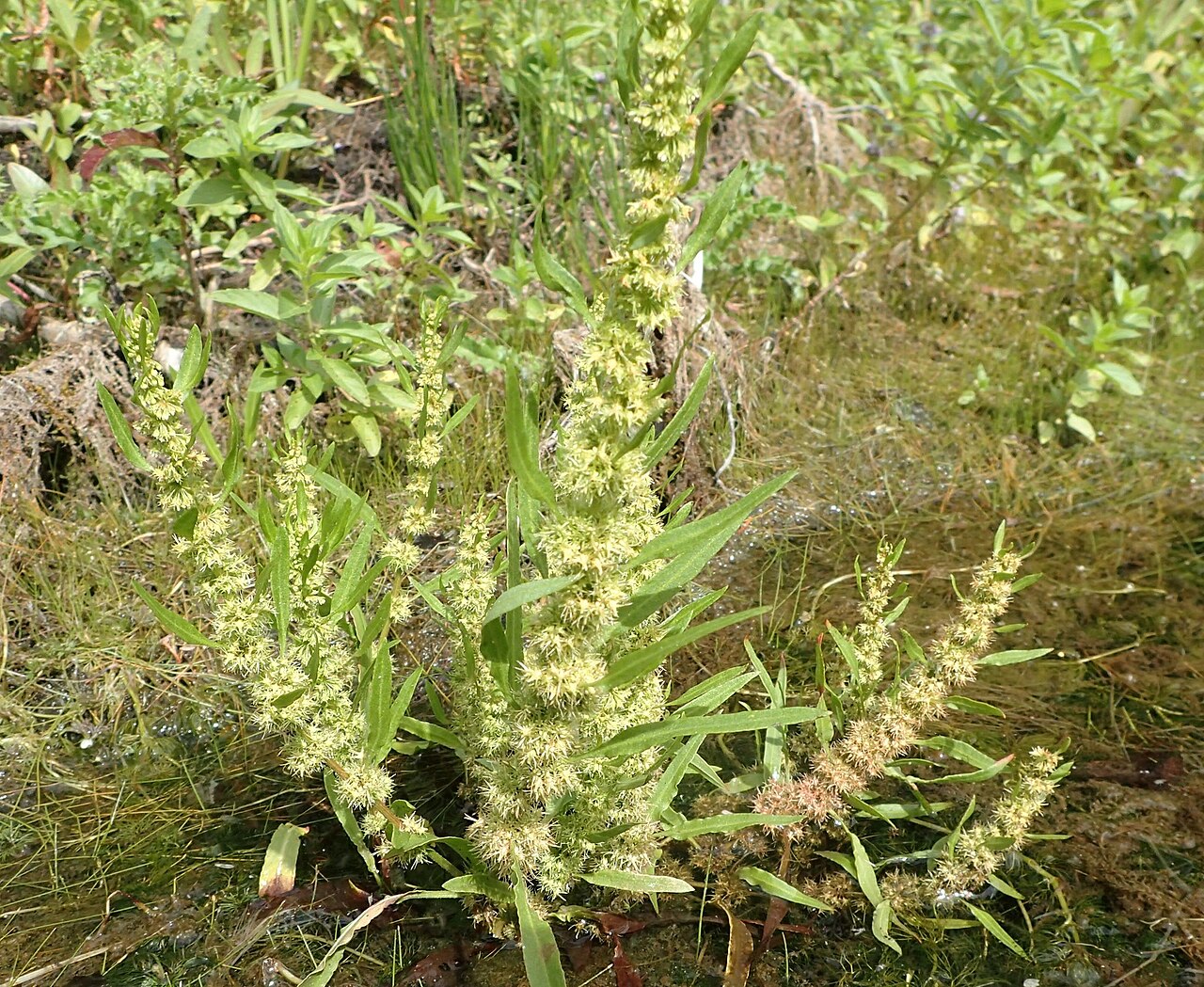
Rumex maritimus, known as Golden Dock, is a small, bushy native dock of muddy shores, drying ponds and wet flats. In late summer its branched stems turn into dense, fuzzy spikes of golden-yellow to rusty-brown fruits, so a mudflat full of golden dock glows gold in the low sun. Each tiny fruit is fringed with long, bristle-like teeth, which makes it one of the easiest docks to recognize.
The name needs some explanation. USDA PLANTS and many older floras call the North American plant Rumex maritimus, a name first given to a European species. The Flora of North America, most recent state floras and iNaturalist now treat the native plant of the Americas as a separate species, Rumex fueginus (named after Tierra del Fuego, at the southern tip of South America), and restrict true R. maritimus to Eurasia. Older references sometimes list it as R. maritimus var. fueginus or R. persicarioides. This page uses the USDA name to match federal records, but it covers the native North American plant, whichever name your field guide uses.
Golden dock belongs to the buckwheat family (Polygonaceae). It is not a garden plant in the usual sense, but it is an important part of the plant community that springs up on exposed mud when water levels drop, feeding waterfowl and shorebirds in fall. Like other docks, its leaves contain oxalates, so it is not a plant for grazing or salads.
Identification
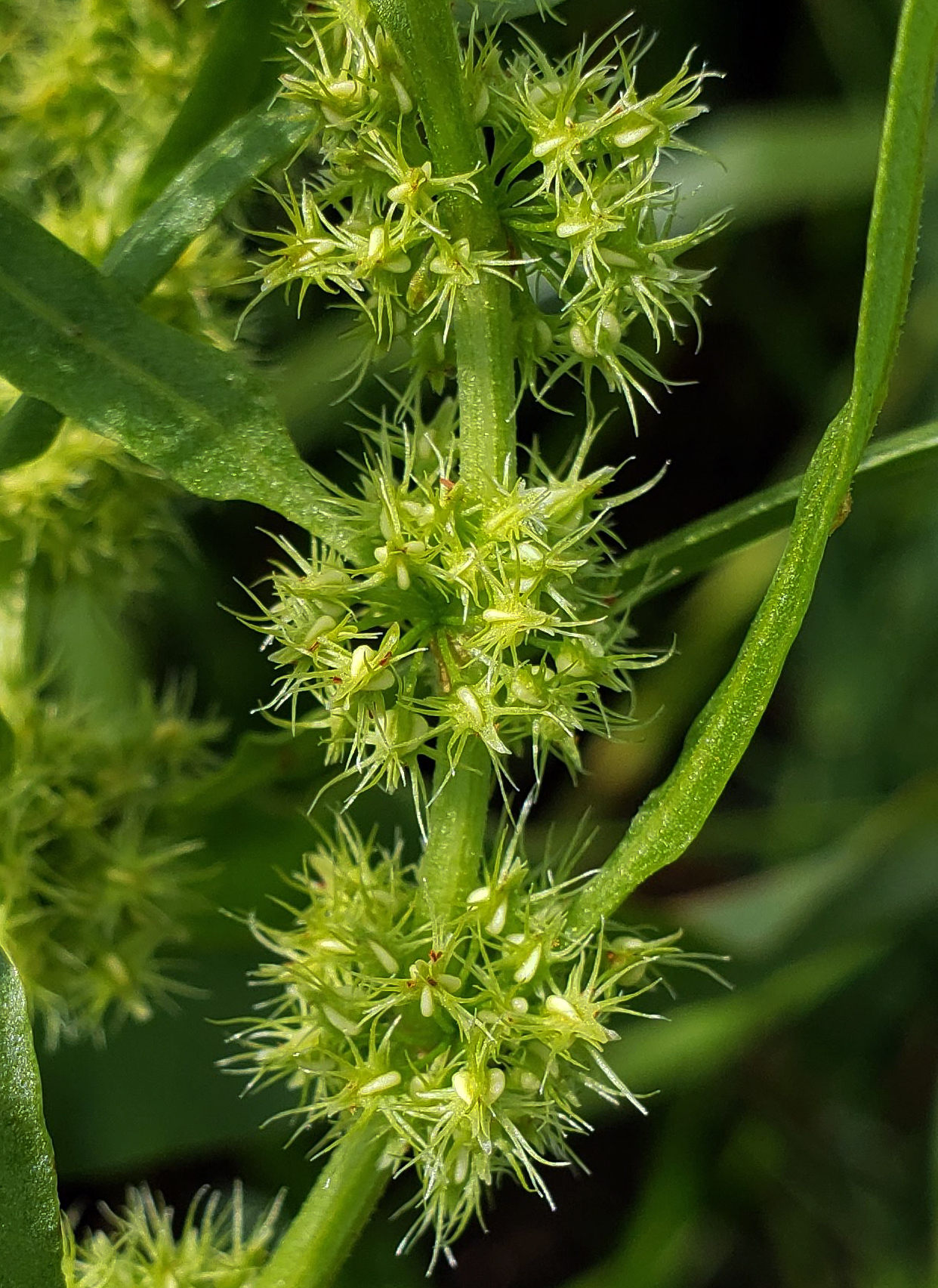
Golden dock is usually an annual or short-lived plant, much smaller than familiar weedy docks such as curly dock. Look at the fruits: the long bristly teeth on the valves set it apart from nearly all other North American docks.
Stems & Habit
Plants are erect or spreading, usually 4 to 24 inches tall (rarely to about 30 inches), and often branch from the base into a bushy, pyramid-shaped plant. The stems are ribbed, green to reddish, and in the native plant often finely hairy. Plants growing on open mud may stay small and flower when only a few inches tall.
Leaves
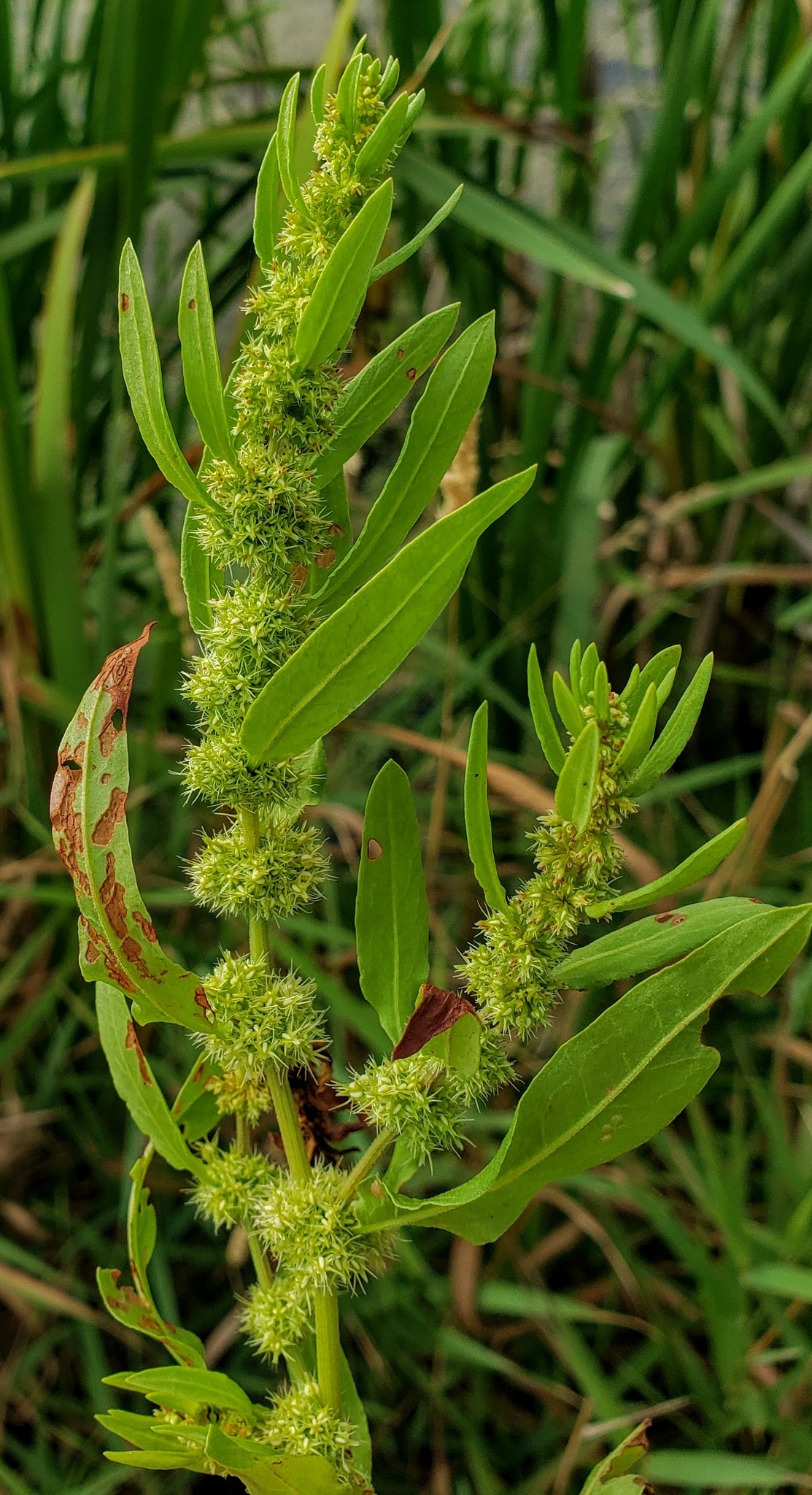
The leaves are narrow, lance-shaped to linear, 1½ to 6 inches long, with flat or slightly wavy margins and a tapered base. Lower leaves are the largest. Leaves continue up into the flowering part of the stem, so the spikes look leafy rather than bare.
Flowers
The tiny greenish flowers grow in dense whorls along the upper stems and branches, the whorls crowding together into continuous, cylindrical spikes. They are wind-pollinated and inconspicuous, and the plant is noticed mostly once it is in fruit.
Fruit
As the fruit ripens, the three inner tepals (valves) enlarge around the small, shiny brown seed (achene, about 1 to 1.5 mm long). Each valve is narrow, with a swollen tubercle on its face and two or three long, bristle-like teeth on each edge, usually longer than the valve is wide. Together the valves and teeth make each fruit look like a tiny burr, and the masses of fruits turn golden yellow, then rusty brown. Eurasian R. maritimus in the strict sense has slightly broader valves and larger achenes, and the North American plant is usually hairier.
Quick Facts
| Scientific Name | Rumex maritimus L. (USDA); native North American plant treated as Rumex fueginus Phil. by Flora of North America |
| Family | Polygonaceae (buckwheat family) |
| Plant Type | Annual to short-lived perennial herb |
| Mature Height | 4–24 in (rarely to about 30 in) |
| Mature Spread | 6–18 in |
| Growth Rate | Fast |
| Sun Exposure | Full sun |
| Water Needs | High; wet mud, shores and drawdown zones |
| Soil Type | Mud, wet sand or silt; tolerates alkaline and slightly saline soils |
| Soil pH | About 6.0–8.5 |
| Bloom Time | June–September |
| Flower Color | Greenish; fruiting spikes golden yellow to rusty brown |
| Fall Color | Golden to reddish-brown fruiting plants |
| Fruit | Achene enclosed in three narrow valves with long bristly teeth |
| Deer Resistant | Generally avoided by browsers (oxalates) |
| USDA Hardiness Zones | 3–9 (grows as an annual) |
Native Range
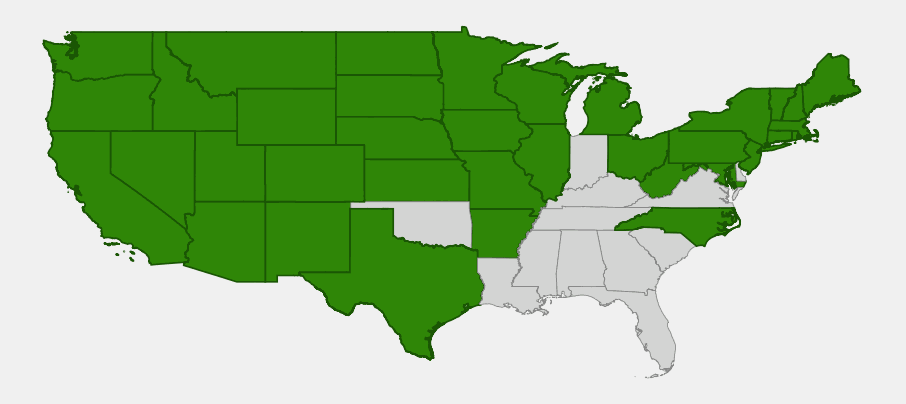
USDA PLANTS records golden dock as native in 36 of the lower 48 states and in Canada from the Yukon and Northwest Territories to the Maritime provinces. It is most common in the northern Great Plains, the Great Lakes states and the Intermountain West, and much more scattered in the Northeast and the southern states. USDA lists Alaska records as introduced, so Alaska is not shown on the map. The native species also grows in South America, which is where the name fueginus comes from.
Its habitat is shoreline mud. It grows on the exposed beds and margins of ponds, lakes, reservoirs and prairie potholes when water levels drop, on sandbars and gravel bars along rivers, in marshes, wet meadows, alkaline flats and ditches. It thrives where water levels fluctuate. A dry summer that exposes a pond bottom can produce a sudden carpet of golden dock from seeds that waited in the mud.
Because it appears and disappears with water levels, golden dock can be abundant one year and absent the next at the same site. In the arid West it is mainly found around reservoirs, stock ponds and alkaline lakes. In the East it is uncommon, with scattered records from lakeshores, river flats and tidal shores.
📋 Regional plant lists featuring Golden Dock: California & Nevada · Arizona & New Mexico · Utah & Western Colorado · Montana & Wyoming · Idaho, Eastern Oregon & Eastern Washington · Nebraska, Kansas & Eastern Colorado · North Dakota, South Dakota & Western Minnesota · Michigan, Wisconsin & Eastern Minnesota · Illinois, Iowa & Missouri · Ohio & Indiana · Arkansas, Louisiana, Eastern Oklahoma & Eastern Texas · North & South Carolina · Maryland, Virginia & West Virginia · New York, Pennsylvania & Northern New Jersey · Delaware, Southern New Jersey & Long Island · Connecticut, Massachusetts & Rhode Island · New Hampshire, Maine & Vermont
Growing & Care Guide
Golden dock is rarely sold and is not a typical garden plant. It is most useful in wetland restoration, in managed waterfowl areas, and in naturalistic pond plantings where water levels rise and fall. Where it grows naturally, the best approach is to leave it alone and let it reseed.
Note on oxalates: like other docks and sorrels, golden dock contains oxalic acid and soluble oxalates, mainly in the leaves. Eating large amounts can cause poisoning, and livestock that graze heavily on docks have been harmed. Do not forage it, and keep it out of hay and pasture plantings.
Light
Full sun. It grows on open mud and disappears once taller plants shade it.
Soil & Water
It needs bare, wet mud or saturated sand or silt, the kind of soil exposed when a pond or wetland draws down in summer. It tolerates alkaline and somewhat saline conditions. It cannot grow in dry garden soil or in permanently deep water.
Planting Tips
Scatter seed on exposed mud in fall or early spring, or let a pond edge draw down naturally in summer and watch for seedlings. In managed wetlands, a summer drawdown of a few inches to a foot of water often brings golden dock up from the existing seed bank.
Pruning & Maintenance
No care is needed. Leave plants standing into fall so seeds ripen and drop. It is a pioneer, so it gradually gives way to perennial sedges, rushes and grasses unless water levels keep fluctuating.
Propagation
Grow from seed. Plants produce large numbers of seeds that stay in the mud for years, waiting for the next drawdown. Seeds collected in fall can be stored dry and sown on wet mud the next year.
Landscape Uses
- Wetland restoration: part of the native mudflat plant community after drawdowns
- Waterfowl management: moist-soil management areas use summer drawdowns to grow seed plants like golden dock
- Natural pond margins: an attractive golden accent on fluctuating shorelines
- Stormwater basins: in sunny basins that hold water in spring and dry in summer
- Nature study: an easy-to-recognize indicator of fluctuating, nutrient-rich shores
Wildlife & Ecological Value
Golden dock is a short-lived plant of temporary habitats, but it comes up exactly when and where many birds need food: on mud exposed in late summer and fall migration.
For Pollinators
Its flowers are wind-pollinated and offer little to pollinators. Docks are caterpillar food plants for some butterflies and moths, including the bronze copper butterfly, which lays its eggs on docks in wet meadows and marshes.
For Birds
The small seeds are eaten by ducks, geese and other waterfowl, rails, and seed-eating songbirds such as sparrows. The mudflats where golden dock grows are also feeding grounds for migrating shorebirds, which hunt invertebrates among the plants.
For Mammals
Muskrats and other small mammals may eat the plants and seeds. Large herbivores generally avoid docks because of their oxalate content.
Ecosystem Role
It is a classic mudflat annual. Its long-lived seeds in the mud let it respond quickly when water levels drop, stabilizing bare sediment and producing a seed crop before the next flood. In prairie potholes and reservoir drawdown zones it is part of the cycle of drying and refilling that keeps these wetlands productive.
Cultural & Historical Uses
Linnaeus named Rumex maritimus in 1753 from European plants of seashores and lakeshores; maritimus means “of the sea.” The Chilean-German botanist Rodolfo Amando Philippi described Rumex fueginus in the nineteenth century from Tierra del Fuego. For a long time North American plants were included in R. maritimus, sometimes as var. fueginus, and USDA still uses that broad concept. The Flora of North America (2005) treats the plants of the Americas as R. fueginus.
Docks in general were used as food and medicine by many peoples, but golden dock is small and its leaves are high in oxalates, so there is little record of it being eaten. Its main human connection is through waterfowl: wetland managers in the Great Plains and Great Lakes have long recognized golden dock as one of the seed-producing annuals that come up on drawn-down mudflats.
Today it is mostly of interest to botanists, birders and wetland managers. Its golden autumn fruiting spikes are a familiar sight on prairie pothole shores and reservoir edges, and the name change from R. maritimus to R. fueginus is a good example of how botanists continue to sort out which plants are truly native to North America.
Frequently Asked Questions
Is golden dock Rumex maritimus or Rumex fueginus?
Both names are used. USDA PLANTS uses Rumex maritimus in a broad sense. The Flora of North America and most current floras call the native plant of the Americas Rumex fueginus and restrict R. maritimus to Eurasian plants. They describe the same native golden dock of North American shores.
Is golden dock edible?
It is not recommended. Like other docks it contains oxalic acid and soluble oxalates, which can be harmful in quantity, especially for people prone to kidney stones, and it has harmed grazing livestock. It is also small and bristly, with little to offer as food.
How do I tell golden dock from other docks?
Look at the fruits. Golden dock’s valves have long, bristle-like teeth on their edges, and the fruiting spikes turn golden yellow. Most other docks, including weedy curly dock and the native pale dock, have smooth or only slightly toothed valves. Golden dock is also smaller and usually annual.
Is golden dock a weed?
It is a native plant of shorelines and wet flats, not an agricultural weed. It can appear in large numbers after a pond dries down, but it is short-lived and gives way to perennial plants.
Why does golden dock appear only in some years?
Its seeds wait in the mud until water levels drop and expose bare sediment in sun. In wet years, when ponds and lakes stay full, few plants appear. In dry summers, large stands can come up from the seed bank.

Looking for a nursery that carries Golden Dock?
Browse our native plant nursery directory: Arizona & Arkansas · California · Colorado & Connecticut · Idaho, Illinois, Iowa & Kansas · Maine, Maryland, Massachusetts, Michigan, Minnesota, Missouri & Montana · Nebraska, Nevada, New Hampshire, New Jersey, New Mexico, New York, North Carolina, North Dakota & Ohio · Oregon · Pennsylvania, Rhode Island, South Dakota, Texas, Utah & Vermont · Washington · West Virginia, Wisconsin & Wyoming

