
Heller’s Rosette Grass (Dichanthelium oligosanthes)
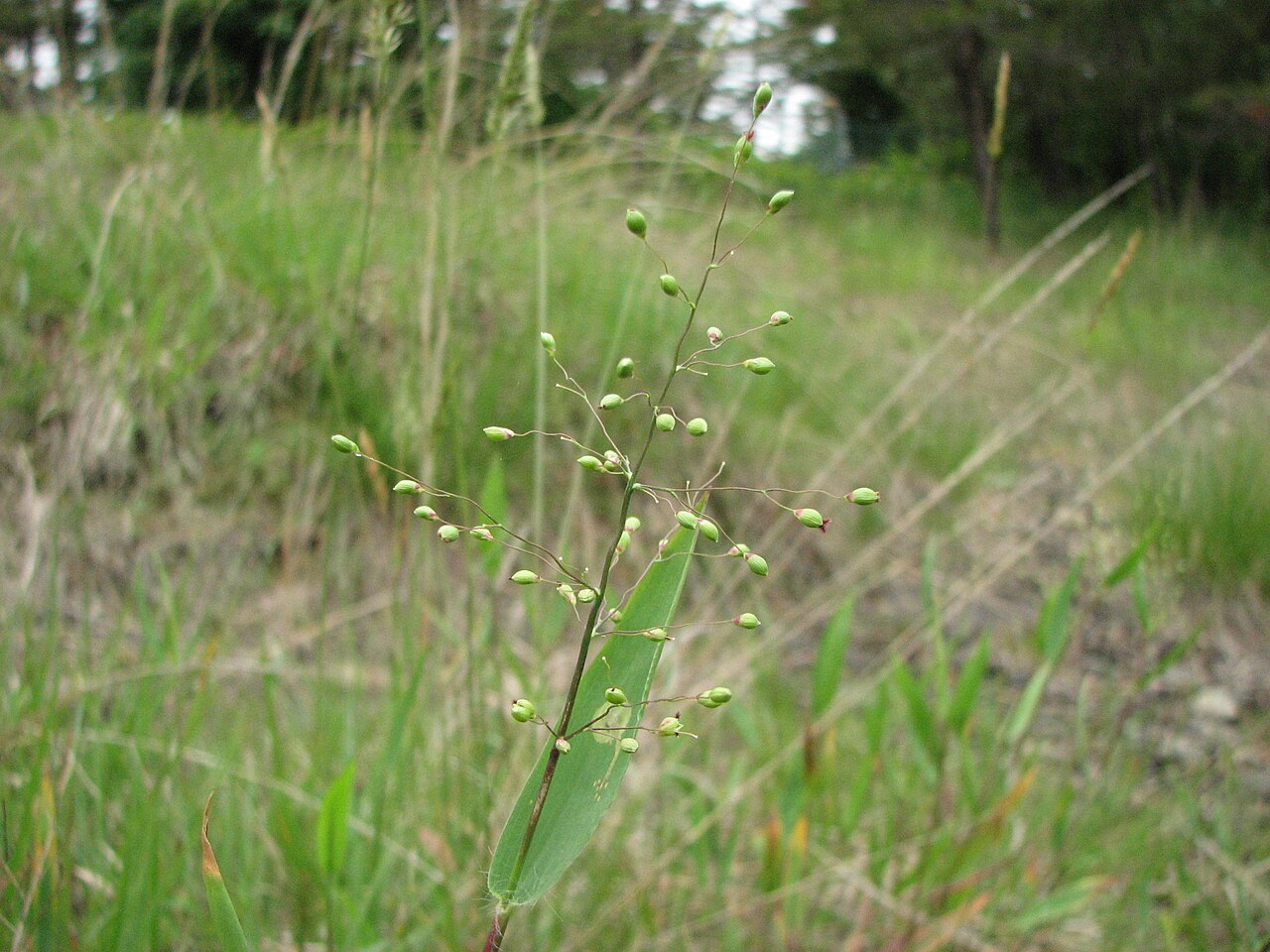
Dichanthelium oligosanthes, known as Heller’s Rosette Grass, Scribner’s rosette grass or few-flowered panicgrass, is a native cool-season bunchgrass found across almost all of the Lower 48 states and into southern Canada. Like other rosette grasses, it spends the winter as a flat rosette of short, broad leaves, sends up leafy stems with open, airy flower clusters in late spring, and produces a second, hidden crop of seed in summer and fall.
It is a grass of dry, sunny or lightly shaded places: open woods, prairies, glades, sandy fields, rocky barrens and roadsides. Its broad leaves and relatively large, round spikelets make it one of the easier rosette grasses to recognize. The name oligosanthes means “few-flowered”, because each panicle has fewer spikelets than most of its relatives.
Heller’s rosette grass is not a showy plant, but it is a useful small grass for prairie, savanna and woodland-edge plantings, and its seeds and evergreen rosettes feed birds and other wildlife. It is also of scientific interest: although it belongs to a subfamily of warm-season grasses, it uses the cool-season (C3) form of photosynthesis, and its genome has been sequenced. This guide covers identification, range and growing tips.
Identification
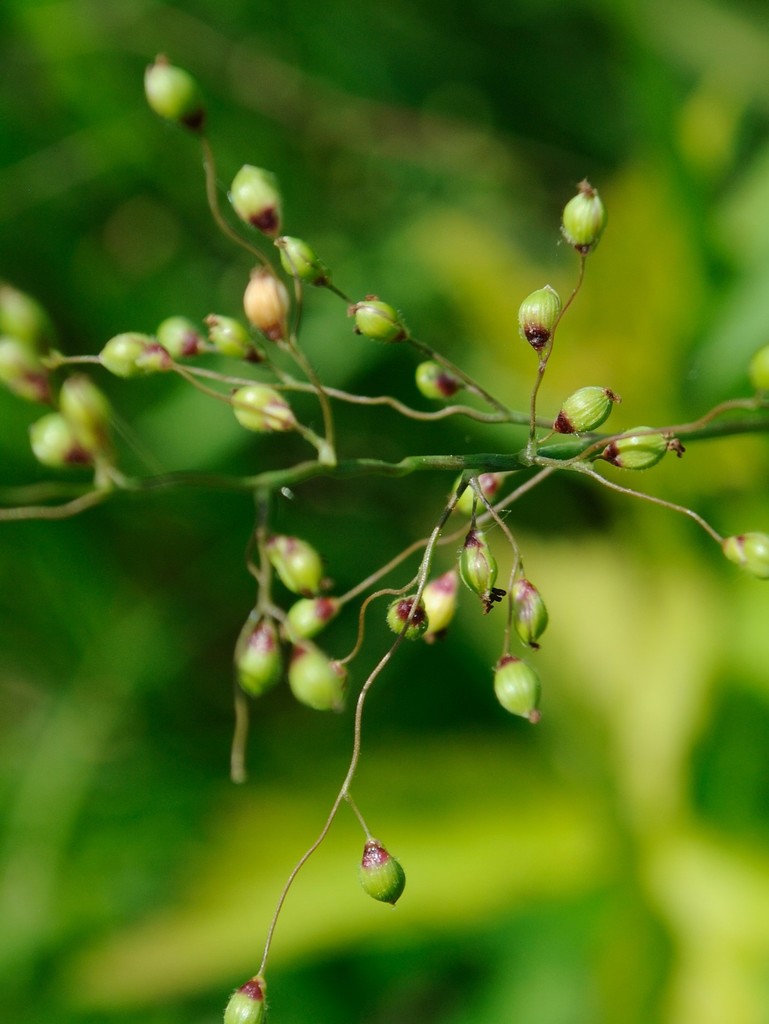
Rosette grasses (Dichanthelium) are a large and difficult group. Heller’s rosette grass stands out for its broad leaves, its stiff, upright stems and its spikelets, which are larger and plumper than in most species.
Growth Habit
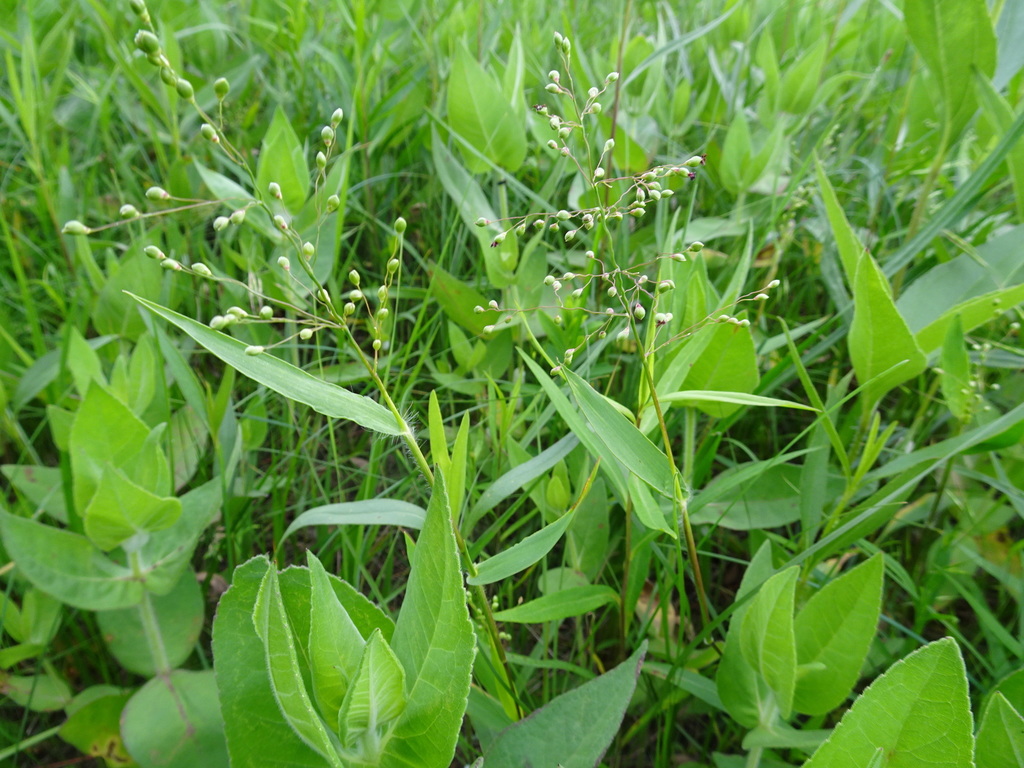
A tufted perennial. In fall and winter it forms a low rosette of short, broad leaves. In spring it sends up erect stems usually 8 to 30 inches tall. After the first flowering it branches from the middle and lower nodes, producing bushy clusters of shorter leafy shoots in summer and fall.
Leaves
The stem leaves are lance-shaped, about 2 to 5 inches long and roughly ¼ to ½ inch wide, often stiff and slightly rounded at the base where they clasp the stem. The leaf sheaths range from nearly smooth to covered in stiff hairs with small bumps at their bases, depending on the variety.
Flowers & Fruit
The spring panicle is open and few-flowered, about 2 to 5 inches long, with spikelets on slender stalks. Each spikelet is round to egg-shaped, about 3 to 4 mm long, green to purplish. Later in the season, small panicles of self-pollinating flowers that never open (cleistogamous flowers) form among the leaves of the side branches and produce much of the seed. Spring flowering is mainly May to June, with later seed through fall.
Look-alikes
Tapered Rosette Grass (D. acuminatum) has narrower, softer leaves and much smaller spikelets (under 2 mm). Bosc’s Panicgrass (D. boscii) has very broad leaves and large spikelets but grows in shady woods and has hairy joints on the stem. Deertongue (D. clandestinum) is much larger, with leaves up to 1 inch wide, and grows in moist soils.
Quick Facts
| Scientific Name | Dichanthelium oligosanthes (syn. Panicum oligosanthes; includes var. scribnerianum) |
| Family | Poaceae (grass family) |
| Plant Type | Cool-season perennial bunchgrass |
| Mature Height | 8–30 in |
| Mature Spread | 6–12 in |
| Growth Rate | Moderate |
| Sun Exposure | Full sun to part shade |
| Water Needs | Low to medium; drought tolerant |
| Soil Type | Sandy, rocky or loamy, well-drained |
| Soil pH | Acidic to alkaline (adaptable) |
| Bloom Time | May–June (open flowers); hidden flowers summer–fall |
| Flower Color | Green to purplish spikelets |
| Fall Color | Tan stems; green to purplish winter rosettes |
| Fruit | Small grain (caryopsis) in a rounded spikelet |
| Deer Resistant | Low; rosettes are grazed |
| USDA Hardiness Zones | 3–9 |
Native Range
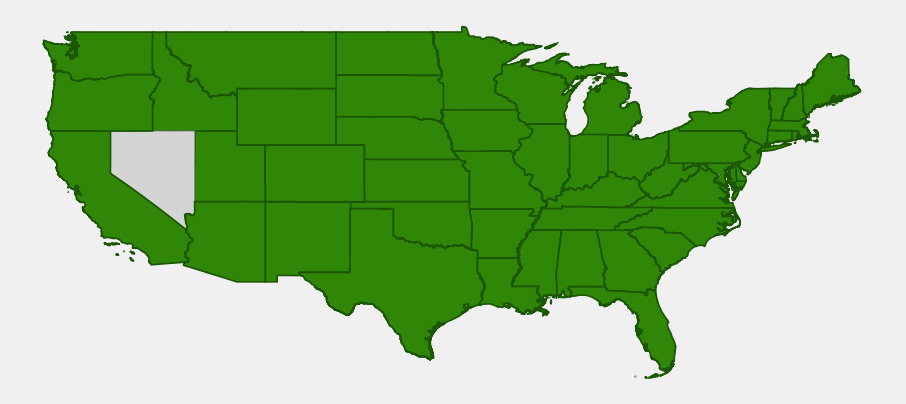
Heller’s rosette grass is one of the most widespread rosette grasses in North America. The USDA records it as native in 47 of the Lower 48 states, from Maine and Florida west to Washington and California, missing only Nevada. In Canada it reaches southern British Columbia, Alberta, Saskatchewan, Manitoba and Ontario, and it extends into northern Mexico.
Botanists usually recognize two varieties. Variety oligosanthes (Heller’s rosette grass in the strict sense) is mainly southern and eastern, especially on the Atlantic and Gulf coastal plains. Variety scribnerianum (Scribner’s rosette grass) is the common form in the Midwest, the Great Plains and the West. The two differ mainly in leaf-sheath hairiness and spikelet size.
It grows in dry to moderately moist, open places: prairies, savannas, oak and pine woodlands, glades, sand barrens, serpentine barrens, old fields, recently cut woods and roadsides. It is most common in the eastern and central states and becomes scattered and local in the Rocky Mountain and Pacific states.
📋 Regional plant lists featuring Heller’s Rosette Grass: Alabama, Georgia & Mississippi · Arkansas, Louisiana, Eastern Oklahoma & Eastern Texas · Arizona & New Mexico · California & Nevada · North Dakota, South Dakota & Western Minnesota · Delaware, Southern New Jersey & Long Island · North & South Florida · Illinois, Iowa & Missouri · Idaho, Eastern Oregon & Eastern Washington · Ohio & Indiana · Kentucky & Tennessee · Maryland, Virginia & West Virginia · Michigan, Wisconsin & Eastern Minnesota · Montana & Wyoming · North & South Carolina · Nebraska, Kansas & Eastern Colorado · New Hampshire, Maine & Vermont · Connecticut, Massachusetts & Rhode Island · New York, Pennsylvania & Northern New Jersey · South & West Texas · Utah & Western Colorado · Western Oregon & Western Washington
Growing & Care Guide
Heller’s rosette grass is occasionally included in native prairie and savanna seed mixes and is sold by a few native seed suppliers. It is easy to grow in lean, well-drained soil and often appears on its own in native plantings.
Light
Full sun to part shade. It does well in open prairie and in the dappled light of oak savannas and woodland edges.
Soil & Water
Grows in sandy, gravelly, rocky or loamy soils that drain well. Once established it is drought tolerant and needs no watering except in long dry spells during its first season. Avoid rich, heavily fertilized soil, where taller plants will crowd it out.
Planting Tips
Sow seed in fall or early spring on lightly prepared soil, or plant plugs in spring. It is a small grass, best used between taller bunchgrasses and wildflowers in prairie and savanna plantings, on dry slopes and in rock gardens. Space plugs about 12 inches apart.
Pruning & Maintenance
Little care is needed. In prairie plantings, a late-winter mow or controlled burn helps keep the planting open; avoid cutting in late fall, because the evergreen rosettes provide winter cover and food.
Propagation
Grow from seed, which can be sown fresh in fall or stratified cold and moist for a few weeks before spring sowing. Clumps can also be divided in early spring. The plant reseeds readily through its self-pollinating fall flowers.
Landscape Uses
- Prairie and savanna plantings: a short grass to fill gaps between taller bunchgrasses
- Dry, sandy or rocky sites: glades, barrens and slopes
- Wildlife plantings: seeds and winter rosettes for birds and mammals
- Woodland edges: part shade under open oaks and pines
Wildlife & Ecological Value
Like other rosette grasses, Heller’s rosette grass provides seed, evergreen forage and cover in the open habitats where it grows.
For Pollinators
Grasses are wind-pollinated and its fall flowers pollinate themselves, so it offers little to bees. Rosette grasses are, however, among the food plants of caterpillars of several grass-feeding skippers and satyrs.
For Birds
The seeds are eaten by northern bobwhite, wild turkey, sparrows, juncos and other seed-eating birds, and because the plant produces seed from spring through fall, it supplies food over a long season.
For Mammals
White-tailed deer, rabbits and rodents graze the green winter rosettes, which are among the few green foods in dry, open habitats in winter. Small mammals also eat the seed.
Ecosystem Role
It is a typical member of the ground layer in prairies, savannas and open woodlands, holding soil on dry slopes and sandy ground. Its ability to flower twice, once with open flowers and again with closed, self-pollinating flowers, helps it persist and spread in disturbed and fire-maintained habitats.
Cultural & Historical Uses
The common name honors Amos Arthur Heller, an American botanist and collector of the late 1800s and early 1900s. The species was long placed in Panicum, as Panicum oligosanthes and Panicum scribnerianum, before rosette grasses were separated into the genus Dichanthelium, a name that means “flowering twice”.
Heller’s rosette grass is a C3 (cool-season) grass in the grass subfamily Panicoideae, a group dominated by C4 warm-season grasses such as switchgrass and the bluestems. Because of this, scientists have used it to study how C4 photosynthesis evolved.
In 2016 researchers published a draft genome of Dichanthelium oligosanthes, sequenced from the offspring of a single plant collected at the Shaw Nature Reserve in Missouri.
Frequently Asked Questions
What is the difference between Heller’s and Scribner’s rosette grass?
They are two varieties of the same species. Variety oligosanthes (Heller’s) is mainly southern and eastern; variety scribnerianum (Scribner’s) is common in the Midwest and West. They differ mainly in hairiness and spikelet size.
Why is it called a rosette grass?
In fall and winter it forms a flat rosette of short, broad leaves at ground level, which stays green through the cold season before the plant sends up flowering stems in spring.
Is it a warm-season or cool-season grass?
Cool-season. It grows in spring and fall, stays green in winter, and uses the C3 type of photosynthesis, even though most of its close relatives are warm-season grasses.
Is it a good grass for a native garden?
Yes, for dry, sunny or lightly shaded sites. It is a small, tidy bunchgrass that fills gaps between taller prairie plants, needs little water, and feeds birds with its seeds.
Where does it grow naturally?
Across nearly all of the Lower 48 states except Nevada, plus southern Canada and northern Mexico, in prairies, open woods, glades, barrens and old fields.

Looking for a nursery that carries Heller’s Rosette Grass?
Browse our native plant nursery directory: Alabama, Arizona & Arkansas · California · Colorado, Connecticut, Delaware, Florida & Georgia · Idaho, Illinois, Indiana, Iowa & Kansas · Kentucky, Louisiana, Maine, Maryland, Massachusetts, Michigan, Minnesota, Mississippi, Missouri & Montana · Nebraska, New Hampshire, New Jersey, New Mexico, New York, North Carolina, North Dakota, Ohio & Oklahoma · Oregon · Pennsylvania, Rhode Island, South Carolina, South Dakota, Tennessee, Texas, Utah, Vermont & Virginia · Washington · West Virginia, Wisconsin & Wyoming

