
Native Lobelias (Lobelia)
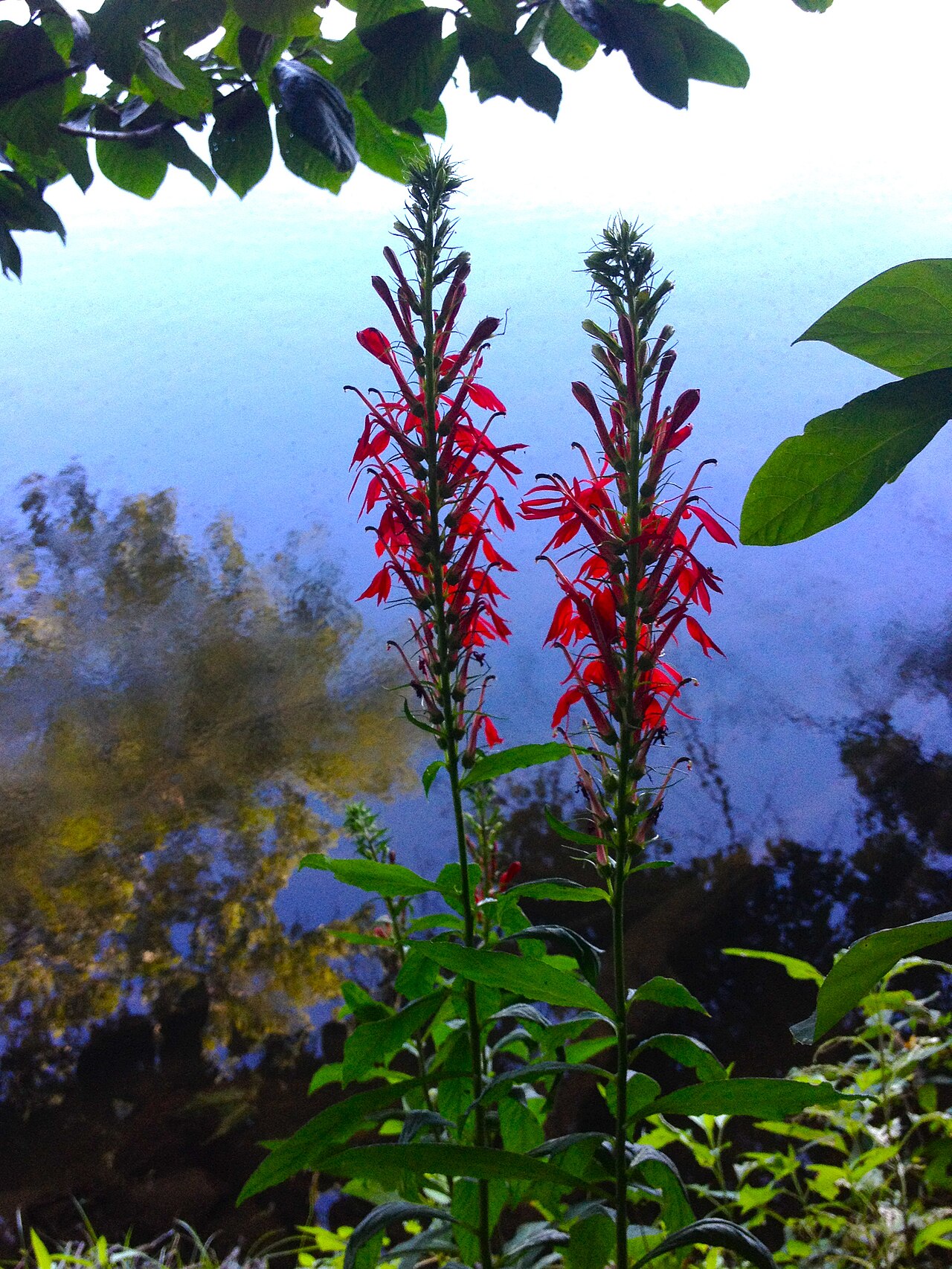
Native lobelias are wildflowers of wet meadows, stream banks, fens, prairies and open woods, best known for two garden favorites: the scarlet cardinal flower and the blue great blue lobelia. Their flowers have a distinctive shape, with two small upper lobes and three larger lower lobes forming a lip, which some people think looks like an open-mouthed fish. Most bloom from midsummer into fall, in shades of red, blue, violet, lavender and white, and they draw hummingbirds and bumblebees.
Many gardeners know lobelia only as the low, trailing blue annual in hanging baskets and window boxes. That plant, edging lobelia, comes from South Africa. The native species are upright perennials, biennials and annuals, usually 1 to 4 feet tall, and most of them like moist soil. Some, such as Kalm’s lobelia and water lobelia, are specialists of fens and lakeshores, while pale-spike lobelia and Indian tobacco grow in drier prairies, fields and woods.
This guide covers the native lobelias you are most likely to meet or grow, where each grows wild, how to grow them, and how to tell them from the non-native bedding lobelias. If you came from our Michigan landscaping article, the species native to Michigan are noted below.
Identification
Lobelias belong to the bellflower family (Campanulaceae), in a group sometimes treated as its own family, Lobeliaceae. The genus is named for Matthias de l’Obel, a Flemish botanist of the 1500s.
Flowers
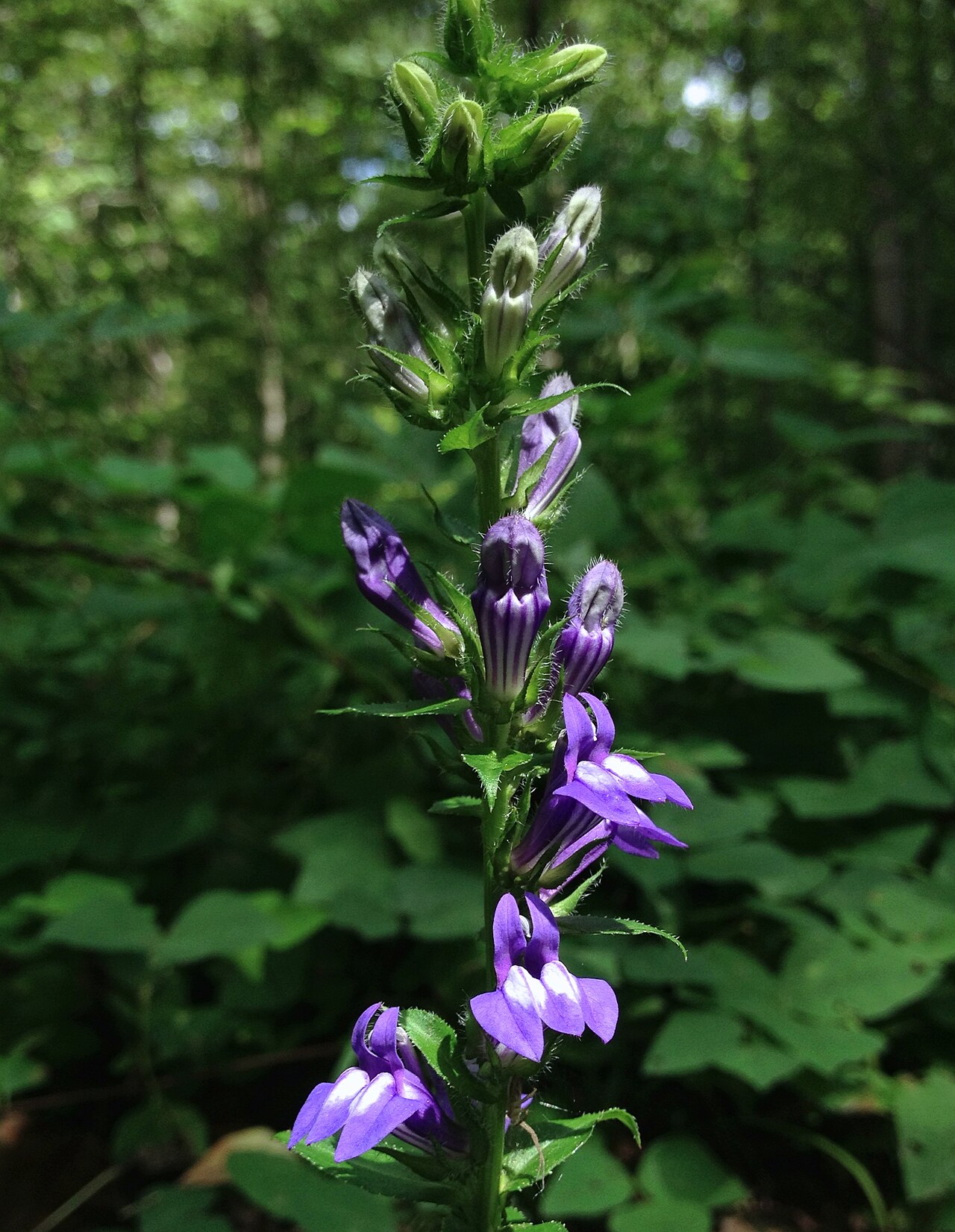
Each flower is two-lipped. The upper lip has two narrow lobes, and the lower lip has three wider, spreading lobes. Unlike most two-lipped flowers, the tube is split down the top, and the stamens are fused into a tube around the style that pokes out through the split. Flowers are arranged in a spike or loose raceme along the top of the stem, opening from the bottom up over several weeks. Colors range from scarlet in cardinal flower to blue, violet, lavender and white in most other species.
Leaves & Stems
Leaves are simple, alternate and usually toothed, from lance-shaped in cardinal flower and great blue lobelia to small and narrow in Kalm’s lobelia. Many species form a flat basal rosette of leaves in fall that overwinters before the plant flowers the next summer. The stems contain a milky or watery sap.
Fruit & Seeds
The fruit is a small capsule that splits at the top to release hundreds of tiny, dust-like seeds. In Indian tobacco the capsule is inflated like a small balloon, which gives that species its scientific name, inflata.
Similar Plants
Great blue lobelia is sometimes confused with blue mistflower or with native bellflowers, but bellflowers have symmetrical, bell-shaped flowers. Cardinal flower might be mistaken for red-flowered salvias or bee balms, which have square stems and paired leaves; lobelias have round stems and alternate leaves.
Quick Facts
| Scientific Name | Lobelia L. |
| Family | Campanulaceae (Bellflower); sometimes placed in Lobeliaceae |
| US-Native Species | About 30 in the mainland US, plus roughly a dozen endemic to Hawaii (approximate) |
| Growth Forms | Short-lived perennials, biennials and annuals; one aquatic species |
| Mature Height | Mostly 1–4 ft; Kalm’s and water lobelia under 1½ ft |
| Sun Exposure | Full Sun to Part Shade |
| Water Needs | Most need moist to wet soil; pale-spike lobelia and Indian tobacco tolerate drier sites |
| Soil Type | Rich, moist loam to wet muck; calcareous sand and marl for Kalm’s lobelia |
| Bloom Time | Mostly July to October; some southern species in spring |
| Flower Color | Red, blue, violet, lavender or white |
| Wildlife Value | Hummingbirds (cardinal flower); bumblebees and other bees (blue species) |
| Deer Resistant | Usually; the bitter, toxic sap discourages deer |
| Toxicity | All lobelias contain toxic alkaloids; do not eat |
| USDA Hardiness Zones | Mostly 3–9, varying by species |
Native Range
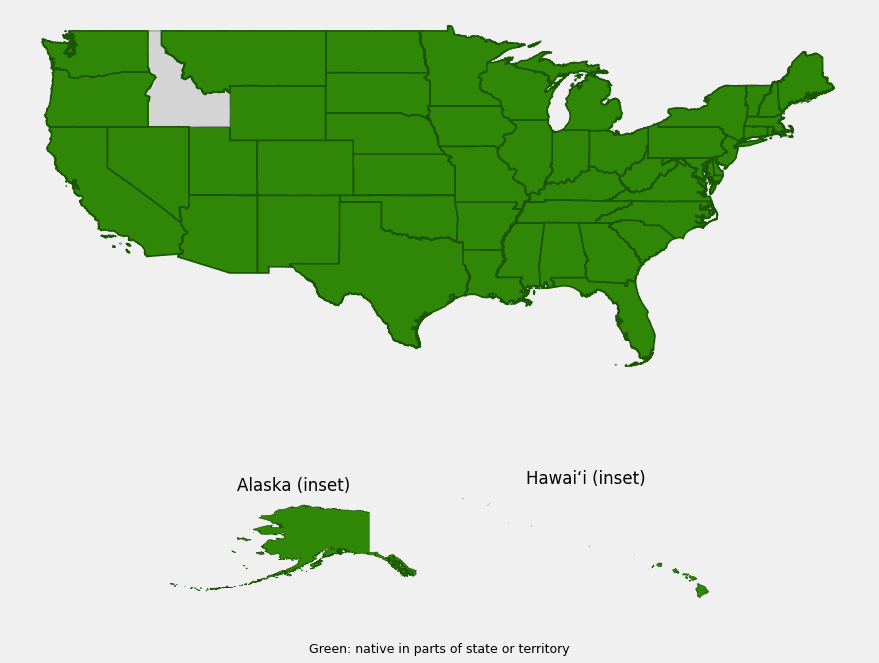
Native lobelias grow in every state except Idaho, from Maine to Florida and west to California, and in Alaska and Hawaii. The East, Midwest and South have the most species and the most familiar ones. Cardinal flower and great blue lobelia line streams and wet meadows across the eastern two-thirds of the country, and the Southeast adds species such as glade lobelia and downy lobelia in its pinelands and coastal plain.
Westward, lobelias become scarce. Cardinal flower follows streams and springs into the canyons of the Southwest, including Arizona, New Mexico, southern Utah, southern Nevada and southern California. Kalm’s lobelia and pale-spike lobelia reach Montana and the Dakotas, great blue lobelia reaches eastern Colorado and eastern Wyoming, and water lobelia grows in a few lakes in Washington, Oregon and Alaska. Hawaii has its own group of tree-like and shrubby endemic lobelias, many of them endangered.
Michigan has a rich set of native lobelias, including cardinal flower, great blue lobelia, Kalm’s lobelia, pale-spike lobelia, Indian tobacco and water lobelia.
📋 Regional plant lists with native lobelias: New Hampshire, Maine & Vermont · Connecticut, Massachusetts & Rhode Island · New York, Pennsylvania & Northern New Jersey · Delaware, Southern New Jersey & Long Island · Maryland, Virginia & West Virginia · North Carolina & South Carolina · Georgia, Alabama & Mississippi · Arkansas, Louisiana, Eastern Oklahoma & Eastern Texas · South & West Texas · Kentucky & Tennessee · Ohio & Indiana · Illinois, Iowa & Missouri · Michigan, Wisconsin & Eastern Minnesota · North Dakota, South Dakota & Western Minnesota · Nebraska, Kansas & Eastern Colorado · Montana & Wyoming · Utah & Western Colorado · Arizona & New Mexico · Western Oregon & Washington · California & Nevada · Alaska · Hawaii
Native Species
These native lobelias are the ones gardeners and naturalists meet most often. Each linked name goes to our full growing guide.
Cardinal flower (Lobelia cardinalis) carries tall spikes of brilliant scarlet flowers, 2 to 4 feet high, from July to September. It grows along streams, ponds, swamps and wet meadows from New England and Michigan to Florida and Texas and west through the Southwest to California. It is a short-lived perennial that needs constant moisture, and ruby-throated hummingbirds are its main pollinators. Native in Michigan.
Great blue lobelia (Lobelia siphilitica) has dense spikes of bright blue to blue-violet flowers with white-striped throats, 1 to 3 feet tall, in late summer and early fall. It grows in moist meadows, stream banks, swamps and wet woods across the East and Midwest to the Great Plains. It is a little easier than cardinal flower in average garden soil and self-sows freely. Bumblebees are its main pollinators. Native in Michigan.
Downy lobelia (Lobelia puberula) is a soft-hairy southeastern species with blue-violet flowers, usually all on one side of the spike, from late summer into fall. It grows in moist to fairly dry open woods, clearings and pinelands from New Jersey and southern Illinois south to Florida and Texas, and tolerates drier soil than most lobelias.
Pale-spike lobelia (Lobelia spicata) has a slender, wand-like spike of small, pale blue to nearly white flowers on stems 1 to 3 feet tall in early to midsummer. It grows in dry to moist prairies, meadows, fields and open woods from New England and the Great Lakes west to the Dakotas and Montana and south to Louisiana. Native in Michigan.
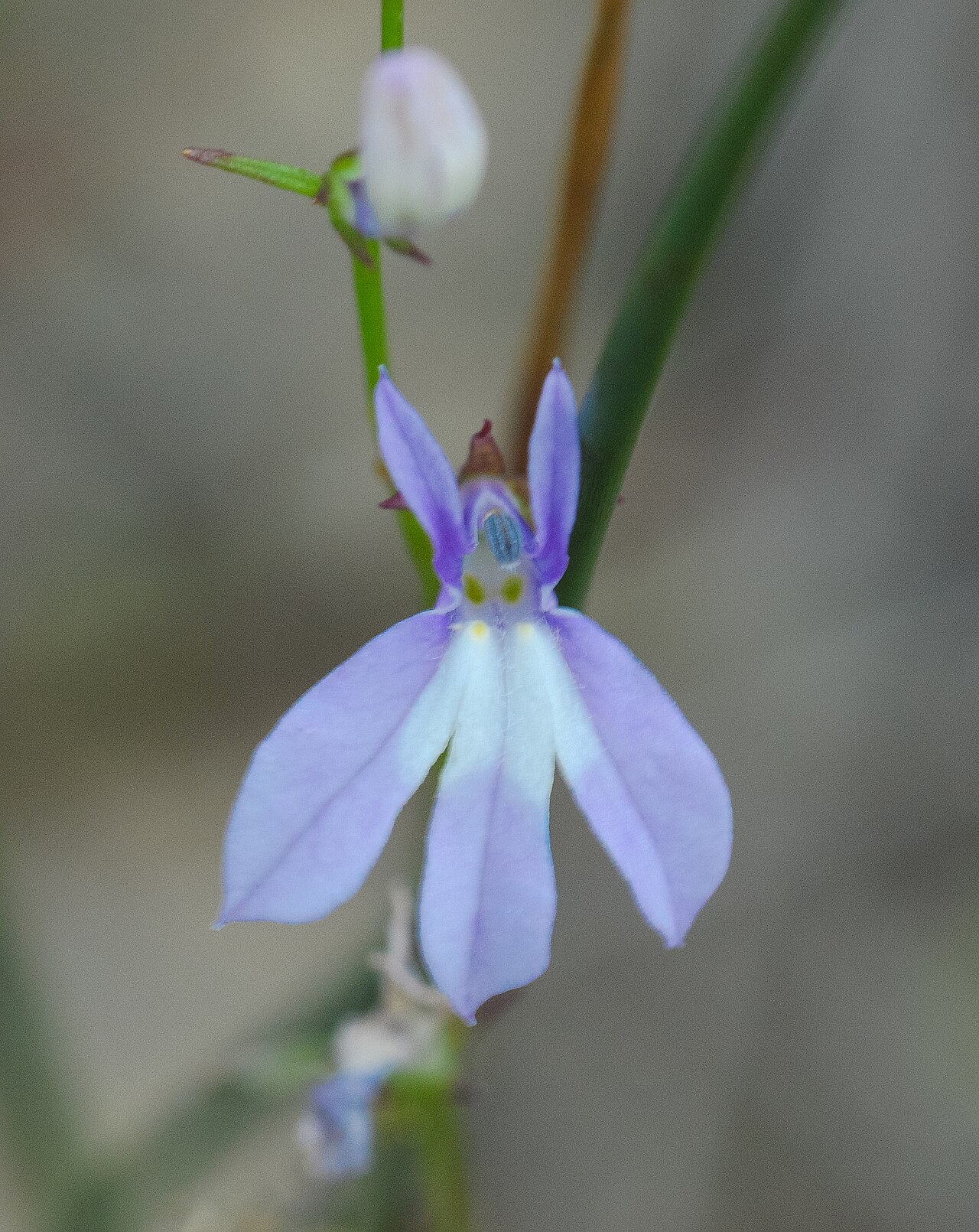
Kalm’s lobelia (Lobelia kalmii), also called brook lobelia, is a delicate plant 4 to 16 inches tall with small sky-blue flowers that have a white eye. It grows on calcareous ground: fens, wet limestone shores, interdunal wetlands and marly lake edges across Canada and the northern US, from Maine and the Great Lakes to Montana and Washington. Michigan’s Great Lakes shorelines and fens are one of its strongholds.
Indian tobacco (Lobelia inflata) is an annual or biennial, 1 to 2 feet tall, with tiny pale blue flowers and inflated, balloon-like seed pods. It is common in old fields, roadsides, clearings and open woods across the East and Midwest. It is one of the most toxic lobelias. Native in Michigan.
Glade lobelia (Lobelia glandulosa) is a slender southeastern species of wet pine savannas, bogs and ditches on the coastal plain from Virginia to Florida and Louisiana. Its large blue-violet flowers open in late summer and fall on narrow, leafy stems.
Water lobelia (Lobelia dortmanna) is an aquatic species that grows as a rosette of hollow leaves on the bottom of clear, sandy, nutrient-poor lakes, sending its pale lavender flowers above the water in summer. It grows across the northern states, including Michigan, with scattered lakes in Washington, Oregon and Alaska, and is rare in much of its range.
Hawaiian lobelias. Hawaii has about a dozen endemic Lobelia species, many with tall, unbranched stems topped by a rosette of long leaves, and they belong to a larger group of Hawaiian lobelioids that evolved alongside the islands’ native honeycreeper birds. Many are endangered, and several are known from only a few plants.
Non-Native Look-Alikes
Most lobelias sold as bedding plants are not native, though some popular perennials have native parents.
- Edging lobelia (Lobelia erinus): The low, mounding or trailing annual sold in flats for baskets, window boxes and edging, with masses of small blue, purple, pink or white flowers. It is native to southern Africa. It does not spread into the wild in the US, but it offers far less to native insects than the native species and dies out in summer heat.
- Hybrid cardinal flowers (Lobelia × speciosa): Garden hybrids such as the Fan and Compliment series, bred from cardinal flower, great blue lobelia and the Mexican L. fulgens, in red, pink, purple and blue. They are partly native in ancestry but are not wild species.
- ‘Queen Victoria’ and other purple-leaved cardinal flowers: Often sold as L. cardinalis but usually derived from Mexican L. fulgens. They are less winter hardy than the native cardinal flower.
- Devil’s tobacco (Lobelia tupa): A large, red-flowered lobelia from Chile, occasionally grown in mild-climate gardens.
None of these non-native lobelias is considered invasive in the US. To support native hummingbirds and bees, choose straight species of cardinal flower or great blue lobelia from a native plant nursery.
Growing & Care Guide
Light
Most native lobelias grow well in full sun if the soil stays moist, and in part shade otherwise. In hot southern gardens, afternoon shade helps cardinal flower and great blue lobelia. Kalm’s and pale-spike lobelia want full sun.
Soil & Water
Cardinal flower, great blue lobelia, glade lobelia and Kalm’s lobelia need soil that never dries out: pond and stream edges, rain gardens, wet meadows or a bed you water regularly. Rich, organic soil is best. Pale-spike lobelia, downy lobelia and Indian tobacco tolerate average to dry soil. Water lobelia needs to grow underwater in clear, unpolluted lakes and isn’t suited to garden ponds.
Planting Tips
Plant in spring or early fall, 12 to 18 inches apart, in groups so the spikes make a show. Combine with other moisture lovers such as swamp milkweed, turtlehead, blue flag iris, Allegheny monkeyflower and sweet Joe-Pye weed.
Pruning & Maintenance
Cardinal flower and great blue lobelia are short-lived perennials, often lasting only a few years. Keep them going by letting some seed heads ripen so plants self-sow. In fall, don’t bury the low winter rosettes under heavy mulch or fallen leaves, which can make them rot; a light mulch or none is best. Cut spent stalks in spring or after seed has dropped.
Propagation
Sow the dust-fine seed on the soil surface without covering it, because it needs light to germinate. Sow outdoors in fall, or give it about 60 days of cold, moist stratification before sowing in spring. Cardinal flower can also be propagated by bending a flowering stem to the ground and pinning it down, since new plantlets form at the leaf joints, or by dividing the offset rosettes in spring.
Landscape Uses
- Rain gardens and pond edges with cardinal flower and great blue lobelia
- Hummingbird gardens, where cardinal flower is one of the best native plants for late summer
- Woodland streamside plantings in part shade
- Prairie and meadow plantings with pale-spike lobelia in drier soil
- Fen and bog gardens with Kalm’s lobelia on wet, alkaline soil
Wildlife & Ecological Value
For Hummingbirds
Cardinal flower is pollinated mainly by the ruby-throated hummingbird in the East. As the bird feeds, the projecting stamen tube touches its forehead and leaves pollen there for the next flower. Few insects can reach the nectar at the base of the long red tube.
For Pollinators
Great blue lobelia and most other blue lobelias are pollinated by bumblebees, which land on the lower lip and push into the flower. Smaller bees, butterflies and skippers also visit, and Kalm’s and pale-spike lobelia attract small bees and flies.
Ecosystem Role
Native lobelias are an important part of late-summer bloom in wetlands, when they and Joe-Pye weed, turtlehead and asters feed hummingbirds and bees preparing for migration or winter. Water lobelia is an indicator of clean, nutrient-poor lakes. In Hawaii, native lobelias and honeycreepers evolved together, and the loss of many birds has left some lobelias with few pollinators.
Toxicity
All lobelias contain lobeline and related alkaloids. Eating the plants can cause nausea, vomiting, a slowed or irregular heartbeat and, in large amounts, more serious poisoning. Keep children and pets from chewing on them. Deer usually avoid them for the same reason.
Cultural & Historical Uses
Indian tobacco was widely used in 19th-century American herbal medicine, especially by Samuel Thomson and his followers, who promoted it as an emetic; it earned the folk name “pukeweed.” Great blue lobelia got its scientific name, siphilitica, from a mistaken 1700s belief that it could cure syphilis. Several Native American peoples used native lobelias in medicine and ceremony. These are historical uses, not recommendations; lobelias are poisonous.
Cardinal flower was introduced to European gardens in the 1600s, and its name refers to the scarlet robes of Roman Catholic cardinals. It remains one of the most admired American wildflowers.
Frequently Asked Questions
Is lobelia native to Michigan?
Yes. Michigan has several native lobelias, including cardinal flower, great blue lobelia, Kalm’s lobelia, pale-spike lobelia, Indian tobacco and water lobelia. The bedding lobelia sold in flats, Lobelia erinus, is from southern Africa.
What colors do native lobelias come in?
Cardinal flower is scarlet. Most other native lobelias are blue, violet or lavender, sometimes with white markings, and white forms occur occasionally. Pink and purple lobelias in garden centers are usually hybrids.
Why did my cardinal flower disappear after a few years?
Cardinal flower is naturally short-lived. Let it set seed or root a few stems, keep the soil moist, and don’t smother the winter rosettes with mulch or leaves.
Do lobelias need wet soil?
Cardinal flower, great blue lobelia and Kalm’s lobelia need consistently moist soil. Pale-spike lobelia, downy lobelia and Indian tobacco tolerate average to dry soil.
Are lobelias poisonous?
Yes. All lobelias contain toxic alkaloids and should not be eaten. Handling them is generally safe.

Looking for a nursery that carries Native Lobelias?
Browse our native plant nursery directory: Alabama, Alaska, Arizona & Arkansas · California · Colorado, Connecticut, Delaware, Florida, Georgia & Hawaii · Illinois, Indiana, Iowa & Kansas · Kentucky, Louisiana, Maine, Maryland, Massachusetts, Michigan, Minnesota, Mississippi, Missouri & Montana · Nebraska, Nevada, New Hampshire, New Jersey, New Mexico, New York, North Carolina, North Dakota, Ohio & Oklahoma · Oregon · Pennsylvania, Rhode Island, South Carolina, South Dakota, Tennessee, Texas, Utah, Vermont & Virginia · Washington · West Virginia, Wisconsin & Wyoming

