
Swamp Smartweed (Polygonum hydropiperoides)
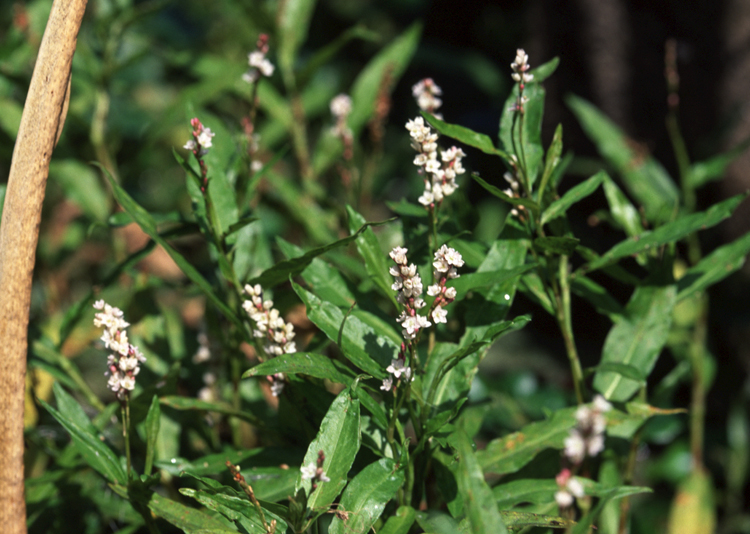
Polygonum hydropiperoides, known as Swamp Smartweed (USDA: swamp smartweed), is a native perennial wetland plant of the buckwheat family (Polygonaceae). Many botanists now place it in the genus Persicaria, as Persicaria hydropiperoides, and it is also called mild water-pepper or false water-pepper. It grows along the muddy edges of ponds, lakes, streams, marshes and ditches across most of the United States, southern Canada and Puerto Rico, and south through Mexico and Central and South America.
Swamp smartweed has slender, reddish, jointed stems, long narrow leaves and, from summer into fall, thin, upright spikes of small white to pale pink flowers. It spreads by creeping stems that root at the joints and often forms loose colonies in shallow water or wet mud. Unlike its relative water-pepper (P. hydropiper), its leaves do not have a sharp, peppery taste, which explains the name “mild water-pepper.”
This is an excellent native plant for pond margins, rain gardens, bioswales and wetland restoration. Its long bloom season feeds bees, wasps and flies, and its seeds are an important food for ducks, rails and songbirds. It is not toxic, but like many smartweeds it can spread in wet soil, so give it room.
Identification
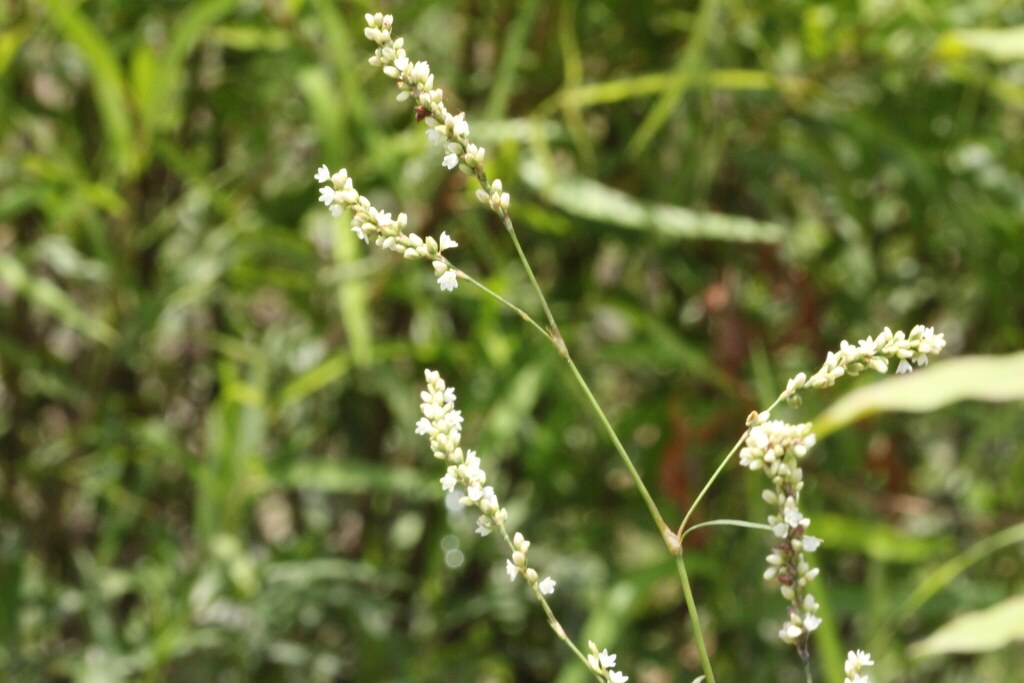
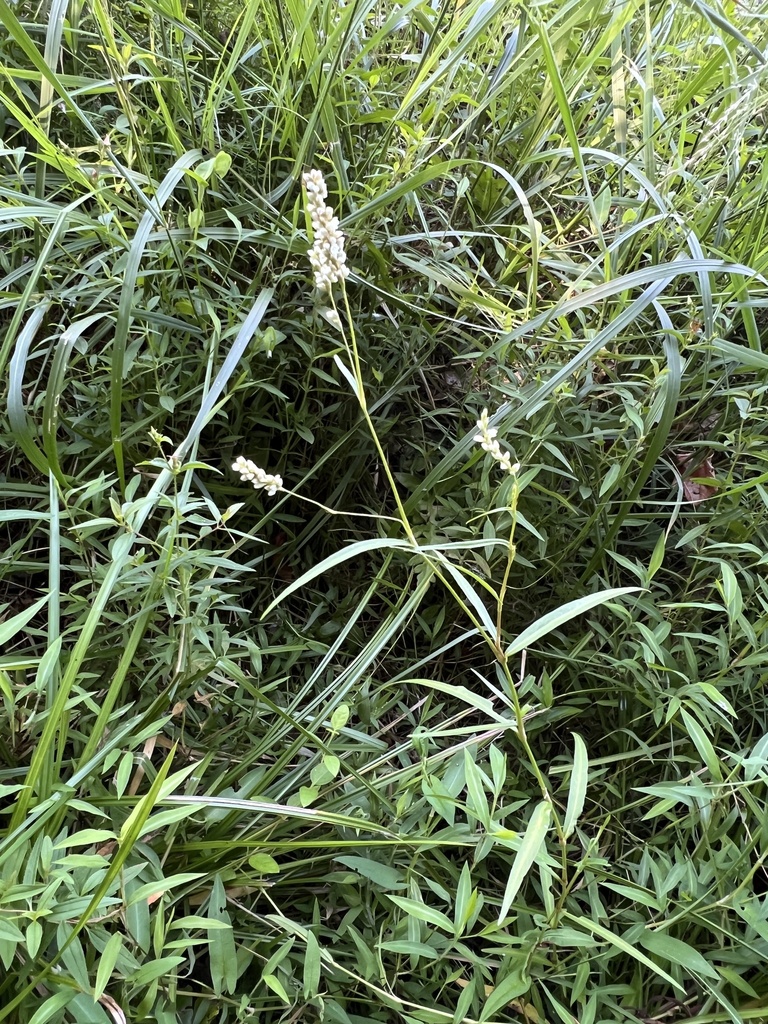
Look for a smartweed with slender, often reddish stems, long narrow leaves, a sheath at each leaf joint fringed with bristles, and very thin, upright, often interrupted spikes of small white to pinkish flowers, growing in mud or shallow water.
Stems & Roots
Plants grow 1 to 3 feet tall from creeping rhizomes and stems that lie along the mud and root at the joints, then turn upward. The stems are smooth or with a few flattened hairs, green to reddish, and swollen at each joint. Like all smartweeds, each joint is wrapped in a papery, tubular sheath (ocrea). In swamp smartweed this sheath is fringed at the top with stiff bristles 1/4 to 1/2 inch long.
Leaves
The leaves are alternate, narrowly lance-shaped, 2 to 6 inches long and 1/4 to 3/4 inch wide, tapering to a point, on very short stalks. They are usually smooth, with a few stiff hairs along the edges and midrib. They lack the dark “thumbprint” blotch found on the leaves of lady’s thumb.
Flowers
From June or July until frost (and nearly year-round in Florida and Puerto Rico), slender, upright spikes 1 to 3 inches long appear at the stem tips and in the upper leaf axils. They are narrow and often interrupted, with small clusters of flowers spaced along the stalk. Each flower is about 1/8 inch long, with five white to pale pink petal-like sepals and no glandular dots.
Fruit & Seeds
Each flower produces a single small, shiny, black, three-sided seed (achene) about 1/8 inch long, enclosed in the dried sepals. Seeds ripen from late summer through fall and fall into the water or mud, where many are eaten by waterfowl.
Look-alikes
Dotted smartweed (P. punctatum) is very similar but has greenish-white sepals covered with tiny glandular dots. Water-pepper (P. hydropiper), a European introduction, has dotted, greenish flowers and a hot, peppery taste. Water Smartweed has short, thick, bright pink spikes and broader leaves, often floating. Pennsylvania smartweed has thick, dense, pink spikes and glandular-hairy flower stalks. Arrowleaf Tearthumb has arrow-shaped leaves and prickly stems.
Safety
Swamp smartweed is not considered toxic. It is a mild-tasting wetland plant and lacks the strong, acrid juices of water-pepper. Its seeds and leaves are eaten by wildlife.
Quick Facts
| Scientific Name | Polygonum hydropiperoides (syn. Persicaria hydropiperoides) |
| Family | Polygonaceae (buckwheat family) |
| Plant Type | Herbaceous perennial; emergent wetland plant |
| Mature Height | 1–3 ft |
| Mature Spread | 2–3 ft; spreads by creeping stems and rhizomes |
| Growth Rate | Fast |
| Sun Exposure | Full sun to part shade |
| Water Needs | High; wet mud or shallow water up to about 6 in deep |
| Soil Type | Muck, mud, sand or silt; wet to saturated |
| Soil pH | About 5.0–7.5 |
| Bloom Time | June–October; nearly year-round in Florida and Puerto Rico |
| Flower Color | White to pale pink |
| Fall Color | Stems and leaves often redden |
| Fruit | Small, shiny, black, three-sided achene |
| Deer Resistant | Moderate; occasionally browsed |
| USDA Hardiness Zones | 3–11 |
Native Range
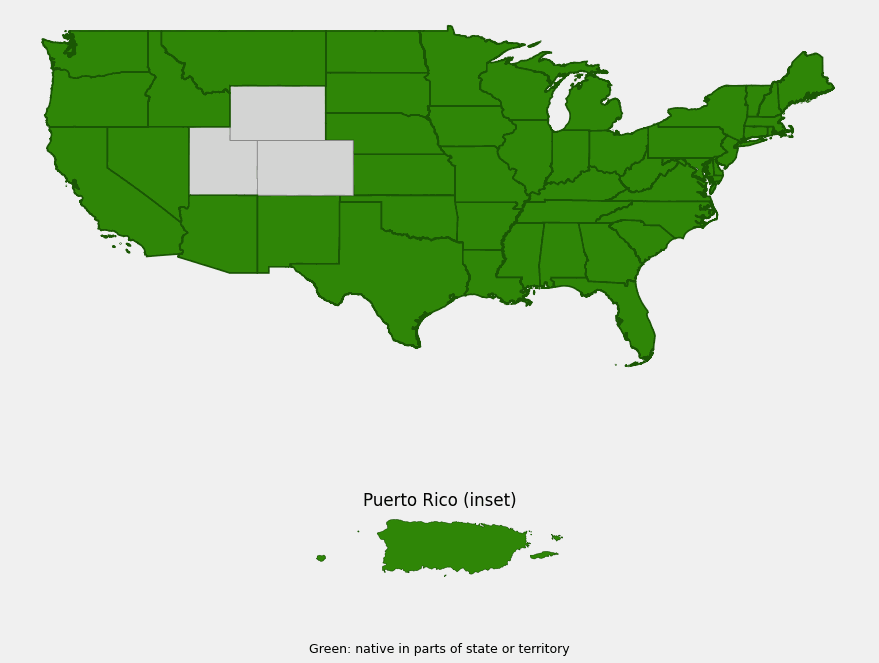
Swamp smartweed is one of the most widespread native smartweeds in the Americas. USDA PLANTS lists it as native in Canada, the lower 48 states and Puerto Rico (it is considered introduced in Alaska). In Canada it grows in British Columbia, Ontario, Quebec, New Brunswick and Nova Scotia. In the United States it is recorded from 45 states, missing mainly from the dry interior of Colorado, Utah and Wyoming. It also ranges south through Mexico, Central America, the Caribbean and South America.
It is most common in the eastern half of the country and along the Pacific Coast. In the East it occurs from Maine to Florida and west to Minnesota, the Dakotas, Kansas, Oklahoma and Texas, including the Edwards Plateau and South Texas. In the West it is common in the lowlands of western Oregon and Washington, in California, and along rivers and ponds in Arizona and New Mexico, with more scattered records in Idaho, Montana and Nevada. In Puerto Rico it grows in wet ditches, marshes and pond margins.
Typical habitats are the shallow margins of ponds, lakes and slow streams, marshes, swamps, wet meadows, wet ditches and muddy shores where water levels rise and fall. It tolerates shallow standing water and periodic flooding, and it often colonizes exposed mud as water levels drop in summer.
📋 Regional plant lists featuring Swamp Smartweed: New York, Pennsylvania & Northern New Jersey · Idaho, Eastern Oregon & Eastern Washington · Ohio & Indiana · Montana & Wyoming · Michigan, Wisconsin & Eastern Minnesota · Kentucky & Tennessee · Nebraska, Kansas & Eastern Colorado · Connecticut, Massachusetts & Rhode Island · New Hampshire, Maine & Vermont · Maryland, Virginia & West Virginia · Delaware, Southern New Jersey & Long Island · Arizona & New Mexico · Illinois, Iowa & Missouri · Alabama, Georgia & Mississippi · North & South Florida · Puerto Rico · North & South Carolina · Arkansas, Louisiana, Eastern Oklahoma & Eastern Texas · South & West Texas · North Dakota, South Dakota & Western Minnesota · Western Oregon & Western Washington · California & Nevada
Growing & Care Guide
Swamp smartweed is easy to grow anywhere the soil stays wet. It is offered by wetland and native plant nurseries, often as plugs or seed for restoration, and it establishes quickly.
Light
Full sun to part shade. It flowers best in sun but grows well in light shade along wooded pond edges.
Soil & Water
Plant it in wet mud, saturated soil or shallow water up to about 6 inches deep. It tolerates sand, silt and mucky clay, fluctuating water levels and periodic flooding. In a garden it needs consistently moist to wet soil; it will not thrive in dry beds.
Planting Tips
Plant plugs 1 1/2 to 2 feet apart along pond edges, in the low zone of a rain garden or bioswale, or in a container water garden. Because it spreads by creeping stems, it fills gaps quickly and helps stabilize muddy banks. In small ponds, keep it in a submerged pot if you want to limit its spread.
Pruning & Maintenance
Little care is needed. Leave the stems standing in fall so birds can eat the seeds, then cut back dead growth in late winter or early spring. Pull runners that spread beyond where you want them.
Propagation
Divide clumps or root stem cuttings in spring or summer; cut stems root readily in water or wet soil. Seed sown outdoors in fall germinates the following spring; stored seed needs cold, moist stratification.
Landscape Uses
- Pond and lake margins: soft, flowering edge planting in shallow water
- Rain gardens and bioswales: the wettest, lowest zones that stay saturated
- Wetland restoration: stabilizes mud and provides waterfowl food
- Wildlife ponds: seeds for ducks and songbirds, cover for amphibians
- Container water gardens: in submerged pots to control spread
Wildlife & Ecological Value
Swamp smartweed is a valuable wildlife plant, especially for wetland birds and pollinators that visit its long-lasting flowers.
For Pollinators
The small flowers produce nectar over a long season and are visited by small bees, honey bees, wasps, flies and small butterflies. The leaves are also eaten by the caterpillars of several moths that feed on smartweeds.
For Birds
The seeds are an important food for ducks such as mallards, teal, wood ducks and pintails, as well as rails, bobwhites and sparrows. Waterfowl managers often encourage smartweeds in moist-soil wetlands for this reason. Wading birds hunt for small fish and frogs among the stems.
For Mammals
Muskrats eat the stems and roots, and deer occasionally browse the leaves. Small mammals eat the fallen seeds.
Ecosystem Role
Its creeping stems and roots help hold muddy shorelines and filter runoff. Dense stands shelter frogs, tadpoles, aquatic insects and small fish, and the decaying stems feed the wetland food web.
Cultural & Historical Uses
The name hydropiperoides means “resembling hydropiper,” the water-pepper, a peppery-tasting relative used as a spice and medicine in Europe and Asia. Swamp smartweed looks similar but lacks the hot taste, which is why it is also called mild water-pepper.
Botanists have long debated whether smartweeds belong in Polygonum or in the separate genus Persicaria. USDA PLANTS currently lists this species as Polygonum hydropiperoides, while many recent floras and online databases use Persicaria hydropiperoides. Both names refer to the same plant.
Smartweeds have been called “smartweeds” because the juice of some species, such as water-pepper, causes a smarting sensation on the skin or tongue. Native peoples and early settlers used several smartweeds in folk medicine. Today swamp smartweed is valued mostly by wetland managers and gardeners as a wildlife food plant.
Frequently Asked Questions
Is swamp smartweed invasive?
No. It is native across most of the United States. It spreads by creeping stems in wet soil and can form colonies, but it is not aggressive in dry soil and is easy to pull out.
Is swamp smartweed the same as Persicaria hydropiperoides?
Yes. Persicaria hydropiperoides and Polygonum hydropiperoides are two names for the same plant. USDA uses Polygonum; many newer floras use Persicaria.
Can swamp smartweed grow in standing water?
Yes. It grows in wet mud and in shallow water up to about 6 inches deep, and it tolerates periodic flooding.
Is swamp smartweed good for wildlife?
Yes. Its seeds are eaten by ducks, rails and songbirds, and its flowers feed bees and other pollinators from summer to fall.
How do I tell it from other smartweeds?
Look for long, narrow leaves, bristly-fringed sheaths at the leaf joints, and thin, interrupted spikes of white to pale pink flowers without glandular dots. Its leaves have no peppery taste.

Looking for a nursery that carries Swamp Smartweed?
Browse our native plant nursery directory: Alabama, Arizona & Arkansas · California · Connecticut, Delaware, Florida & Georgia · Idaho, Illinois, Indiana, Iowa & Kansas · Kentucky, Louisiana, Maine, Maryland, Massachusetts, Michigan, Minnesota, Mississippi, Missouri & Montana · Nebraska, Nevada, New Hampshire, New Jersey, New Mexico, New York, North Carolina, North Dakota, Ohio & Oklahoma · Oregon · Pennsylvania, Rhode Island, South Carolina, South Dakota, Tennessee, Texas, Vermont & Virginia · Washington · West Virginia & Wisconsin