
Woolly Plantain (Plantago patagonica)
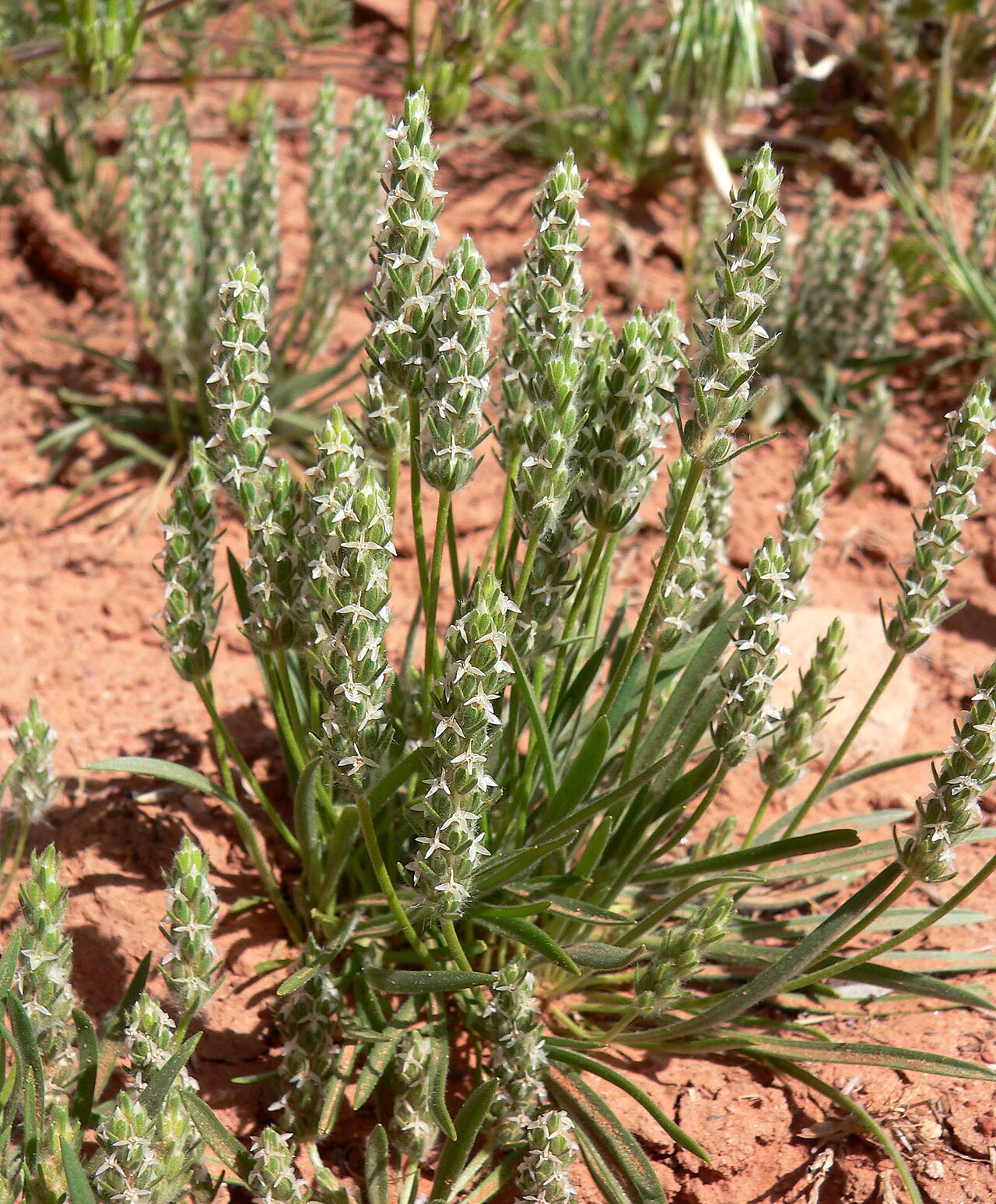
Plantago patagonica, known as Woolly Plantain, Pursh's plantain or woolly Indianwheat, is a small native annual in the plantain family (Plantaginaceae). It forms a little tuft of narrow, gray-green, hairy leaves and sends up several slender stalks, each topped with a dense, cylindrical spike of tiny papery flowers wrapped in long white hairs. Most plants are only 2 to 8 inches tall.
It is one of the most widespread wildflowers of the dry West. Woolly plantain grows from the Great Plains to the Pacific states and south into Mexico, in shortgrass prairie, sagebrush steppe, desert scrub, pinyon-juniper woodland and sandy or gravelly open ground. Despite its species name, which refers to Patagonia, it is native to both North and South America.
It is easy to overlook, but in wet springs it can carpet bare ground between grasses and shrubs. It is a common plant of disturbed and overgrazed range, yet it also belongs to healthy prairie and desert communities, where its seeds feed small birds, rodents and ants.
Identification
Look for a low, grayish, hairy annual with grass-like leaves all at the base and several erect, woolly, cylindrical flower spikes, blooming in spring on dry, open ground.
Growth Habit
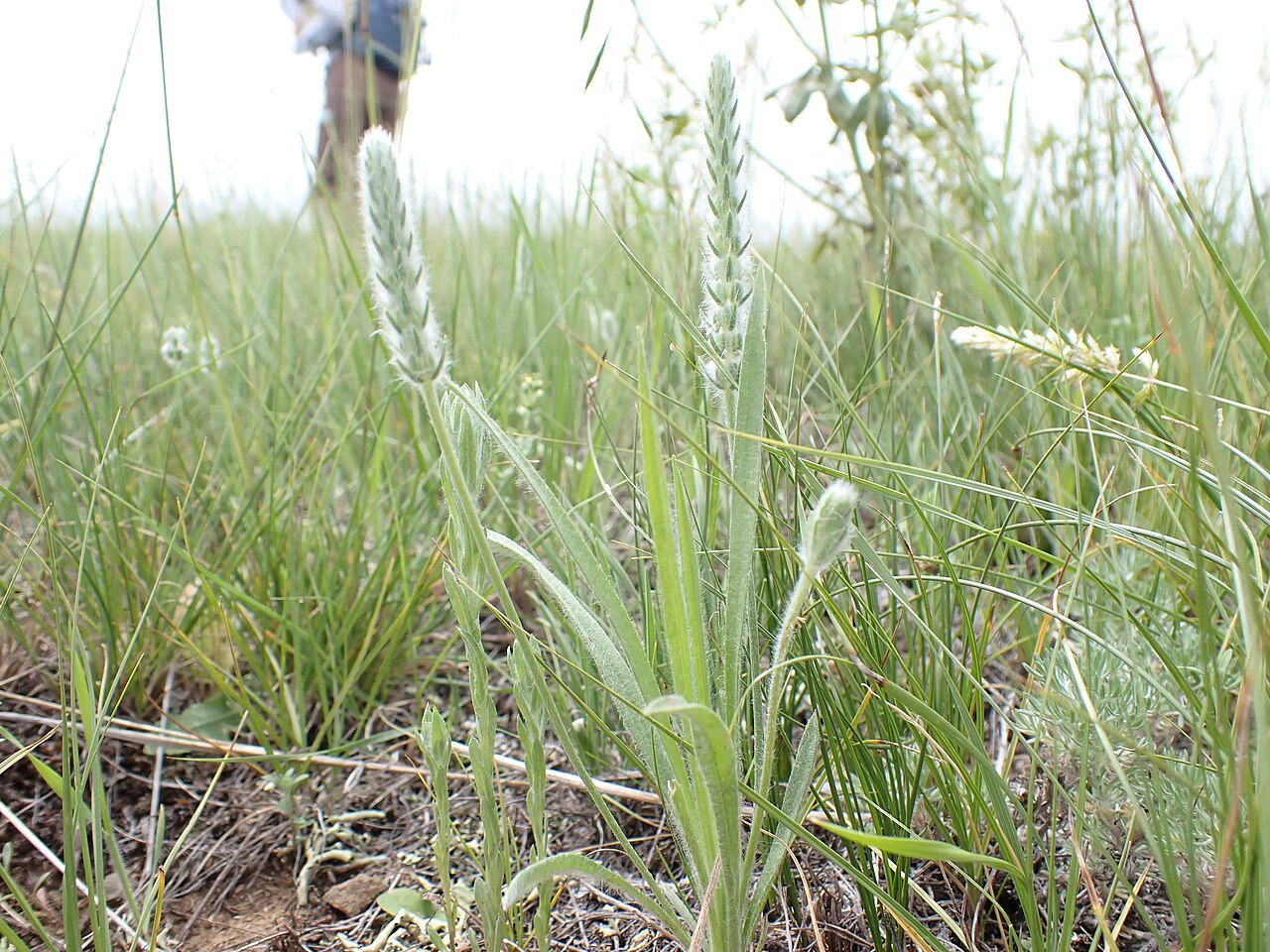
Woolly plantain is a winter or spring annual that germinates after fall or winter rain and dies after setting seed in late spring or summer. It has no true stem above ground; the leaves form a basal tuft, and one to many leafless flower stalks rise from it, usually 2 to 8 inches tall and occasionally up to about a foot.
Leaves
The leaves are linear to very narrowly lance-shaped, about 1 to 5 inches long and less than 1/4 inch wide, with smooth edges and one to three faint veins. They are covered with soft, long white hairs that give the plant a gray-green or silvery look.
Flower Spikes
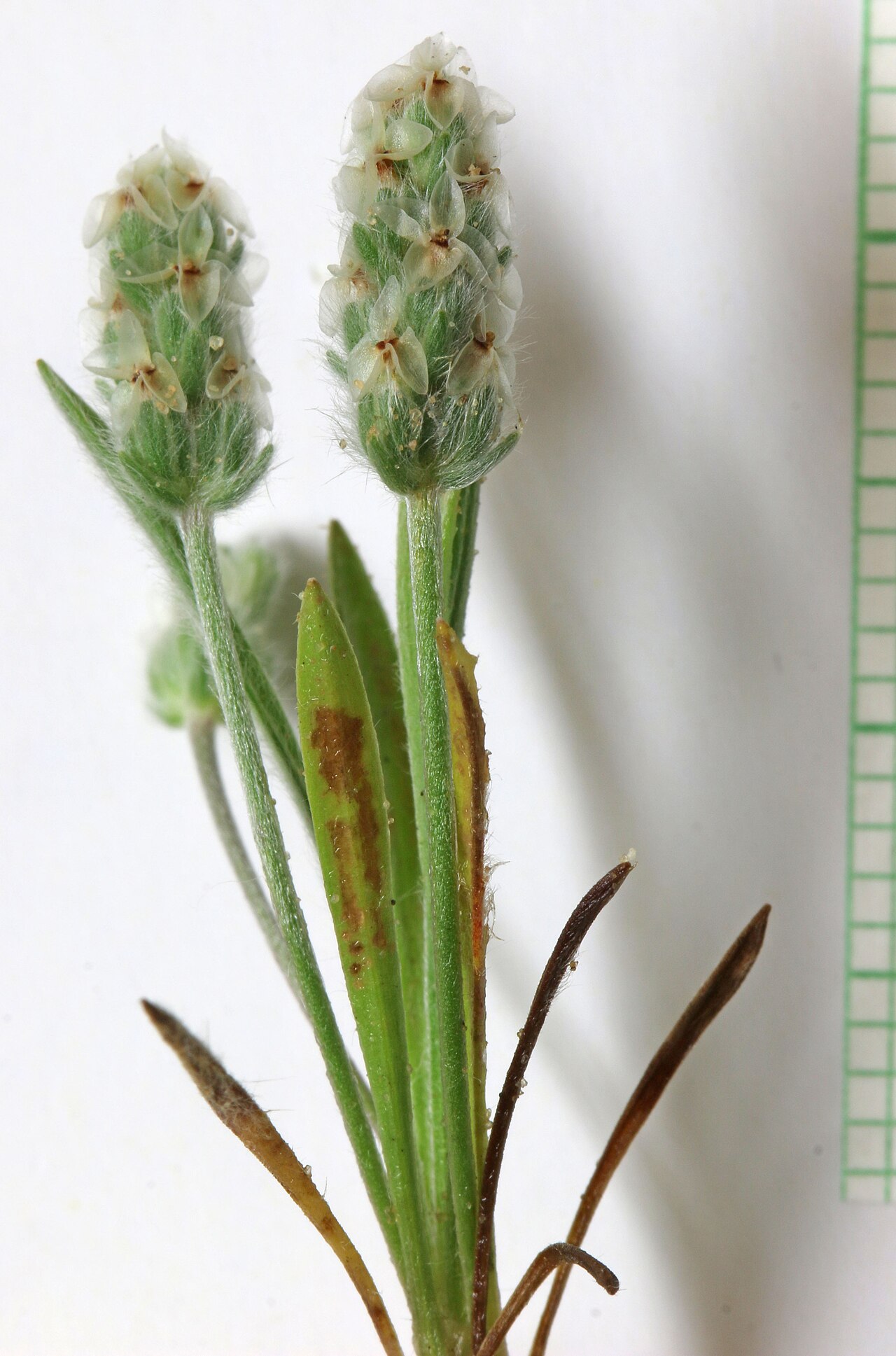
Each stalk ends in a dense, cylindrical spike about 1/2 to 4 inches long. The tiny flowers have four papery, translucent, whitish to tan petals and are partly hidden by narrow bracts and a coat of long, woolly white hairs. Spikes appear from about March to June in the Southwest and into July or August on the northern plains. The flowers are mostly self-pollinated or wind-pollinated and have no showy color.
Fruit & Seeds
Each flower forms a tiny capsule that opens around the middle like a lid, releasing two boat-shaped, brown seeds. Like the seeds of other plantains, they turn sticky and gelatinous when wet, which helps them stick to the soil (and to animals).
Look-alikes
Other small plantains of the West are similar. Dot-seed plantain (Plantago erecta) of California and Oregon has shorter, more oval spikes and is less woolly. Bracted plantain (Plantago aristata) has long, bristle-like bracts sticking far out from the spike. Desert Indianwheat (Plantago ovata) of the Southwest has broader, silkier leaves and short spikes. The weedy English plantain (Plantago lanceolata) is a perennial with much broader, ribbed leaves and short, dark flower heads.
Quick Facts
| Scientific Name | Plantago patagonica Jacq. (syn. P. purshii) |
| Family | Plantaginaceae (plantain family) |
| Plant Type | Annual wildflower (forb) |
| Mature Height | 2–8 in (rarely to 12 in) |
| Mature Spread | 2–6 in |
| Growth Rate | Fast (completes its life cycle in one season) |
| Sun Exposure | Full sun |
| Water Needs | Low; dry soils |
| Soil Type | Sandy, gravelly, rocky or silty soils; well drained |
| Soil pH | Neutral to alkaline (about 6.5–8.5) |
| Bloom Time | March–July (later in the north) |
| Flower Color | Whitish to tan, in woolly white spikes |
| Fall Color | None (annual) |
| Fruit | Small capsules with two mucilaginous seeds |
| Deer Resistant | Mostly; too small and hairy to be favored |
| USDA Hardiness Zones | Annual (grows in zones 3–10) |
Native Range
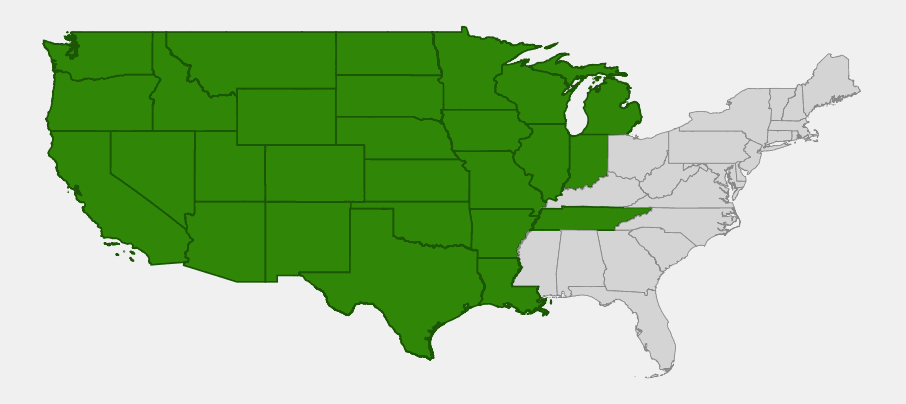
Woolly plantain is native across most of the western two-thirds of the United States. USDA PLANTS records it in nearly 40 states. It is native from Washington, Montana and North Dakota south to California, Arizona, New Mexico and Texas, east across the Great Plains and prairie states to Minnesota, Wisconsin, Illinois, Missouri and Arkansas. Records from Michigan, Indiana, Louisiana and Tennessee are at the eastern edge of its range and are scattered, mostly on sandy ground. In Canada it grows in British Columbia, Alberta, Saskatchewan and Manitoba, and it also occurs in Mexico and South America.
Farther east, plants found along railroads and in waste places are considered introduced. Go Botany lists it as introduced in New England, where it arrived with western wool at nineteenth-century carding mills, and state checklists treat records from Ohio and Virginia and the Atlantic seaboard as non-native. Those states are not shown on the map.
It grows in shortgrass and mixed-grass prairie, sand hills, sagebrush steppe, desert grassland and scrub, pinyon-juniper woodland, open ponderosa pine forest, washes, roadsides and old fields, usually on dry, sandy, gravelly or rocky soils, from near sea level to about 8,000 feet.
📋 Regional plant lists featuring Woolly Plantain: Idaho, Eastern Oregon & Eastern Washington · Ohio & Indiana · Montana & Wyoming · Michigan, Wisconsin & Eastern Minnesota · Kentucky & Tennessee · Nebraska, Kansas & Eastern Colorado · Utah & Western Colorado · Arizona & New Mexico · Illinois, Iowa & Missouri · Arkansas, Louisiana, Eastern Oklahoma & Eastern Texas · South & West Texas · North Dakota, South Dakota & Western Minnesota · California & Nevada
Growing & Care Guide
Woolly plantain is not sold as a garden plant, but it belongs in seed mixes for prairie, desert and dry meadow restorations, and it often arrives on its own in sunny, sparsely planted gravel gardens in its native range.
Light
Full sun. It does not tolerate shade or competition from tall, dense plants.
Soil & Water
Plant it in lean, well-drained sandy, gravelly or rocky soil. It germinates with fall, winter or early spring moisture and needs no irrigation after that. Rich soil and summer watering favor weeds that crowd it out.
Planting Tips
Scatter seed in fall or late winter on bare or lightly raked soil between bunchgrasses, cacti and other low plants. Press it in lightly rather than burying it. It works well in dry prairie and desert seed mixes alongside grasses and annual wildflowers.
Pruning & Maintenance
No pruning is needed. Let plants dry in place and drop their seed so the colony renews itself each year. Keep aggressive non-native annual grasses such as cheatgrass under control.
Propagation
Grow it from seed only. Collect the dry spikes in late spring or summer, rub out the seed, and sow it where it is to grow. Seedlings do not need transplanting.
Landscape Uses
- Prairie and desert restoration: a native annual that fills bare ground between perennials
- Gravel and rock gardens: a small, silvery accent in dry, sunny gaps
- Wildlife plantings: seeds for small birds, rodents and ants
- Erosion control: quick cover on bare, sandy soils in its native range
Wildlife & Ecological Value
Woolly plantain is small, but it is common enough across western rangelands to matter to wildlife.
For Pollinators
The flowers are tiny and largely self- or wind-pollinated, so they offer little to bees. Plantains in general are larval host plants for the common buckeye butterfly and several checkerspot butterflies, whose caterpillars feed on the leaves.
For Birds
Horned larks, sparrows, quail and other ground-feeding birds eat the seeds.
For Mammals
Pocket mice, kangaroo rats and other rodents eat the seeds, and livestock and wild grazers nibble the green plants in spring.
Ecosystem Role
As a quick-growing annual, it covers bare soil after wet winters, and ants gather its seeds. Range managers note that it tends to increase on heavily grazed or disturbed ground, so a very dense stand can be a sign of past overuse.
Cultural & Historical Uses
The species name patagonica refers to Patagonia in southern South America, where the plant was first described by Nikolaus von Jacquin in the eighteenth century. North American plants were long called Plantago purshii, after Frederick Pursh, the botanist who described many of the plants collected by the Lewis and Clark expedition.
The common name Indianwheat, used for several western plantains, refers to the seeds, which Indigenous peoples of the Southwest and Great Basin gathered as food. When wet, plantain seeds form a slippery gel, the same property that makes the commercial fiber psyllium (from the related Plantago ovata) useful.
The genus name Plantago comes from the Latin planta, sole of the foot, a reference to the flat leaves of the broad-leaved plantains that seem to follow human footsteps.
Frequently Asked Questions
Is woolly plantain a weed?
It is a native wildflower in the western and central United States, though it often grows on disturbed or overgrazed ground. East of its native range it occurs only as an introduced plant along railroads and waste areas.
Why is it called woolly plantain?
Its leaves and flower spikes are covered with long, soft, white hairs that make the whole plant look woolly or silvery.
Is woolly plantain an annual?
Yes. It sprouts after cool-season rain, flowers in spring or early summer, sets seed and dies, returning the next year from seed.
Is woolly plantain related to psyllium?
Yes. Both are in the genus Plantago. Commercial psyllium comes from Plantago ovata, but woolly plantain seeds also turn gelatinous when wet.
Where does woolly plantain grow?
In dry, open places across the Great Plains and West, from prairies and sand hills to sagebrush steppe and deserts, and north into southern Canada.

Looking for a nursery that carries Woolly Plantain?
Browse our native plant nursery directory: Arizona & Arkansas · California · Colorado · Idaho, Illinois, Indiana, Iowa & Kansas · Louisiana, Michigan, Minnesota, Missouri & Montana · Nebraska, Nevada, New Mexico, North Dakota & Oklahoma · Oregon · South Dakota, Tennessee, Texas & Utah · Washington · Wisconsin & Wyoming
