
One-Flowered Cancer-Root (Orobanche uniflora)
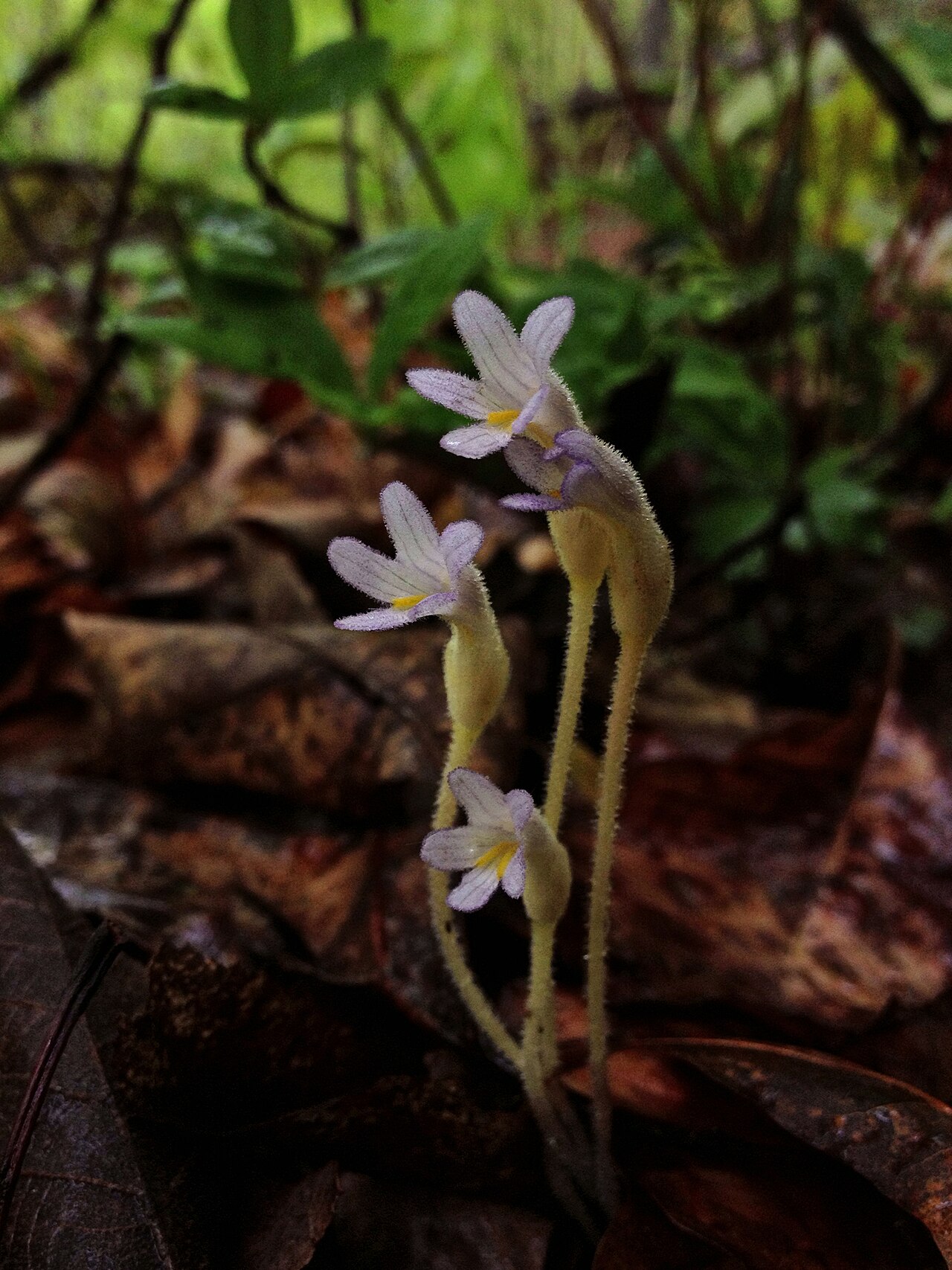
Orobanche uniflora, known as One-Flowered Cancer-Root (USDA: oneflowered broomrape) and also as naked broomrape or ghost pipe, is a small native wildflower in the broomrape family (Orobanchaceae). Many botanists now place it in the genus Aphyllon, as Aphyllon uniflorum. It has no green leaves and no chlorophyll. Instead, it is a holoparasite: it attaches to the roots of other plants and takes all of its water, sugars and nutrients from them.
For most of the year the plant is invisible, living as a small underground structure fused to its host’s roots. In spring it sends up one to several slender, pale, glandular-hairy stalks 2 to 6 inches tall. Each stalk carries a single nodding, tubular flower, white to lavender or purple, with two yellow ridges in the throat, which is where the name “one-flowered” comes from. It parasitizes a remarkably wide range of hosts, including stonecrops, saxifrages, bedstraws, asters, goldenrods and many other plants.
It has one of the widest ranges of any North American wildflower, found in Alaska, across Canada and in nearly every state. Because it lives entirely on its host, it cannot be grown from nursery stock, cannot be transplanted, and should never be dug up or picked. This page is a guide to recognizing and appreciating it where it grows.
Identification
One-flowered cancer-root is easy to recognize: a leafless, pale stalk with one tubular flower at the tip, often in small groups, appearing in spring on the forest floor or in open, rocky places.
Growth Habit
Each plant has a short underground stem attached to a host root, with a few small, overlapping scales. From it rise one to several flower stalks (pedicels), each 2 to 6 inches tall, pale cream, yellowish, pink or purplish and covered in fine glandular hairs. There are no green leaves. USDA lists it as an annual; individual plants are short-lived, though populations persist for years where hosts grow.
Flowers
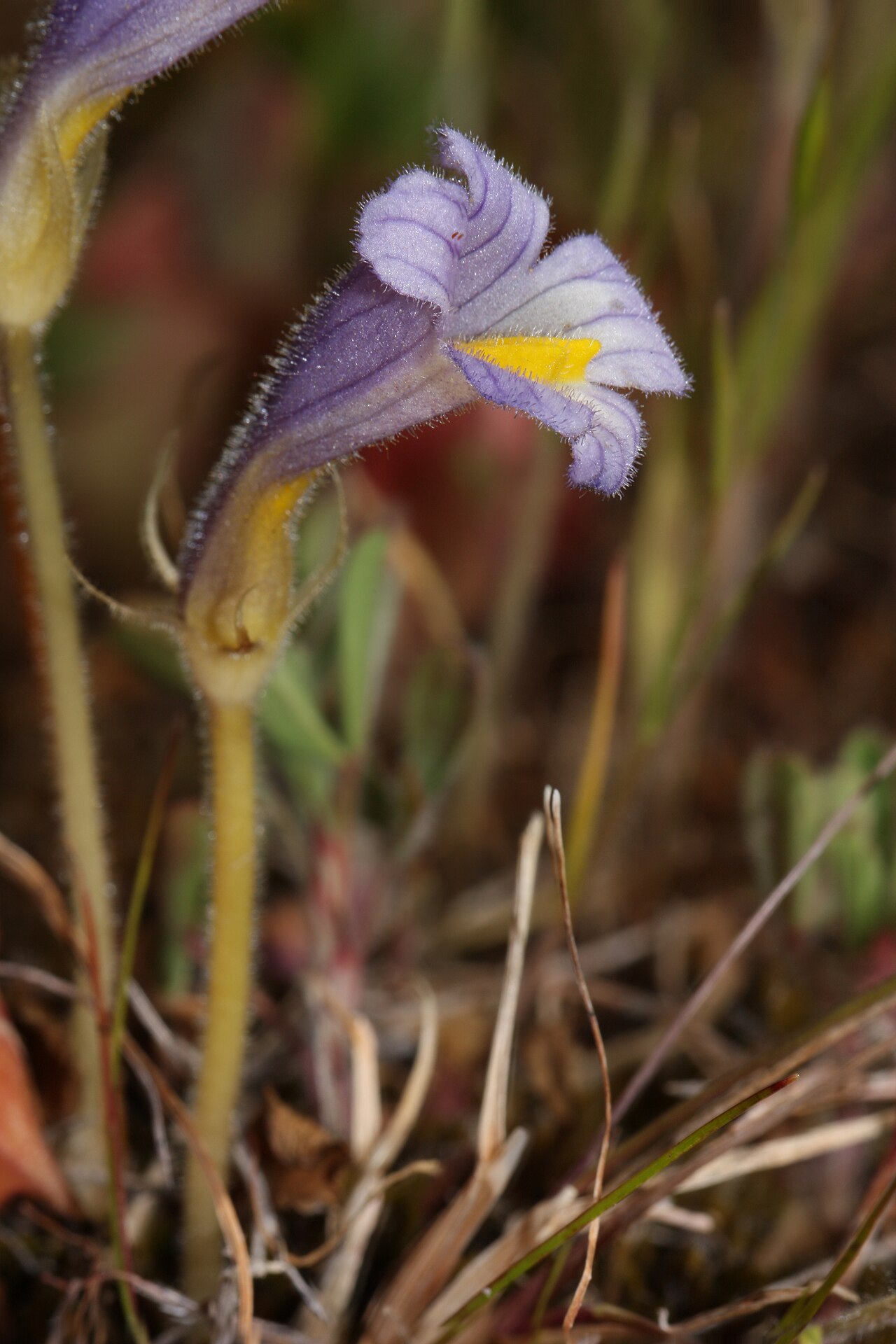
Each stalk ends in one flower about 3/4 to 1 inch long. The corolla is a curved tube that opens into five rounded, spreading lobes. It ranges from almost pure white in many eastern populations to lavender, violet or deep purple, especially in the West, with two yellow, hairy ridges (folds) on the lower side of the throat. The calyx is short, with five narrow, pointed lobes. Flowers appear from April to June, later at high elevations and in the North, and have a faint sweet scent.
Fruit & Seeds
After flowering, a small, oval capsule forms inside the withering flower and splits to release hundreds of tiny, dust-like seeds. The seeds germinate only when chemical signals from a suitable host root are nearby.
Variation
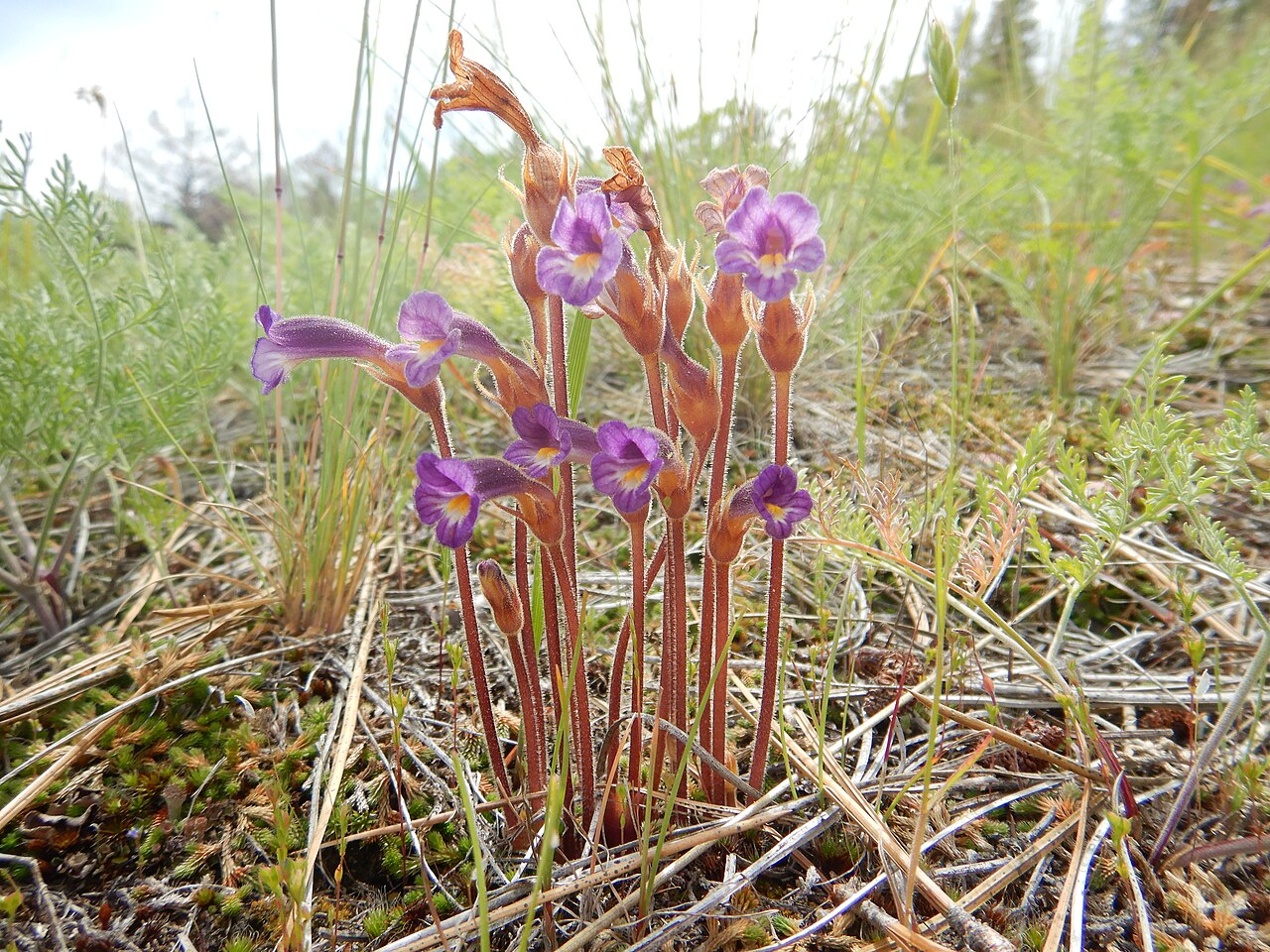
Western plants, sometimes treated as a separate variety or subspecies (occidentalis, purpurea or sedii), often have deeper purple flowers and more stalks per plant and are frequently found on stonecrops (Sedum) and saxifrages in rocky places. Eastern plants are more often white to pale lavender in moist woods.
Look-alikes
Indian Pipe (Monotropa uniflora) is also white with one nodding flower per stem, but it has fleshy, scaly stems, a bell-shaped flower and grows from fungi, not plant roots. American Cancer-root (Conopholis americana) has thick, yellow-brown, pinecone-like spikes of many flowers under oaks. Beechdrops (Epifagus virginiana) has branched, brown stems with many small flowers under beech trees in late summer. Clustered broomrape (Aphyllon fasciculatum) of the West has several to many flowers on stalks arising from a shared, thicker stem above ground.
Safety & Conservation
The plant is not known to be dangerous to touch, but it should not be eaten or used as a remedy. Although it is widespread, it is uncommon in many places and is listed as rare in some states. Its stalks are fragile and easily trampled. Enjoy and photograph it, but leave it where it grows.
Quick Facts
| Scientific Name | Orobanche uniflora (also Aphyllon uniflorum) |
| Family | Orobanchaceae (broomrape family) |
| Plant Type | Holoparasitic herb without chlorophyll; short-lived |
| Mature Height | 2–6 in |
| Mature Spread | A few inches; small clusters |
| Growth Rate | Appears for a few weeks in spring |
| Sun Exposure | Shade to full sun (depends on host habitat) |
| Water Needs | Varies with habitat; moist woods to dry rocky slopes |
| Soil Type | Wherever its host plants grow; undisturbed soil |
| Soil pH | Variable |
| Bloom Time | April–June (to July in the North and mountains) |
| Flower Color | White to lavender or purple, with yellow throat ridges |
| Fall Color | None; plants wither soon after seeding |
| Fruit | Small capsule with many dust-like seeds |
| Deer Resistant | Not applicable; rarely browsed |
| USDA Hardiness Zones | Not cultivated; native in zones 2–9 |
Native Range
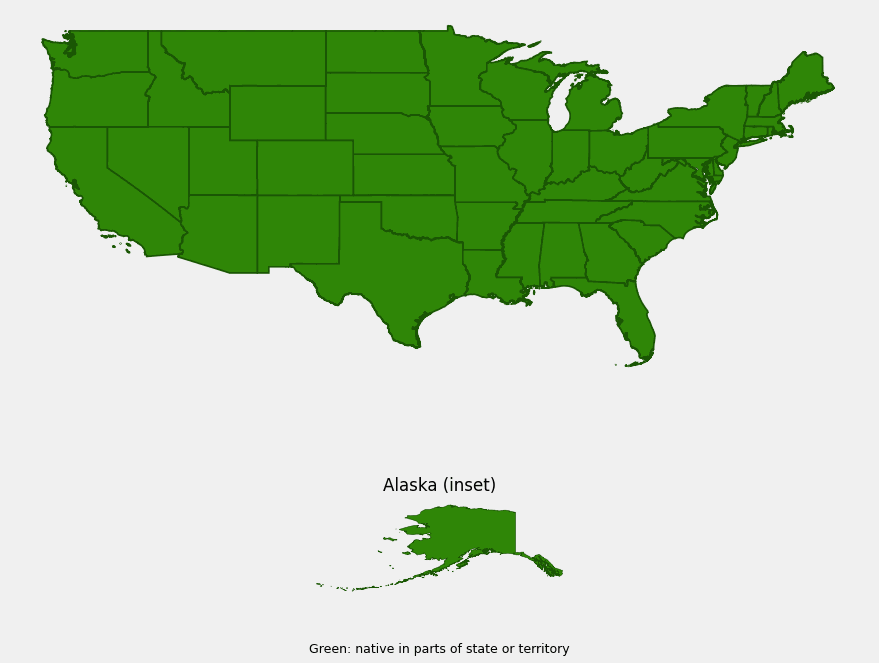
One-flowered cancer-root is one of the most widespread wildflowers in North America. USDA PLANTS lists it as native in Alaska, Canada, the lower 48 states and Saint Pierre and Miquelon, with records from Alaska and all 48 contiguous states. In Canada it grows from British Columbia and Alberta east to Newfoundland and the Maritime provinces.
In the East it is a plant of moist, rich woods, stream banks and wooded slopes from Maine and Quebec south to northern Florida and Louisiana. In the Midwest and Great Plains it is scattered in woods and prairies, and in Texas it reaches the eastern forests and, more rarely, the Edwards Plateau. In the West it is common in open woods, rocky outcrops, grasslands and sagebrush slopes, from the coast of Washington, Oregon and California through the Cascades, the Columbia Plateau and the Rocky Mountains, and north into Alaska.
Because it is parasitic, its exact habitat depends on its hosts. It favors undisturbed ground where its host plants have grown for many years: moist hardwood and mixed forests, mossy banks, rock ledges, meadows and grassland. It is easy to overlook, appears for only a few weeks, and is often more widespread than records suggest.
📋 Regional plant lists featuring One-Flowered Cancer-Root: New York, Pennsylvania & Northern New Jersey · Idaho, Eastern Oregon & Eastern Washington · Ohio & Indiana · Montana & Wyoming · Michigan, Wisconsin & Eastern Minnesota · Kentucky & Tennessee · Nebraska, Kansas & Eastern Colorado · Utah & Western Colorado · Connecticut, Massachusetts & Rhode Island · New Hampshire, Maine & Vermont · Maryland, Virginia & West Virginia · Delaware, Southern New Jersey & Long Island · Arizona & New Mexico · Illinois, Iowa & Missouri · Alabama, Georgia & Mississippi · Alaska · North & South Florida · North & South Carolina · Arkansas, Louisiana, Eastern Oklahoma & Eastern Texas · South & West Texas · North Dakota, South Dakota & Western Minnesota · Western Oregon & Western Washington · California & Nevada
Can You Grow It?
No. One-flowered cancer-root cannot be grown from nursery stock and is not sold. It has no green leaves and cannot make its own food; it lives attached to the roots of a host plant. A plant that is dug up is cut off from its host and dies, and its dust-like seeds germinate only beside a suitable host root. Please never dig, pick or transplant it. The best way to “grow” it is to protect the places where it already grows.
Light
Light does not matter to the cancer-root itself, because it does not photosynthesize. It grows in deep forest shade in the East and in full sun on rocky slopes in the West, wherever its hosts thrive.
Soil & Water
Leave the soil undisturbed where it grows. Digging, tilling, heavy trampling, soil compaction and herbicide use around host plants can wipe out a population. Avoid raking away leaf litter or changing drainage in woods where it appears.
Planting Tips
There is nothing to plant. If it appears on your land, protect its hosts: native stonecrops, saxifrages, bedstraws, asters, goldenrods and other wildflowers. Growing a diverse native ground layer is the best long-term support. Mark known patches so they are not mowed or trampled in spring.
Pruning & Maintenance
Leave the stalks alone after flowering so the seed capsules can ripen and release their seeds. Do not pick the flowers. If mowing is needed, wait until after the plants have set seed in early summer.
Propagation
It cannot be propagated in gardens or nurseries. Seeds released where it grows may, over many years, find host roots and produce new plants. Leave the seeds where they fall; do not try to collect or scatter them.
Where to See It
- Moist eastern woods in spring: look along shaded stream banks and mossy slopes in April and May
- Rocky outcrops and ledges: check around stonecrops and saxifrages, especially in the West
- Western grasslands and open woods: often in groups of purple flowers on dry, open slopes
- Columbia River Gorge and Pacific Northwest trails: a familiar spring wildflower on open bluffs and in oak woodlands
- Nature preserves and parks: join a spring wildflower walk; stay on trails and photograph only
Wildlife & Ecological Value
One-flowered cancer-root takes nourishment from its hosts, but it is also part of the web of life in the places where it grows.
For Pollinators
The tubular flowers are visited by bumble bees and other bees, which reach nectar at the base of the tube; the yellow ridges in the throat act as guides. Self-pollination also occurs.
For Birds
Birds do not depend on it directly, but it grows in rich woods and grasslands that support many birds.
For Mammals
Deer, rabbits and rodents occasionally nibble the stalks, but the plant is too small and short-lived to be an important food.
Ecosystem Role
As a root parasite, it draws on many kinds of host plants and may slightly reduce the vigor of individual hosts, an example of the many quiet interactions among plants underground. Its presence usually indicates long-undisturbed soil with a rich community of native herbs.
Cultural & Historical Uses
The name cancer-root dates back to old herbal traditions in which some broomrapes were used to treat sores and ulcers, which were then often described as “cancers.” There is no evidence that the plant treats cancer, and it should not be used as a remedy.
The genus name Orobanche comes from Greek words meaning roughly “vetch strangler,” because Old World broomrapes attack vetches and other legumes. Aphyllon, the genus name favored in many recent floras, means “without leaves.” The species name uniflora or uniflorum means “one-flowered.”
Genetic studies have shown that the North American broomrapes with one flower per stalk and their relatives form a group distinct from the Old World Orobanche, which is why many floras now use Aphyllon. Unlike several Old World broomrapes that are serious crop pests, this native species is a harmless and charming spring wildflower.
Frequently Asked Questions
Can I grow one-flowered cancer-root in my garden?
No. It is a parasite that lives on the roots of other plants and has no green leaves. It cannot be bought, transplanted or grown from seed in a garden. Protect it where it grows instead.
Is it the same as Indian pipe or ghost pipe?
No. It is sometimes called ghost pipe, but Indian pipe (Monotropa uniflora) is a different plant that gets its food from fungi. One-flowered cancer-root has a tubular, five-lobed flower with yellow ridges and attaches directly to plant roots.
What plants does it parasitize?
Many. Hosts include stonecrops, saxifrages, bedstraws, asters, goldenrods and other herbaceous plants. In the West it is often found on stonecrops and saxifrages in rocky places.
Does it harm its host plants?
It takes water and nutrients from the host and may weaken it a little, but it is a small native plant and is not considered a pest.
Why is it called Aphyllon uniflorum in some books?
Recent genetic studies separated the North American broomrapes from the Old World genus Orobanche, and many floras now call this species Aphyllon uniflorum. USDA PLANTS still uses Orobanche uniflora.

Looking for a nursery that carries One-Flowered Cancer-Root?
Browse our native plant nursery directory: Alabama, Alaska, Arizona & Arkansas · California · Colorado, Connecticut, Delaware, Florida & Georgia · Idaho, Illinois, Indiana, Iowa & Kansas · Kentucky, Louisiana, Maine, Maryland, Massachusetts, Michigan, Minnesota, Mississippi, Missouri & Montana · Nebraska, Nevada, New Hampshire, New Jersey, New Mexico, New York, North Carolina, North Dakota, Ohio & Oklahoma · Oregon · Pennsylvania, Rhode Island, South Carolina, South Dakota, Tennessee, Texas, Utah, Vermont & Virginia · Washington · West Virginia, Wisconsin & Wyoming