
Arumleaf Arrowhead (Sagittaria cuneata)
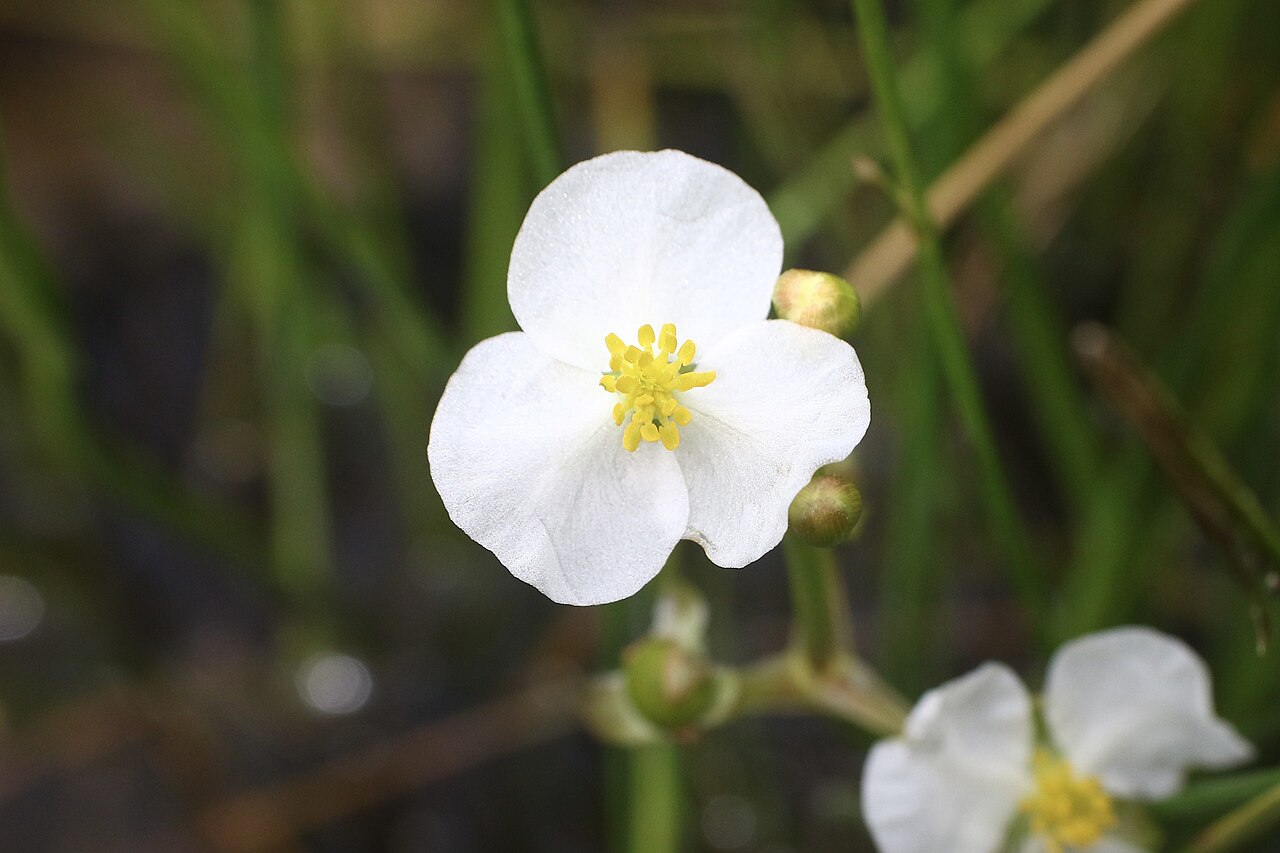
Sagittaria cuneata, known as Arumleaf Arrowhead or northern arrowhead, is a native aquatic perennial of ponds, marshes, lake shores and slow streams across the northern and western United States, Alaska and Canada. It has the classic arrow-shaped leaves of its genus and spikes of crisp white, three-petaled flowers, but it is a smaller, more variable plant than the familiar Duck Potato. In deeper water it may grow only floating or ribbon-like submerged leaves and never show an arrowhead at all.
Like its relatives, arumleaf arrowhead forms starchy tubers at the ends of underground runners in late summer and fall. These tubers are one of the foods known as wapato or duck potato, eaten cooked by Indigenous peoples across the West and Great Plains and relished by ducks, geese and muskrats. The plant is an excellent choice for wildlife ponds and wetland restoration in cool and dry-summer regions.
This page covers how to tell arumleaf arrowhead from other arrowheads, its wide native range, how to grow it in a pond or bog garden, its value to wildlife, and the traditional use of its tubers, which should only be eaten cooked.
Identification
Arumleaf arrowhead is a member of the water-plantain family (Alismataceae). Telling it from other arrowheads takes a close look at the bracts below the flowers and at the tiny beak on each seed.
Growth Form
It grows from fibrous roots and slender rhizomes that end in small tubers. Plants are usually 8 to 20 inches tall above the water, sometimes up to about 3 feet, and form loose colonies in shallow water or on mud. Plants in deeper or flowing water can be entirely submerged, with long, flat, ribbon-like leaves trailing in the current.
Leaves
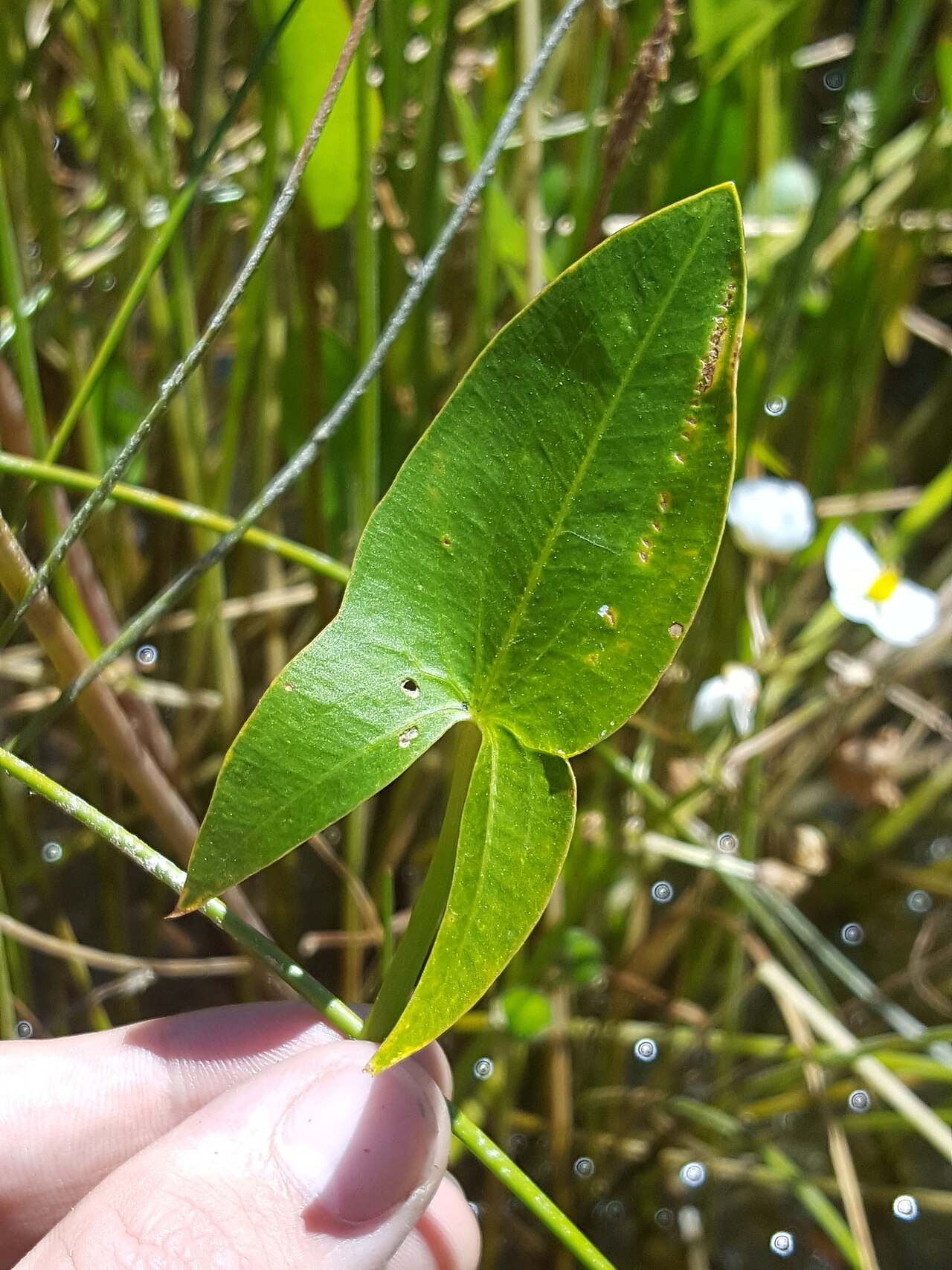
Leaves come in three forms, often on the same plant. Emergent leaves stand above the water on long stalks and are arrowhead-shaped, with a pointed main blade and two narrower, backward-pointing basal lobes; the blade is usually 2 to 6 inches long. In deeper water the plant makes floating leaves that are heart-shaped or oval, like small lily pads, and submerged leaves that are flat and strap-like (phyllodes). The variety of leaf shapes is why the species can be hard to recognize.
Flowers
From June to September, an upright stalk carries the flowers in whorls of three. Each flower has three green sepals and three rounded white petals about 1/2 inch long. The upper flowers are male, with a ring of yellow stamens; the lower flowers are female, with a green ball of pistils. The bracts beneath each whorl are relatively long, narrow and pointed (often over 1/2 inch), and joined at the base. Female flowers have stalks (pedicels) that are often as long as or longer than those of the males.
Fruit & Tubers
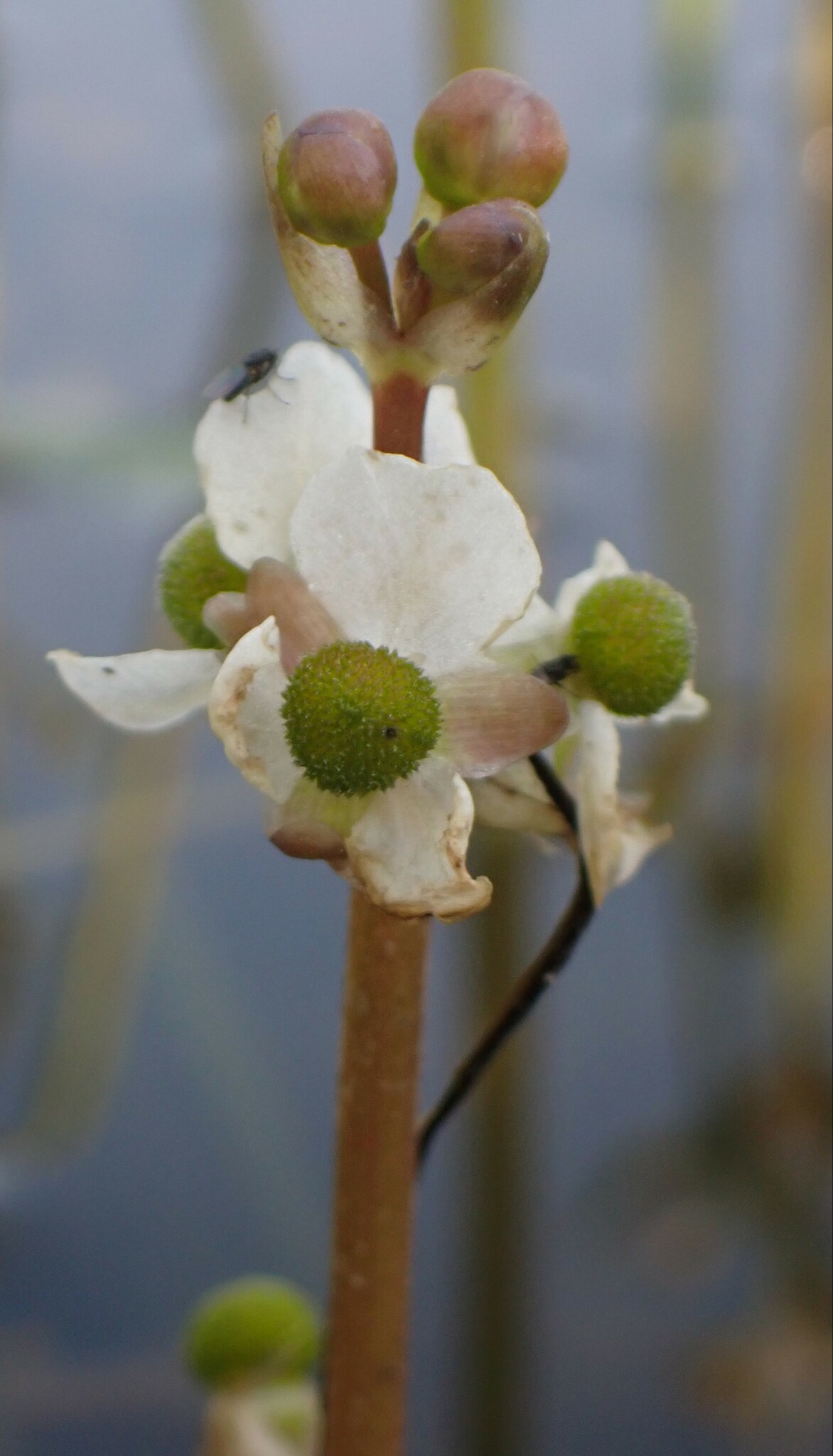
The female flowers develop into round heads of tiny, flattened, winged seeds (achenes). On arumleaf arrowhead each achene has a minute beak that points upward at the top, a key difference from duck potato, whose beak sticks out sideways. In fall, the rhizomes produce small, roundish tubers about 1/2 to 1 inch across, usually a few inches below the mud surface.
Similar Species
Duck Potato (Sagittaria latifolia) is larger, with broad arrowhead leaves, short broad bracts and seeds with a sideways beak. Lanceleaf Arrowhead and Delta Arrowhead are southern species with lobeless or differently shaped leaves, and Awl-leaf Arrowhead is a small, mostly submerged plant of Atlantic coastal tidal flats. Water-plantains (Alisma) have oval leaves and much smaller, branched flower clusters. The introduced arrowheads sold in the aquarium trade should not be planted outdoors.
Quick Facts
| Scientific Name | Sagittaria cuneata Sheldon |
| Family | Alismataceae (water-plantain family) |
| Plant Type | Aquatic emergent perennial |
| Mature Height | 8–20 in above water (to 3 ft) |
| Mature Spread | Spreads by rhizomes and tubers into colonies |
| Growth Rate | Moderate to fast |
| Sun Exposure | Full sun to part shade |
| Water Needs | Wet; mud to water about 2 ft deep |
| Soil Type | Mucky, silty or sandy wetland soil |
| Soil pH | About 6.0–8.5; tolerates alkaline water |
| Bloom Time | June–September |
| Flower Color | White with yellow stamens |
| Fall Color | Leaves yellow and die back |
| Fruit | Round heads of tiny achenes with a minute upright beak; tubers in fall |
| Deer Resistant | Moderate; foliage browsed at times |
| USDA Hardiness Zones | 2–8 |
Native Range
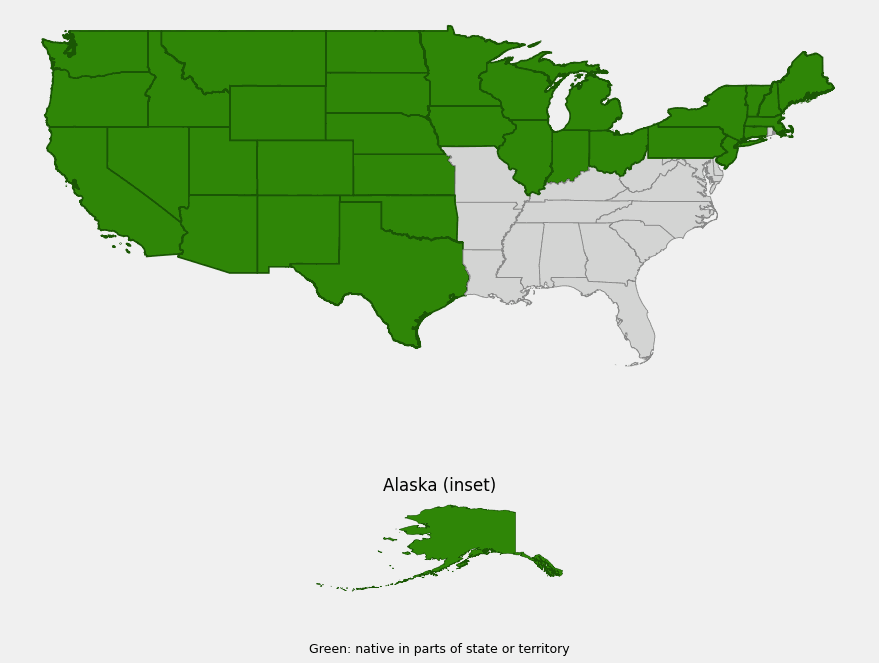
USDA PLANTS lists arumleaf arrowhead as native in Alaska and 32 states of the lower 48: across the West from Washington, Oregon and California to Arizona, New Mexico and western Texas; through the Rocky Mountain and Great Plains states; across the upper Midwest; and east to New York, Pennsylvania, New Jersey and New England. It is also native across Canada from Yukon and British Columbia to the Maritime provinces. It is most common in the northern Great Plains, the Rockies and the upper Midwest.
It grows in shallow water and on muddy shores of ponds, lakes, marshes, prairie potholes, irrigation ditches, slow streams and river backwaters, from lowlands to high mountain lakes. Unlike duck potato, it tolerates cold, alkaline and fairly hard water, which helps explain its abundance in the West and Great Plains.
At the southern and eastern edges of its range, in states such as Ohio, Indiana, Pennsylvania, New Jersey, Connecticut and Massachusetts, it is uncommon to rare and local. It is absent from most of the Southeast, where other arrowheads take its place.
📋 Regional plant lists featuring Arumleaf Arrowhead: Alaska · Western Oregon & Western Washington · Idaho, Eastern Oregon & Eastern Washington · California & Nevada · Arizona & New Mexico · Utah & Western Colorado · Montana & Wyoming · Nebraska, Kansas & Eastern Colorado · North Dakota, South Dakota & Western Minnesota · South & West Texas · Michigan, Wisconsin & Eastern Minnesota · Illinois, Iowa & Missouri · Ohio & Indiana · New York, Pennsylvania & Northern New Jersey · Delaware, Southern New Jersey & Long Island · Connecticut, Massachusetts & Rhode Island · New Hampshire, Maine & Vermont
Growing & Care Guide
Arumleaf arrowhead is an easy native for ponds, water gardens, rain gardens with standing water and wetland restoration, especially in the North and West. Wetland nurseries sell it as plants or tubers, and it is often included in wetland seed and plug mixes for restoration.
Light
It flowers best in full sun and tolerates light part shade. In heavy shade it produces few flowers and weaker tubers.
Soil & Water
Plant it in wet, mucky or silty soil, in water from saturated mud to about 1 to 2 feet deep; it flowers best in a few inches of water. It tolerates fluctuating water levels and some drying in late summer once established. It grows in neutral to alkaline water and handles cold, hard water better than many other arrowheads.
Planting Tips
Plant tubers or potted plants in spring, pressing tubers 2 to 4 inches into the mud. In a lined pond, grow it in a wide, shallow container filled with heavy garden loam or aquatic soil (not potting mix, which floats), topped with gravel, and set the pot so the crown is a few inches below the surface. Allow room for it to spread. Protect new plantings from geese, ducks and muskrats, which eat the tubers.
Pruning & Maintenance
Remove dead foliage in late fall or early spring if you want a tidy pond. Divide or thin container plants every few years. Leave some plants in place in natural ponds for wildlife. Plants are winter-hardy as long as the tubers are below the ice.
Propagation
The easiest method is to plant the tubers, which can be collected in fall or early spring from your own plants. It also spreads by rhizomes and can be divided in spring. Seed can be sown on wet mud after cold, moist stratification, but tubers establish much faster.
Landscape Uses
- Wildlife ponds: tubers and seeds feed waterfowl, and the colonies shelter frogs and young fish
- Water gardens: a compact arrowhead with crisp white flowers for container ponds
- Wetland restoration: common in seed and plug mixes for marshes, prairie potholes and constructed wetlands
- Shoreline stabilization: rhizomes help hold soft muddy edges
- Stormwater basins: tolerates fluctuating water levels in retention ponds
Wildlife & Ecological Value
Arumleaf arrowhead is a valuable wildlife plant, especially for waterfowl in the northern prairies and the West.
For Pollinators
The flowers are visited by small bees, flies, wasps and beetles that feed on pollen and nectar. A long flowering season makes it a reliable summer resource along shorelines.
For Birds
Ducks, geese and swans dig up and eat the starchy tubers, and dabbling ducks eat the seeds. Canvasbacks, mallards and other ducks use wetlands where arrowhead tubers are abundant. Marsh birds such as rails and blackbirds forage and shelter among the plants.
For Mammals
Muskrats and beavers eat the tubers and leaves, and deer and moose sometimes browse the foliage in shallow water.
Ecosystem Role
Colonies stabilize soft sediments, absorb nutrients from the water and provide shelter for aquatic insects, tadpoles and young fish. Its tolerance of fluctuating water makes it an important pioneer in seasonal wetlands and prairie potholes.
Cultural & Historical Uses
Arrowhead tubers, often called wapato (a Chinook Jargon word) or duck potatoes, were an important food for many Indigenous peoples. Tubers of arumleaf arrowhead and duck potato were gathered in late fall or early spring, often by wading into the water and loosening them with the toes so they floated to the surface, and were roasted, boiled or dried for winter. Muskrat caches were also raided for tubers.
The genus name Sagittaria comes from the Latin sagitta, “arrow,” for the leaf shape. The species name cuneata means “wedge-shaped.” It was named by botanist Edmund Perry Sheldon in 1893. The common name arumleaf refers to its leaves, which resemble those of arums such as arrow arum.
Safety note: arrowhead tubers are edible only when cooked. Raw tubers are bitter and can upset the stomach. Only forage from clean water, since wetland plants absorb pollutants, and be sure of your identification, because some toxic wetland plants such as water hemlock grow in the same habitats. Never harvest in large amounts from small wild populations.
Frequently Asked Questions
How is arumleaf arrowhead different from duck potato?
Arumleaf arrowhead is usually smaller, with narrower leaves, longer narrow bracts below the flower whorls and seeds with a tiny upright beak. Duck Potato has broader leaves, short bracts and a sideways seed beak. Both are native and both make edible tubers.
Are arumleaf arrowhead tubers edible?
Yes, when cooked. The tubers are one of the foods known as wapato and were roasted or boiled by Indigenous peoples. Don’t eat them raw, harvest only from clean water and be certain of your identification.
Why doesn’t my arrowhead have arrow-shaped leaves?
In deeper or flowing water, arumleaf arrowhead often grows only floating heart-shaped leaves or submerged ribbon-like leaves. Arrow-shaped leaves usually appear when it grows in shallow water or on mud.
How deep should I plant arumleaf arrowhead?
Plant tubers 2 to 4 inches into the mud in water from a few inches to about 2 feet deep. It flowers best in shallow water, about 2 to 6 inches deep, in full sun.
Is arumleaf arrowhead invasive?
No. It is a native plant across much of North America. It spreads by rhizomes and tubers into colonies, but waterfowl and muskrats keep it in check, and it is easy to thin in a garden pond.

Looking for a nursery that carries Arumleaf Arrowhead?
Browse our native plant nursery directory: Alaska & Arizona · California · Colorado & Connecticut · Idaho, Illinois, Indiana, Iowa & Kansas · Maine, Massachusetts, Michigan, Minnesota & Montana · Nebraska, Nevada, New Hampshire, New Jersey, New Mexico, New York, North Dakota, Ohio & Oklahoma · Oregon · Pennsylvania, South Dakota, Texas, Utah & Vermont · Washington · Wisconsin & Wyoming

